Oral Tradition Storytelling For Kids
Standard parents read a story to finish the day; Pro parents tell a story to build a legacy. Most bedtime routines are just a race to the ‘off’ switch. But the Pro move is using that time to install your family’s values. When you tell the stories of your own grandparents—their struggles, their wins, and their grit—you aren’t just putting your child to sleep; you are waking up their sense of belonging to a lineage.
Every family has a history, but not every family has a lore. Lore is what happens when history is spoken, shared, and repeated until it becomes part of a child’s DNA. This isn’t about being a professional performer. It is about being a primary source of identity.
In a world full of digital noise, your voice is the signal. This guide will show you how to master the art of oral tradition storytelling for kids to build resilient, confident, and connected humans.
Oral Tradition Storytelling For Kids
Oral tradition storytelling for kids is the practice of passing down history, values, and cultural wisdom through the spoken word rather than through written text. Historically, this was how every human culture survived. Before printing presses or tablets, we had the fire. We had the porch. We had the bedside.
In modern terms, oral storytelling involves sharing personal anecdotes, family history, or improvised tales without the aid of a book. It relies on eye contact, vocal inflection, and the relationship between the teller and the listener. While a book provides a fixed narrative, oral tradition is dynamic. It changes based on the child’s reaction. It adapts to the moment.
Real-world applications of this practice are everywhere. Indigenous cultures use oral tradition to preserve medicinal knowledge and land history. West African Griots serve as living libraries for their communities. In a modern family setting, oral tradition is used to explain where a child’s name came from, how their parents met, or how a great-grandfather survived a difficult winter. It turns “data” into “meaning.”
How It Works: The Mechanics of Family Lore
Storytelling is essentially the transmission of a narrative arc. For kids, this arc needs to be clear, emotional, and relevant. Research from Emory University suggests that the way we structure these stories matters deeply for a child’s development.
Researchers Marshall Duke and Robyn Fivush identified three specific types of family narratives. Understanding these is the key to doing “Pro Lore” correctly.
The Ascending Narrative
This is the classic “rags to riches” story. It usually sounds like: “We started with nothing, worked three jobs, and now we have this house.” While inspiring, it can sometimes put pressure on a child to only succeed.
The Descending Narrative
This is the “loss” story. It sounds like: “We used to be important and wealthy, but then the war/depression/bad luck happened, and we lost it all.” This narrative can sometimes lead to a sense of victimhood if not handled carefully.
The Oscillating Narrative
This is the Pro move. It is the healthiest narrative for a child’s psychology. It says: “We’ve had some big wins, but we’ve also had some tough breaks. No matter what happened, we stuck together and kept going.” This builds a “family shield” of resilience. It teaches the child that life has ups and downs, but the family unit is the constant.
To make it work, you don’t need a script. You need “story bones.” Identify a protagonist (usually a family member), a conflict (a problem they faced), and a resolution (how they handled it). Fill in the rest with sensory details as you go.
Benefits of Oral Storytelling Over Reading
Reading is vital for literacy, but oral storytelling is vital for identity. The benefits are measurable and long-lasting.
Building Resilience and the “Intergenerational Self”
Children who know their family history have a higher sense of control over their lives and higher self-esteem. Psychologists call this the “intergenerational self.” The child feels like they are part of something bigger than their own small problems. When they face a challenge at school, they think, “My Grandpa survived a world war; I can survive this math test.”
Neuroscience of the Spoken Word
Studies using near-infrared spectroscopy (NIRS) have shown that oral storytelling activates the brain more consistently than reading from a picture book. When a child listens to a spoken story, they must engage in “active imagination.” Because there are no pictures to look at, the child’s brain has to build the movie itself. This strengthens the prefrontal cortex and improves visualization skills.
Emotional Intelligence and Empathy
Oral stories often involve more “elaborative reminiscing.” When you tell a story about the time you were scared on your first day of work, you are modeling emotional regulation. You are showing your child that “The Big Scary Parent” was once a “Small Scared Kid.” This builds a massive bridge of empathy and social intelligence.
Challenges and Common Mistakes
The biggest challenge is often the parent’s own “stage fright.” We think we have to be as polished as a Disney movie. We don’t.
The Perfection Trap
Many parents stop because they can’t remember the exact dates or names. In oral tradition, the “fact” is less important than the “truth.” If you can’t remember if the dog was a Beagle or a Mutt, pick one and keep going. The value is in the connection, not the archive.
The “Boredom” Mistake
Do not turn your family lore into a history lecture. Kids do not care about the year the local factory opened. They care about the time the factory floor flooded and Grandpa had to swim to his locker. Focus on the action, the emotion, and the “gross” or “funny” details.
The Monologue Pitfall
Pro storytelling is a dialogue. If your child isn’t asking questions or interrupting, you might be talking *at* them instead of *with* them. Encourage the “But why?” and the “Then what happened?” It makes the story theirs, too.
Limitations: When Oral Tradition Needs a Pivot
While powerful, oral tradition isn’t a silver bullet. There are times when it needs a careful approach.
Handling Family Trauma
Not every family story is happy. Some involve addiction, loss, or pain. The limitation here is age-appropriateness. You don’t have to tell the “dark” version to a five-year-old. You can simplify the struggle to “Grandpa had a sickness that made him act mean, but we loved him anyway.” As the child grows, the lore can become more complex and honest.
Incomplete History
If you don’t know your family history—perhaps due to adoption or estrangement—you might feel limited. In this case, you build “Found Lore.” Tell stories about your own life, your friends, or the “family” you have chosen. The psychological benefits of a narrative arc remain the same even if the bloodline is different.
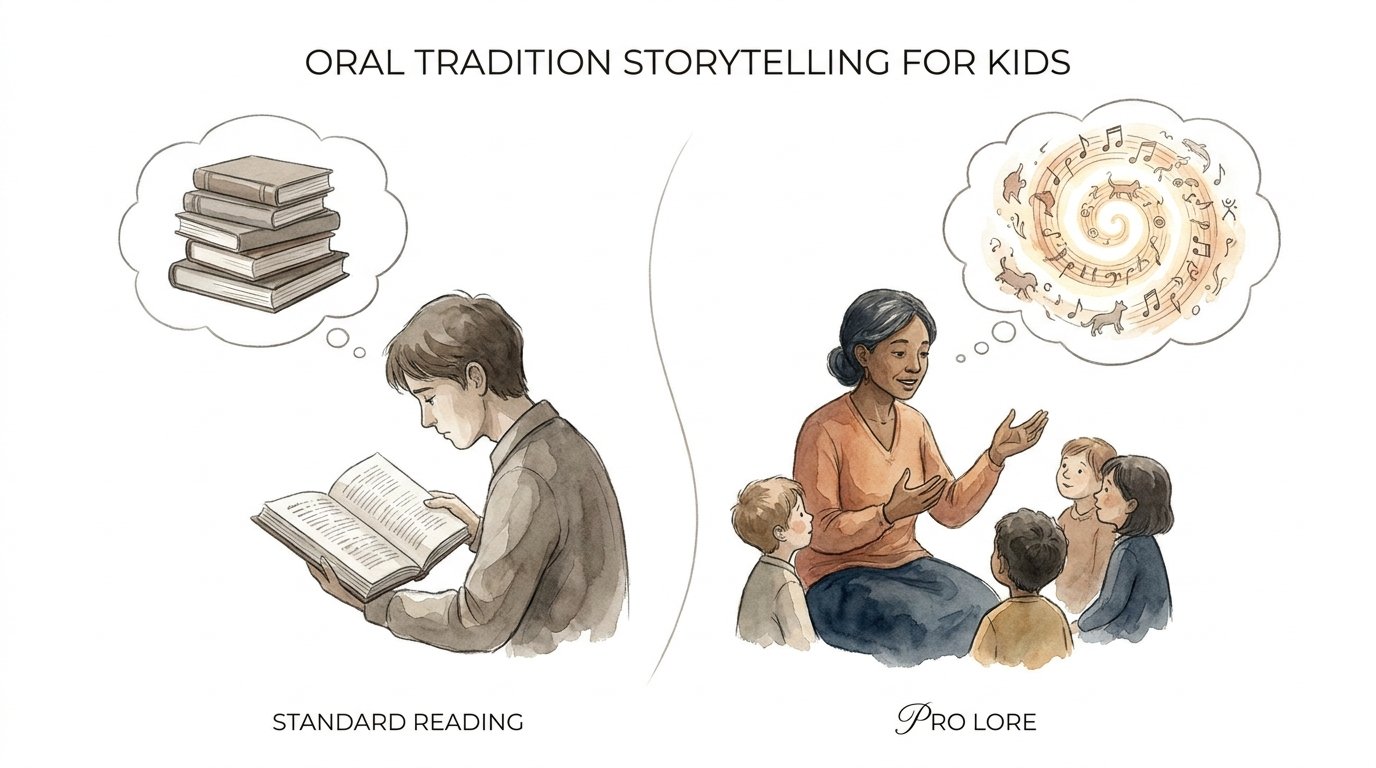
Standard Reading vs. Pro Lore
Most parents view these as the same thing. They aren’t. Here is how they compare in a practical sense:
| Feature | Standard Reading | Pro Lore (Oral) |
|---|---|---|
| Primary Goal | Literacy & Language | Identity & Values |
| Visuals | Fixed (Illustrations) | Mental (Imagination) |
| Flexibility | Low (Scripted) | High (Interactive) |
| Brain Activation | Decoding & Recognition | Visualization & Synthesis |
Practical Tips: Starting Your Lore Today
You don’t need a campfire. You just need a prompt. Use these “Pro” hacks to start tonight.
- The “I Remember When” Prompt: Start your story with these four words. It signals to the child’s brain that a true, personal story is coming.
- Use Sensory Hooks: Instead of saying “it was cold,” say “the wind felt like tiny needles on my cheeks.” Sensory details make the story “sticky” in the child’s memory.
- The Cliffhanger Method: If the story is getting long, stop at a moment of high tension. “I opened the door, and there stood…” Tell the rest tomorrow. It builds massive engagement.
- The “Do You Know” Scale: Periodically ask your kids the questions from the Emory study. “Do you know where your parents met?” “Do you know about an illness or something really terrible that happened in our family?” This reinforces the learning.
- Photo Catalyst: If you’re stuck, pull up one old photo on your phone. Tell the story of what was happening five minutes before the photo was taken.
Advanced Considerations: Scaling the Story
For the serious practitioner, storytelling becomes a system for long-term character development.
Using Archetypes
When telling family stories, lean into archetypes. Was Great-Aunt Martha “The Explorer”? Was Uncle Jim “The Trickster”? Assigning these roles helps children categorize the values you are trying to transmit. They start to see themselves as “The Next Explorer” in the family line.
The Hero’s Journey in Everyday Life
Apply Joseph Campbell’s Hero’s Journey to mundane events. Your story about getting lost in the city isn’t just a mistake; it’s a “Call to Adventure,” followed by “Challenges and Temptations,” and finally a “Return with the Elixir” (the lesson learned). This structure makes even small stories feel epic.
Digital Archiving
While the tradition is oral, the Pro move is to eventually record these sessions. Use a simple voice memo app while you tell a story. One day, your child will have the lore in your own voice to play for their own children. This is how you bridge the gap between oral tradition and a permanent family archive.
Example Scenarios
Let’s look at how theory translates into practice.
Scenario 1: The Resilience Story
Child: “I’m sad because I didn’t make the soccer team.”
Parent: “I remember when your Dad was ten. He wanted to be in the school play more than anything. He practiced his lines until he could say them in his sleep. But on the day of the audition, he got so nervous he forgot every word. He didn’t get the part. He cried the whole way home. But do you know what he did the next day? He joined the stage crew. He realized he loved the theater even if he wasn’t the one on stage. Our family doesn’t always get what we want the first time, but we always find a way to stay in the game.”
Scenario 2: The Mischief Story
Child: “Tell me a story about when you were little.”
Parent: “Once, when I was six, I decided I wanted to see if a cat could really land on its feet. I didn’t drop the cat, but I built a ‘parachute’ out of a grocery bag and tied it to the cat’s harness. The cat was NOT happy. He ran under the porch and stayed there for two days. I learned that day that just because you have a ‘science experiment’ doesn’t mean you should ignore how other people—or animals—feel.”
Final Thoughts
Oral tradition storytelling for kids is the ultimate low-tech, high-impact parenting tool. It costs nothing but time and pays dividends for generations. By moving from a “Standard” routine of passive reading to a “Pro” routine of active lore-building, you are giving your children more than just a good night’s sleep. You are giving them a map of who they are and where they came from.
Start small. Pick one story from your childhood. Share a win. Share a “spectacular fail.” Most importantly, share the “oscillating” reality of your family’s journey. When you do this, you aren’t just telling a story; you are installing the software that will run your child’s life long after you are gone.
Experiment with different prompts and watch how your child’s eyes light up when they realize they are a character in a much larger, much older story. That is the power of the oral tradition. Use it to build your legacy tonight.
Sources
1 roseandrex.com | 2 lauragraceweldon.com | 3 emory.edu | 4 hubpages.com | 5 thenonanxiousleader.com | 6 familyhistorystorybooks.com | 7 findandconnect.gov.au | 8 psychologytoday.com | 9 unr.edu | 10 nih.gov