screen free activities for family
Stop paying for ‘entertainment’ when the best family memories are free. You don’t need a monthly fee to have fun. Rediscover the abundance of free, screen-free activities right outside your door.
We are living in the age of the subscription trap. Every few months, another streaming service hikes its prices, promising “exclusive” content that usually ends up being background noise while everyone scrolls on their phones anyway. Recent data shows that the average American household now shells out over $111 per month on digital subscriptions alone. That is more than $1,300 a year for the privilege of sitting on a couch and staring at a glowing rectangle.
It does not have to be this way. The most vibrant, high-energy, and rewarding moments of your life are not hidden behind a paywall. They are waiting in your backyard, at your local library, and in the “boredom” that most of us try so hard to avoid. Real connection happens when the Wi-Fi is off and the imagination is on. This guide will show you exactly how to reclaim your time, save your money, and build a family culture rooted in real-world adventure.
screen free activities for family
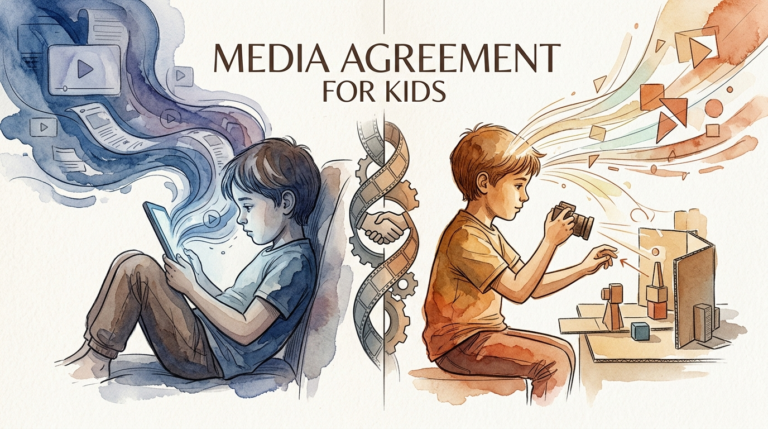
At its core, screen-free living is about presence over pixels. It refers to any activity that engages the mind, body, or social senses without the mediation of a digital device. While it might sound like a “digital detox” or a punishment, it is actually a return to the most natural form of human interaction. In a world where teens spend upwards of eight hours a day on screens, these activities serve as a necessary biological reset.
Why do these activities exist? They exist to satisfy our innate need for tactile experience and social bonding. Humans are hardwired for physical movement and face-to-face communication. When we replace those with digital simulations, we often feel a sense of “digital fatigue” or brain fog. Screen-free activities for family are used in real-world situations to strengthen emotional bonds, improve cognitive focus, and reduce the symptoms of anxiety often linked to social media use.
Think of screen-free time as a “mental palate cleanser.” Just as a chef uses ginger to clear the taste buds between courses, a nature walk or a board game clears the dopamine receptors after a day of digital overstimulation. Whether it is a “mud kitchen” for toddlers or a neighborhood scavenger hunt for pre-teens, these activities bridge the gap between simple play and meaningful development.
The Real-World Context
You see these activities in action at community parks, bustling libraries, and quiet hiking trails. They are the building blocks of childhood. When a child builds a fort out of cardboard boxes, they are practicing engineering and spatial reasoning. When a family cooks a meal together without a YouTube tutorial running in the background, they are practicing teamwork and patience. These are not just “time fillers”—they are the foundation of a resilient family unit.
How to Transition Your Family to Screen-Free Fun
Moving from a screen-centric household to an active one requires a strategy. You cannot simply pull the plug and expect everyone to be happy. You need a step-by-step approach that replaces digital dopamine with real-world excitement.
1. Conduct a “Digital Audit”
Start by identifying when your family uses screens the most. Is it during the “witching hour” before dinner? Is it the first thing everyone does on Saturday morning? Once you identify the peaks, you can target those specific times for replacement. Do not try to go 100% screen-free overnight. Start with “Unplugged Saturdays” or “No-Device Dinners.”
2. Create a “Boredom Toolkit”
Boredom is not the enemy; it is the spark for creativity. However, children (and adults) often need a little nudge. Create a physical box or jar filled with slips of paper. Each slip should have one simple, free activity written on it. When someone says, “I’m bored,” they pull a slip. This removes the “decision fatigue” that often sends us back to our phones.
3. Designate “Tech-Free Zones”
Establish physical boundaries in your home. The dining table and bedrooms are excellent places to start. Use a physical “charging station” located in a common area like the kitchen. When the family enters a tech-free zone, phones go in the basket. This simple physical act signals a transition to a different mode of being.
4. Focus on “Open-Ended” Materials
Stock your home with items that have more than one use. Cardboard boxes, old sheets, sticks, rocks, and a deck of cards are infinitely more valuable than a specialized toy that only does one thing. These materials require the user to provide the “engine” of the fun, which leads to longer engagement and deeper focus.
The Powerful Benefits of Unplugging
The advantages of prioritizing screen-free activities for family go far beyond just saving money on your Netflix bill. Research consistently shows that “green time” (time in nature) acts as a powerful counterbalance to “screen time.”
Improved Mental Health: Excessive screen use is frequently linked to irritability and “dopamine crashes.” In contrast, spending as little as 20 minutes outdoors can lower cortisol levels and significantly reduce stress. Families who engage in regular physical play report lower levels of conflict and higher levels of general happiness.
Cognitive Development: For children, screen-free play is essential for developing “executive function.” This includes the ability to plan, focus attention, and juggle multiple tasks. While apps claim to be educational, they often provide “passive” learning. Real-world activities like baking or building a fort require active problem-solving and fine motor skills.
Stronger Social Bonds: When you are looking at a screen, you are “alone together.” When you are playing a game of tag or telling stories around a fire pit, you are building shared history. These are the “core memories” that children carry into adulthood. You will never remember the 500th TikTok you watched, but you will remember the time the whole family got lost on a trail and found a hidden waterfall.
Financial Freedom: Let’s talk numbers. If you cancel just three $15/month subscriptions, you save $540 a year. That is money that can go toward a national park pass, better hiking boots, or a high-quality tent. You are trading a recurring fee for a lifetime of skills.
Common Mistakes to Avoid
Many families fail at going screen-free because they fall into predictable traps. Avoid these pitfalls to ensure your transition sticks.
The “Monitor” Trap: Do not sit on the sidelines and tell your kids to “go play” while you scroll on your own phone. Children are expert hypocrite-detectors. If you want them to be engaged, you must be engaged. Your participation is the highest form of validation for the activity.
The “Perfect Aesthetic” Mistake: Do not worry about making your screen-free life look like a Pinterest board. Real fun is messy. If you are too worried about the “mud” in the mud kitchen or the “mess” of the indoor fort, you will kill the joy of the activity. Embrace the chaos.
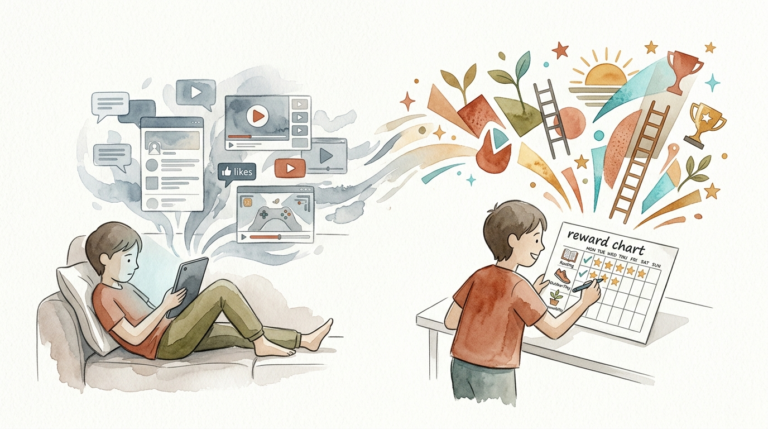
Treating Screens as a “Reward”: When you say, “If you play outside for an hour, you can have 30 minutes of iPad,” you are teaching your child that the screen is the “gold” and the outdoors is the “work.” This reinforces the screen’s value. Instead, frame the outdoors as the adventure and the screen as a tool for specific tasks.
Lack of Preparation: If you wait until everyone is already whining to think of an activity, you have already lost. Have your “Boredom Toolkit” ready. Have the snacks packed. Have the library books on the table. Friction is the enemy of screen-free success.
When Screen-Free Isn’t Realistic
It is important to maintain a balanced perspective. Screens are not “evil”—they are tools. There are situations where screen-free activities for family may not be the immediate solution, and that is okay.
During extreme weather events, such as heatwaves or blizzards, staying indoors with a movie might be the safest option. For parents working from home without childcare, a strategic 30 minutes of a high-quality educational show can be a necessary “babysitter.” The goal is not perfection; it is intentionality.
Furthermore, some children with specific neurodivergent needs may find certain digital tools helpful for self-regulation or communication. The key is to distinguish between “intentional use” (using a device for a specific purpose) and “passive consumption” (scrolling or watching endlessly to kill time). If the screen is serving a clear, limited purpose, do not beat yourself up over it.
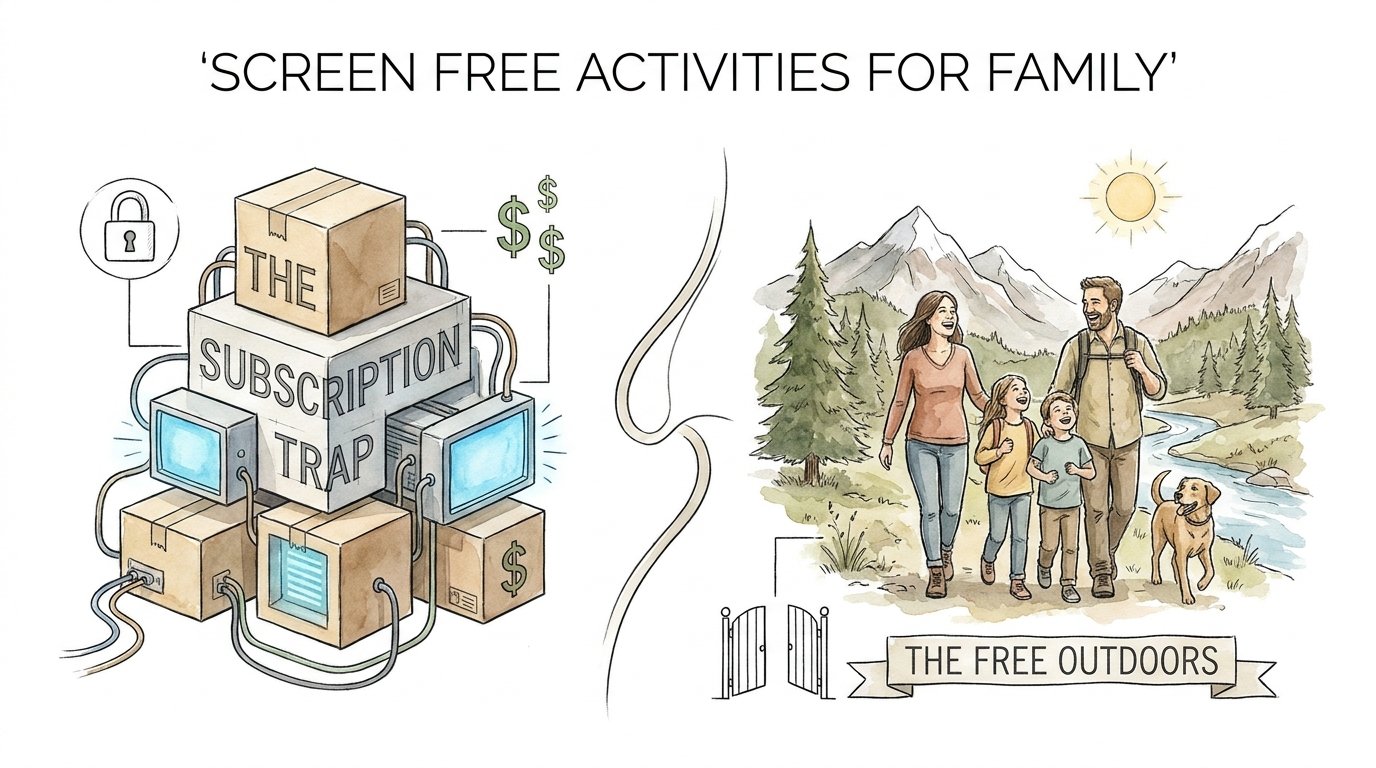
The Subscription Trap vs. The Free Outdoors
The following table compares the costs and outcomes of the typical “Subscription Lifestyle” versus a “Free Outdoors Lifestyle.”
| Factor | The Subscription Trap | The Free Outdoors |
|---|---|---|
| Monthly Cost | $50 – $200+ | $0 (Free) |
| Physical Impact | Sedentary, eye strain | Active, Vitamin D, improved sleep |
| Social Connection | Isolation (“Alone Together”) | Direct engagement, teamwork |
| Creativity Level | Passive consumption | Active creation, imagination |
| Long-Term Value | Fleeting entertainment | Core memories, life skills |
Practical Tips for Instant Engagement
Ready to start today? Here are some high-energy, zero-cost screen-free activities for family that you can implement right now.
- Nature Scavenger Hunt: Create a list: a flat rock, a yellow leaf, something that smells like pine, a feather. Head to the nearest park and race to find them.
- The Living Room “Ninja Warrior” Course: Use pillows, painters’ tape on the floor, and chairs to create an obstacle course. Use a stopwatch to see who can finish the fastest.
- Flashlight Tag: Wait until dusk and head to the backyard. It’s a classic for a reason—it’s thrilling and requires zero equipment other than a light.
- Neighborhood Bingo: Draw a 5×5 grid with things like “a red car,” “a barking dog,” “a basketball hoop,” or “a garden gnome.” Walk through your neighborhood and mark them off.
- “Chopped” Kitchen Challenge: Give the kids three random ingredients (like an apple, crackers, and cheese) and have them “plate” a creative snack for you.
Advanced Strategies for Long-Term Success
For those who want to go deeper, you can turn screen-free living into a core part of your family’s identity. This requires moving from “activities” to “lifestyle.”
Seasonal Planning
Don’t let the weather dictate your fun. Create a “Four Seasons” bucket list. In the fall, focus on leaf pressing and forest hikes. In the winter, try “ice suncatchers” (freezing water and berries in a tray outside). In the spring, start a “guerilla garden” in a neglected corner of the yard. Planning ahead prevents the “there’s nothing to do” slump when the seasons change.
Community Involvement
Look for local resources that are already free. Most libraries have “maker spaces” with 30D printers or craft supplies. Many local hardware stores offer free weekend workshops for kids. By tapping into community resources, you expand your “Boredom Toolkit” without spending a dime. You also show your children that they are part of a larger, physical community, which is a powerful antidote to digital isolation.
Skill-Based Play
Instead of just “playing,” focus on “learning a craft.” This could be whittling sticks, learning to tie complex knots, or identifying every bird species in your zip code. When play has a goal of mastery, it becomes much more addictive (in a good way) than a video game. The “leveling up” happens in real life, and the rewards are tangible skills.
Example Scenarios: A Day in the Life
Let’s look at how this works in practice. Imagine a typical “Screen-Free Saturday.”
8:00 AM: Instead of reaching for tablets, the kids find the “Boredom Jar.” They pull a slip that says: “Pancake Art.” The family spends the next hour trying to pour batter into the shapes of animals. It’s messy, loud, and delicious.
10:30 AM: The family heads to a local state park. They aren’t there for a grueling hike; they are there for “creek stomping.” They spend two hours turning over rocks to find crawfish and building small dams out of sticks. Total cost: $0. Total engagement: 100%.
1:00 PM: Lunch is a picnic on a blanket in the backyard. Because there are no screens, the conversation flows naturally. They talk about the crawfish they saw and plan the “Great Cardboard Fortress” for the afternoon.
3:00 PM: The “Subscription Trap” would have them watching a movie now. Instead, they find three large shipping boxes from a recent delivery. Using duct tape and markers, they build a multi-room castle. The kids spend the next three hours in imaginative play, defending their fort from “dragons” (the family dog).
7:00 PM: Dinner is followed by a “Storytelling Circle.” Everyone has to contribute three sentences to a collaborative, ridiculous story. The night ends with everyone tired, happy, and ready for deep, screen-free sleep.
Final Thoughts
Transitioning to more screen-free activities for family is not about being “anti-tech.” It is about being “pro-connection.” It is a declaration that your family’s memories are too valuable to be sold back to you at $15.99 a month. When you strip away the digital noise, you find that your children are more creative, your spouse is more present, and you are more relaxed.
The best part is that you can start right now. You don’t need a new app, a faster connection, or a premium account. You just need to step outside, take a breath, and look at the world with a bit of curiosity. Your “Boredom Toolkit” is already waiting for you. Start small, stay consistent, and watch as your family’s real-world adventures begin to outshine anything you could find on a screen.
If you found this guide helpful, consider looking into related skills like nature journaling or basic wilderness survival. These are excellent ways to deepen your family’s connection to the outdoors and build even more screen-free confidence. The world is big, it’s free, and it’s waiting for you.
Sources
1 youtube.com | 2 curiousneuron.com | 3 thescreenfreedad.com | 4 magicalkids.shop | 5 sparklestories.com | 6 wholechildcounseling.com | 7 screenfree.org | 8 screenwiseapp.com | 9 childrenandnature.org | 10 usu.edu | 11 kidsplaymuseum.org | 12 macaronikid.com | 13 nih.gov | 14 resubs.app | 15 adwave.com | 16 crumblecrate.com | 17 nih.gov | 18 hopespringsbh.com | 19 kqed.org | 20 cnet.com | 21 frugalfun4boys.com