Low Cost Family Birthday Ideas
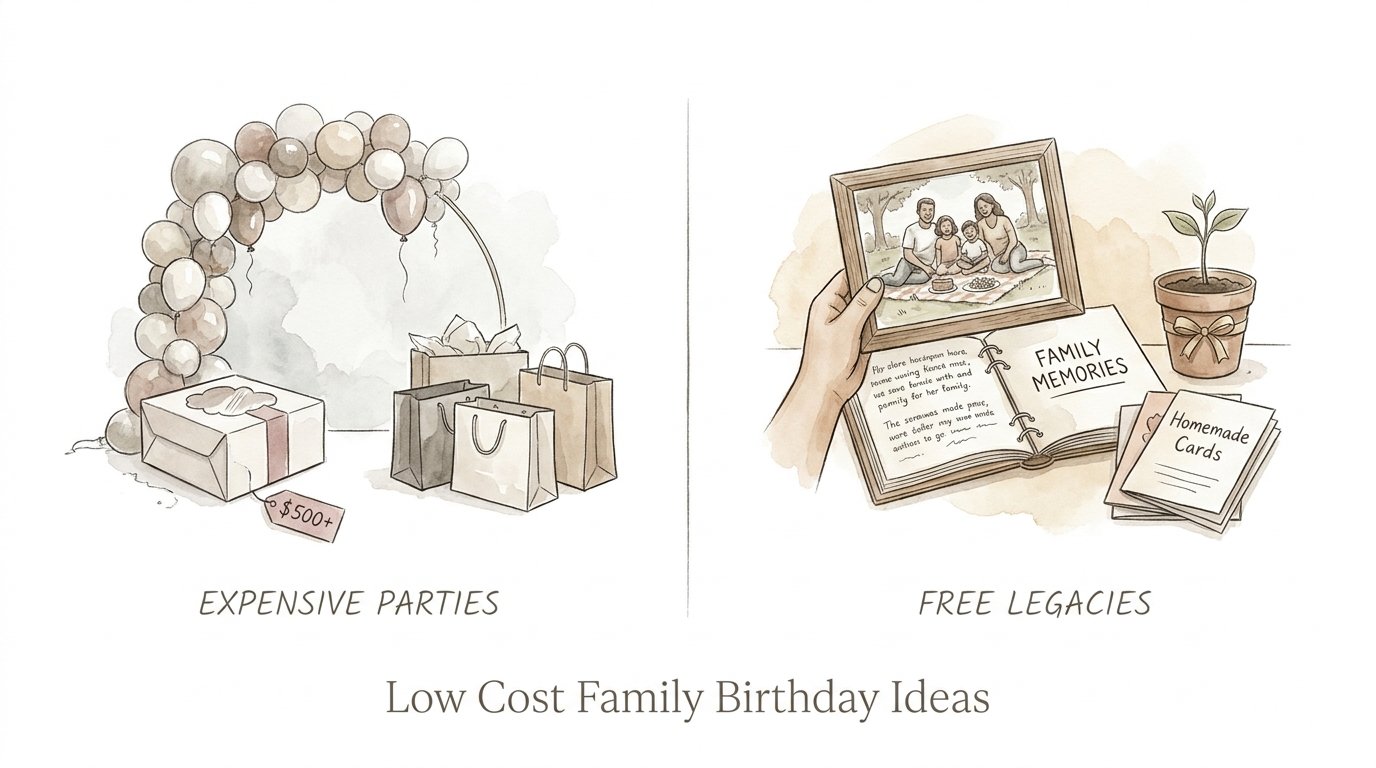
Why does the $500 party end in a sensory meltdown while the $0 tradition creates a memory that lasts 20 years? We’ve been sold the lie that a child’s joy is proportional to the price of the venue. The truth? A child doesn’t want a rental space; they want a ritual. While the plastic toys from the party will be in a landfill by next year, the tree they planted with you will grow as they do. One costs a paycheck; the other builds a person.
When we look back at our own childhoods, we rarely remember the specific brand of party favors or the high-tech entertainment at a rented gym. We remember the smell of pancakes in the morning, the way our bedroom door was covered in streamers, or the specific way our parents sang the birthday song. These small, repeatable acts are the anchors of childhood. They provide a sense of stability and belonging that no amount of money can purchase.
This guide is designed to help you navigate the shift from expensive, high-stress events to meaningful, low-cost traditions. We will explore why these rituals matter from a psychological perspective and provide a massive toolkit of ideas you can implement this year. Whether you are a parent on a tight budget or simply someone looking to deepen your family’s emotional connection, these strategies offer a path toward more intentional celebrations.
Low Cost Family Birthday Ideas
Low cost family birthday ideas are intentional acts, activities, or rituals designed to celebrate a person’s life without requiring a significant financial investment. Unlike standard commercialized parties that focus on external entertainment and expensive venues, these ideas prioritize the relationship between the birthday child and their family members. They exist because children thrive on predictability, recognition, and emotional safety rather than material excess.
In the real world, these ideas manifest as “legacy traditions”—things that happen every single year, regardless of where the family is living or how much money is in the bank. For example, a “Birthday Interview” is a free activity where you ask the child the same set of questions every year. Over time, this creates a chronological map of their changing personality. Another example is the “Balloon Avalanche,” where you tape a plastic tablecloth full of balloons over their bedroom door so they are showered in color the moment they wake up.
These concepts matter because they remove the “performance” aspect of parenting. When we stop trying to impress other parents or create “Pinterest-perfect” events, we can focus on what actually makes a child feel seen. A special plate used only once a year or a handwritten letter describing the child’s milestones can do more for their self-esteem than a three-hour session at a trampoline park. These traditions build an internal narrative for the child that says, “I am valued for who I am, not just for the party I can host.”
How It Works: Creating a Ritual from Scratch
Transforming a simple idea into a lasting tradition requires intention and repetition. According to research from the American Psychological Association, there is a distinct difference between a routine and a ritual. A routine is something you do because it needs to get done, like brushing teeth. A ritual is an act infused with symbolic meaning. To make a low-cost birthday idea work, you must move it from the “routine” category into the “ritual” category.
The first step is to choose a “touchstone” moment. This is a specific time during the birthday—such as the first five minutes of the morning or the last ten minutes before bed—where the ritual will occur. Consistency is the secret sauce. If you decide to do a “Birthday Breakfast Candle,” you must do it every single year. The anticipation of the event is often more powerful for a child’s development than the event itself.
The second step involves the “emotional imprint.” After the activity is finished, take a moment to reflect. This could be as simple as saying, “I love that we do this every year because you are so special to us.” This verbal affirmation anchors the memory in the child’s mind. Finally, you must adapt the tradition as the child grows. A “Balloon Avalanche” works for a toddler, but for a teenager, it might evolve into a “Year in Photos” banner hung in the hallway. The core principle remains the same: use what you have to create a symbolic celebration of their growth.
The Benefits of Choosing Meaning Over Money
The practical and measurable benefits of choosing low-cost rituals are extensive. From a developmental standpoint, rituals offer a sense of “ontological security.” This means the child feels a deep sense of order and safety in their world. When life gets chaotic—due to a move, a change in schools, or global events—the birthday ritual remains a constant. It acts as a psychological anchor that lowers cortisol levels and reduces the “fight-or-flight” response often triggered by overstimulating, loud, and expensive party venues.
Another significant benefit is the fostering of identity. Rituals answer the fundamental question: “Who are we as a family?” When you have a tradition like the “Birthday Shoe Fairy” (where a few quarters are left in the child’s shoe), you are building a unique family culture. This shared history strengthens the bond between siblings and parents, creating a “tribe” mentality that protects against loneliness and social anxiety later in life.
Furthermore, these traditions are highly efficient. They require almost no setup time compared to the logistics of booking a venue, managing RSVPs, and coordinating catering. By choosing low-cost ideas, you reclaim your time and energy. This allows you to be “fully present” for your child. A parent who is not stressed about the cost of the pizza or the behavior of the hired clown is a parent who can actually look their child in the eye and enjoy the moment.
Challenges and Common Mistakes to Avoid
The most frequent error parents make is falling into the “Comparison Trap.” In the age of social media, it is easy to feel that your $0 tradition is “not enough” because it doesn’t look as flash as a neighbor’s professional event. This mindset ignores the reality that children don’t process “value” through a dollar lens; they process it through an “attention” lens. If you are distracted by trying to photograph the perfect moment for Instagram, you are undermining the very ritual you are trying to build.
Another common mistake is “Over-Engineering.” Sometimes parents try to start five or six new traditions at once. This leads to burnout and makes the birthday feel like a series of chores rather than a celebration. It is much better to have one solid, repeatable ritual than six half-hearted ones. Start small. Choose one thing for the morning and perhaps one thing for dinner. Let those settle into the family rhythm before adding more.
Finally, avoid the “Static Tradition” pitfall. You must be willing to let traditions evolve. If your ten-year-old suddenly finds the “Birthday Crown” embarrassing, don’t force it. The goal is to celebrate the child, not the activity. When a ritual feels like an obligation rather than a joy, it loses its psychological power. Pivot the activity to something more age-appropriate, like a “Birthday Movie Marathon,” while keeping the core intention of focused family time.
Limitations: When the $0 Model Needs a Supplement
While low-cost rituals are the backbone of a meaningful life, there are times when they may not fully satisfy a child’s social needs. As children reach the “tween” and “teen” years, their peer group becomes a primary focus of their identity. A small family ritual is still vital, but it might need to be balanced with a social gathering. This doesn’t mean you have to spend $1,000, but it does mean acknowledging that the child may want to include friends in their celebration.
Environmental constraints can also play a role. If you live in a small apartment, some high-energy DIY games like a “Backyard Carnival” aren’t feasible. You must adapt your ideas to your physical space. Similarly, if your child has specific sensory needs (such as Autism or ADHD), even low-cost “messy” play like a Jackson Pollock painting party might be overwhelming rather than fun. In these cases, the limitation isn’t the cost, but the nature of the activity.
It is also important to recognize that traditions alone cannot fix a strained relationship. A birthday ritual is a tool for connection, but it works best when built on a foundation of daily routines and respectful communication. If the only time a family focuses on a child is during their birthday, the ritual can feel hollow or performative. The limitation here is that a birthday is only one day out of 365; the “legacy” is built by the consistency of the other 364.
Comparison: Expensive Parties vs. Free Legacies
The following table breaks down the measurable differences between a standard high-cost party and a focus on low-cost family traditions.
| Feature | Expensive Party Venue | Low-Cost Family Ritual |
|---|---|---|
| Financial Cost | High ($300 – $1,000+) | Minimal to Zero ($0 – $30) |
| Stress Level | High (RSVPs, logistics, timing) | Low (Flexible, intimate) |
| Memory Duration | Short-term (Often forgotten by next year) | Life-long (Becomes a “core memory”) |
| Child’s Input | Passive (Usually follows venue rules) | Active (Can co-create the ritual) |
| Social Pressure | Extreme (Comparison with other parents) | Minimal (Focused on the internal family) |
| Developmental Value | Social entertainment | Identity, security, and belonging |
Practical Tips for Immediate Application
Creating a magical birthday doesn’t require a magic wand; it requires a “Birthday Toolkit.” Keep a specific bin in your closet labeled “Birthday.” Throughout the year, if you see streamers on sale or find a cool second-hand board game, put it in the bin. When the big day arrives, you aren’t rushing to the store; you are pulling from a curated collection of joy.
Balloons are the highest-ROI decoration you can buy. A bag of 50 balloons costs about $5 and can transform a room. Instead of just blowing them up, use them strategically. Fill their bathtub with them. Put them inside their car for the morning commute. Tape them across their bedroom door frame so they have to “bust through” them like a football player. This creates high-visual impact for almost no cost.
Leverage the “Free Economy.” Many local businesses offer “Birthday Freebies”—free donuts, ice cream scoops, or small toys. Map these out and make a “Birthday Treasure Map” where you visit three or four of these spots as a family. It turns a series of errands into a high-stakes adventure. Additionally, use digital resources. There are countless free templates online for scavenger hunts, “Yes Day” certificates, and birthday interview sheets.
Advanced Considerations for the Serious Legacy Builder
For those who want to go beyond simple fun and move into “Legacy Building,” consider the concept of “Memory Archiving.” This is the process of documenting the low-cost traditions so the child can look back on them at age 18. Instead of just taking random photos on your phone, create a “Birthday File.” This is a physical or digital folder where you save three things every year: the birthday letter, the completed birthday interview, and one photo of them with their “Growth Chart.”
Another advanced technique is the “Intergenerational Connection.” Ask a grandparent or a family friend to contribute to the ritual. This could be a “Letter for the Future” where they write down one thing they admire about the child this year. When the child turns 18, they receive a box of 18 letters from the most important people in their lives. This is a gift that literally no amount of money can replicate.
Scaling is also an important factor. As your family grows, you might find yourself managing multiple birthdays. To prevent burnout, create a “Standardized Ritual Package.” Perhaps every child gets the same “Special Breakfast” and the same “Scavenger Hunt Format,” but with personalized clues. This creates a sense of fairness and tradition across the entire sibling group while keeping the workload manageable for the parents.
Example Scenario: The Indoor Treasure Hunt
Let’s look at how a simple “Indoor Treasure Hunt” works in practice. This is a perfect example of a $0 activity that creates high excitement and movement. Instead of handing the child their gifts, you hand them an envelope with the first clue.
Clue #1: “Today is your day, let’s start the fun! Go look where the dirty laundry is done.”
The child runs to the washing machine.
Clue #2: “You found the first one, you’re doing great! Now find the place where we put every plate.”
The child runs to the kitchen cupboard.
Clue #3: “Cereal and milk or a warm piece of toast, go to the spot that you like the most!” (Their favorite chair).
Clue #4: “Almost there, don’t you worry. Go where we go when we’re in a big hurry!” (The front door or the car).
At the final location, they find their birthday gift—even if it’s just a small book or a homemade coupon for a “Late Bedtime.” The thrill of the hunt makes the gift ten times more exciting. It engages their brain, their body, and their sense of play.
The Essential Birthday Interview Questions
For a lasting legacy, ask these questions every year and record the answers.
- What is your favorite color right now?
- Who is your best friend?
- What do you want to be when you grow up?
- What is your favorite thing to do with Mom/Dad?
- What was the happiest moment of this past year?
- What are you really good at?
- What is one thing you want to learn how to do this year?
- If you had $100, what would you buy?
- What is your favorite book/movie?
- What makes you feel brave?
Final Thoughts
Low-cost birthday ideas are not about being “cheap”; they are about being “rich” in the things that actually matter. By focusing on rituals and traditions rather than rental spaces and plastic toys, you are giving your child the gift of a stable identity. You are teaching them that their value isn’t tied to a price tag and that their family is a place of creativity and connection.
Remember that the goal is progress, not perfection. If you forget to do the interview one year, don’t quit. Simply pick it back up the next. The “legacy” is built over decades, not days. Start with one simple ritual this year—perhaps a letter or a special breakfast—and watch how it transforms the energy of your home.
As you move forward, keep experimenting with what works for your unique family dynamic. Some families love high-energy scavenger hunts, while others prefer quiet movie nights. There is no “right” way to celebrate a life, as long as the focus remains on the person and the bond you share. You have all the tools you need right now to create a memory that will be talked about at the Thanksgiving table twenty years from now.
Sources
1 instituteofchildpsychology.com | 2 speechblubs.com | 3 awakenedpathcounseling.com | 4 apa.org | 5 makeandtakes.com | 6 beccaren.com | 7 itsalwaysautumn.com | 8 youtube.com | 9 eighteensummers.co | 10 thesavvysparrow.com | 11 etsy.com | 12 prasadainhome.com | 13 medium.com