Diy Escape Room Ideas For Families
Is your family game night stuck on ‘Start’ while your kids are craving a real mission? Most families settle for the same dusty box on Friday nights. But pro-level bonding happens when you stop being players and start being a team. We traded the dice for a DIY home escape room—the transition from bored to breathless took exactly ten minutes of setup.
Creating an immersive adventure in your living room doesn’t require a Hollywood budget or a degree in engineering. It requires a shift in mindset. Instead of following a rulebook, you are building a world where every drawer might hold a secret and every photo on the wall is a potential clue. This is about turning your home into a playground for the mind, where the reward isn’t just winning, but the shared “Aha!” moments that happen along the way.
In practical terms, a home escape room is a series of interconnected puzzles tied together by a narrative. It matters because it bridges the gap between digital entertainment and physical play. While video games offer dopamine hits, they often isolate players. A DIY mission forces everyone to talk, listen, and combine their unique strengths—whether that is the logic of a teenager or the eagle eyes of a seven-year-old.
Diy Escape Room Ideas For Families
A DIY escape room is a live-action game where participants solve puzzles and complete tasks in a set amount of time to achieve a specific goal, such as “escaping” a room or finding a hidden treasure. Unlike a standard board game, the environment itself is part of the play. It exists to turn a familiar space into a high-stakes scenario, using everyday objects to represent extraordinary items.
In the real world, these setups are used for birthday parties, holiday gatherings, or simply to liven up a Tuesday. Families use them to teach problem-solving without it feeling like homework. Imagine your dining room table isn’t just for eating; it’s now the workstation of a mad scientist. That stack of mail? It’s actually intercepted intelligence from a rival spy agency. The power of this concept lies in its ability to transform the mundane into the magical.
Visualizing the concept is easier when you think of it as a movie where your family are the main characters. If you choose a “Jungle Trek” theme, the green rug becomes quicksand and the houseplant hides the key to the base camp. If you go with a “Space Station” vibe, the microwave is the airlock control panel and the Wi-Fi password is the coordinates for home. The theme dictates the logic, and the logic dictates the fun.
Popular Theme Starters
- The Secret Agent Mission: Use manila folders, “top secret” stamps, and invisible ink. The goal is to defuse a (timer-based) bomb.
- The Lost Mummy’s Tomb: Use old sheets to create “stone” walls and tea-stained paper for ancient scrolls. The goal is to find the amulet before the curse takes effect.
- The Candy Factory Sabotage: Use colorful decorations and kitchen-based puzzles. The goal is to find the secret recipe stolen by a rival confectioner.
- The Time Traveler’s Glitch: Use objects from different rooms to represent different eras. The goal is to fix the “machine” (a decorated box) to return to the present.
How It Works: Step-by-Step Mission Control
Building a successful room follows a logical progression. You cannot simply throw random locks at your family and expect a cohesive experience. Start with the story. A strong narrative provides the “Why” behind every puzzle. If players know they are trying to save the world, they will work much harder to solve a math problem than if they are just told to “figure out the code.”
Once the story is set, map out the “Game Flow.” This is the sequence of events from the moment they enter the room to the final victory. Most beginners should stick to a Linear Path, where Puzzle A leads to Puzzle B, which leads to Puzzle C. This ensures no one gets overwhelmed and the story unfolds in order. More experienced creators might try a Non-Linear Path, where multiple puzzles can be solved at once, eventually converging for the final solution.
Design your puzzles around what you already own. You don’t need fancy electronic locks when a “word lock” can be a simple piece of paper with blanks to fill in. Use the “Search, Solve, Unlock” cycle. Players search the room for a clue, solve the puzzle associated with it, and use the answer to unlock the next stage. Actionable advice: keep a master “Game Master” sheet that lists every clue, its location, and its solution. You will be surprised how quickly you forget your own codes once the clock starts ticking.
The Anatomy of a DIY Puzzle
- The Cipher: A classic “A=1, B=2” or a more complex Caesar shift where every letter is moved three places down the alphabet.
- The Physical Task: Having to balance a marble on a tray or stack cups in a specific pattern shown in a photo.
- The Hidden Object: Taping a key to the underside of a chair or hiding a clue inside a hollowed-out book.
- The Sensory Clue: Smelling different jars of spices to match a “recipe” or listening to a recorded message for a specific keyword.
Benefits of the Pro Mission Approach
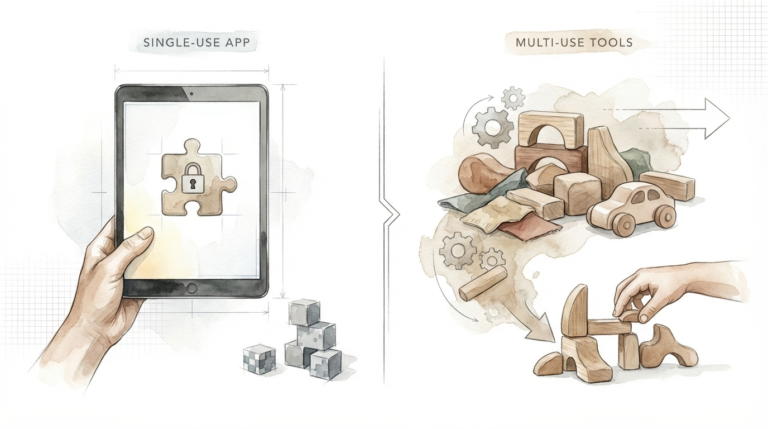
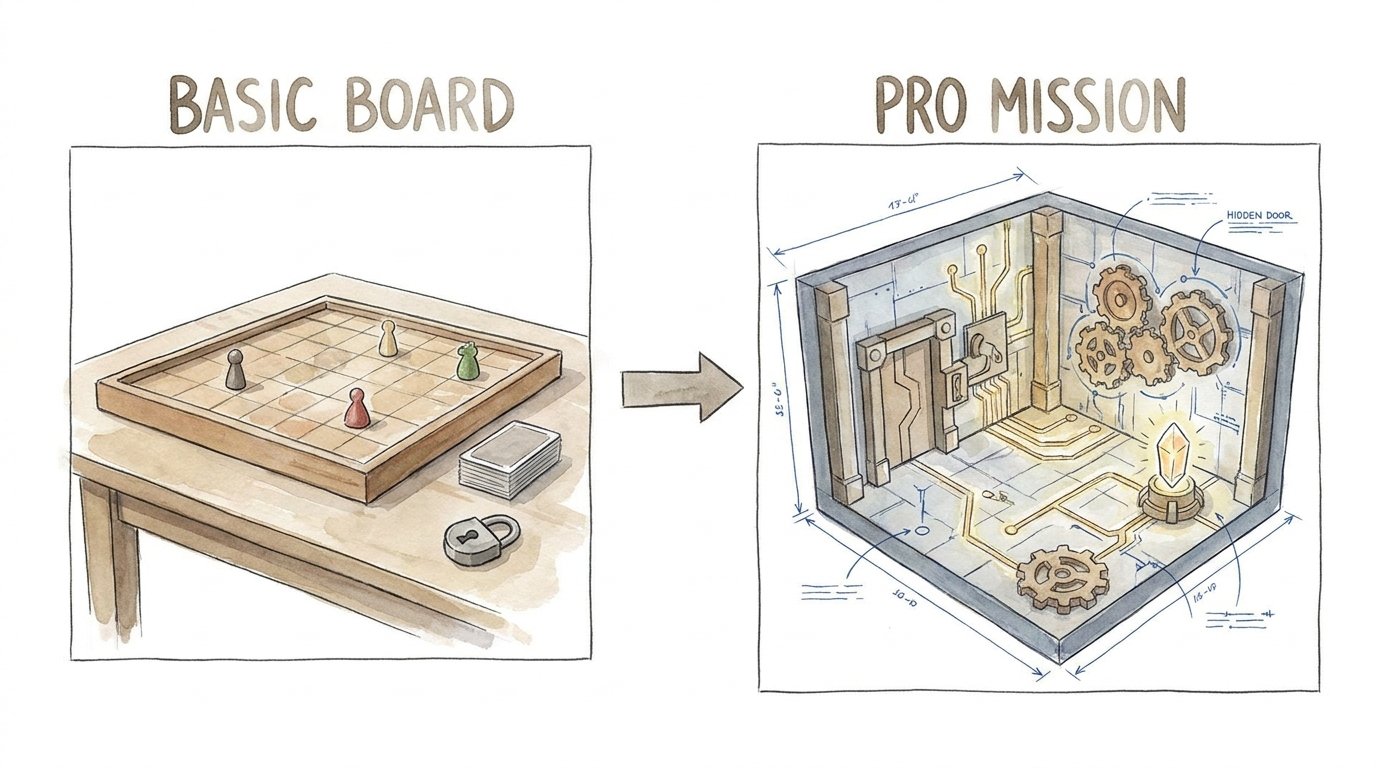
The primary advantage of a DIY escape room over a standard board game is the level of active engagement. In a “Basic Board” scenario, players often wait their turn, leading to phone-scrolling and disinterest. In a “Pro Mission” setup, every player is constantly moving, observing, and communicating. The physical nature of the game keeps energy levels high and ensures that even the most reluctant participants get sucked into the flow.
Practical benefits also include the development of soft skills. Teamwork isn’t just a buzzword here; it is a survival requirement. Siblings who usually bicker find themselves collaborating because they both want to beat the timer. It also rewards different types of intelligence. The family member who is great at math handles the ciphers, while the one who is observant finds the hidden key in the couch cushions. Everyone gets to be the hero for a few minutes.
Cost-efficiency is another major factor. A professional escape room for a family of four can cost upwards of $150. A DIY version costs essentially nothing if you use household items, or maybe $20 if you buy a few cheap padlocks. You also have the benefit of unlimited customization. You can tailor the puzzles to your kids’ current interests, their skill levels, and even your own inside jokes, making the experience far more memorable than a generic commercial room.
Challenges and Common Mistakes
One of the biggest pitfalls is making the puzzles too difficult. As the creator, the solution seems obvious because you built it. For a player under pressure, even a simple riddle can feel like advanced calculus. If players get stuck for more than ten minutes on a single task, the frustration starts to outweigh the fun. Always have a “hint system” ready to keep the momentum going without giving away the answer entirely.
Another frequent error is the inclusion of red herrings. Beginners often think adding false clues makes the game more “pro,” but in a home setting, it usually just causes confusion. Your family will naturally find “accidental” red herrings—like a random piece of junk mail or a weirdly shaped shadow—so there is no need to add intentional ones. Stick to the rule of “Every object in the game has a purpose.”
Logistical bottlenecks can also kill the vibe. This happens when there is only one puzzle to solve and five people are trying to crowd around it. If you have a larger family, design “Parallel Puzzles” where two or three small tasks can be solved simultaneously to reveal pieces of a larger code. This ensures everyone has something to do and prevents the “observer effect” where younger kids just watch the older ones do everything.
Limitations and Realistic Constraints
The biggest limitation of a DIY setup is immersion level. You are playing in your living room, so players will always know they are in their living room. You cannot easily install hidden doors or high-tech laser grids. Managing expectations is key. Focus on the “theatre of the mind” and use sound effects or lighting to help bridge the gap. A dark room with a few flashlights is infinitely more immersive than a fully lit kitchen.
Physical space is also a boundary. If you are playing in a small apartment, you have to be clever with how you hide items. You don’t want the game to turn into a messy “search and destroy” mission where your family rips the house apart. Set clear boundaries: “Clues are never inside the electronics” or “Do not move the heavy furniture.” These constraints actually strengthen the game by focusing the players’ attention on the designed elements.
Lastly, the one-time use nature of an escape room is a trade-off. Unlike a board game you can play every week, once the family knows the solutions, the “mission” is over. This means you have to spend a decent amount of time preparing for a 60-minute experience. To mitigate this, design puzzles that are modular—meaning you can swap out the story and the codes while keeping the physical props for a future “sequel.”
Comparison: Basic Board vs. Pro Mission
When deciding how to spend your evening, it helps to see how these two formats stack up. While both are valid, they offer very different psychological and social outcomes.
| Feature | Basic Board Game | DIY Pro Mission |
|---|---|---|
| Setup Time | 2-5 Minutes | 30-60 Minutes |
| Engagement | Turn-based, passive periods | Continuous, active movement |
| Skill Focus | Luck, strategy, individual win | Logic, teamwork, shared victory |
| Customization | None (static rules) | High (themes and difficulty) |
| Replayability | High | Low (one-and-done per story) |
Practical Tips for Immediate Success
Start small. Your first mission doesn’t need ten rooms and twenty locks. Use one room and five solid puzzles. The “search” phase is always a crowd-pleaser for kids. Hide the first clue in plain sight but in an unexpected way—like taped to the back of a TV remote or inside a cereal box. This sets the tone that “nothing is as it seems.”
Use “Atmospheric Anchors.” This is a pro-level tip that involves using one or two high-quality props to sell the whole theme. If it’s a detective game, a single trench coat and a magnifying glass do more for the vibe than ten printed posters. For a space theme, wrap a few boxes in tin foil. These visual cues tell the players’ brains that the game has officially begun.
Establish a “Hint Economy.” Instead of just shouting hints when they get stuck, give them three physical “Hint Tokens” (like poker chips or coins). They have to decide as a team when to trade a token for a clue from the Game Master. This adds a layer of strategy and prevents them from relying on you too early in the game. It also makes the eventually solved puzzle feel like more of an accomplishment.
- The “Magic” Mirror: Write a code on a mirror using a dry-erase marker, then wipe it away. It will be invisible until someone breathes on the glass, revealing the foggy message.
- Book Cipher 2.0: Give them three numbers like 12-4-2. This means Page 12, 4th line, 2nd word. It forces them to find a specific book first.
- The UV Secret: Buy a cheap UV flashlight and pen. Hide numbers for a padlock in plain sight on the walls; they only appear when the “special scanner” is used.
Advanced Considerations for Serious Creators
Once you have mastered the basics, you can start integrating technology. QR codes are a free and easy way to add a digital layer. A QR code on a “classified document” could link to a private YouTube video of a “villain” taunting the players or a sound file of a countdown. This adds a level of polish that feels professional without requiring any coding knowledge.
Consider Branching Narratives. This is where the players’ choices actually affect the outcome. If they solve Puzzle A quickly, they get the “Good Path” with easier clues. If they fail a task, they might have to take a longer, more difficult “detour.” This makes the world feel reactive and increases the stakes. It requires more prep work, but the payoff in player satisfaction is massive.
For those willing to spend a little on hardware, NFC tags and Arduino offer infinite possibilities. You can set up a “magic altar” where placing three specific objects (with NFC stickers) in a certain order triggers a magnetic lock to open a drawer. This is the “WOW” factor found in $500,000 commercial rooms that you can replicate for under $50 with a bit of tinkering. It moves the game from “puzzles on paper” to “interactive environment.”
Example Scenario: Mission Kitchen-Possible
The Story: A double agent has hidden the “Override Code” for the house security system somewhere in the kitchen. The alarm will go off in 45 minutes unless the family finds the code and “inputs” it into the microwave (the keypad represents the entry system).
Step 1: The Hook. The family finds a manila folder on the kitchen table. Inside is a “Mission Briefing” and a single jigsaw puzzle piece. On the back of the piece is written: “The cold truth is hidden where the sun doesn’t shine.”
Step 2: The Search. Players realize “cold” refers to the fridge. They find a magnetic spice tin on the side of the fridge. Inside are the remaining four jigsaw pieces. They assemble the puzzle to reveal a picture of a specific cookbook on the shelf.
Step 3: The Cipher. Inside the cookbook at the “Pizza” page, they find a bookmark with the numbers 114-6-1. They turn to page 114, 6th line, 1st word: “Balloons.”
Step 4: The Physical Task. In the corner of the room are three balloons. They have to pop them to find small scraps of paper. Only one balloon has the scrap; the others have “Dud” written on them. The scrap says: “Look under the captain’s chair.”
Step 5: The Final Unlock. Taped under the head-of-the-table chair is a small box with a 3-digit combination lock. The code is found by counting the number of “Secret Agent” posters you’ve hidden around the room. Inside the box is the “Override Code” (e.g., 5-5-2-1). They “enter” it into the microwave keypad, and the Game Master plays a “System Disarmed” sound effect. Mission Accomplished.
Final Thoughts
The beauty of a DIY home escape room is that it values creativity over complexity. You are not just providing a game; you are providing an experience that your family will talk about for years. It turns the familiar walls of your home into a landscape of mystery and turns your family members into a specialized task force. The transition from “bored at home” to “saving the world” is only a few puzzles away.
Do not be afraid to fail on your first attempt. If a puzzle is too hard, give a hint. If a lock won’t open, “bypass” it with a story element. The goal is the flow of the game and the smiles on your kids’ faces. As you get more comfortable, you can scale up the tech, the story, and the difficulty, turning your living room into the ultimate “Pro Mission” headquarters.
Experiment with different themes and challenge your family to create their own rooms for you to play. This circular creativity deepens everyone’s understanding of logic and design. Stop playing by the old rules and start building your own. Your next great mission is waiting just behind the next closed door.
Sources
1 reddit.com | 2 medium.com | 3 amazeescape.com | 4 escaperoomgeeks.com | 5 lockpaperescape.com | 6 myraceparty.com | 7 escapethisfrederick.com | 8 diy.org | 9 escaperoomsupplier.com | 10 myraceparty.com | 11 questroom.com | 12 escaperoomsupplier.com | 13 teachingideas.ca | 14 lockpaperescape.com