Natural Holiday Decoration Traditions
We’ve replaced the scent of the winter forest with the smell of a factory—is your holiday tradition actually alive? Modern holidays have become a ‘unboxing’ event of plastic goods kept in the attic. We are missing the biological connection to the seasons. When you gather the decor from your own land, you aren’t just decorating a house; you are teaching your children to read the rhythm of the earth. Switch from the sterile to the living this year.
Stepping into the woods with a pair of shears is a radical act of rebellion against the consumerist grind. It invites the wild into your living room. It turns a chore into a scavenger hunt. This guide will show you how to identify, forage, and preserve the natural world to create a home that breathes with the season.
Natural Holiday Decoration Traditions
Natural holiday decoration traditions are the original way humans celebrated the return of the light. Long before the first injection-molded plastic tree was sold in 1930, people looked to the landscape for symbols of resilience. Evergreens were not just pretty; they were a biological promise that spring would return.
In ancient Rome, citizens exchanged greenery and garlands during the festival of Saturnalia. Norse cultures used holly and ivy to symbolize the cycle of life and rebirth during the darkest days of the year. These traditions eventually merged with Christian practices, where the thorny leaves of holly came to represent the crown of thorns and its red berries symbolized blood.
Today, these traditions exist as a way to ground ourselves. We use natural materials because they engage all our senses. The scratch of a pine needle, the sticky scent of sap, and the deep, uneven greens of a cedar branch provide a sensory depth that plastic cannot replicate. Whether you live on a sprawling farm or in an apartment near a local park, these traditions are accessible to anyone willing to look closer at the winter landscape.
How to Ethically Forage Your Festive Greenery
Foraging is a skill that requires both sharp eyes and a soft touch. You cannot simply walk into the woods and hack away at the first tree you see. Respect for the ecosystem ensures that there will be greenery to harvest next year and that the local wildlife remains undisturbed.
Follow the one-third rule. Never take more than one-third of any individual plant or a specific stand of plants. This allows the plant to recover and ensures that animals, like birds who rely on winter berries for food, have enough to survive. If you are harvesting from slow-growing species, take even less—perhaps only one-twentieth of the growth.
Always seek permission before foraging on land that isn’t yours. While public parks often allow for the collection of fallen branches or pinecones, cutting live greenery may require a permit. Private property is off-limits unless you have the owner’s blessing.
Carry the right tools. A sharp pair of bypass pruners will make clean cuts that heal quickly, whereas dull shears or snapping branches by hand can invite disease and pests into the plant. Make your cuts at a 45-degree angle just above a leaf bud or a branch junction. This directs the plant’s energy into new growth for the spring.
Identifying the Best Plants for Your Holiday Display
The winter landscape is far more diverse than most people realize. Once the deciduous trees drop their leaves, the structures of evergreens and the vibrant colors of berries become the stars of the show.
Evergreens and Conifers
- Pine: Known for its long, soft needles and flexibility. White pine is a favorite for swags because it drapes beautifully.
- Cedar and Juniper: These offer a unique, scale-like texture and a pungent, woody aroma. They are incredibly hardy but can dry out quickly if not properly hydrated.
- Spruce: Spruce branches are stiff and excellent for holding heavy ornaments. Be warned: they are prickly and can drop needles faster than fir trees.
- Fir: Often considered the gold standard for holiday greenery. Firs have flat needles that are soft to the touch and hold their scent for weeks.
Berries and Architectural Stems
- Holly: The classic holiday choice. Look for Ilex opaca (American Holly) for its iconic spiked leaves and red berries.
- Winterberry: This is a deciduous holly that drops its leaves but keeps its brilliant red berries, making it a stunning addition to vases.
- Red Twig Dogwood: Even without leaves, these bright red stems provide a vertical, sculptural element to outdoor pots and indoor arrangements.
- Dried Hydrangeas: Don’t overlook the “dead” flowers in your garden. Dried hydrangea heads add a vintage, rustic feel to wreaths.
Preservation Techniques: Keeping Greenery Fresh for Weeks
The biggest enemy of natural decor is the modern furnace. Indoor air is notoriously dry, and once a branch is cut, it begins a countdown to becoming a fire hazard. You must treat your greenery like cut flowers or fresh produce to keep it vibrant through New Year’s Day.
Start with a deep hydration session. Before you arrange your greenery, recut the stems at an angle and soak them in a bathtub or a large bucket of room-temperature water for 24 hours. This allows the plant cells to fully saturate.
Apply an anti-desiccant spray. Products like Wilt-Pruf act as a thin, waxy coating that seals the pores (stomata) of the leaves, preventing moisture from evaporating. This is especially important for broadleaf evergreens like holly or magnolia.
If you want your greenery to last for months rather than weeks, consider the glycerin method. Mix one part vegetable glycerin with two parts hot water. Submerge the stems in this solution for several days. The plant will pull the glycerin into its tissues, replacing the water with a substance that doesn’t evaporate. This leaves the foliage feeling soft and supple, though it may darken the color slightly.
Practical Benefits of Switching to Living Decor
Choosing natural decor isn’t just about aesthetics; it offers measurable advantages for your home and your well-being.
Environmental Impact: Most artificial wreaths and garlands are made of PVC, a plastic that is difficult to recycle and often contains lead. When your natural decor reaches the end of its life, it goes into the compost pile, returning nutrients to the earth.
Cost Efficiency: While high-end artificial greenery can cost hundreds of dollars, foraging is essentially free. Even if you purchase a few “filler” items from a local nursery, the cost is a fraction of the price of premium plastic alternatives.
Mental Health: Scientific studies on biophilia suggest that having living plants in our environment reduces cortisol levels and improves mood. The act of gathering these materials forces you to spend time outdoors, providing a much-needed break from the “winter blues.”
Aromatic Therapy: No “pine-scented” candle can match the complex olfactory profile of real balsam or cedar. These natural scents contain phytoncides, which have been shown to boost the human immune system.
Challenges and Common Mistakes
The transition from plastic to natural isn’t without its hurdles. Many beginners make the mistake of placing fresh greenery too close to heat sources. Avoid mantels that sit directly above an active fireplace or windows that receive intense afternoon sun. These conditions will turn your beautiful garland into a brittle mess in 48 hours.
Another frequent error is ignoring the “sap factor.” Freshly cut conifers will bleed resin. This sap is nearly impossible to get out of carpets or off finished wood surfaces. Always use a protective barrier, such as a plastic liner or a decorative tray, under your arrangements.
Over-harvesting is a mistake that harms your reputation as a steward of the land. If you strip a single holly bush of all its berries, you are removing a vital food source for local birds. Think like a gardener, not a consumer. Prune with the intention of helping the plant grow back stronger in the spring.
Limitations and Environmental Constraints
Natural decor is not ideal for every situation. If members of your household suffer from severe allergies or asthma, certain evergreens—particularly those that may carry mold spores or high levels of pollen—can cause respiratory distress. In these cases, sticking to dried elements like orange slices or wood stars is a safer bet.
Climate also plays a role. If you live in a very warm, humid environment, fresh greenery may mold or rot before it dries out. Conversely, in extremely dry desert climates, you may find that even with anti-desiccant sprays, your decor lasts only a few days.
Practical boundaries include the weight of the material. Fresh cedar garland is significantly heavier than plastic. You cannot rely on flimsy adhesive hooks to hold it up. You will need sturdy nails, screws, or heavy-duty wire to secure large natural installations safely.
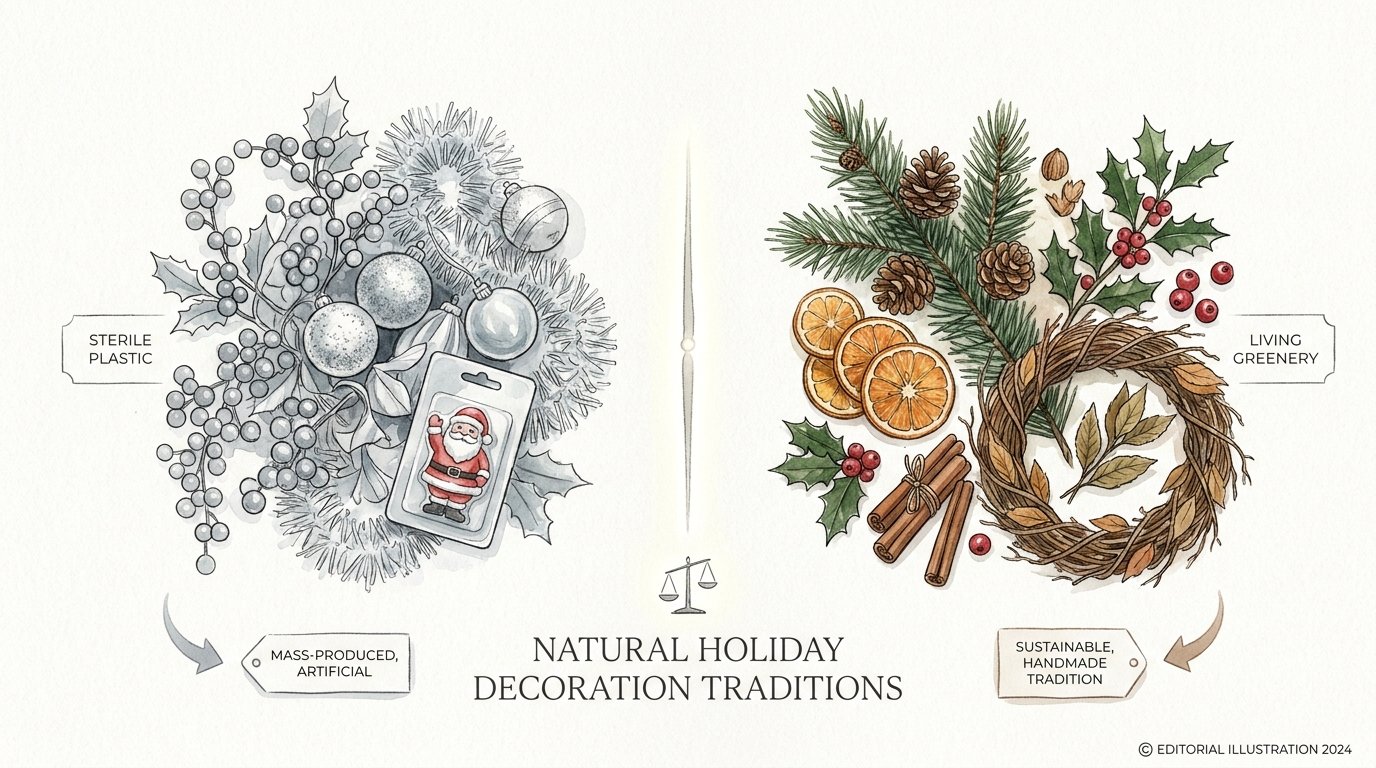
Live Greenery vs. Plastic Decor
| Feature | Natural Decor | Plastic Decor |
|---|---|---|
| Initial Cost | Free to Low | Moderate to High |
| Lifespan | 2–6 Weeks | 10+ Years |
| Scent | True Forest Aroma | Chemical or None |
| Disposal | Compostable | Landfill |
| Maintenance | Daily Misting | Dusting Only |
Practical Tips and Best Practices
Maximizing the life of your natural decor requires a proactive maintenance schedule.
- Mist Daily: Use a fine-mist spray bottle to hydrate the surface of the needles. This mimics the dew they would receive in the wild.
- Use LED Lights: Traditional incandescent bulbs generate heat that dries out branches. Switch to LEDs, which stay cool to the touch.
- Check Water Daily: If you have branches in a vase or a live tree in a stand, never let the water level drop below the base of the stems. Once the sap seals over the cut, the plant can no longer take up water.
- Keep It Cool: If you have a porch or a garage, move your wreaths or garlands outside overnight to give them a “rest” in the cool, humid night air.
Think about using “floral foam” for complex centerpieces. This green, porous material can be soaked in water, providing a constant reservoir for your stems. Just ensure the foam stays saturated throughout the season.
Advanced Considerations: Going Beyond the Basics
For the serious practitioner, natural holiday decor is an opportunity to experiment with plant physiology and regional biodiversity.
Consider the pH of your water. Many evergreens prefer slightly acidic conditions. Adding a small amount of lemon juice or a commercial floral preservative to your vase water can help keep the vascular system of the branches open and functioning.
Explore bark textures. In many regions, the peeling bark of River Birch or the smooth, white skin of Aspen provide a striking contrast to dark evergreens. These can be used to create structural “frames” for your decorations that require no hydration at all.
Scaling your decor means understanding structural integrity. If you are building a massive 20-foot garland, you must use a wire core (like 12-gauge galvanized wire). Natural branches are heavy and have a high “drag” coefficient. Without a strong skeleton, the garland will stretch and eventually break under its own weight.
Example Scenario: The Foraged Mantel
Imagine you want to decorate a standard 5-foot fireplace mantel using only what you can find in your backyard and kitchen.
First, gather three large boughs of White Pine and two branches of Eastern Red Cedar. Recut the ends and soak them in the tub overnight. While they soak, slice two oranges into 1/4-inch rounds and dry them in a 200°F oven for three hours.
The next day, spray the greenery with Wilt-Pruf and let it dry. Secure a length of twine across the mantel. Using florist wire, attach the Pine boughs first to create a base. Tuck the Cedar branches into the gaps to provide a different texture and scent.
Thread the dried orange slices onto a piece of jute twine and drape it across the greenery. Add five or six large pinecones that you’ve gathered and cleaned of debris. Finally, weave in a strand of cool-touch LED lights. The result is a professional-grade display that cost zero dollars and smells like a deep winter forest.
Final Thoughts
Natural holiday decoration traditions are about more than just making a room look festive. They are about re-engaging with a world that we often ignore during the colder months. When you take the time to forage and preserve, you are participating in a cycle that is thousands of years old.
The transition from plastic to living greenery requires a shift in mindset. You are no longer just an “unboxer”; you are a caretaker. You must monitor moisture, watch for heat stress, and handle your materials with respect. This extra effort pays off in the form of a home that feels truly connected to the earth.
Experiment with the plants that grow in your specific region. Whether it’s the eucalyptus of California, the magnolia of the South, or the balsam of the North, every landscape has something beautiful to offer. Take the first step this year—leave the plastic in the attic and bring the living world inside.
Sources
1 platthillnursery.com | 2 realflowers.co.uk | 3 woodlandtrust.org.uk | 4 marysmeals.org | 5 thursd.com | 6 powellgardens.org | 7 substack.com | 8 heartysol.net | 9 growscripts.com | 10 newsandsentinel.com | 11 ca.gov | 12 plt.org