Durable Travel Journals For Modern Kids
In 50 years, will your kids be looking for a compatible charging cable or opening a window into their own childhood? We trust our most precious family moments to servers we don’t own and hardware designed to fail in three years. ‘Then’ meant recording life on archival paper that survives floods and moves. ‘Now’ means hoping the cloud login still works in 2074. It’s time to return to the permanent record.

Screens are placeholders. They are flickering lights that vanish when the battery dies. A physical journal is a legacy. It is a tactile, smellable, holdable piece of history that stays in the family. When you hand a child a pen and a durable book, you aren’t just giving them a craft. You are giving them a time machine.
Parents often worry about the mess or the weight of a physical diary. They think a digital photo album is “good enough.” But “good enough” doesn’t survive the evolution of file formats. “Good enough” doesn’t teach a child how to observe the world with their own eyes instead of through a lens.
Durable Travel Journals For Modern Kids
A durable travel journal is a specialized notebook designed to withstand the chaos of family adventures. These aren’t your standard school notebooks with thin pages and flimsy spirals. They are built with rugged covers, high-quality paper, and reinforced bindings. They exist to capture the sensory overload of a new city or the quiet wonder of a mountain trail.
Kids are not gentle. They drop things in the dirt. They spill juice. They cram their bags into overhead bins. A durable journal survives this treatment. These books use materials like heavy-weight cardstock, vegan leather, or even waterproof stone paper. They provide a safe harbor for ticket stubs, pressed flowers, and scribbled thoughts.

Real-world use looks like a six-year-old sitting on a dusty curb in Rome, sketching the Colosseum. It looks like a teenager in a rainy Seattle cafe, protected by a water-resistant cover. These journals act as an anchor. While the world moves at a digital blur, the journal slows time down. It forces the child to engage with their surroundings in a way a smartphone never could.
The Architecture of a Permanent Record
Building a journal that lasts decades requires specific technical features. You cannot grab any notebook off a discount shelf and expect it to survive the trek. Understanding the “why” behind the materials helps you choose a tool that truly becomes a family heirloom.
Binding Matters Most
Avoid journals that use only glue at the spine. These are called “perfect bound” books, but they are far from perfect for travel. Over time, the glue dries out and becomes brittle. Pages start falling out like autumn leaves. Look for “Smyth sewn” bindings. This method uses thread to stitch groups of pages together. It allows the book to lie flat, making it easier for small hands to write and draw.
Paper Weight and GSM
GSM stands for “Grams per Square Meter.” It measures the density of the paper. Standard printer paper is usually around 80 GSM. For a durable travel journal, you want at least 100 to 120 GSM. This thickness prevents ink from bleeding through to the other side. It also provides the structural integrity needed to hold heavy items like polaroid photos or thick museum stickers.
Archival Quality and pH Balance
Time is the enemy of wood-pulp paper. Standard paper contains acid that causes it to turn yellow and crumble over 50 years. True archival paper is acid-free and often buffered with calcium carbonate. This neutralizes the environment and keeps the pages white and flexible for centuries. If you want the journal to be readable in 2074, “acid-free” is a non-negotiable requirement.
Benefits of the Tactile Experience
Switching from digital notes to a physical journal offers measurable cognitive advantages. Science shows that the brain processes handwriting differently than typing. It isn’t just about nostalgia; it is about neurological development and deep memory retention.
Handwriting activates the Reticular Activating System (RAS) in the brain. This system acts as a filter, telling the brain what to prioritize. When a child physically writes “The ocean was turquoise,” their brain engages with the memory more deeply than if they just snapped a photo. This process strengthens neural pathways and helps them retain the experience for years.
Physical journaling also builds “working memory.” Children must organize their thoughts, choose words, and manage spatial layout on the page. Research indicates that kids who journal regularly can perform up to 20% better in language arts. They learn to observe details—the smell of a bakery, the sound of a foreign language, the texture of a train ticket.
Emotional regulation is another massive win. Traveling can be stressful for kids. Changes in routine and long transit times lead to meltdowns. A journal provides a private, safe space to process those “big feelings.” It gives them a sense of control and a quiet outlet during the loud moments of a trip.
Challenges and Common Mistakes
Most parents start with great intentions but fall into predictable traps. Avoid these errors to ensure the journaling habit actually sticks throughout the vacation.
The “Daily Requirement” Trap
Do not force your child to write every single day. This turns a fun activity into a chore. If they feel pressured, they will produce “The ocean was blue” entries just to get it over with. Encourage them to journal when they are inspired or during “gap times” like waiting for a flight. A few high-quality entries are better than thirty pages of bored repetition.
Incompatible Ink and Materials
Stone paper is a popular choice for durability because it is waterproof and tear-resistant. However, it is made of calcium carbonate and HDPE plastic. Most gel pens and fountain pens will smudge on it because the ink cannot soak in. If you choose a stone paper journal, you must use ballpoint pens or pencils. Testing your tools before the flight prevents a smeared, unreadable mess.
Ignoring the “Bulge Factor”
Kids love to tape things into their books. Shells, sand, thick brochures, and coins all add volume. If the journal has a tight, rigid spine, it will eventually “alligator mouth” and break. Choose a journal with an elastic closure or a flexible softcover that can expand as the trip progresses.
Limitations of Physical Media
Acknowledge the trade-offs. While paper offers timelessness, it lacks the features of modern technology. Understanding these boundaries helps you manage expectations.
Weight is a primary concern. For ultra-light backpackers, every ounce counts. A thick, leather-bound journal adds bulk to a child’s carry-on. If you are moving quickly between many destinations, a pocket-sized version might be more practical than a large coffee-table style book.
Physical journals also lack a “search” function. You cannot hit Command+F to find the name of that specific gelato shop in Florence. You have to flip through the pages. However, many enthusiasts argue that this “manual search” is exactly what makes the experience valuable. It forces you to relive the entire journey as you look for one specific detail.
Finally, physical media is susceptible to total loss. A fire or a lost backpack means the memories are gone forever. Digital files can be backed up to multiple locations. To mitigate this, many families take photos of completed journal pages at the end of every trip. This provides a digital safety net for the physical original.
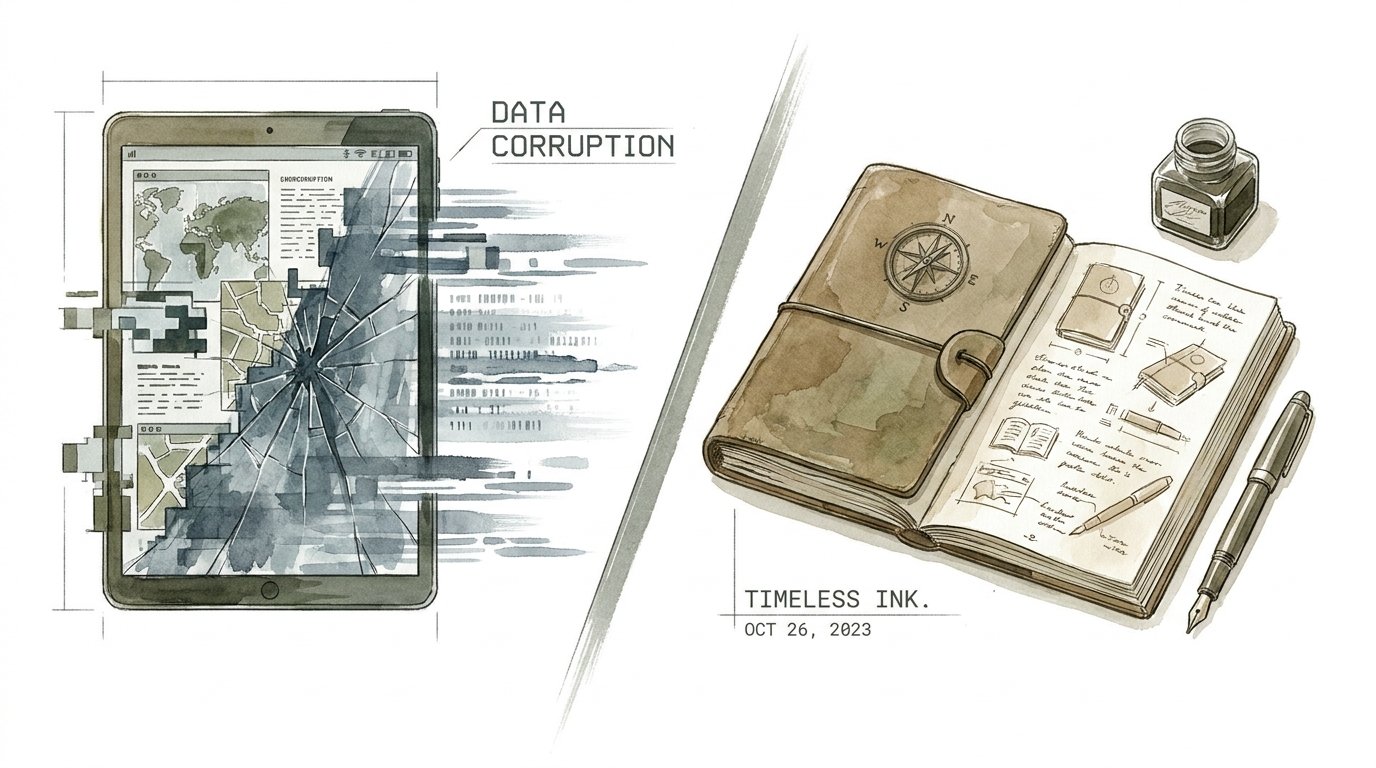
DATA CORRUPTION vs. TIMELESS INK
The choice between digital and analog isn’t just about preference; it’s about the physics of preservation.
| Feature | Digital (The Cloud) | Physical (Timeless Ink) |
|---|---|---|
| Lifespan | 3–10 years before hardware/format shift. | 200+ years with archival paper. |
| Sensory Connection | None (Glass and light). | Tactile (Texture, scent, handwriting). |
| Cognitive Load | Low (Easy to delete/ignore). | High (Encourages focus and reflection). |
| Accessibility | Requires power, internet, and password. | Always “on.” Just open the cover. |
| Durability | Fragile (Water and drops kill the device). | Resilient (Durable covers and stone paper). |
Practical Tips for Young Journalers
Success depends on the setup. You cannot expect a child to fill a blank book without some guidance and the right tools.
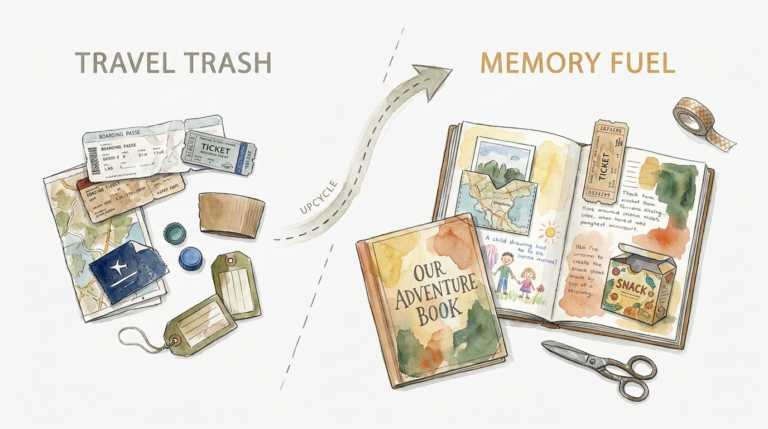
- Use “Scrapbook” style tools: Carry a small glue stick and a roll of washi tape. Taping in a sugar packet from a French cafe or a metro ticket from London makes the journal a three-dimensional experience.
- Pre-fill the pages: If your child is intimidated by blank white space, write a prompt at the top of every fifth page. Questions like “What was the weirdest thing you ate today?” or “Draw the view from the window” give them a starting point.
- Invest in a “Travel Pouch”: Keep the journal, a few colored pencils, and a pen in a dedicated zippered bag. This keeps the supplies organized and makes it easy to grab the kit for a long car ride.
- Focus on the Five Senses: Encourage them to write one thing they smelled, tasted, heard, touched, and saw. This simple framework builds a vivid picture of the destination.
- Add Photo Corners: Instead of gluing photos directly, use archival photo corners. This allows you to remove the photo later if needed without tearing the page.
Advanced Considerations for Long-Term Archiving
If you are serious about these journals becoming family treasures, think about the storage environment. Even the most durable book can be damaged by the wrong conditions.
Keep finished journals in a cool, dry place. Humidity leads to mold and causes pages to stick together. Avoid storing them in unfinished basements or hot attics. A shelf in a living area is usually perfect because the temperature and humidity remain relatively stable.
Consider using “interleaving” for pages with heavy ink or pasted items. This involves placing a thin sheet of acid-free tissue paper between the pages. It prevents “ghosting” (ink transferring to the opposite page) and protects delicate items like pressed flowers from sticking to the facing sheet.
Digital backups are your “insurance policy.” Once a year, scan the most important pages of your kids’ journals. Use a high-resolution flatbed scanner rather than a phone app for the best quality. Save these files in multiple formats, including PDF/A, which is specifically designed for long-term digital preservation.
The “Costa Rican Jungle” Scenario
Imagine a family trip to the rainforest. You are surrounded by 90% humidity and frequent rain. A standard notebook would turn into a soggy sponge within 48 hours. The glue would dissolve, and the ink would run.
In this scenario, a stone paper journal with a synthetic cover is the only logical choice. The child can sit on a damp log and draw a toucan without worrying about the page tearing. If a water bottle leaks in their backpack, the memories remain intact.
Contrast this with a tablet. The humidity might fog the lens or corrode the charging port. A single drop onto a rock would shatter the screen. The physical, durable journal survives the environment while the digital device requires a protective bubble to function. Theory becomes reality the moment the first rainstorm hits.
Final Thoughts
Building a permanent record of your child’s life is an act of love. It requires a shift away from the “instant” culture of social media and a return to the deliberate nature of ink and paper. Durable travel journals give your kids a way to reclaim their own history from the void of the cloud.
The goal isn’t perfection. It isn’t about beautiful handwriting or professional-grade sketches. It is about the smudge of dirt from a mountain hike and the shaky handwriting of a kid who just saw the ocean for the first time. These imperfections are the soul of the journal.
Start small. Buy a high-quality book with sewn binding and acid-free paper. Give your child a pen and the permission to make a mess. In five decades, they won’t remember the likes on a post, but they will remember the weight of the book in their hands and the window it opens into the person they used to be.
Sources
1 duncanandstone.com | 2 twisttravelmag.com | 3 insidethetravellab.com | 4 independenttravelcats.com | 5 techwriteredc.com | 6 packhacker.com | 7 quora.com | 8 seseprinting.com | 9 youtube.com | 10 reddit.com | 11 medium.com | 12 kidsvillepeds.com | 13 agood.com