Durable Toys For Sensory Development
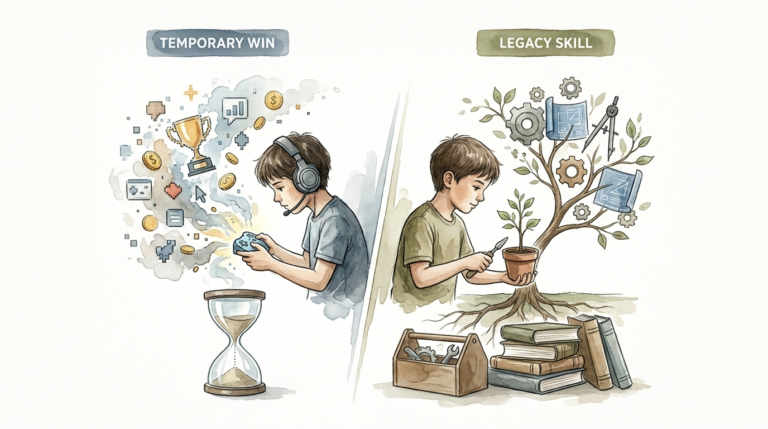
We traded the weight of history for the convenience of plastic—and our children are feeling the loss. There’s a reason your child keeps breaking their toys—they’re built to be broken. We’ve lost the era of the ‘legacy tool.’ Switching back to heirloom materials like wood and forged steel doesn’t just save money; it teaches a child to value the weight, resistance, and permanence of the real world.
Most modern playrooms are filled with “low-fidelity” sensory environments. These spaces feature lightweight, hollow plastic objects that feel identical regardless of whether they are a truck, a doll, or a block. This lack of variety starves a child’s developing nervous system of the nuanced feedback it needs to understand physics, gravity, and the limits of material strength.
Choosing heirloom toys is a deliberate act of rebellion against the disposable culture. It is an investment in your child’s cognitive foundation. In this guide, we will explore why durable materials matter for sensory development and how you can transition your home from a plastic graveyard to a workshop of legacy tools.
Durable Toys For Sensory Development
Durable toys for sensory development are playthings made from high-density, natural materials like solid hardwood, forged steel, stone, and heavy fibers. These materials provide what neuroscientists call “high-fidelity” sensory input. Unlike a plastic car that feels the same in July as it does in December, a wooden block responds to the environment. It holds warmth. It changes texture as it ages. It carries a weight that demands respect from a toddler’s small hands.
Sensory development is the process where a child’s brain learns to interpret signals from their environment. When a child picks up a heavy oak block, their proprioceptive system—the “hidden sense” of body position and effort—immediately engages. They have to adjust their grip strength. They have to calculate the balance point. This doesn’t happen with a feather-light plastic block that offers no resistance to gravity.
Real-world application of these toys can be seen in Montessori and Waldorf classrooms. In these environments, children use “real” objects because the feedback is honest. If a glass pitcher is dropped, it breaks. If a steel shovel is left in the rain, it may rust. These consequences are the best teachers. They help children move from passive observers to active, careful participants in the physical world.
The Role of Tactile Feedback
Texture provides the primary map of the world for a young child. Natural materials offer an infinite variety of surfaces. You can find the smoothness of a polished maple rattle, the slight grain of a cedar block, or the cool, dense weight of a forged steel hammer. Each of these variations forces the brain to create a more complex neural map of “touch.”
Weight and Proprioception
Proprioception is the sense that tells you where your limbs are without looking at them. Heavy toys provide “heavy work,” which is grounding for the nervous system. Carrying a bucket filled with wooden blocks provides a different neurological experience than carrying one filled with hollow plastic. The resistance of the weight helps children develop better motor control and spatial awareness.
The Mechanics of Material Resistance
Understanding how these toys work requires looking at the physics of the materials themselves. When a child interacts with a toy, they are essentially running a series of miniature scientific experiments. They are testing the limits of force, the effects of friction, and the reality of thermal conductivity.
Thermal Conductivity and Temperature
Plastic is an insulator; it feels relatively neutral to the touch. Wood and metal are different. Steel pulls heat away from the hand, feeling cold until it is “warmed” by the child’s own body heat. This change in temperature is a sensory signal. It tells the child that they are interacting with something “real” that exists in the same thermal environment they do.
Soundscapes of Play
Listen to a child playing with plastic. You hear a high-pitched, hollow clatter. This sound can be overstimulating and irritating to both the child and the parent. Now, listen to the “click” of two solid maple blocks or the “ping” of a steel chime. These are organic soundscapes. They are lower in frequency and more satisfying to the ear, helping children maintain focus for longer periods without becoming sensory-overwhelmed.
Kinetic Feedback and Force
Forged steel tools or heavy wooden vehicles require a specific amount of force to move. This teaches the concept of inertia. A heavy wooden train set won’t go flying off the tracks with a tiny nudge like a plastic one might. The child must learn to apply the correct amount of energy to achieve the desired result. This “tuning” of the body’s output is essential for developing fine motor skills.
Benefits of Heirloom Materials
Investing in quality materials provides measurable advantages that go beyond just “feeling good.” These benefits impact the child’s health, their psychology, and the family’s long-term finances.
Neurological “Calibration”
Natural materials help calibrate a child’s sense of reality. Because wood has a grain, it breaks in a specific direction. Because steel is dense, it is difficult to bend. These properties are consistent and predictable. Plastic, on the other hand, can be molded into any shape, often hiding the “truth” of how an object should behave based on its appearance.
Emotional Connection and “Presence”
Children often form deeper bonds with heirloom toys. This is partly due to the “presence” of the material. A handcrafted wooden doll has a soul that a mass-produced plastic figurine lacks. Research shows that children value unique, authentic objects more than exact replicas. An heirloom toy that ages and develops “scars” from play becomes a part of the child’s personal history.
Non-Toxicity and Health
Safety is a major driver for the switch to heirloom toys. Many plastics contain phthalates, BPA, and PVC—chemicals that can off-gas or leach when chewed on. High-quality wooden toys are finished with food-safe oils like linseed or beeswax. Forged steel is inherently non-toxic. When you choose these materials, you eliminate the “hidden” chemical load in the playroom.
The Economics of the Legacy Tool
While the upfront cost is higher, heirloom toys are cheaper over a decade. A $60 set of solid hardwood blocks will last 50 years. Five $15 plastic sets will break and end up in a landfill within five years. You aren’t just buying a toy; you are buying a tool that will serve multiple children and perhaps even the next generation.
Challenges and Common Pitfalls
The transition to heirloom toys isn’t without its hurdles. Many parents start with good intentions but fall into traps that lead to frustration or wasted money.
The “Pinterest” Trap
Avoid the urge to buy toys just because they look beautiful in a photo. Heirloom toys are tools for play, not just decor. Some “aesthetic” wooden toys are made from cheap plywood or soft pine that splinters easily. Look for hardwoods like maple, birch, oak, or walnut. These are dense enough to withstand being thrown or chewed.
Overwhelming the Space
A common mistake is replacing thirty plastic toys with thirty wooden ones. Heirloom toys are dense and heavy. A room filled with too many high-fidelity objects can actually be overstimulating. Follow the “less is more” rule. A child only needs a few high-quality items to engage in deep, imaginative play.
Ignoring Maintenance
Natural materials require care. If you treat a wooden toy like a plastic one—leaving it outside in the rain or letting it get bone-dry—it will crack. Parents often forget that wood is a biological material that needs to “breathe” and be nourished with oil occasionally.
Limitations of Heirloom Materials
It is important to be realistic about where these materials might not be the best fit. A balanced understanding strengthens your ability to curate a great play space.
Weight-to-Safety Ratio
Very heavy toys can be dangerous for toddlers who are still in the “throwing” stage. A solid steel car is a legacy item, but it can also dent a hardwood floor or cause a bruise if it becomes a projectile. Matching the weight of the toy to the child’s developmental stage is crucial.
Water Play Constraints
Wood does not like to be submerged. While a plastic boat is fine in the bathtub for hours, a wooden one will swell and eventually mold if not dried properly. For water play, stone or specialized marine-grade woods are better, but plastic still often wins in this specific niche for ease of use.
Portability Factors
Heirloom toys are not “diaper bag friendly.” You probably won’t want to carry a set of solid steel tools through an airport. They are heavy and take up space. For travel, lighter materials or natural fibers like wool and cotton are often a better compromise.
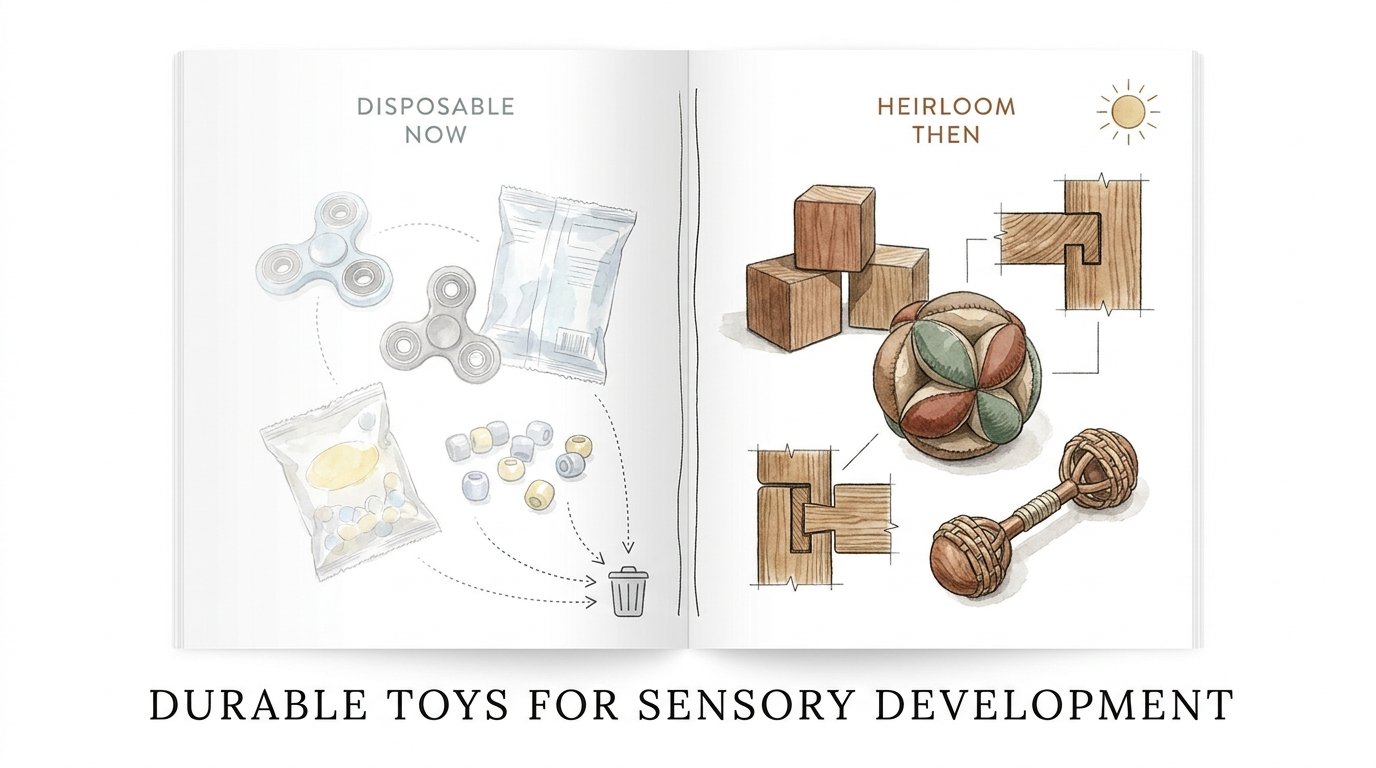
Comparison: Disposable vs. Heirloom
The following table highlights the functional differences between mass-produced plastic and heirloom-quality materials.
| Feature | Disposable Plastic | Heirloom (Wood/Steel) |
|---|---|---|
| Sensory Input | Low-fidelity; uniform texture. | High-fidelity; varied grain/weight. |
| Thermal Property | Insulating; always feels “neutral.” | Conductive; adapts to environment. |
| Durability | Fragile; snaps under pressure. | Resilient; gains character with age. |
| Chemical Safety | Risks of BPA/Phthalates. | Naturally non-toxic. |
| Resale Value | Zero; usually ends in landfill. | High; often sold as “vintage” or “antique.” |
Practical Tips and Best Practices
If you are ready to start building a legacy collection, these steps will help you maintain the quality and safety of your investment.
- Choose Solid Wood: Always verify that “wooden” toys are solid wood rather than MDF or composite. Composites use glues that can off-gas and they don’t handle moisture well.
- Season Your Wood: Every few months, rub your wooden toys with a mixture of beeswax and olive oil. This prevents the wood from drying out and provides a beautiful, natural scent.
- Address Splinters Immediately: If a toy gets a rough edge, use 220-grit sandpaper to smooth it down in the direction of the grain. This is a five-minute fix that makes the toy like new.
- Prevent Rust on Steel: If your child has a set of steel tools, keep them dry. If a spot of rust appears, use a bit of steel wool and a drop of mineral oil to buff it out.
- Implement Toy Rotation: Because these toys are heavy and significant, don’t keep them all out at once. Keep 5–10 items available and rotate them every few weeks to keep the child’s interest high.
Advanced Considerations for Serious Practitioners
For those who want to go beyond simple blocks and cars, consider creating a “Children’s Workshop.” This involves introducing real tools for real work, a concept favored by many advanced educators.
Building a Child’s Toolset
Instead of a plastic hammer that squeaks, give an older child (age 4+) a small 8oz forged steel hammer. The weight allows them to actually drive a nail. This teaches the gravity-driven mechanics of a swing. Real tools require real safety training, which builds a child’s sense of responsibility and self-worth.
The Importance of Wood Species
Different woods offer different sensory and functional benefits. Maple is incredibly dense and antibacterial, making it the king of teething toys. Walnut is dark and provides high visual contrast, which is great for children with visual processing needs. Ash is flexible and shock-resistant, making it perfect for tool handles or items that will take a beating.
Acoustic Tuning in the Playroom
You can “tune” your playroom for better focus by selecting toys based on their sound. Hardwoods produce a sharp “click,” while softwoods produce a duller “thud.” Mixing these sounds provides a rich auditory landscape that helps children learn to distinguish between different materials based on sound alone.
Example Scenario: The Garden Experiment
Imagine two children in a backyard. Child A has a plastic toy spade. Child B has a small spade made of forged steel with an ash wood handle.
Child A pushes the plastic spade into the dirt. The plastic flexes and bends. It struggles to cut through a small root. The child learns that tools are flimsy and frustrating. Eventually, they use the spade as a projectile because it isn’t very good at digging.
Child B pushes the steel spade into the dirt. The weight of the metal does half the work. The sharp edge cuts through the soil with a satisfying “slice.” The child feels the vibration of the earth through the wooden handle. They spend thirty minutes focused on a single hole, learning exactly how much pressure is needed to move the earth. They learn that a quality tool is an extension of their own body.
Final Thoughts
We often think of toys as mere entertainment, but they are actually the first instruments a human uses to understand the universe. Every time we choose a durable, heirloom-quality object over a disposable plastic one, we are giving our children a more honest map of reality. We are telling them that quality matters, that things can last, and that the world is something to be respected rather than consumed and discarded.
The shift toward legacy materials like wood and forged steel is more than an aesthetic choice. It is a developmental strategy that nourishes the senses and builds a foundation of physical competence. These toys don’t just sit in a box; they hold memories, they survive the rough-and-tumble of growing up, and they wait patiently on the shelf to be discovered by the next generation.
Start small. Replace one broken plastic bin with a single set of solid wood blocks or a real metal bucket. Watch how your child’s play changes. Notice the focus, the care, and the quiet satisfaction that comes from holding something that has weight and history. You aren’t just cleaning up the playroom; you are building a legacy.
Sources
1 imamontessori.org | 2 bluebrontide.com | 3 oskarswoodenark.com.au | 4 tinylandus.com | 5 bumbutoys.com | 6 zigpoll.com | 7 geni-toys.com.au | 8 bumbutoys.com | 9 forestoy.com | 10 forgedsteeltools.com | 11 growwithmesubscriptionbox.co.uk | 12 poppaswoodencreations.co.nz | 13 graceandhaven.co | 14 medium.com | 15 nih.gov | 16 universalwoodentoys.com | 17 bellalunatoys.com | 18 kidkenmontessori.com | 19 wildroots.love | 20 cloudmontessori.com | 21 forgedmetalart.com.au | 22 mokuomo.com