Organized Sensory Play For Focus
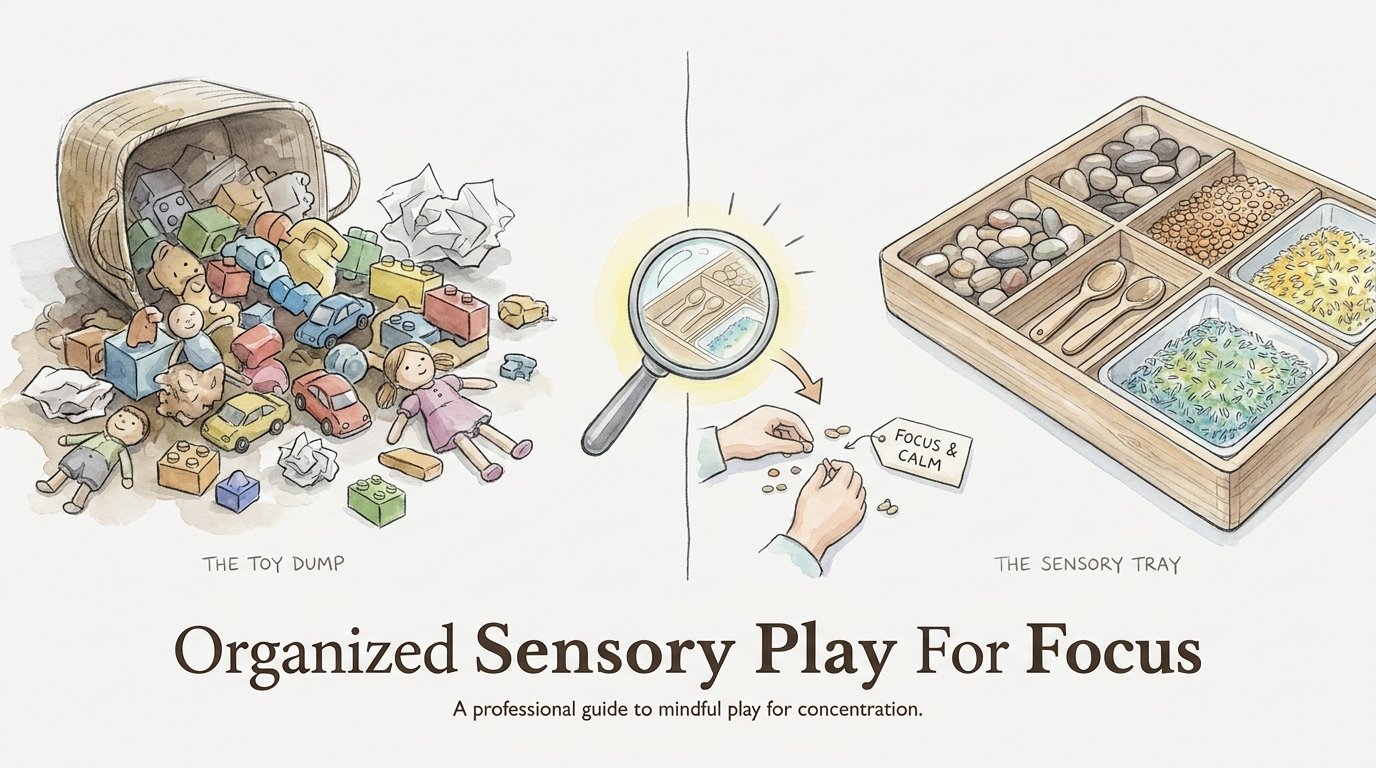
When everything is available at once, nothing is actually explored; order is the bridge to deep concentration. We often think more toys equals more play, but the ‘Toy Dump’ actually paralyzes a child’s decision-making. Moving from chaos to a structured sensory tray provides visual and tactile order. This setup invites the child to compare, contrast, and focus on one specific input at a time, leading to much longer play sessions.

Organized Sensory Play For Focus
Organized sensory play is the intentional arrangement of materials in a contained space to stimulate a child’s senses. It moves away from the traditional “toy dump” where dozens of unrelated items are scattered on the floor. Instead, a sensory tray or bin focuses on a specific theme or set of textures. This method creates a “yes space” where exploration is encouraged and boundaries are clear.
Research from the University of Toledo suggests that an abundance of toys actually reduces the quality of play. When toddlers have fewer choices, they engage in more creative and sophisticated play for longer periods. A sensory tray acts as a focal point, reducing external distractions and allowing the brain to enter a flow state. This setup is used in Montessori and Reggio Emilia classrooms worldwide to foster independence and deep concentration.
Imagine a child standing before a mountain of plastic blocks, cars, and dolls. The brain struggles to choose. Now, imagine that same child in front of a tray filled with smooth blue rice, a few silver scoops, and three small wooden fish. The invitation to play is clear, quiet, and irresistible. This structured environment doesn’t just entertain; it builds the neural pathways necessary for higher-level learning.
How to Set Up Your First Sensory Tray
Creating a sensory tray is a straightforward process that requires a container, a base filler, and a few purposeful tools. Consistency in setup helps the child understand the “rules” of the space while keeping the mess manageable.
Step 1: Choose the Container
Select a shallow, wide container that allows the child to reach every corner comfortably. A plastic storage bin with a lid is a popular choice because it allows for easy cleanup and storage. Many parents use the IKEA FLISAT table, which features inset bins, but a simple galvanized tray or even a large baking sheet can work for smaller setups.
Step 2: Pick a Sensory Base
The base is the primary material the child will touch and manipulate. For beginners, dry fillers like uncooked rice, dried beans, or pasta are excellent because they are easy to vacuum if spilled. If the child is still in the “mouth everything” phase, stick to taste-safe bases like ground oats, cereal, or plain water.
Step 3: Add Manipulatives and Tools
Tools turn exploration into skill-building. Include items that encourage different types of hand movements. Tongs and tweezers build the “pincer grasp” needed for writing. Scoops and measuring cups teach concepts of volume and capacity. Small figurines, such as plastic animals or vehicles, help the child transition into “small world” imaginative play.
Step 4: Establish the Play Zone
Define where the play happens to prevent the “toy dump” effect from creeping back in. Laying down a large towel or a waterproof “splat mat” under the tray creates a physical boundary. Teach the child that the materials stay inside the bin or on the mat. This structure provides a sense of security and order that children thrive on.
Benefits of the Structured Tray Approach
Structured sensory play offers measurable developmental advantages that go far beyond simple entertainment. It targets specific areas of growth that a chaotic play environment often neglects.
- Cognitive Development: Children naturally act like little scientists when they interact with a tray. They hypothesize what will happen when they pour water into sand or hide a toy under a pile of beans. This builds critical problem-solving and cause-and-effect reasoning.
- Fine Motor Skill Refinement: Handling small tools like spoons, funnels, and droppers strengthens the small muscles in the hands and wrists. These movements are essential precursors to holding a pencil or fastening buttons.
- Language Expansion: Sensory play is a goldmine for new vocabulary. As children feel different textures, they learn descriptive words like “gritty,” “slimy,” “smooth,” or “translucent.” Parents can narrate the play to introduce complex verbs like “sifting,” “shoveling,” and “submerging.”
- Self-Regulation and Calming: Rhythmic activities like pouring rice or running hands through cool water have a grounding effect on the nervous system. This is particularly beneficial for children who feel overstimulated by loud noises or crowded environments.
- Social Cooperation: When siblings or peers share a tray, they must negotiate space and materials. This fosters turn-taking, collaboration, and empathy as they work together on a shared “mini-world.”
Challenges and Common Mistakes
Transitioning to organized play isn’t always seamless. Most parents encounter a few common hurdles during the first few weeks of implementation.
The “Rice Storm” Error
The most frequent mistake is allowing the child to dump the entire bin immediately. If the child thinks the goal is to make a mess, they miss the opportunity for focus. Address this by setting clear expectations. If the material leaves the bin, the tray goes away for a short period. Consistency is key to teaching the boundary.
Overcomplicating the Theme
Pinterest-perfect trays are beautiful, but they can be overwhelming. Adding too many colors, figurines, and tools can recreate the “toy dump” paralysis within the bin itself. Start with one base and two or three tools. Let the child’s curiosity lead the way before adding more complexity.
Ignoring Safety Hazards
Small fillers like dried chickpeas or water beads can be choking hazards for children under three. Always supervise sensory play closely. Avoid materials like raw kidney beans, which are toxic if ingested, or certain types of water beads that can be dangerous if swallowed. Always choose age-appropriate materials.
Limitations of Sensory Trays
While sensory trays are powerful tools, they are not a universal solution for every play session. Understanding these limitations helps you integrate them more effectively into your child’s routine.
Environmental constraints often dictate the type of play possible. A water-based tray might not be ideal for a carpeted living room during a busy work-from-home morning. Some children also suffer from “sensory defensiveness,” where they find certain textures—like wet slime or dry sand—distressing rather than engaging. In these cases, forcing the play can lead to meltdowns rather than focus.
Practical boundaries also include the “novelty factor.” If a sensory tray is left out 24/7, it eventually becomes part of the room’s background noise. It loses its power to command attention. Successful sensory play requires a rotation system where trays are introduced, enjoyed, and then put away to maintain their impact.
Comparison: Toy Dump vs. Sensory Tray
| Feature | The Toy Dump | The Sensory Tray |
|---|---|---|
| Decision Making | Paralyzed by too many choices. | Guided by a clear, focused invitation. |
| Play Duration | Short “hopping” between items. | Extended periods of deep focus (Flow). |
| Cleanup Effort | High (sorting dozens of items). | Medium (contained and predictable). |
| Skill Focus | Generic/Random exploration. | Targeted fine motor and cognitive goals. |
| Stress Levels | Higher (clutter increases cortisol). | Lower (order promotes calmness). |
Practical Tips for Success
Maximizing the effectiveness of a sensory tray requires a blend of preparation and observation. Use these best practices to keep the experience fresh and educational.
- Implement a Rotation Schedule: Don’t show your child every sensory base at once. Keep a stash of different fillers—like dyed rice, cornmeal, and pom-poms—in the closet. Swap the tray contents every 3–5 days to reignite interest.
- Control the Mess with a “Tray in a Tray”: For particularly messy materials like water or kinetic sand, place the small sensory tray inside a much larger, shallow plastic bin. This creates a secondary “buffer zone” to catch spills before they hit the floor.
- Narrate, Don’t Direct: Sit near your child and describe what they are doing. Use phrases like, “I see you are burying the blue dinosaur under the cold rice.” This builds language without interrupting the child’s internal thought process.
- Temperature Play: Experiment with the temperature of your materials. Chilled water or ice cubes provide a completely different sensory input than warm soapy water. These subtle changes can double the time a child spends engaged with the tray.
Advanced Considerations for Practitioners
Serious practitioners of sensory play often look beyond the five basic senses to include the proprioceptive and vestibular systems. These “hidden” senses deal with body awareness and balance.
Integrating heavy work into a sensory tray can help children who are seeking more intense input. For example, using a heavy base like wet sand or large river stones requires more muscular force to move. This “heavy work” provides calming input to the joints and muscles, which can be highly effective for children with high energy or ADHD.
Scaling sensory play for older children involves adding academic elements. A preschooler might use a tray of salt to “write” letters they find on hidden flashcards. A school-aged child might use a tray to model geological formations or the solar system. The transition from pure sensory exploration to “sensory-enhanced learning” ensures the method remains relevant as the child matures.
Examples and Scenarios
To see how this works in real life, consider these three age-appropriate scenarios that replace the “toy dump” with structured exploration.
Scenario 1: The “Taby” (12–24 Months)
A one-year-old is often overwhelmed by a toy box full of plastic gadgets. Instead, set up a “Taste-Safe Construction Site.” Use ground-up Cheerios as the “dirt” in a shallow tray. Add two small construction trucks and one large spoon. The child focuses on the texture of the cereal and the way the trucks leave tracks in the “sand.” The play is calm, focused, and safe for a child who still explores with their mouth.
Scenario 2: The Preschooler (3–5 Years)
A four-year-old might usually scatter blocks across the room. Replace that chaos with a “Frozen Ocean” tray. Fill a bin with blue-tinted water and large ice blocks containing frozen plastic sea animals. Provide a small spray bottle of warm water and a pair of salt shakers. The child must problem-solve how to “rescue” the animals from the ice, using fine motor skills and observing the science of melting.
Scenario 3: The Collaborative Siblings
Instead of fighting over a pile of random toys, two siblings are given a “Garden Wash” tray. One side of a divided tray contains “mud” (cocoa powder and water) with plastic flowers. The other side contains clean, soapy water with scrubbing brushes. One child “plants” the flowers in the mud, while the other “harvests” and washes them clean. They are forced to communicate and coordinate their roles, turning play into a social lesson.
Final Thoughts
Order is not the enemy of creativity; it is the foundation upon which it is built. By moving away from the “toy dump” and toward the structured sensory tray, you provide your child with the mental space they need to truly engage. This simple shift in the environment can transform a house full of “nothing to play with” into a laboratory of deep concentration and discovery.
Experimenting with different bases and themes allows you to tailor the experience to your child’s specific developmental needs. Whether you are focusing on fine motor skills, language development, or simply seeking a moment of calm, the sensory tray offers a versatile and effective solution.
The goal is not to have a perfect, mess-free home, but to create a space where play is intentional and rewarding. Start with a simple bin of rice and a few kitchen tools today. You might find that the quietest play sessions are the ones where the most learning is actually taking place.
Sources
1 psychologytoday.com | 2 firstfiveyears.org.au | 3 simpleintentional.com | 4 mayrivermontessori.com | 5 medium.com | 6 mybrightwheel.com | 7 sensorynstuff.com | 8 entertainyourtoddler.com | 9 activelittles.com | 10 littlebinsforlittlehands.com | 11 busytoddler.com | 12 brighterfuturesindiana.org | 13 simplyspecialed.com | 14 clevelandclinic.org | 15 miracle-recreation.com