Using Junk Mail For Pretend Play
Your ‘junk mail’ is actually the world’s most effective (and free) literacy curriculum. That pile of bills and grocery catalogs is a nuisance to you, but a masterclass in literacy for your toddler. Turn the ‘trash’ into a neighborhood post office and watch them practice writing, sorting, and social roles without a single expensive workbook.
Most parents look at a stack of credit card offers and pizza coupons as a chore to be recycled. To a child, those envelopes represent a world of mystery, adult responsibility, and complex symbols. This shift in perspective is the secret to unlocking early reading and writing skills in your own living room.
Early childhood experts call this “environmental print.” It is the functional text that surrounds us every day, from the “M” on a McDonald’s sign to the bold red “SALE” on a grocery flyer. For a pre-reader, these symbols are the very first bridge between seeing a picture and understanding that print carries specific, actionable meaning.
You don’t need a $40 monthly subscription box or a stack of boring tracing sheets to teach your child the alphabet. You just need the recycling bin, a few markers, and a sense of play. This guide will show you how to transform “junk” into a high-powered learning laboratory.
Using Junk Mail For Pretend Play
Junk mail pretend play is the act of repurposing marketing materials, billing statements, and catalogs into props for imaginative scenarios. In the world of a three-year-old, a glossy insurance pamphlet isn’t a solicitation—it’s a high-stakes “business document.” A grocery store circular isn’t an ad—it’s a menu for a five-star restaurant or a treasure map for a shopping trip.
This type of play exists because children are hardwired to mimic the adults around them. They see you sorting the mail, opening envelopes, and writing checks. When they engage with these same materials, they aren’t just playing; they are trying on “adult” roles and learning the mechanics of communication. This process is often called “logographic reading,” where the brain recognizes a logo or a font style (like the Cheerios box) before it can actually decode the individual letters.
In a real-world context, this is how literacy begins. Before a child can read the word “Stop,” they read the red octagon. Before they read the word “Pizza,” they recognize the local parlor’s logo on a coupon. Junk mail is the ultimate source of this environmental print, offering a high-contrast, colorful, and diverse library of symbols for them to explore.
By bringing these materials into their play space, you are providing a “low-stakes” environment for literacy. There are no wrong answers here. If they “read” a credit card offer as a “letter from Grandma,” they are successfully practicing the concept that paper and print represent thoughts and messages. That is the fundamental foundation of all future education.
How It Works: Setting Up Your Literacy Lab
Transforming your junk mail into a curriculum requires a small amount of curation and a dedicated space. You want to create a “Mail Center” that feels official and accessible. Start by designating a specific corner of the playroom or a low shelf in the kitchen for these materials.
Step 1: The Sorting Station. Provide three or four bins or shoeboxes. Label them with simple categories like “Letters,” “Pictures,” “Big Mail,” and “Small Mail.” Ask your child to help you sort the day’s delivery. This isn’t just busy work; sorting develops “algebraic thinking,” which is the ability to recognize patterns and relationships between objects. They are looking at shapes, sizes, and colors, which are the same visual skills needed to distinguish between a “b” and a “d” later on.
Step 2: The Tools of the Trade. A post office needs equipment. Include a variety of markers, crayons, and stamps. If you don’t have real postage stamps, use stickers or small squares of paper and a glue stick. Provide a pair of child-safe scissors for “processing” the mail. Opening envelopes is a major fine motor workout. Tearing, cutting, and peeling stickers build the intrinsic muscles in the hand that are required for proper pencil grip in kindergarten.
Step 3: The Delivery System. Create a “mailbox” for every family member. This can be as simple as an envelope taped to a bedroom door or a decorated cereal box. Encourage your child to “deliver” specific items to specific people. “This has a picture of a car; that goes to Daddy!” “This is purple; that belongs to Mommy!” This adds a layer of social-emotional development, as they learn to consider the interests and identities of others.
Step 4: The Scripted Interaction. Once the station is set up, step into a role. Ask the “Mail Carrier” when the post office opens. Ask them to help you “write” a grocery list using a catalog. By narrating the play, you are introducing complex vocabulary like “envelope,” “address,” “recipient,” and “signature” in a context that makes sense to them.
Benefits of Junk Mail Literacy
The advantages of using junk mail over expensive workbooks are measurable and immediate. First and foremost is the cost-effectiveness. You are taking a resource that would otherwise be discarded and extracting hundreds of hours of educational value from it. There is no financial barrier to entry, making this an accessible tool for every household.
Beyond the budget, this approach fosters organic literacy. Workbooks often feel like a chore because they are disconnected from real life. Junk mail, however, is “living” text. When a child recognizes a logo they saw on a billboard earlier that day, their brain makes a powerful connection between the physical world and the printed page. This boosts their confidence as a “reader” long before they can actually decode phonics.
The fine motor development is another major win. Many children struggle with writing because their hands are physically weak from lack of varied movement. Opening “difficult” envelopes, folding papers to fit inside, and carefully placing “stamps” on corners are all activities that strengthen the hands far more effectively than simply holding a pencil and tracing a line.
Finally, this play-based approach encourages lengthy engagement. Studies show that children will invest significantly more time in activities they choose themselves. Because they are “in charge” of the post office, they stay engaged longer, leading to more repetitions of letter recognition and “pretend writing” (scribbling), which is a vital developmental stage of emergent writing.
Challenges and Common Mistakes
The biggest pitfall in junk mail play is a lack of curation. You cannot simply hand a child a giant pile of mail and expect them to learn. Some mail is boring, some is sharp, and some contains sensitive information. If the pile is too overwhelming, the child will likely just scatter it and move on. You must act as the “editor,” selecting the most colorful, logo-heavy, and interesting pieces for the play area.
Another common mistake is over-correction. If your child is “writing” a letter and it’s just a series of squiggles, do not tell them they are doing it wrong. Do not try to force them to write real letters. This stage is called “symbolic representation,” and it’s a necessary step. If you correct them too early, you risk killing their enthusiasm for the process. Instead, say, “Tell me what your letter says!” and write their “translation” at the bottom.
Safety is also a factor. Staples and plastic windows can be problematic. Staples can scratch small hands, and the thin plastic on envelope windows can be a choking hazard for very young toddlers. Always do a quick “safety sweep” of the mail before handing it over. Remove any sharp staples and check for small detachable parts.
Lastly, don’t forget privacy. Children often want to show their “work” to others or take it out of the house. Ensure you have removed or blacked out any sensitive information like account numbers, social security digits, or barcodes that could lead to identity theft. A thick black permanent marker is your best friend here.
Limitations: When This May Not Be Ideal
While junk mail is a fantastic tool, it has its boundaries. It is not a replacement for high-quality picture books. While junk mail teaches environmental print and logos, it does not offer the narrative structure, complex vocabulary, or emotional depth of a well-written children’s book. Use junk mail to build the “mechanics” of literacy, but keep reading books to build the “soul” of it.
Environmental constraints also play a role. If your household is trying to go zero-waste or paperless, your supply of “curriculum” might be low. In this case, you can supplement with empty food boxes (cereal, pasta, crackers), which offer the same “environmental print” benefits without requiring more mail to be sent to your house.
There is also the mess factor. A neighborhood post office can quickly turn into a paper-shredding disaster zone. If you are in a small space or have a low tolerance for clutter, you might find this activity stressful. It requires a clear “cleanup system,” such as a large recycling bin located right next to the play area, to keep the paper from taking over your home.
Literacy Lab vs. Recycling Bin
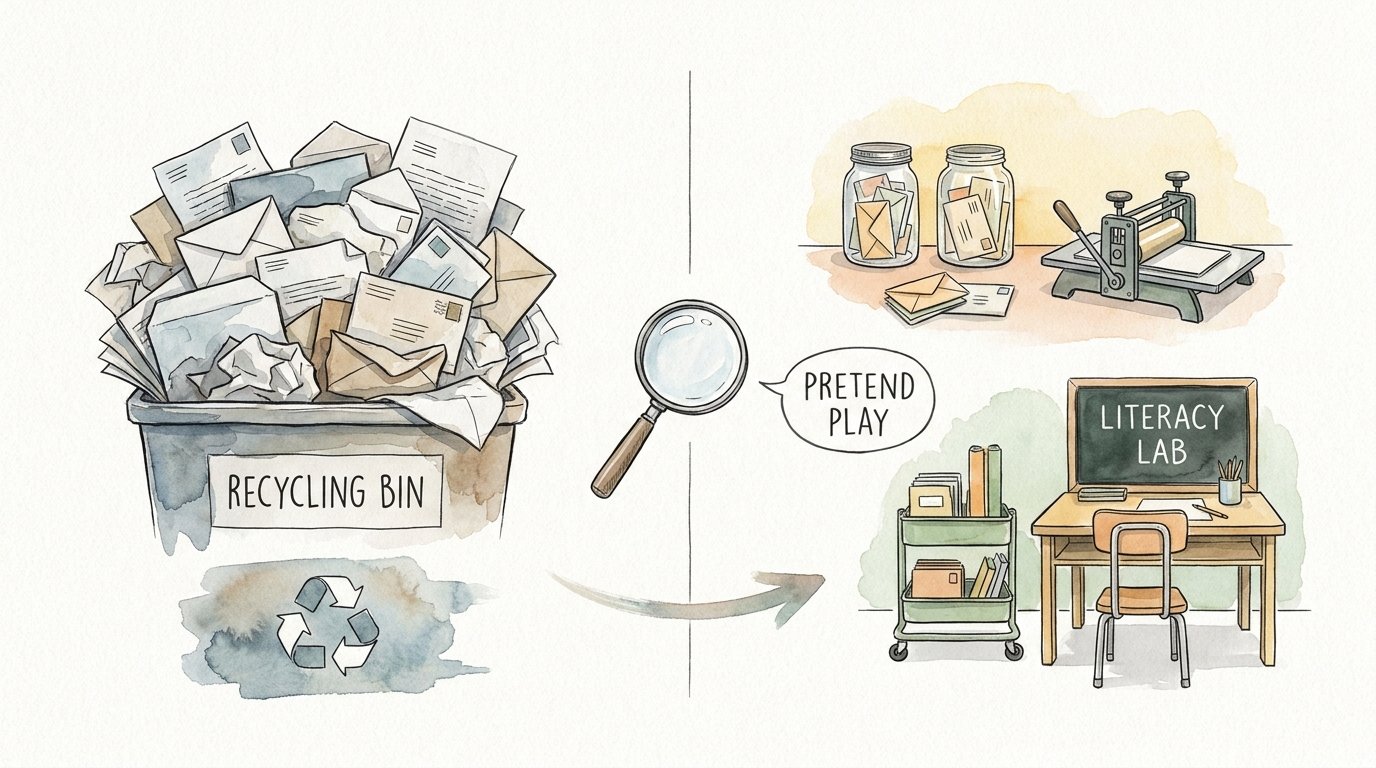
To understand the value of this transition, consider the differences between viewing mail as waste versus viewing it as a resource. The following table highlights the shift in developmental focus when you move from the “Recycling Bin” mindset to the “Literacy Lab” mindset.
| Factor | Recycling Bin Mindset | Literacy Lab Mindset |
|---|---|---|
| Child’s Role | Passive Observer | Active “Mail Carrier” / Writer |
| Skill Targeted | None (Waste Removal) | Visual discrimination, Fine Motor |
| Cognitive Task | Ignoring Clutter | Sorting, Categorizing, Reading Logos |
| Emotional Impact | “Don’t touch that!” | “Help me with this important job.” |
| Cost | $0 | $0 |
Practical Tips for Success
To get the most out of your “trash” curriculum, follow these best practices:
- Keep the “Good Stuff”: Prioritize grocery store circulars, toy catalogs (especially around holidays), and bright, colorful postcards. These have the highest density of recognizable symbols.
- Use a “Letter Opener”: If your child is old enough, a dull plastic letter opener can be a thrilling “adult” tool that builds significant hand-eye coordination.
- Create a “Word Wall”: If your child recognizes a logo (like Target or LEGO), cut it out and tape it to the wall at their eye level. This builds a “reading vocabulary” they can be proud of.
- Add Real Stamps: If you have old, non-denominated stamps or “service” stamps (like “Return to Sender”), add them to the mix. The “click” of a rubber stamp is incredibly satisfying and encourages repetitive play.
- Incorporate Math: Use the prices in grocery flyers. Ask the child to “buy” the apples and find the “number 2” next to the price. This merges literacy with early numeracy.
Advanced Considerations for Serious Play
For parents who want to take this further, you can introduce the concept of Critical Media Literacy. As children get older (5–7 years old), you can start asking questions like, “Why did this company send us this picture of a shiny toy?” or “How are they trying to make us feel?” This is the beginning of understanding advertising and persuasion.
You can also use junk mail to teach geography and systems. Look at the postmarks. “This letter came from a city called Des Moines! Let’s look at the map.” Explain the journey of a letter from a warehouse to a truck to your front door. This expands the play from simple “writing” into a broader understanding of how the world is interconnected.
If your child is starting to show interest in “real” letters, use the junk mail as a scavenger hunt. “Can you find three capital ‘A’s in this car magazine?” or “Find a word that starts with the same sound as your name.” This bridges the gap between logographic reading (logos) and alphabetic principle (letter-sound correspondence).
Examples and Scenarios
Scenario A: The Neighborhood Delivery Service. Your child puts on a backpack (their “mail bag”) and walks around the living room. You have taped envelopes with family members’ names on different “houses” (chairs). The child must look at the “address” (the name they recognize or the first letter) and deliver the right catalog to the right house. This practices name recognition and gross motor movement.
Scenario B: The Catalog Chef. Give your child a grocery circular and a paper plate. Ask them to “cook” a dinner by cutting out the foods they want to serve and gluing them to the plate. This requires them to “read” the pictures and labels to find specific ingredients, practicing categorization (fruits vs. vegetables) and fine motor skills (cutting and gluing).
Scenario C: The Check-Writer. Many credit card offers come with “fake” checks or forms. Let your child “sign” these documents. They are practicing the physical flow of writing without the pressure of being legible. This builds “writing stamina”—the ability to stay with a writing task for more than a few seconds.
Final Thoughts
The beauty of junk mail literacy is that it removes the “performance” aspect of learning. There are no grades, no red pens, and no “wrong” ways to play. By simply allowing your child to interact with the print that already exists in your home, you are validating their curiosity and showing them that the world is a place full of information waiting to be discovered.
Remember that the goal isn’t to have a three-year-old who can read the fine print on a loan application. The goal is to foster a child who is confident, curious, and comfortable around printed language. When they realize that they can “read” the world around them, their motivation to learn the “real” rules of reading skyrockets.
Next time the mail carrier drops a thick stack of advertisements through your door, don’t sigh. Smile. Your child’s favorite new “workbook” just arrived, and it didn’t cost you a dime. Set up the mailbox, grab the markers, and let the neighborhood post office open for business.
Sources
1 stayathomeeducator.com | 2 readychild.org | 3 especiallyeducation.com | 4 weebly.com | 5 notjustcute.com | 6 jessicawellinginteriors.com | 7 howweelearn.com | 8 buggyandbuddy.com | 9 thegeniusofplay.org