Visual Routine Vs Verbal Reminders For Toddlers
Are you working harder than the piece of wood on your wall? Every time you repeat ‘Put on your shoes,’ you are training your child to ignore the first three times you say it. Strategic parenting isn’t about louder volume; it’s about better anchors. Moving the instruction from your mouth to a visual board removes the power struggle and hands the autonomy back to the child.
Parents often find themselves trapped in a loop of verbal nagging. This cycle creates a high-stress environment where the parent feels like a broken record and the child feels constantly managed. Transitioning to a system-led home changes the dynamic. You stop being the “bad guy” and start being the coach.
Visual systems are not just for children with specific needs. They are fundamental tools for any young brain navigating the complex world of adult expectations. This guide explores how to stop talking and start showing. You will learn to build a home environment that runs on systems rather than your own emotional energy.
Visual Routine Vs Verbal Reminders For Toddlers
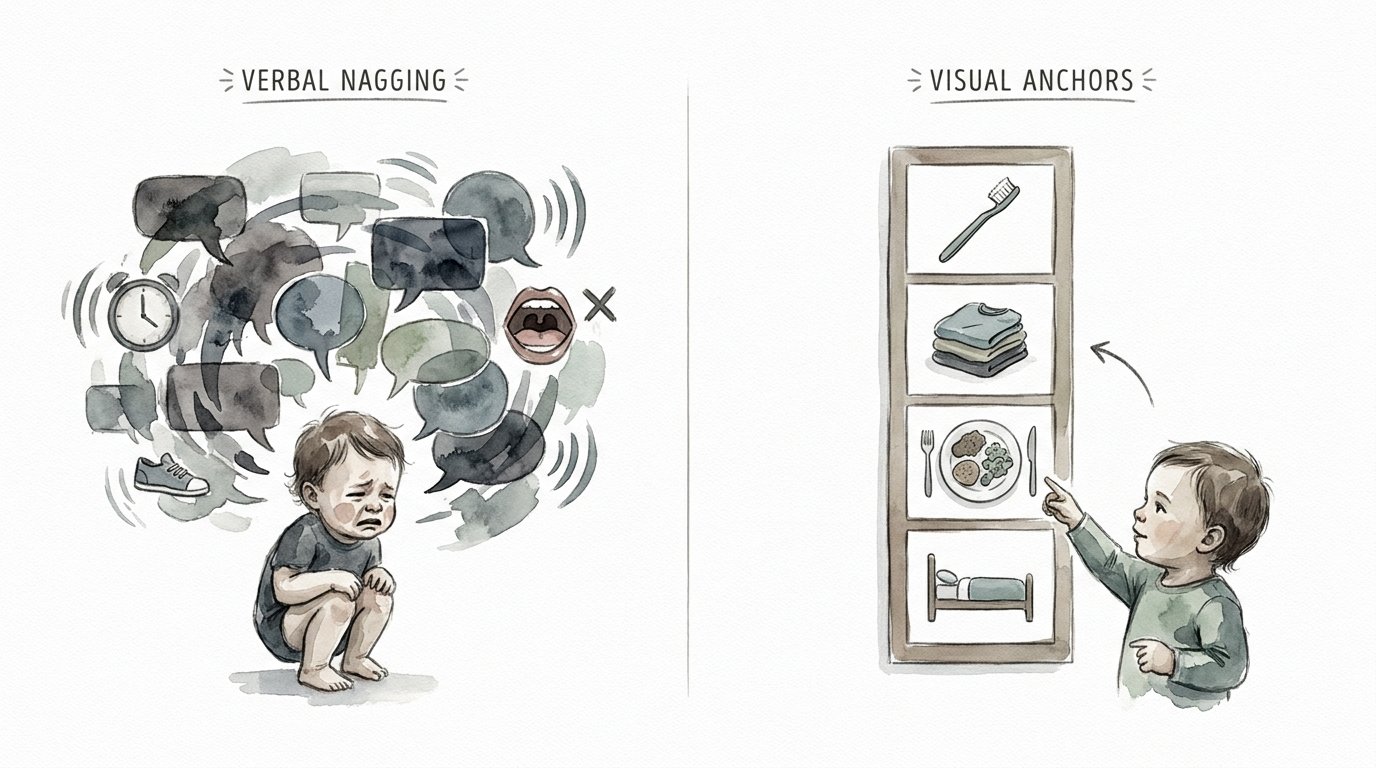
Verbal reminders are invisible, fleeting, and abstract. When you give a verbal command, the child must hear it, process the language, hold it in their working memory, and execute the task. This requires heavy lifting from the prefrontal cortex, which is still under construction in toddlers. If a bird flies past the window or a sibling makes a noise, that verbal instruction often vanishes instantly.
Visual routines are concrete, permanent, and static. They act as “anchors” in the physical environment. A picture of a child brushing their teeth does not disappear once you look at it. It remains there, providing a constant reference point. This reduces the cognitive load on the child. They do not have to “remember” what you said because the information is physically present.
Real-world situations often highlight this contrast during high-stress windows. Consider the morning rush. A parent using verbal reminders might say, “Get your socks, eat your eggs, and find your backpack.” The toddler, overwhelmed by the three-step sequence, usually does none of those things. A parent using a visual routine points to the board. The child sees the icon for socks. The instruction is clear, constant, and non-negotiable.
Shift the authority from your voice to the system. When a child argues with a parent, it is a power struggle. When a child looks at a visual schedule, there is no one to argue with. The board says it is time for pajamas. The board is neutral. This neutrality is the secret to reducing meltdowns and increasing cooperation.
How It Works: The Mechanics of Visual Anchors
Human brains process visual information 60,000 times faster than text or spoken language. This is particularly true for toddlers who are still mastering verbal fluency. A visual anchor provides an immediate “mental map” of the task ahead. It creates a bridge between the abstract concept of “getting ready” and the physical actions required.
Implementation follows a specific sequence of “Look, Do, Check.” The child looks at the visual cue. They perform the specific action associated with that cue. They then “check” the task off by moving a card or placing a sticker. This physical interaction provides a hit of dopamine, reinforcing the behavior.
First-Then boards are the simplest entry point for this system. This technique uses two icons. The “First” icon shows a non-preferred task, like putting on shoes. The “Then” icon shows a preferred outcome, like going to the park. This structure teaches the child the concept of delayed gratification in a visual format they can actually see.
Successful systems rely on “borrowed executive function.” You are essentially externalizing the part of the brain responsible for planning and organization. Instead of the child trying to use their undeveloped internal “air traffic control,” they use the visual board as a physical guide. This builds the neural pathways for independence before the child is biologically capable of doing it all in their head.
The Benefits of System-Led Parenting
Independence is the primary reward of this approach. Children who follow a visual schedule begin to view themselves as capable agents. They no longer wait for an adult to tell them every single move. This sense of agency is a critical building block for self-esteem and confidence.
Stress reduction is the immediate benefit for the parent. You stop being the person who “ruins the fun” by ending playtime. The timer or the schedule ends the playtime. This preserves your relationship with your child. You become the partner who helps them follow the plan, rather than the antagonist who imposes it.
Executive function skills receive a massive boost through consistent use of visual aids. These tools specifically support working memory, cognitive flexibility, and inhibitory control. By interacting with a sequence of events, children learn to anticipate transitions. This predictability reduces the anxiety that often leads to tantrums.
Communication improves because the expectations are clear. There is no ambiguity in a photo of a coat. Verbal language can be nuanced, emotional, or confusing. Visuals are binary. Either the task is done, or it is not. This clarity creates a safer emotional environment for children who struggle with sensory processing or language delays.
Challenges and Common Mistakes
Complexity is the number one killer of visual routines. Parents often create elaborate charts with twenty different icons for a single morning. This leads to cognitive overload. A toddler sees a wall of pictures and feels defeated before they start. Keep it simple. Start with three main steps and grow from there.
Using the board as a punishment tool is another frequent error. “You didn’t do what the board said, so no dessert” turns a helpful tool into a weapon. The board should be a neutral guide, not a source of shame. Focus on the success of following the plan rather than the failure of missing a step.
Neglecting the “Teaching Phase” leads to total system failure. You cannot simply hang a piece of wood on the wall and expect the child to know what to do. You must model the system. Walk them through it. Point to the picture. Do the task together. Move the icon. Do this for at least a week before expecting them to use it independently.
Forgetting the “Fun Stuff” makes the schedule look like a list of demands. If every icon on the board is a chore, the child will eventually ignore it. Balance the routine with “wins.” Include icons for “Dance Party,” “Snack Time,” or “Story.” This ensures the child views the board as a roadmap to good things, not just a list of “have-tos.”
Limitations and Realistic Constraints
Environmental changes can disrupt the effectiveness of a visual system. If the family travels or moves to a new house, the physical anchors are gone. Parents must prepare portable versions of the routine for these transitions. A laminator and some Velcro make these systems mobile, but it requires extra effort.
Pathological Demand Avoidance (PDA) is a profile where children may perceive any instruction—even a visual one—as a threat to their autonomy. For these children, a standard visual schedule might actually increase anxiety. In these cases, the system must be highly collaborative or “choice-based” rather than a fixed sequence.
Skill deficits are often mistaken for performance deficits. A visual schedule tells a child *when* to do something, but it does not teach them *how* to do it. If a child doesn’t truly know how to put on their pants, a picture of pants won’t help. Ensure the child has mastered the physical skill before adding it to the independent schedule.
Parental consistency is the hardest limitation to overcome. The system only works if the parent refers to it every single time. If you go back to verbal nagging because you are in a hurry, the child learns that the board doesn’t actually matter. You must be more disciplined than the toddler to make the system stick.
Comparison: Verbal Nagging vs. Visual Anchors
| Factor | Verbal Nagging | Visual Anchors |
|---|---|---|
| Nature of Information | Fleeting and abstract | Permanent and concrete |
| Emotional Tone | Often high-stress or annoyed | Neutral and objective |
| Cognitive Load | High (requires processing/memory) | Low (immediate recognition) |
| Power Dynamic | Parent vs. Child (Authority) | System as Guide (Autonomy) |
| Effectiveness Over Time | Decreases (child tunes out) | Increases (becomes a habit) |
Practical Tips for Immediate Implementation
Use real photos of your child doing the tasks. Seeing their own face brushing their teeth or putting on shoes is much more powerful than a generic clip-art icon. It creates a “social story” where they are the hero of the routine. This increases engagement and helps the child visualize the successful completion of the task.
Place the routine at the child’s eye level in the exact location where the tasks happen. The “Get Dressed” routine belongs in the bedroom. The “Hand Washing” routine belongs in the bathroom. Putting everything in one central kitchen location forces the child to travel back and forth, which increases the chance of distraction.
Incorporate physical interaction. Velcro is the gold standard for a reason. The “crunch” of pulling off a card and moving it to an “All Done” pocket provides sensory feedback. This physical act of closing a loop is highly satisfying for a toddler brain. It transforms a chore into a game of completion.
Keep your language minimal while using the board. Instead of a long explanation, point to the board and say one word: “Schedule.” This forces the child to do the mental work of looking and interpreting. It breaks your habit of verbal nagging and trains them to look to the system for answers.
Advanced Considerations for Long-Term Success
Fading prompts is the ultimate goal for serious practitioners. Initially, you might point to every picture and walk the child through the steps. Over time, you should stand further away. Eventually, the goal is for the child to enter the room, look at the board, and begin the routine without you saying a word.
Neurodivergent adaptations can make these systems even more robust. For children with ADHD, using a “Visual Timer” alongside the routine helps them perceive the passage of time. For autistic children, ensuring icons are highly specific and unchanging provides the predictability they need to feel safe.
Transitioning to written lists happens naturally as the child develops literacy. You can start by pairing the icon with the word. Eventually, you can remove the icon entirely. This scales the system with the child’s development, moving from a toddler “picture board” to a grown-up “to-do list.”
Dynamic schedules allow for “Life Happens” moments. Keep a few “Surprise” or “Change” icons handy. When the usual routine is disrupted by a doctor’s appointment or a visitor, physically place the “Change” icon on the board. This teaches the child that while the plan can change, the *system* of communicating that change is still reliable.
Example Scenario: The Morning Transformation
Consider the “Underwear Standoff.” In a verbal-nagging household, the parent says “Get dressed” six times while the toddler plays with a toy truck. The parent eventually gets angry, the toddler cries, and the parent ends up dressing the child while everyone is miserable.
In a system-led household, the parent points to the morning board. The first icon is “Pajamas Off.” The second is “Clothes On.” The child sees the truck but also sees the board. The parent stays silent, merely pointing if the child stalls. The child moves the “Pajamas” card to the “Done” bin. They feel a sense of progress.
Once dressed, the child moves to the “Breakfast” icon. They know exactly what is coming next. The parent is in the kitchen preparing food, not in the bedroom arguing about socks. The morning flows because the “Piece of wood on the wall” is doing the heavy lifting of management.
By the time the family reaches the car, the child has successfully completed five tasks independently. They arrive at preschool feeling capable and regulated. The parent arrives at work with their emotional energy intact. This is the power of a visual anchor in action.
Final Thoughts
Visual routines are not a “fix” for a “broken” child; they are a bridge for a developing brain. They respect the child’s need for autonomy while providing the structure required for a functional home. Moving the management of the day from your vocal cords to a physical system is the single most effective way to lower the temperature in your household.
Start small with one specific window of time, like the thirty minutes before bed. Focus on the “Look, Do, Check” flow and be patient with the teaching phase. Your consistency is the fuel that makes this engine run. Once the child trusts the system, you will find yourself with a lot more silence—and a lot more cooperation.
Experiment with different formats until you find what clicks for your family. Whether it is a magnetic board, a Velcro strip, or a simple hand-drawn chart, the medium matters less than the message. The message is simple: you are capable, the plan is clear, and we are in this together. Encouraging this independence today builds the executive function skills they will use for the rest of their lives.
Sources
1 autismlittlelearners.com | 2 challengingbehavior.org | 3 childcareed.com | 4 youtube.com | 5 napacenter.org | 6 timetimer.com | 7 carolinatherapyconnection.com | 8 linksaba.com | 9 biermanautism.com | 10 hopekidsot.com.au | 11 gentlecaretherapy.com | 12 educatingjacob.com | 13 sunnysidechildrensclinic.com | 14 bethel.edu | 15 missouristate.edu | 16 nwckidsimpact.org | 17 mastermindbehavior.com | 18 aspect.org.au | 19 marieclaire.co.uk | 20 youtube.com