how to reduce screen time tips for kids
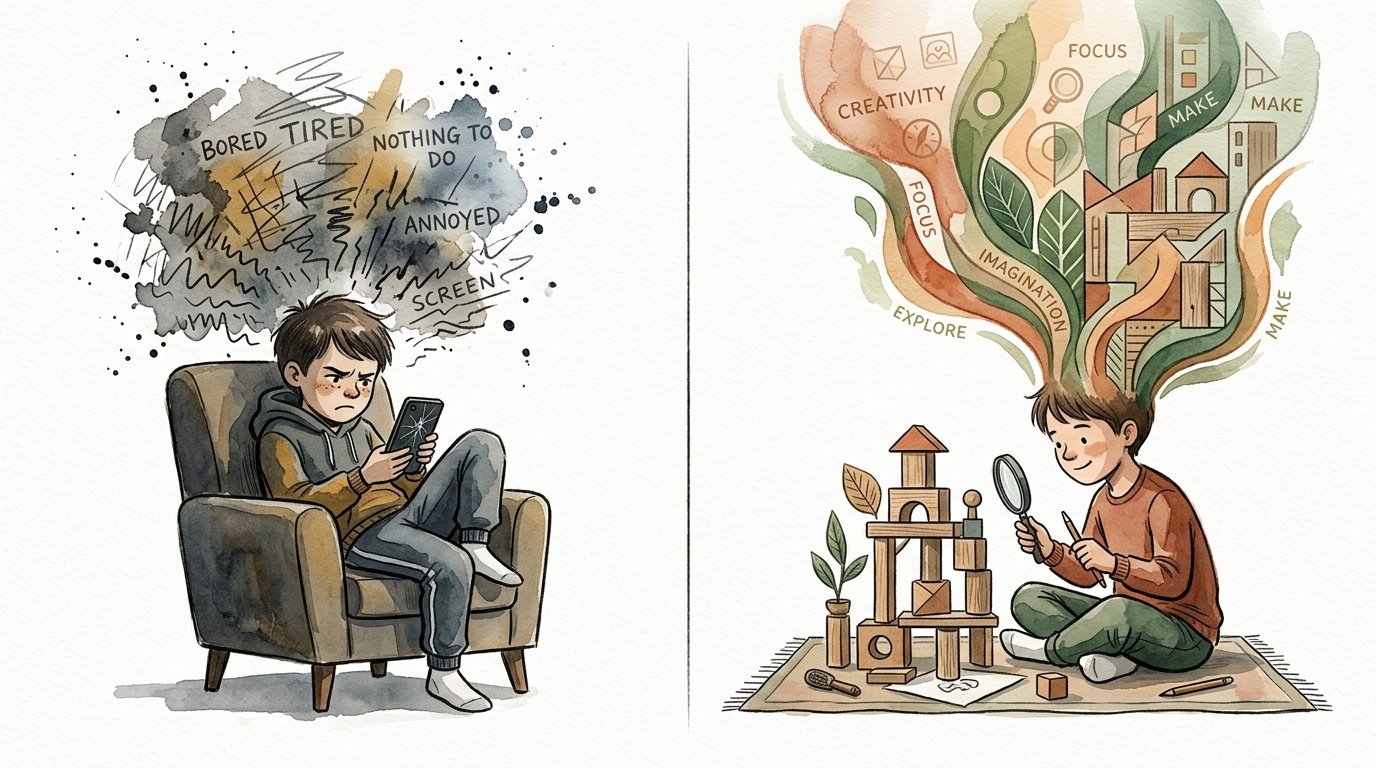
Boredom is the soil where creativity grows. Don’t pave it over with a screen. The next time your kid says they are bored, don’t reach for the iPad. That itch of boredom is exactly what they need to spark their next great idea.
Most parents feel an immediate internal panic when they hear those two words: “I’m bored.” It feels like a failure of parenting or a looming tantrum. We live in a world where the average eight-year-old spends over three hours a day on a device. By the time they hit their teens, that number often rockets to seven or nine hours.
This constant stream of stimulation is a relatively new experiment in human history. We are essentially “paving over” the quiet moments of childhood with high-definition glass. When every second is filled with a YouTube Short or a game level, the brain never has to work to find its own fun.
Understanding how to manage this digital tide isn’t about being a “tech-hater.” It is about reclaiming the developmental space your child needs to grow. In this guide, we will explore why boredom is a secret weapon and how you can systematically lower screen time without losing your mind.
how to reduce screen time tips for kids
Reducing screen time is the process of shifting a child’s environment from high-stimulation digital intake to low-stimulation, self-directed play. It is not just about taking a tablet away. It is about restructuring the home so that the “default” activity isn’t staring at a backlight.
In a world where 81% of kids under 13 now own their own device, the challenge is structural. Screens are used for school, socializing, and simple entertainment. Because of this, a simple “on/off” switch rarely works for long. We need a more nuanced approach that differentiates between active creativity and passive consumption.
Think of screen time like a digital diet. You wouldn’t feed your child only dessert. Similarly, you shouldn’t allow their brain to only consume “empty-calorie” content like endless scrolling or unboxing videos. Real-world situations, like waiting at a restaurant or a long car ride, are the primary “danger zones” where parents reach for the iPad as a survival tool.
Instead of seeing these moments as problems to solve, see them as opportunities for training. When you reduce screen time, you are essentially “un-paving” the brain. You are allowing the soil of boredom to become fertile again.
How to Reclaim the Boredom Space
The transition away from heavy screen use requires a step-by-step strategy. You cannot go from six hours a day to zero overnight without a massive emotional backlash. The brain has become accustomed to high dopamine spikes, and it needs a “cooling off” period.
Start by creating a family media agreement. This is a formal document, ideally printed and posted on the fridge, that outlines exactly when and where screens are allowed. When the rules are visible and consistent, you eliminate the constant “Can I have my tablet?” negotiations that drain parental energy.
Designate “Tech-Free Zones” in the home. The most critical areas are the dining table and the bedrooms. Research shows that keeping screens out of the bedroom is the single most effective way to improve a child’s sleep quality and mental health.
Use a “Screen Time Token” system for younger children. Give them physical coins or cards at the start of the week representing their total allotted time. Once they spend their tokens, the screens stay off. This teaches them to prioritize high-value games over mindless scrolling.
Model the behavior you want to see. Children are biologically wired to mimic their caregivers. If you are constantly checking your phone during dinner, they will view screens as the ultimate priority. Put your own phone in a “docking station” in another room during family hours to show that human connection comes first.
Benefits of the Digital Detox
The advantages of reducing screen time go far beyond just having a quieter house. When children are forced to sit with their own thoughts, their brains activate the Default Mode Network (DMN). This is the neurological system responsible for daydreaming, self-reflection, and creative problem-solving.
Lower screen time is directly linked to better physical health. Sedentary behavior is a leading contributor to childhood obesity. When the screen is off, kids move more. They climb, jump, and run, which builds motor skills and strengthens their cardiovascular systems.
Improved sleep is a massive “win” for the whole family. The blue light emitted by tablets suppresses melatonin, the hormone that tells the body it’s time to sleep. By cutting screens at least one hour before bed, you allow your child’s brain to enter a natural sleep cycle, leading to fewer meltdowns the next day.
Social skills flourish in the absence of devices. In-person play requires negotiation, empathy, and the ability to read non-verbal cues—all things that are stripped away in a digital environment. Real-world play teaches kids how to resolve conflict and build lasting friendships.
Challenges and Common Mistakes
The biggest pitfall most parents face is using screens as a “tantrum stopper.” When a child melts down in public and we hand them a phone to quiet them, we are accidentally rewarding the meltdown. This creates a cycle where the child learns that high-intensity negative behavior leads to high-intensity digital rewards.
Another common mistake is the “Cold Turkey” approach. Abruptly removing all technology without providing alternatives leads to intense frustration. You must have a “boredom kit” ready—mismatched art supplies, building blocks, or books—to give them a starting point for their creativity.
Failing to distinguish between “active” and “passive” screen time is also a hurdle. Not all screen time is equal. Coding a game or editing a video is a creative, cognitive task. Watching someone else play a video game on YouTube is passive consumption. Treat these differently in your rules.
Consistency is the hardest part. If you give in once because you are tired, the child knows the rules are negotiable. Stick to the agreement, even when it’s difficult. The short-term pain of a “boredom protest” is worth the long-term gain of a resilient, creative child.
Limitations of Universal Rules
Screen time rules are not a one-size-fits-all solution. For neurodivergent children, such as those with ADHD or Autism, screens often serve a different purpose. They can be a tool for sensory regulation or a safe space to practice social interactions without the overwhelming unpredictability of the real world.
For some kids, technology is a vital communication tool. Non-verbal children may use tablets for AAC (Augmented and Alternative Communication) apps. In these cases, the “screen” isn’t entertainment; it’s their voice. Restricting it would be detrimental to their development.
School requirements also create a practical boundary. Many modern curriculums require tablets or laptops for homework and research. You cannot simply ban screens if your child’s education depends on them. The goal should be to manage “recreational” screen time rather than academic use.
Geographic and social factors also play a role. If a child’s entire social circle interacts through a specific online game, removing it entirely could lead to social isolation. In these instances, the “quality and context” approach is more effective than a strict time limit.
Boredom: Nuisance vs. Asset
| Feature | Boredom as Nuisance | Boredom as Asset |
|---|---|---|
| Parental View | A problem to be fixed immediately. | An opportunity for growth. |
| Child’s Response | Whining and seeking external entertainment. | Daydreaming and self-initiated play. |
| Brain Activity | Passive seeking of dopamine spikes. | Activation of the Default Mode Network. |
| Long-term Outcome | Dependency on screens for emotional regulation. | Increased creativity and problem-solving skills. |
| Complexity | Low (just hand over a device). | High (requires patience and transition). |
Practical Tips for Immediate Application
Implement the “3-2-1 Rule” for a balanced day. This means no screens 3 hours before a big event (like a sport or family dinner), no screens 2 hours before school, and no screens 1 hour before bed. This creates “buffers” that allow the brain to transition between different states of focus.
Create a “Boredom Jar.” Write down thirty different activities on slips of paper—things like “build a fort,” “draw a dragon,” or “reorganize your books.” When your kid says they are bored, they pull a slip. They must do that activity for at least 15 minutes before they can ask for anything else.
Use physical timers. Digital parental controls are great, but a physical sand timer or a kitchen clock provides a visual representation of time passing. It helps children understand that screen time is a finite resource.
Take a “Digital Sabbath.” Pick one day a week—Sunday is a popular choice—where the entire family goes screen-free. No phones, no TVs, no laptops. Use this day for hiking, board games, or simply sitting in the backyard. It resets the family’s “boredom threshold” and reminds everyone how to connect without Wi-Fi.
Advanced Considerations for Tech-Savvy Parents
If your child is older, shift the conversation from “monitoring” to “mentoring.” Teach them about the “attention economy.” Explain how apps are designed by engineers to keep them scrolling as long as possible. When kids understand they are being manipulated by an algorithm, they often become more defensive of their own time.
Audit your home network. Use router-level controls like Circle or Gryphon to set hard “bedtimes” for the internet. This prevents the “sneaky tablet” issue where kids try to get online after hours. However, use these as a safety net, not a replacement for open conversation.
Encourage “Creative Tech.” If your child loves screens, steer them toward creation. Minecraft in “Creative Mode” is better than watching Minecraft videos. Learning to use Procreate for digital art or Scratch for coding transforms the device from a “window” they look through into a “tool” they use to build.
Focus on the “Why.” Ask your child how they feel after an hour of gaming versus an hour of playing outside. Help them notice the “post-screen grumpiness” that often follows a long session. Developing this self-awareness is the ultimate goal of screen management.
The Digital Sabbath Scenario
Imagine a typical Saturday morning. In Scenario A, the kids wake up and immediately grab their tablets. They sit in silence for three hours, bathed in blue light. When it’s time for lunch, they are irritable, they have “brain fog,” and they resist any attempt to go outside.
In Scenario B, the “Digital Sabbath” is in effect. The tablets are in a locked drawer. For the first thirty minutes, the kids whine. They mope around the living room. They say life is “unfair.” Then, something happens.
The youngest finds a stack of old magazines and starts cutting out pictures. The oldest starts building a massive bridge out of LEGOs to connect the coffee table to the couch. By noon, they have created a “news station” and are filming a “broadcast” using an old cardboard box as a camera.
Scenario B required more parental patience during the first hour of whining. However, the result was a morning filled with cognitive development, motor skill practice, and sibling bonding. The “soil” of boredom was allowed to grow a “forest” of imagination.
Final Thoughts
Reducing screen time is one of the greatest gifts you can give your child in the 21st century. It is not about depriving them of technology, but about protecting the space where their unique personality and creativity are formed. By setting clear boundaries and valuing “empty” time, you are teaching them that they are enough, even without a constant stream of external input.
Experiment with different strategies and see what fits your family’s rhythm. You might find that the “boredom protests” get shorter each week as your children rediscover the joy of their own imagination. Reclaiming those hours allows for more movement, better sleep, and deeper family connections.
The goal is to raise adults who control their devices, rather than being controlled by them. Start today by putting the iPad away and letting the boredom begin. You might be surprised by the brilliant ideas that start to grow.
Sources
1 safariltd.com | 2 childmind.org | 3 integratedcareclinic.com | 4 choc.org | 5 blankspaces.app | 6 monstermath.app | 7 marcus.org | 8 aap.org | 9 kidsmentalhealthfoundation.org | 10 buildingbrains.ca | 11 explodingtopics.com | 12 harvard.edu | 13 monarchassessment.com | 14 corticacare.com | 15 explainingbrains.com | 16 mayoclinic.org | 17 childrenandscreens.org | 18 learningrx.com | 19 childmind.org | 20 chadd.org | 21 linksaba.com | 22 encoresupport.org | 23 commonwealthpeds.com | 24 nih.gov | 25 aap.org