Nature Journaling For Kids Vs City Records
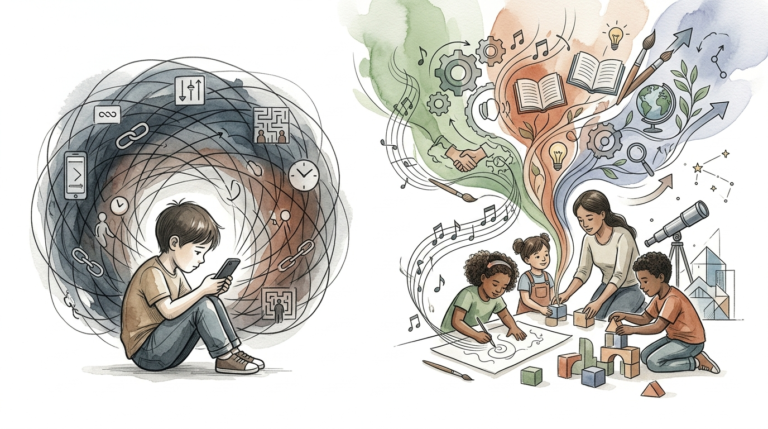
Is your child’s travel memory a digital blur or a hand-drawn discovery? We spend thousands on ‘destination’ vacations just to watch our kids scroll in a different city. Switch the screen for a field journal and watch their observation skills transform from passive to profound. One records pixels; the other records the pulse of the planet.
Nature Journaling For Kids Vs City Records
Nature journaling for kids is the practice of observing the natural world and recording those experiences through a mix of sketching, writing, and data collection. It is not just an art project. It is a scientific tool that transforms a child from a passive observer into an active explorer. While city records and digital logs focus on the “where” and “when” through quick snaps and GPS tags, nature journaling focuses on the “how” and “why.”
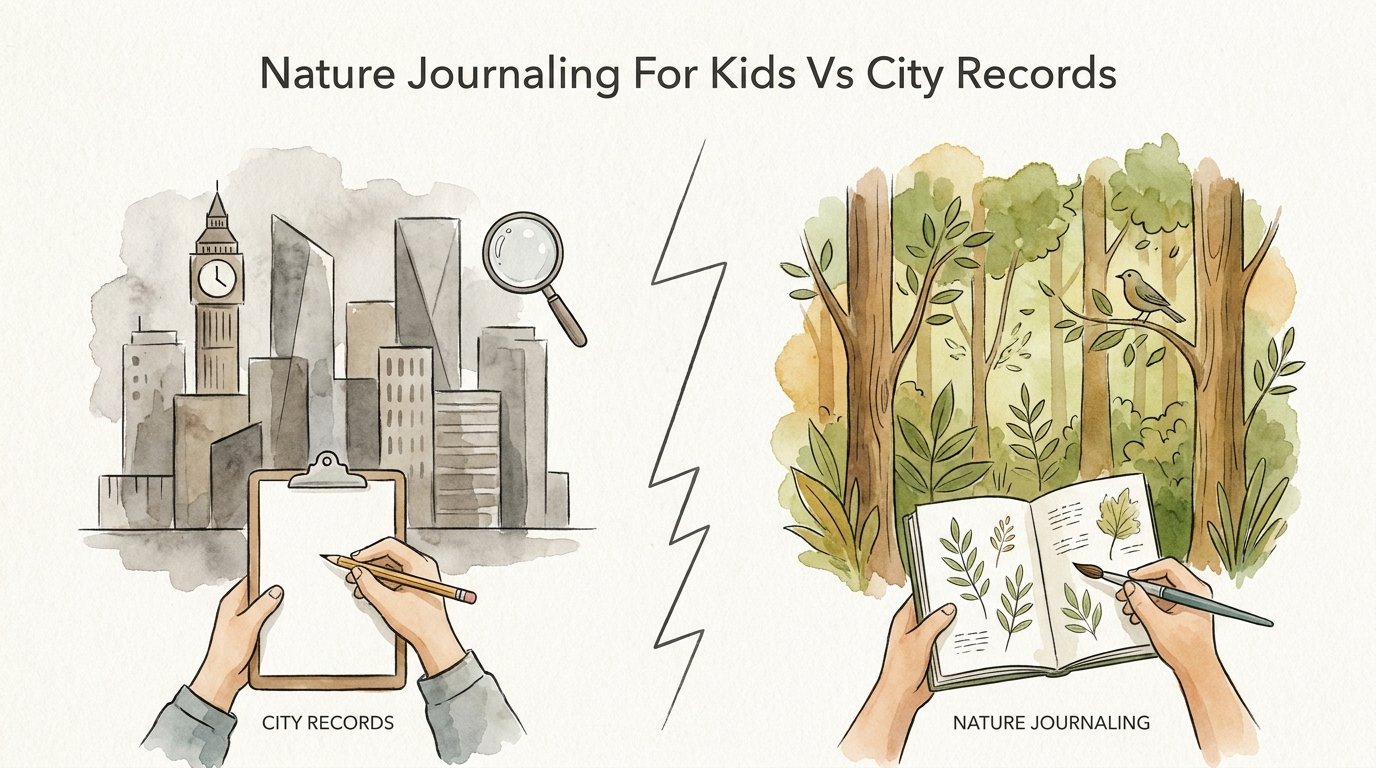
In the “Concrete Jungle” of our modern digital lives, children often record their world through pixels. They take a photo and move on. This is a “city record”—a fast, efficient, but often hollow way of logging presence. In contrast, the “Living Forest” approach of journaling requires a child to sit, breathe, and notice the way a leaf veins branch or how a beetle navigates a blade of grass.
This method is used by naturalists, scientists, and artists to document the specific details of a location. For a child, it creates a personal connection to their environment. It turns a standard walk in the park into a high-stakes investigation of local biodiversity. By using a journal, they aren’t just taking a picture of a bird; they are recording the pulse of that bird’s life.
Think of it like the difference between a tourist and a resident. A tourist takes a photo of the monument. A resident knows where the moss grows on the north side and which birds sing at dawn. Nature journaling helps your child become a resident of the planet, no matter where they are traveling.
How to Start Your First Field Journal
Starting a nature journal does not require a degree in biology or fine arts. It begins with the right mindset and a few basic tools. The goal is to move beyond the “digital blur” and into a space of intentional discovery. Follow these steps to set your young explorer up for success.
1. Assemble a Lightweight Field Kit
A heavy bag is the fastest way to end a journaling session. Keep the kit simple and portable. A blank sketchbook with thick paper (at least 120gsm) is ideal for handling both pencils and light watercolors. Include a few graphite pencils, an eraser, and a small set of colored pencils.
For more advanced explorers, add a magnifying glass or a small pair of binoculars. These tools allow kids to see the “invisible” world, like the texture of a moth’s wing or the pattern of a hawk’s flight. Store everything in a dedicated “adventure pouch” that stays by the door or in the car.
2. Master the Three Core Prompts
If a child stares at a blank page, they often freeze. Use the “I notice, I wonder, it reminds me of” framework popularized by naturalists like John Muir Laws. This structure guides their attention without forcing a specific result.
I notice: Encourage them to list physical facts. “I notice the stem is fuzzy.” “I notice the bird has a red patch on its wing.” This builds the foundation of scientific observation.
I wonder: This is where curiosity takes over. “I wonder why this plant grows in the shade.” “I wonder what this insect eats.” Every “wonder” is a potential research project for later.
It reminds me of: This connects new information to previous knowledge. “It reminds me of a tiny umbrella.” “It reminds me of the scales on a dragon.” This step builds neural pathways through analogy and metaphor.
3. Find a “Sit Spot”
A sit spot is a specific place in nature where a child goes regularly to observe. It could be a corner of the backyard, a bench at a local park, or a spot near a window. The key is consistency. By returning to the same spot, they notice changes in weather, seasons, and wildlife behavior that a “digital blur” traveler would miss.
The Scientific Benefits of Nature Journaling
Nature journaling offers measurable advantages for childhood development. It isn’t just about pretty pictures; it’s about brain architecture. Research shows that drawing an object requires more cognitive processing than simply taking a photograph or writing a description.
When a child sketches a flower, they engage in “encoding across modalities.” They are using visual, kinesthetic, and semantic processing centers in the brain simultaneously. This results in much higher recall rates. Studies have shown that students who draw scientific concepts can recall nearly double the information compared to those who only use text.
Beyond memory, this practice hones fine motor skills. The act of controlling a pencil to mimic the curve of a petal or the sharp angle of a twig builds hand-eye coordination. It also serves as a powerful antidote to “nature-deficit disorder,” reducing stress and anxiety by grounding the child in the present moment.
Journaling also builds “naturalist intelligence.” This is the ability to recognize patterns in nature and categorize information. This skill is foundational for careers in science, engineering, and data analysis. It teaches kids to look past the surface and understand the systems that keep our world running.
Common Challenges and How to Solve Them
The biggest hurdle in nature journaling isn’t a lack of nature; it’s the “perfectionism trap.” Many children, especially those over the age of eight, become self-conscious about their drawing skills. They compare their work to digital images and feel like they’ve failed.
Explain that the journal is a place for learning, not art. It is a scientific record. If a drawing doesn’t look like the object, they can use labels and words to clarify. “The bird was fatter than this drawing,” is a perfectly valid scientific note. Focus on the accuracy of the observation, not the beauty of the sketch.
Another common mistake is “over-parenting” the process. Parents often want to jump in and identify every plant or fix every drawing. This kills curiosity. Instead, be a co-explorer. Use phrases like, “I’m not sure what that is, let’s look at the shape of the leaves together.” Let the child lead the discovery.
Physical discomfort is the third major pitfall. If a child is cold, hungry, or being bitten by mosquitoes, they won’t want to journal. Always pack snacks, water, and sun protection. A comfortable explorer is a curious explorer.
Limitations: When This Method Faces Hurdles
While nature journaling is versatile, it does have realistic constraints. In extreme weather, like heavy rain or sub-zero temperatures, physical paper journals become difficult to manage. In these cases, it is better to take a “digital record” (a photo or voice note) and complete the journal entry back at home or in the car.
In highly urbanized environments, some parents feel there isn’t enough “nature” to journal. This is a misunderstanding of the concept. You can journal about the weeds growing in sidewalk cracks, the behavior of city pigeons, or the formation of clouds. However, the “Living Forest” experience is certainly easier to facilitate in biodiverse areas.
There is also a learning curve. Nature journaling requires more time and effort than digital logging. For families on a tight schedule, finding the 20-30 minutes required for a deep journaling session can be a challenge. It requires a conscious choice to prioritize “pulse” over “pixels.”
Digital Logs vs. Analog Field Journals
To understand the trade-offs between digital and analog recording, consider the following factors. While technology has its place, the analog journal offers depth that digital tools often lack.
| Feature | Digital City Records | Analog Field Journals |
|---|---|---|
| Speed | Instant (Seconds) | Slow (Minutes to Hours) |
| Memory Retention | Low (Passive) | High (Active Processing) |
| Sensory Engagement | Visual Only | Multi-sensory (Touch, Smell, Sound) |
| Cost | High (Device/Data) | Low (Paper/Pencil) |
| Portability | High | Moderate |
| Skill Level | Entry-level | Developmental |
The “Concrete Jungle” approach (Digital) is excellent for wide-scale logging and quick sharing. However, the “Living Forest” approach (Analog) is superior for education, mindfulness, and creating lasting family memories.
Practical Tips for Every Young Explorer
To keep the momentum going, vary the activities within the journal. Don’t just draw plants every time. Use these best practices to keep the experience fresh and engaging for different ages.
- Create a Sound Map: Have the child sit in the center of a page and mark an ‘X’. Ask them to close their eyes and listen. Every time they hear a sound (a bird, a car, the wind), they draw a symbol or write a word on the page in the direction it came from.
- Use Leaf Rubbings: For younger kids who struggle with shapes, place a leaf under the page and rub a crayon over it. This captures the “pulse” of the leaf’s structure instantly.
- Include Metadata: Teach them to record the date, time, location, and weather for every entry. This turns a simple drawing into a valuable piece of citizen science data.
- The “Secret Nature Mission”: Give them a specific goal. “Find three different shades of green” or “Find something that was made by an animal.”
- Tape in Specimens: If it is legal and ethical, tape a fallen leaf or a bit of dried mud into the journal. These tactile elements make the journal feel like a real treasure chest.
Advanced Considerations: Scaling Up the Experience
As children grow older, their journaling can become more sophisticated. Move from simple sketches to detailed species tracking and data visualization. Older kids can start using “counts and measurements.” For example, they can track the number of bees visiting a specific flower over a ten-minute period.
Encourage them to research their findings at home using field guides or apps like iNaturalist. This bridges the gap between the “Concrete Jungle” and the “Living Forest.” They can use the digital tool to identify the species they drew, then add the scientific name and interesting facts to their journal page.
Consider focusing on “phenology”—the study of cyclic and seasonal natural phenomena. A teenager might track the bud-burst of a specific tree over several weeks, creating a visual timeline of spring’s arrival. This type of long-term project builds discipline and a deep understanding of ecological systems.
Real-World Scenario: The Coastal Discovery
Imagine a family visiting a rocky beach. The younger child uses their digital camera to take fifty blurry photos of seagulls. They are excited in the moment, but by dinner, those photos are just pixels in a cloud storage folder. They haven’t really “seen” the beach.
The older child brings their field journal. They find a tide pool and sit for twenty minutes. They notice a small crab hiding under a rock. They sketch the crab’s shell, noting the jagged edges. They wonder why it stays so still. They record the temperature of the water and the smell of the salt air.
Ten years later, the digital photos are likely lost or forgotten. But the hand-drawn discovery in that journal remains. That child can look at their sketch and remember the exact feeling of the sun on their neck and the sound of the waves. They didn’t just visit the beach; they recorded its pulse.
Final Thoughts
Nature journaling for kids is more than a hobby; it is a way of life that rejects the “digital blur” of modern travel. By choosing the journal over the screen, you are giving your child the tools to process the world with depth and intention. You are moving them out of the “Concrete Jungle” and into the “Living Forest,” where every leaf and insect has a story to tell.
The transition from passive scrolling to active observation doesn’t happen overnight. It starts with a single blank page and a curious question. Whether you are in a bustling city park or a deep wilderness, there is always something waiting to be discovered. Grab a pencil, find a sit spot, and start recording the pulse of the planet today.
This practice builds a foundation for scientific thinking, artistic expression, and emotional well-being. It is an investment in your child’s brain and their bond with the earth. Don’t let their childhood be a collection of pixels—make it a hand-drawn discovery that lasts a lifetime.
Sources
1 ed.gov | 2 littlemonstersuniverse.com | 3 nih.gov | 4 edutopia.org | 5 runwildmychild.com | 6 glaquarium.org | 7 marleypeifer.com | 8 psu.edu | 9 simplycharlottemason.com | 10 naturejournalingweek.com | 11 morecurricular.co.uk | 12 plt.org | 13 arisehomeeducation.com | 14 journalingwithnature.com | 15 chadd.org | 16 littlemonstersuniverse.com | 17 sproutingwildones.com | 18 wanderingleavesstudio.com | 19 nabt.org | 20 thefoster.org | 21 lilyandthistle.com | 22 thimbleandtwig.com | 23 thezoofamily.com | 24 berkeley.edu