Mimicry In Child Development Vs Screen Time
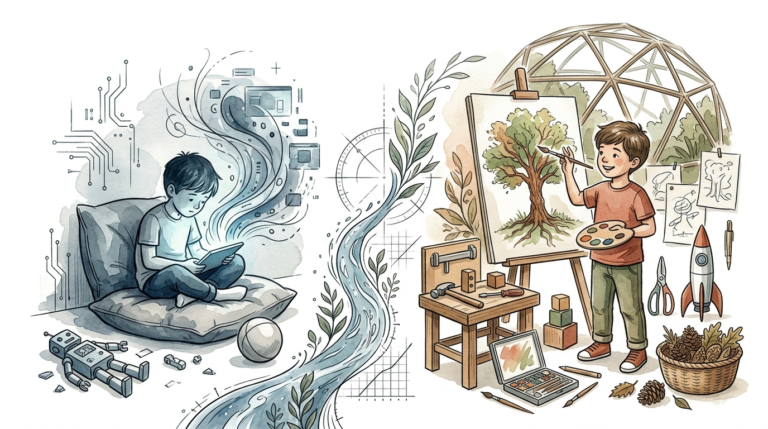
For thousands of years kids learned through mimicry; now they learn through pixels. Which one builds a life skill? We give children apps to ‘play house’ while we do the actual housework alone. Our ancestors knew that ‘dramatic play’ wasn’t a separate activity—it was an apprenticeship. Hand them a real rag, a real broom, or a real bowl, and let them join the world.

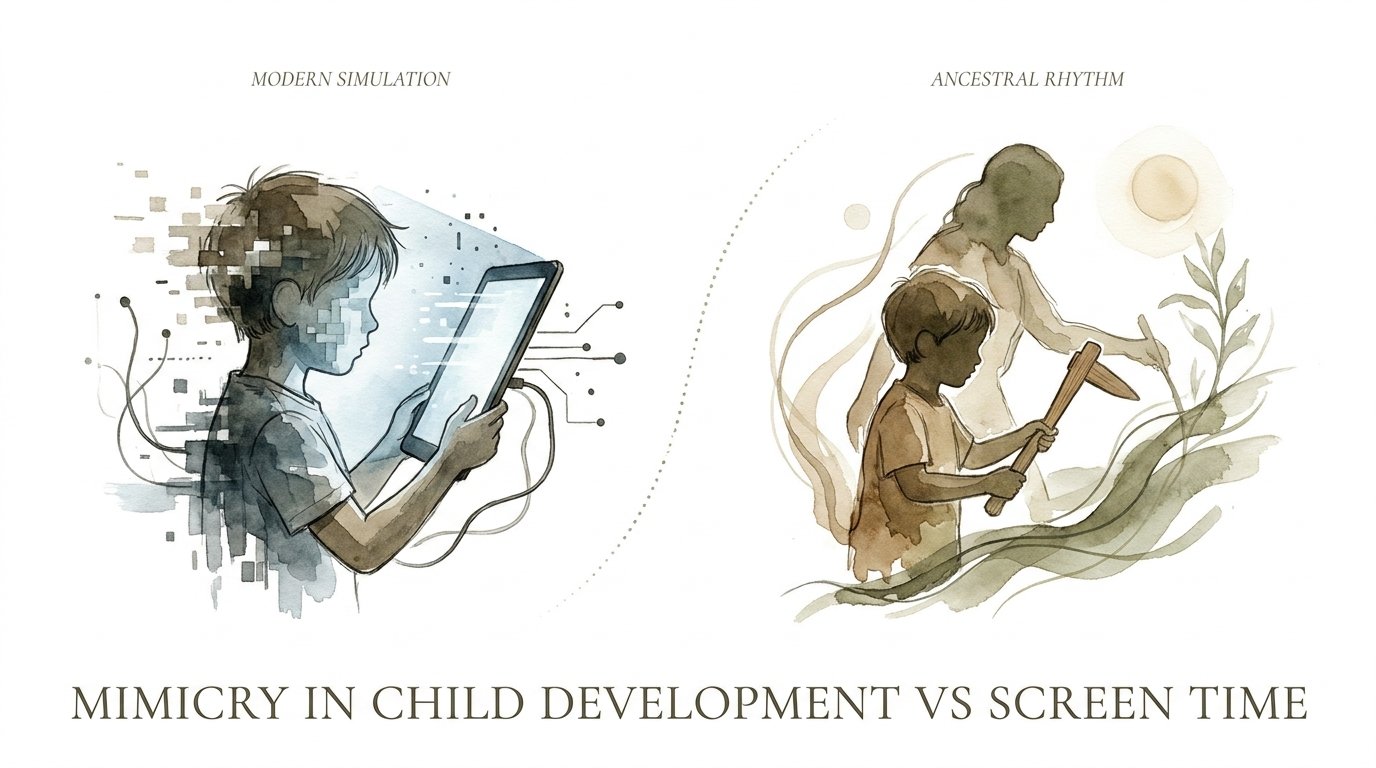
Parenting in the digital age feels like a constant battle between convenience and connection. We see the allure of the glowing screen—the “digital babysitter” that offers five minutes of peace. Yet, deep down, we know that a high-definition simulation of a kitchen can never replace the tactile resistance of real dough or the satisfying splash of soapy water. This shift from physical participation to digital observation represents a fundamental change in human development. It is the move from ancestral rhythm—where life and learning were one—to modern simulation, where learning is an isolated, pixelated event.
Understanding this transition is not about shaming modern parents. It is about reclaiming a powerful, natural tool that is already in your home. Mimicry is the “secret sauce” of human evolution. It is how we conquered fire, built civilizations, and passed down the wisdom of generations. When we bring our children back into the flow of our daily lives, we aren’t just getting the chores done. We are building the foundations of their brain, their empathy, and their independence. This guide will walk you through why mimicry matters and how you can swap the screen for a broom today.
Mimicry In Child Development Vs Screen Time
Mimicry is the primary way human beings make sense of their environment. In child development, it is often called “social learning” or “observational learning.” From the moment a baby mirrors your smile, they are using a specialized system of brain cells known as mirror neurons to understand your intent. These neurons fire both when the child performs an action and when they watch you perform it. This creates a biological bridge between “you” and “them,” allowing them to “try on” your behaviors and emotions before they can even speak.
In the real world, mimicry happens during “dramatic play” or participation in household tasks. A toddler watches their father sweep the floor and immediately wants to grasp the handle. They aren’t just moving dirt; they are learning the rhythm of the household. They are understanding that they are part of a team. They are practicing joint attention, which is a critical precursor to advanced language and social skills. This is the ancestral rhythm: the child is an apprentice to the adult, gradually gaining mastery through constant, low-stakes observation and repetition.
Now, contrast this with screen time. When a child “plays house” on a tablet, the feedback loop is fundamentally different. There is no physical resistance, no weight to the objects, and no shared social energy. Research indicates that while mirror neurons still activate during screen use, the activation is significantly weaker than in real-life interactions. There is no eye contact, no nuanced facial feedback, and no “serve and return” dialogue. A child might learn to swipe a finger to “clean” a digital plate, but they miss the sensory-rich experience of temperature, texture, and the social pride of contributing to the family unit.
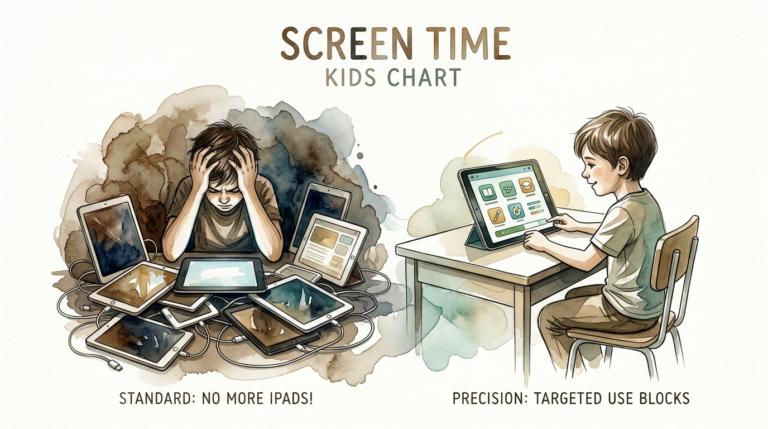
The danger of excessive screen time lies in its ability to displace these rich, mimetic experiences. Every hour spent in front of a screen is an hour not spent observing the complex, subtle behaviors of humans in the physical world. This leads to what many experts call “simulation fatigue”—where the child becomes an expert in digital interfaces but remains a novice in the basic mechanics of life and social connection. By choosing mimicry over pixels, we ensure that the “programming” our children receive is human-centric and deeply rooted in reality.
How the “Watch, Do, Master” Cycle Works
Transitioning from a screen-heavy environment to a mimicry-based one requires a shift in how we view our daily tasks. We shouldn’t see chores as “work” and play as “leisure.” Instead, we should see them as two sides of the same coin. The “Watch, Do, Master” cycle is the framework for this natural apprenticeship.
Step 1: The “Watch” Phase (The Silent Lesson)
Children are always watching, even when you think they are distracted. In this phase, you simply perform your tasks with a bit more intention. Slow down your movements. If you are folding laundry, do it where the child can see you. You don’t need to give a lecture; the visual input is the lecture. This is where those mirror neurons are working overtime, mapping out the motor sequences required for the task. Your child is building a mental blueprint of “how to be a human in this house.”
Step 2: The “Do” Phase (The Messy Middle)
This is where most parents give up because the “help” from a toddler actually makes the task take three times longer. However, this is the most critical developmental stage. Hand them a real tool—a small, child-sized broom or a damp rag. Let them “scrub” the baseboards while you mop the floor. At this stage, the goal isn’t a clean house; the goal is participation. They are testing the mental blueprint they built in the “Watch” phase. They are feeling the weight of the tool and the friction of the cloth.
Step 3: The “Master” Phase (The Functional Contributor)
Over time, the child’s mimicry turns into actual skill. They no longer need to watch your every move. They understand the “why” behind the task—that we wash dishes so we have clean plates for dinner. This creates a sense of self-efficacy. They realize they have the power to change their environment for the better. This transition from “playing house” to “maintaining a home” is a massive milestone in social-emotional growth that a screen simply cannot provide.
Benefits of Real-World Mimicry
The advantages of choosing mimicry over digital simulation go far beyond just learning how to sweep or fold a shirt. It impacts the very architecture of the developing brain and the child’s future character.
One of the most immediate benefits is the development of practical life skills. A child who has spent years mimicking kitchen tasks will, by age eight or nine, be capable of preparing simple meals and managing their own space. This independence reduces anxiety because the world feels navigable and predictable. They aren’t waiting for an app to tell them what to do; they have the physical memory of doing it themselves.
Furthermore, mimicry fosters deep empathy and social bonding. Because mirror neurons are also involved in processing emotions, a child who mimics your gestures and actions also begins to “feel” your intent. When you work together to clean up a spill, you are co-regulating. You are showing them that mistakes can be fixed with effort and that family members support one another. This “serve and return” interaction is the gold standard for healthy attachment.
Finally, real-world mimicry promotes executive functioning and problem-solving. Screens are often “perfect”—buttons work every time, and the physics are simplified. Real life is glitchy. A rag gets too wet, a broom handle is too long, or a sock won’t fold quite right. Dealing with these minor frustrations in a safe, mimetic environment builds resilience. It teaches the child to adjust their approach, seek help, and try again—skills that are infinitely more valuable than high-speed swiping.
Challenges and Common Mistakes
The biggest challenge in embracing mimicry is our own obsession with efficiency. Modern life is fast. We have schedules, deadlines, and a “clean enough” standard that usually requires us to do everything ourselves while the kids are out of the way. When we try to involve a child, we often get frustrated by the mess or the slow pace. This frustration is felt by the child, who then associates “helping” with “doing it wrong” or “annoying Mom and Dad.”
Another common mistake is providing fake versions of real tools. While toy kitchens have their place in imaginative play, they often lack the functional feedback of real objects. A plastic knife that doesn’t actually cut a banana doesn’t teach the child about pressure or safety. A toy broom that doesn’t pick up dust doesn’t provide the satisfaction of a job well done. When possible, use real (but safe) tools. A small metal whisk or a real spray bottle filled with water provides a level of engagement that plastic toys cannot match.
We also tend to over-correct. If your toddler “wipes” the table and leaves streaks, your instinct is to grab the rag and fix it immediately. This tells the child that their contribution wasn’t good enough. Instead, praise the effort and the “work.” You can come back later and do a “deep clean” when they are asleep. The goal is to keep the spark of mimicry alive so that it eventually blossoms into genuine skill. If you kill the curiosity now, you’ll be begging them to help when they are teenagers, and by then, the “apprenticeship window” may have closed.
Limitations: When Mimicry Isn’t Enough
While mimicry is a powerful tool, it does have its constraints. It requires presence. In a world where many parents work long hours or have multiple jobs, the “ancestral rhythm” of constant side-by-side participation is difficult to maintain. We shouldn’t expect ourselves to be “on” 24/7. There are times when a child needs independent play, and yes, there are times when a well-chosen educational show is a necessary tool for parental sanity.
Environmental limitations also play a role. If you live in a small apartment, there may not be room for a child to “apprentice” in every task. Safety is another factor; you can’t have a three-year-old mimicking you as you use a circular saw or work with boiling oil. In these cases, we must find bridge activities. If you are doing something dangerous, give the child a related, safe task nearby—like sorting the “wood scraps” (blocks) or “prepping the ingredients” (playing with water in the sink).
It is also important to recognize that not all mimicry is positive. Children are sponges for our stress, our tone of voice, and our own screen habits. If they see us constantly distracted by our phones, they will mimic that “still face” and “disconnected presence.” The power of mimicry means that we are always on stage. This can be exhausting and is a significant psychological trade-off for parents who value their own digital “unplugged” time.
Modern Simulation vs. Ancestral Rhythm
To help visualize the difference, let’s compare how a child learns a basic life skill—preparing food—through these two different lenses.
| Feature | Modern Simulation (Apps/Games) | Ancestral Rhythm (Real Mimicry) |
|---|---|---|
| Sensory Input | Visual and auditory only. Flat surfaces. | Tactile, olfactory, gustatory, and visual. 3D depth. |
| Social Feedback | Pre-programmed sounds (bells/whistles). | Real-time human reaction and shared purpose. |
| Fine Motor Skills | Gross swiping or tapping movements. | Pincer grasp, wrist rotation, and pressure control. |
| Consequences | “Game over” or restart. No real loss. | Spilled water, sticky hands, or a tasty snack. |
| Brain Activity | Weak mirror neuron activation; high dopamine loops. | High mirror neuron activation; healthy oxytocin. |
Practical Tips for Immediate Application
You don’t need to overhaul your entire life to start leveraging the power of mimicry. Start small and focus on the “low-hanging fruit” of daily chores. These simple adjustments can turn your home into a classroom without adding a single “lesson” to your schedule.
- The “Shadow” Bucket: Keep a small bucket with a few safe, real tools—a microfiber cloth, a small spray bottle with water, and a handheld brush. When you start cleaning, hand the child the bucket.
- Kitchen Participation: Give them a dull butter knife and a banana. Let them “slice” while you chop the onions. The motor movements are similar, and they feel like they are “cooking” the meal with you.
- Laundry Sorting: Instead of doing laundry in the laundry room, bring the basket to the living room floor. Let them “mimic” the folding. Even if they just make a mess of the piles, they are learning the categories of clothing and the concept of “putting away.”
- Narrate Your Actions: Use simple, descriptive language. “I am sweeping the crumbs into the pile. Now I use the dustpan.” This connects the visual mimicry to language acquisition.
- The 10-Minute Limit: If you are in a rush, don’t force the participation. Set a timer for 10 minutes of “joint work,” and then transition the child to independent play while you finish the task at speed.
The key is consistency over perfection. If you make it a habit to invite them into your world for even 15 minutes a day, you are reinforcing the idea that they are a capable, contributing member of the family. This is the antidote to the “passive consumer” mindset that screens often encourage.
Advanced Considerations: The Neurobiology of Imitation
For those who want to dive deeper, it is worth looking at how mimicry affects the prefrontal cortex. This part of the brain is responsible for “executive functions” like planning, focus, and impulse control. When a child mimics a multi-step process—like setting the table—they are practicing sequencing. They have to remember that the placemat goes first, then the plate, then the fork. This mental “stacking” of tasks is a high-level cognitive exercise that prepares them for school and complex problem-solving later in life.
There is also the concept of biological synchrony. When a parent and child perform a task together, their heart rates and brain waves often synchronize. This physiological alignment lowers the child’s cortisol levels (stress) and increases their receptivity to learning. Screens, by contrast, often lead to “arousal-jag”—a state of high stimulation and low physical movement that can lead to meltdowns when the device is taken away. Mimicry is inherently “grounding” because it engages the body and the mind simultaneously.
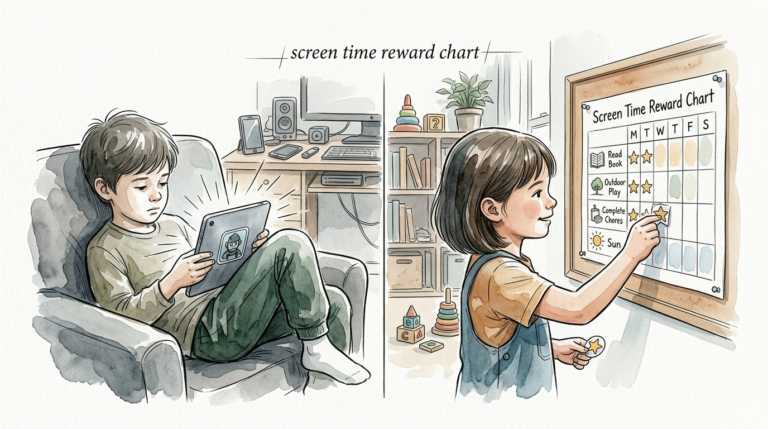
Finally, consider the long-term impact on intrinsic motivation. In digital games, kids are motivated by “external” rewards—stars, points, or leveling up. In mimetic learning, the reward is the outcome itself. The table is clean, the dog is fed, or the cake is in the oven. This builds a brain that looks for satisfaction in the work, rather than a dopamine hit from a notification. This shift is essential for building a “worker” mindset in an age of “viewer” passivity.
Examples and Scenarios
Let’s look at a realistic scenario: Morning Coffee and Breakfast.
The Screen Way: You are tired. You hand the child a tablet with a “cooking game” while you scramble to make eggs and pour coffee. The child is quiet but isolated. You are productive but stressed. When the tablet is taken away for breakfast, the child has a meltdown because they were in the middle of a digital “level.”
The Mimicry Way: You give the child a plastic cup and a spoon. While you stir the coffee, they “stir” their water. While you crack the eggs, you let them “whisk” a bowl of water with a real whisk. It’s slightly messy, but the child is engaged with you. They are watching your face, mimicking your “concentrating” expression, and feeling the splash of the water. By the time breakfast is ready, they are already “in the rhythm” of the morning. There is no transition shock because they were never “gone” into a digital world.
Another example: The Garden or Yard. Instead of giving a child a “toy lawnmower” that just makes noise, give them a small hand-trowel. While you weed the garden, let them “dig a hole for the worms.” They are mimicking your posture and your focus. They are learning about the earth and the seasons. This is environmental education in its purest form, passed down through the simple act of “doing together.”
Final Thoughts
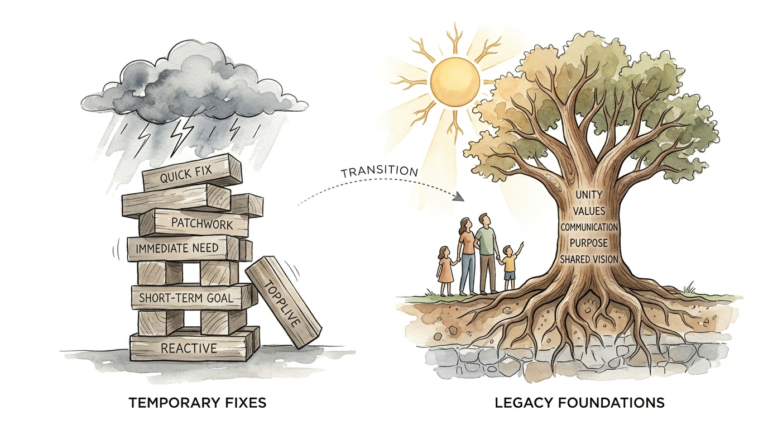
Choosing mimicry over screen time is a long-term investment in your child’s humanity. It is about more than just chores; it is about identity. When a child mimics your work, they are saying, “I want to be like you. I want to be part of this world.” This is the highest form of flattery and the most effective form of education. It builds a bridge between generations that a fiber-optic cable can never replicate.
We live in a world that tries to outsource everything to an app. But some things—like the warmth of a shared task or the pride of a real-life skill—cannot be digitized. Start today by looking at your child not as someone to “entertain” while you do the work, but as a young apprentice waiting for their first real tool. The mess will be bigger, the pace will be slower, but the child will be whole.
If you found this helpful, consider exploring related concepts like Montessori practical life skills or Waldorf-inspired play. These systems have long championed the idea that the “work” of the adult is the “play” of the child. By bridging that gap, we create a home that is not just a place to live, but a place to grow.
Sources
1 getkidsinternetsafe.com | 2 neuronest.ie | 3 medium.com | 4 toddlersense.com | 5 bellalunatoys.com | 6 babywisemom.com | 7 mittsure.com | 8 bunnyhopkinstoys.com | 9 nesca-newton.com