Permaculture For Kids Activities
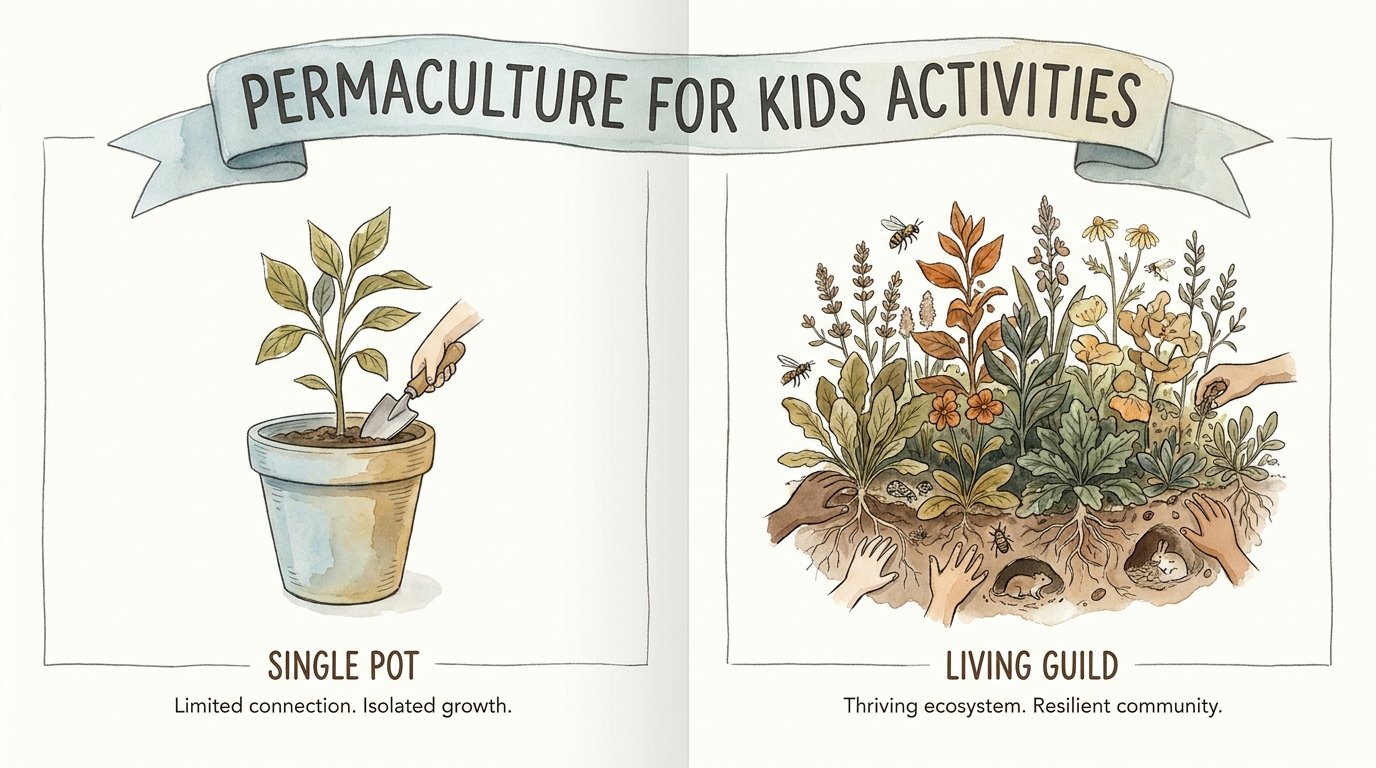
One plant is a prisoner; a garden guild is a thriving community. Growing a single plant in a pot is a science project; growing a guild is an education in citizenship. When children see how plants support, protect, and feed one another, they learn the power of systems thinking. It’s the difference between memorizing a plant’s name and understanding its role in the universe.

Most gardening for kids focuses on the “what.” We teach them what a seed looks like. We show them what a tomato tastes like. But permaculture moves the focus to the “how.” It teaches how a bean plant shares nitrogen with a thirsty corn stalk. It demonstrates how a flower invites a ladybug to a feast of aphids.
This isn’t just about growing food. It’s about growing humans who understand connection. You are about to turn your backyard or classroom into a living laboratory. Step-by-step, we will build systems that take care of themselves.
Permaculture For Kids Activities
Permaculture is a design system that mimics nature. It stands for “permanent agriculture.” In the real world, forests don’t need gardeners to spray fertilizer or pull every weed. They have systems. Permaculture for kids activities bring these systems to life through hands-on play.
One of the best ways to start is through “Site Observation.” Ask children to find a “Sit Spot.” This is a place where they sit quietly for ten minutes. They look for patterns. Where does the sun hit? Where does the water puddle after rain? This activity builds “Pattern Literacy.”
Another favorite is the “Bug Hotel” project. Kids gather sticks, hollow reeds, and pinecones. They stack them into a wooden frame. This creates a home for solitary bees and spiders. It teaches children that every “creepy crawly” has a job. Spiders are the security guards. Bees are the delivery drivers for pollen.
You can also try “Seed Balls.” Mix clay, compost, and native seeds. Roll them into small spheres. Children can toss these into bare patches of soil. It’s a “guerrilla gardening” tactic that mimics how seeds travel in the wild. These activities move away from the “don’t touch” rules of traditional gardening. They encourage interaction and stewardship.
How It Works: Building a Living Community
A garden guild works because every member has a job. Think of it like a sports team or a small town. In permaculture, we call these “functions.” When you plant a fruit tree alone, you have to do all the work. You provide the food, the water, and the protection.
In a guild, the plants do the work for you. We design these communities using the “Seven Layers” of a forest.
The Seven Layers of a Guild
Children can visualize this as a tall building with different floors.
- The Canopy: This is the tallest tree, like a large apple or nut tree. It’s the roof of the house.
- The Sub-Canopy: These are smaller trees that like a little shade, like dwarf peaches or elderberries.
- The Shrub Layer: These are bushes like blueberries or currants.
- The Herbaceous Layer: These are non-woody plants like comfrey, dill, or sage.
- The Groundcover: These plants hug the earth, like strawberries or clover. They are the “living carpet.”
- The Root Layer: These grow underground, like carrots, garlic, or radishes.
- The Vine Layer: These are the climbers, like grapes or climbing beans, that use the trees as ladders.
The Plant Jobs (Functions)
Every plant in the guild must provide at least two or three benefits. We look for “Nitrogen Fixers.” These are plants like beans and peas. They take nitrogen from the air and store it in their roots. When the plant dies, that nitrogen becomes fertilizer for the trees.
We also look for “Dynamic Accumulators.” These are plants with long taproots, like comfrey. They act like miners. They reach deep into the earth to pull up minerals that other plants can’t reach. When you chop the leaves and drop them on the ground, you are giving the soil a multi-vitamin.
“Pollinator Attractors” are the party planners. They grow bright flowers to bring in bees and butterflies. “Pest Repellents” are the bouncers. Plants like garlic or marigolds have strong smells that confuse bad bugs. When kids understand these roles, they stop seeing weeds and start seeing workers.
Benefits of the Guild Approach
The most measurable benefit of a guild is resilience. A single potted plant dies if you forget to water it for two days. A guild creates its own shade and mulch. The soil stays moist longer. The plants are healthier because they aren’t “lonely.”
Educational benefits are even higher. Children develop “systems thinking.” They learn that changing one part of the garden affects everything else. If they pull out all the “weedy” dandelions, they might notice the bees have no food in early spring. This connects directly to science standards like ecology and biology.
Practicality is another win. Guilds require less maintenance over time. Once the groundcover fills in, you don’t need to weed. Once the nitrogen fixers are established, you don’t need to buy bags of fertilizer. It saves money and reduces waste. It’s a “generative” system rather than just a “sustainable” one.
Challenges and Common Mistakes
One frequent error is “The Perfectionist Parent” trap. Adults often want the garden to look like a magazine. They want straight rows and bare soil. Nature hates bare soil. Nature sees bare soil as an injury and tries to heal it with weeds.
Another mistake is “Invasive Enthusiasm.” Kids love mint. Mint is a great groundcover, but it is aggressive. If you plant it without a barrier, it will take over the entire guild. You must teach children about boundaries and plant behavior.
Impatience is the biggest hurdle. A guild takes two to three years to really “click.” The first year they sleep, the second year they creep, and the third year they leap. Children are used to instant gratification. You must frame the waiting period as a “mystery” or an “observation phase.”
Limitations and Realistic Constraints
Permaculture isn’t magic. It has boundaries. Space is a major constraint. You cannot build a full-scale chestnut tree guild on a small apartment balcony. In small spaces, you have to scale down. A “guild” might just be a tomato plant, a basil plant, and some marigolds in a large tub.
Climate also dictates your success. You cannot force a tropical banana guild to work in a snowy mountain region. You must choose “native” or “adapted” species. If the plants are fighting the weather, they won’t have energy to support each other.
Light is the final boundary. Most fruit-bearing guilds need at least six hours of sun. If your yard is a deep forest of old oaks, you cannot plant a sun-loving apple guild beneath them. You have to work with what the land provides. Sometimes that means building a “fungal guild” focused on mushrooms and shade-loving ferns instead.
Single Pot vs. Living Guild
Understanding the difference between a traditional garden and a permaculture guild is easier with a direct comparison.
| Feature | Single Pot (Isolated) | Living Guild (Community) |
|---|---|---|
| Fertilizer | Must be added by humans. | Produced by “fixer” plants. |
| Watering | Needs daily attention. | Stored by mulch and roots. |
| Pests | Often requires chemicals. | Controlled by predator insects. |
| Labor | High maintenance per plant. | High setup, low maintenance. |
| Learning | Basic plant anatomy. | Complex ecology and ethics. |
Practical Tips for Success
Start small. A “One-Tree Guild” is better than a “Zero-Tree Orchard.” Pick one fruit tree that your children actually like to eat. If they hate pears, don’t plant a pear guild.
Let the children own the design. Give them a piece of paper and circles representing the mature size of the plants. Let them move the circles around like a puzzle. This teaches “Spatial Awareness.”
Use real tools. Plastic shovels break and frustrate kids. Get them small, high-quality metal trowels. Teach them how to clean and oil their tools. This builds respect for the craft.
Use the “Socratic Method.” Instead of telling them what a plant does, ask them questions. “Why do you think this plant has such a strong smell?” “Where does the water go when it hits these big leaves?” This encourages them to find the answers through observation.
Advanced Considerations for Serious Practitioners
If you want to take your guild to the next level, look into “Mycorrhizal Inoculation.” This involves adding beneficial fungi to the soil. These fungi create a “Wood Wide Web.” They literally connect the roots of different plants. They trade sugar for minerals. Teaching kids about the “invisible” part of the garden is mind-blowing for them.
Consider “Water Harvesting.” Instead of a flat garden, create “Swales.” These are shallow trenches dug on the contour of the land. They catch rainwater and let it soak slowly into the guild. It’s a lesson in “Earthworks” and hydrology.
Think about “Succession.” What will the guild look like in ten years? As the canopy tree grows, the plants underneath will get less sun. You need to plan for “Shade-Tolerant” replacements. This is long-term strategic thinking that most adults struggle with, but kids can learn it early.
Example: The Classic Apple Tree Guild
Let’s look at a real-world example of a community built around an apple tree. This is a perfect starter guild for a family.
- The Centerpiece: An Apple Tree (The Canopy/Food Producer).
- The Mulcher: Comfrey (Plant 3 feet from the trunk). Its big leaves can be cut and dropped to feed the soil.
- The Fertilizer: White Clover (Groundcover). It fixes nitrogen and stays low so you can walk on it.
- The Pest Guard: Garlic or Chives (Root Layer). The smell keeps aphids and deer away from the tree bark.
- The Insect Party: Dill and Fennel (Herbaceous). Their umbrella-shaped flowers attract tiny wasps that eat caterpillars.
- The Trap Crop: Nasturtiums (Groundcover/Vine). Aphids love them more than the apple tree. They “sacrifice” themselves to keep the tree clean.
Children can help plant each of these “neighbors.” They can be assigned to “check on the garlic” or “harvest the nasturtium flowers” (which are edible and peppery!).
Final Thoughts
Permaculture for kids is about more than just gardening. It is a way of seeing the world. It replaces the idea of “competition” with the reality of “cooperation.” In a world that feels increasingly fragmented, these guilds offer a vision of how different individuals can thrive together.
Your garden will become a place of wonder. Children will stop asking “Can I go inside?” and start asking “What happened to the ladybugs today?” They will learn that waste is just a resource in the wrong place. They will see that their own hands have the power to heal the earth.
Start your first guild this weekend. Even if it is just three plants in a corner of the yard. Watch how the children respond to the responsibility. Watch how the plants respond to the community. You aren’t just planting seeds; you are planting the future.
Sources
1 thegreenworldproject.com | 2 permaculturepractice.com | 3 kiddle.co | 4 motherearthnews.com | 5 medium.com | 6 researchgate.net | 7 starkbros.com | 8 childreninpermaculture.com | 9 educatedbynature.com | 10 buildingafoodforestscotland.com | 11 sdhortnews.org | 12 rootsandboots.com | 13 homestead-honey.com | 14 cornell.edu | 15 edutopia.org | 16 selfeducatingfamily.com | 17 neverendingfood.org | 18 worldpermacultureassociation.com | 19 permies.com