tips for no phone summer
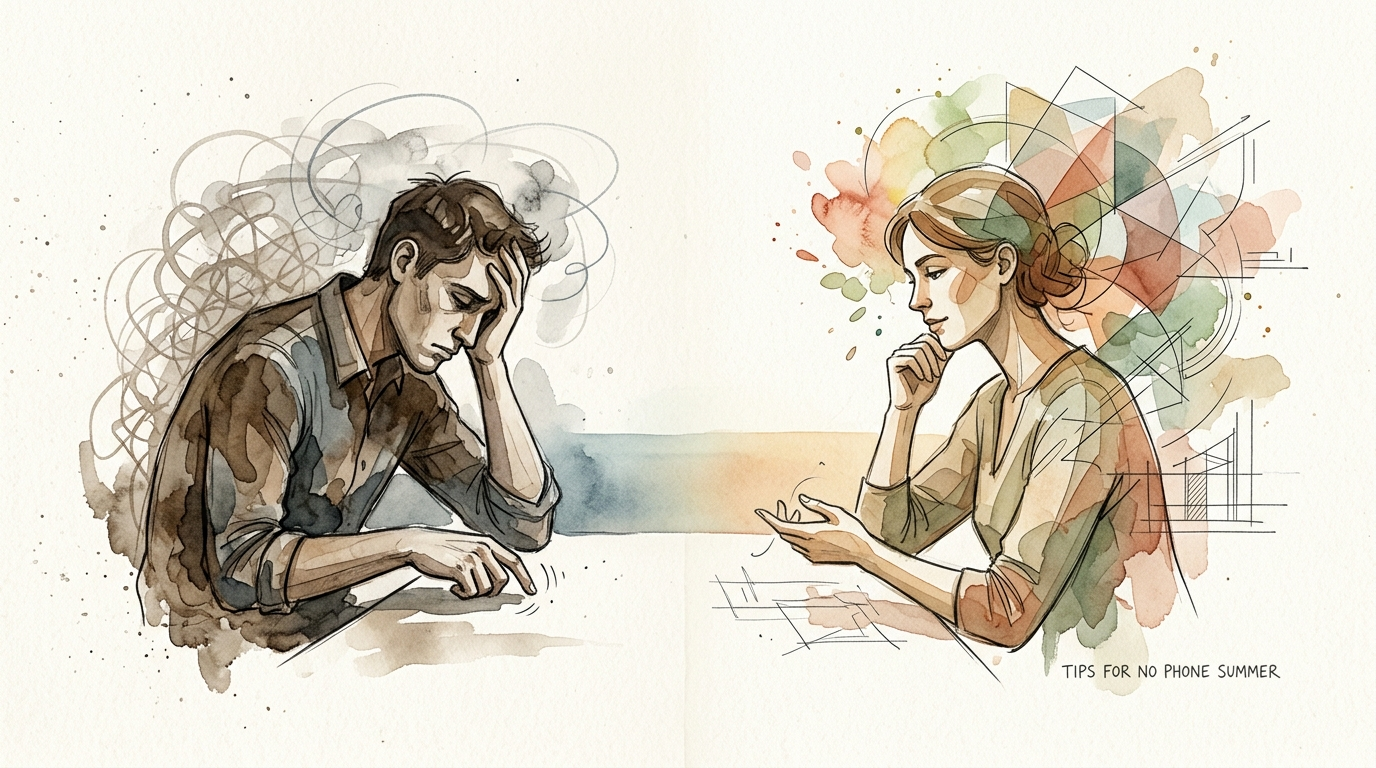
Boredom isn’t the enemy; it’s the spark for your next great invention. When we kill boredom with a screen, we kill creativity. These tips show you how to lean into the quiet moments to find your best ideas yet. You might feel a twitch in your thumb right now, a ghostly phantom vibration from a pocket that hasn’t buzzed in minutes. That is the sound of your brain begging for a hit of digital dopamine.
The modern world has declared war on empty space. We check our phones while the coffee brews, while the traffic light is red, and even while we’re supposedly watching a movie. We have forgotten how to be alone with our thoughts. This summer, a growing movement called “Analog Summer” is helping people reclaim their attention spans by deliberately choosing tangible, offline experiences over the infinite scroll.
If you feel like your focus is a frayed wire, you aren’t alone. Recent statistics suggest Americans check their phones roughly 144 times a day, spending an average of four and a half hours staring at glass. This constant bombardment suppresses the very neural network responsible for your best ideas. By stepping back, you aren’t just taking a break; you are staging a revolution for your mind.
tips for no phone summer
A no phone summer—often called an “Analog Summer”—is a deliberate commitment to reduce or eliminate smartphone usage during the warmest months of the year. It is not a luddite rejection of all technology, but a strategic choice to prioritize the physical over the digital. Think of it as a seasonal “reset” for your brain’s reward system.
In 2026, this movement has exploded into a full cultural phenomenon. Retailers like Michaels have reported a 136% increase in searches for “analog hobbies,” while interest in traditional crafts like knitting and woodworking has soared by over 1,200% in some categories. People are trading “AI slop” and repetitive social media loops for the “friction” of a physical hobby.
In a real-world setting, a no phone summer looks like carrying a paperback book instead of an e-reader, using a physical map to navigate a new city, or leaving your device in a “parking station” by the front door when you get home. It’s about re-learning the art of “idleness” and “solitude deprivation”—the rare state of being entirely alone with your own mind without the safety net of a notification.
How the “Boredom Spark” Works
To understand why a phone-free summer is so powerful, you have to look at the neuroscience of the “Default Mode Network” (DMN). When you aren’t focused on a specific task—like when you’re staring at the clouds or washing dishes—your brain doesn’t actually shut down. Instead, the DMN kicks into high gear. This network is the engine room of imagination, memory consolidation, and self-reflection.
When you reach for your phone to kill ten seconds of boredom, you are essentially “muffling” the DMN. You are telling your brain to stop daydreaming and start consuming. This prevents your mind from making the “unexpected connections” that lead to creative breakthroughs. A famous 2014 study at the University of Central Lancashire found that participants who performed a “magnificently boring” task—like copying numbers from a phone book—performed significantly better on subsequent creativity tests than those who weren’t bored.
The “dopamine detox” is another key principle here. While you can’t literally “fast” from a naturally occurring chemical, you can perform a behavioral reset. High-stimulation activities like scrolling TikTok provide immediate, short-lived “charges” that reinforce addictive loops. A phone-free summer allows your brain to find pleasure in “lower-fidelity” rewards, like the smell of a garden or the rhythm of a long walk.
The Measurable Benefits of Stepping Back
The most immediate benefit of a phone-free summer is the restoration of your attention span. Without the constant interruption of push notifications, your brain regains the capacity for “deep work” and sustained focus. You’ll find that you can read for longer stretches and engage in deeper conversations with friends and family.
Sleep quality also sees a massive improvement. The blue light from screens suppresses melatonin, but the psychological “noise” of social media is often more damaging. By removing the phone from the bedroom, you eliminate the “revenge bedtime procrastination” that keeps you scrolling until 1:00 AM. Many participants report waking up feeling more refreshed and less anxious about the day ahead.
Finally, there is the benefit of “present-moment awareness.” When you aren’t viewing your life through a lens—literally or figuratively—you notice the details. You see “the way a flicker flies” or the specific shade of a summer sunset. This isn’t just poetic; it’s a form of mental hygiene that has been shown to reduce symptoms of anxiety and depression.
Challenges and the Reality of Digital Withdrawal
Do not expect this process to be easy. If you are used to checking your phone every few minutes, you will experience a legitimate form of withdrawal. For the first few weeks, you may feel moody, irritable, and restless. Your brain is essentially “cranky” because it isn’t getting its usual sugar-rush of notifications.
One common mistake is trying to go “cold turkey” without a plan. If you simply take away the phone and don’t replace it with another activity, the boredom will feel like a nuisance rather than an asset. You will likely find yourself staring at the wall or, worse, finding a different screen to scroll, like a laptop or a TV.
Another hurdle is the “logistics of modern life.” We have offloaded so many functions to our phones that “kicking the brick” can create genuine friction. How do you navigate without Google Maps? How do you handle two-factor authentication (2FA) for your bank? These are not insurmountable obstacles, but they require preparation. Failing to account for these needs is the number one reason people abandon their digital minimalism goals.
Limitations and Realistic Boundaries
A “no phone summer” does not mean you have to live like a hermit. For many, work requirements or family emergencies make total abstinence impossible. If your job requires you to be reachable via Slack or email, a “puritanical” approach will only lead to stress and failure.
The key is “intentionality.” You might decide that your phone is a “tool, not a toy.” This means you use it for specific tasks—like a five-minute check of work messages at noon—and then put it away. It also means recognizing that some environments are more “analog-friendly” than others. Trying to navigate a foreign country where everything is done via QR codes might not be the best time for a 100% detox.
Credibility in digital minimalism comes from balance. It’s about building a “life you want to live” rather than a set of rigid rules that make you miserable. If a device is dictating your behavior, you aren’t free. But if you are using that device to facilitate a value—like calling a far-away parent—then it is serving its purpose.
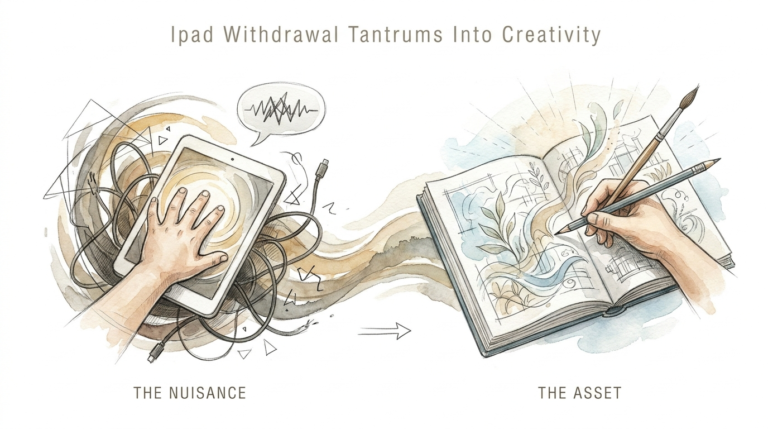
Boredom: Nuisance vs. Creative Asset
Understanding the shift in perspective is crucial for success. Most people view boredom as a problem to be solved, while high-performers view it as a state to be mined.
| Factor | Boredom as a Nuisance | Boredom as a Creative Asset |
|---|---|---|
| Core Reaction | Anxiety, restlessness, “itch” to scroll. | Calm, receptivity, mind-wandering. |
| Primary Goal | Eliminate the feeling as fast as possible. | Explore the feeling to see where it leads. |
| Brain State | Externalized, reactive, dopamine-seeking. | Internalized, DMN-active, generative. |
| Long-term Result | Reduced attention span, mental fatigue. | Original ideas, increased “fluid” intelligence. |
Practical Tips for Your Analog Summer
If you want to survive and thrive without your smartphone, you need to add “friction” to your digital life and “ease” to your physical life. Start by designating “parking stations” for your devices. A simple bowl by the front door can serve as the designated spot for your phone. The moment you enter your home, the phone stays in the bowl.
Use “single-purpose devices” to replace smartphone apps. Wear an old-fashioned wristwatch so you don’t check your screen “just for the time.” Buy a physical alarm clock to keep the phone out of the bedroom. Invest in a dedicated MP3 player or an old iPod for music, and a standalone digital or film camera for photos. This allows you to enjoy the benefits of technology without the “infinite scroll” that comes with an all-in-one device.
Switch your phone to “grayscale mode.” Most apps are designed with bright, “high-arousal” colors to keep you engaged. Removing the color kills the dopamine spike and makes the screen look like a dull tool rather than a vibrant toy. You should also turn off all non-essential notifications. Keep the pings for phone calls and calendar alerts, but kill the red dots for social media, news, and “promotions.”
Advanced Considerations for Long-Term Success
For those who want to go beyond a simple summer break, consider “decentralizing” your smartphone entirely. This involves moving essential services to a “dumb phone” or a “minimalist phone” like the Light Phone III or the Wisephone II. These devices offer calls, texts, and maybe a few tools like a calculator or a simple map, but they lack a web browser and an app store.
Managing two-factor authentication (2FA) is the “boss level” of digital minimalism. Many people find success using a physical security key like a YubiKey, which plugs into a computer to verify your identity. Alternatively, you can use a “backup phone”—an old device that stays in a drawer and is only turned on when you need to authenticate a login.
Finally, focus on building “community support.” It is much harder to be the only person without a phone in a group of ten people scrolling at dinner. Talk to your friends and family about your goals. You’ll likely find that many of them are also feeling “digital overwhelm” and would welcome a “phones-in-the-middle” rule for social gatherings.
Real-World Scenarios
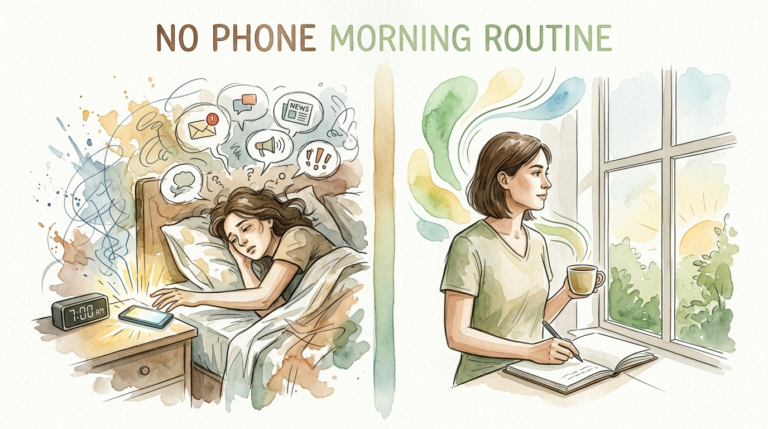
Imagine a Saturday morning. In the “Smartphone Scenario,” you wake up at 7:30 AM and immediately check your notifications. You spend 45 minutes in bed scrolling through news headlines and social media feeds. By the time you get up, you are already “mentally cluttered” and slightly anxious. Your “creative window” for the day has been closed by external noise.
In the “Analog Scenario,” your physical alarm clock wakes you up. You leave the phone in the kitchen drawer. You spend those first 45 minutes drinking coffee on the porch, watching the birds, and letting your mind wander. By 8:15 AM, you’ve had three original ideas for a work project and realized you want to start a garden. You are “internally directed” and ready for the day.
Another scenario involves navigation. Instead of blindly following a blue dot on a screen, you spend five minutes studying a paper map before you leave. You gain a “spatial understanding” of your city that a GPS can never provide. You notice landmarks, understand the layout of neighborhoods, and feel a sense of “competence and agency” that makes the trip an adventure rather than a chore.
Final Thoughts
The goal of a no phone summer is not to “fix” yourself, but to remember who you are when you aren’t being prompted by an algorithm. It is a return to a “higher-fidelity” version of reality where your attention is your most valuable currency. By leaning into boredom, you give yourself the greatest gift a modern person can receive: the space to think.
Start small. Maybe this weekend is your first “analog 48.” Notice the discomfort, observe the twitch in your thumb, and then watch what happens when that feeling fades. You might find that the world is much bigger, louder, and more beautiful than a six-inch screen could ever suggest.
As the summer heats up, let your devices cool down. Experiment with the quiet. Reclaim your focus. You aren’t losing out on the digital world; you are finally showing up for the real one.
Sources
1 charlesleon.uk | 2 kansascity.com | 3 charlesleon.uk | 4 vice.com | 5 vice.com | 6 reddit.com | 7 braintasticscience.com | 8 neurosity.co | 9 newdirectionsbrooklyn.com | 10 harvard.edu | 11 superpower.com | 12 medium.com | 13 247dct.org | 14 richinwhatmatters.com | 15 globalleadersinstitute.org | 16 psychologytoday.com | 17 youtube.com | 18 therealists.org | 19 inpact-psychologyconference.org | 20 substack.com | 21 amendo.com | 22 acon24.com | 23 acon24.com | 24 theguardian.com | 25 stlouischildrens.org | 26 youtube.com