Outdoor Survival Skills For Kids
When the signal drops, does their world end, or does it finally begin? Modern life is fragile. Nature is resilient. Teaching our kids how to interact with the world without a battery is the ultimate insurance policy for their confidence.

Most children today can navigate a tablet before they can tie a square knot. They understand the mechanics of a touchscreen but might struggle to find North if their phone dies. This disconnect isn’t just about losing a connection to the outdoors; it is about losing the fundamental human ability to solve problems under pressure.
Wilderness survival isn’t about scaring kids with worst-case scenarios. It is about empowering them with the knowledge that they are capable of handling whatever the world throws their way. When a child knows how to build a shelter or signal for help, they move through the world with a different kind of posture—one of quiet confidence instead of fragile dependency.
In this guide, we will break down the essential pillars of survival education for the next generation. From the psychological “S.T.O.P.” method to the physical mechanics of fire and shelter, we will explore how to turn any backyard or local trail into a classroom for life.
Outdoor Survival Skills For Kids
Outdoor survival skills for kids are a set of practical techniques and mental frameworks designed to help children stay safe, calm, and healthy if they become lost or separated from adults in a natural environment. These skills are often referred to as bushcraft or wilderness self-reliance. While adults might focus on long-term survival, the goal for kids is usually “survival until rescue.”
The core of these skills is the ability to meet basic human needs—shelter, water, fire, and signaling—using minimal gear and natural resources. In a real-world situation, a child who has practiced these skills is less likely to panic. Instead of wandering deeper into the woods, they use a learned protocol to stay put and make themselves visible to search teams.
Think of these skills as the “original STEM.” Building a lean-to involves geometry and physics. Purifying water requires an understanding of biology and chemistry. Starting a fire safely is a lesson in thermodynamics and responsibility. These skills are used in scouting programs, outdoor education camps, and by families who want to ensure their children are resilient explorers.
Beyond the “what” and the “where,” the “why” is simple: preparation prevents panic. A child who knows that a whistle is louder than their voice and that a pile of leaves can keep them warm is a child who can wait out a storm with a level head.
How to Teach the Core Pillars of Survival
Teaching survival skills works best when it is broken down into actionable, hands-on lessons. Start small in the backyard before moving to the deep woods. Use the following step-by-step approaches for each major skill.
The S.T.O.P. Rule: The Psychology of Staying Alive
The most important skill isn’t physical—it is mental. The S.T.O.P. acronym is a universal survival standard that every child should memorize as their first line of defense against panic.
- S – Stop: As soon as you realize you are lost or alone, sit down. Staying in one place is the number one way to get found faster.
- T – Think: Take deep breaths. Remember your training. Think about what you have in your pack.
- O – Observe: Look around. Are there landmarks? Can you hear a road or a river? Is the sun going down?
- P – Plan: Based on what you have and where you are, make a simple plan. “I will blow my whistle and build a leaf nest.”
Shelter Building: The “Hug-a-Tree” Method
Exposure is often a bigger threat than hunger or thirst. Teach children to build “micro-shelters” that trap body heat. A classic example is the debris hut or a simple lean-to.
Start by finding a sturdy “ridge pole” (a long, thick stick). Lean one end against a low tree branch or a rock. Prop smaller sticks along the sides to create a “rib” structure. Finally, pile as much dry leaves, pine needles, and brush as possible onto the ribs. The goal is to create a thick “blanket” of insulation at least two feet thick. If they have a poncho or an emergency blanket in their kit, show them how to use it to waterproof the roof.
Water Procurement and Purification
Kids need to understand that even clear water can contain “invisible monsters” (bacteria). Teach them to always prioritize finding water but to never drink it raw unless it is a life-or-death emergency.
Practice using a portable water filter like a Sawyer Mini or a LifeStraw. Show them how to scoop water from a moving source rather than stagnant puddles. If you have a metal cup, demonstrate boiling water for at least one minute to make it safe. You can also build a simple sand-and-charcoal filter in a plastic bottle as a science project to show how debris is removed, though emphasize that boiling is still required to kill germs.
Signaling: Being Seen and Heard
A child’s voice will give out long before their whistle does. Every child should carry a pea-less whistle on their person. Teach the international distress signal: three loud blasts, a pause, and then repeat.
Visual signals are also critical. Practice using a small signal mirror to reflect sunlight toward a target. If they are in an open area, show them how to make a “V” or an “X” on the ground using bright orange trash bags or large rocks. These symbols tell pilots above that someone needs help.
Benefits of Survival Training for Children
Mastering survival skills provides measurable benefits that translate directly into a child’s everyday life. It builds a foundation of character that technology simply cannot replicate.
Increased Self-Confidence: There is a massive psychological shift when a child realizes they can provide for their own basic needs. Successfully lighting a fire with a ferro rod or building a waterproof fort gives them a “can-do” attitude that carries over into schoolwork and sports.
Resilience and Problem-Solving: Nature is unpredictable. When a shelter branch breaks or damp wood won’t light, children have to adapt. This teaches them that failure is a part of the process and that persistence leads to success. They learn to view obstacles as puzzles to be solved rather than reasons to quit.
Physical Health and Sensory Development: Survival training requires movement—hauling sticks, hiking to water sources, and fine motor skills like knot tying. It engages all five senses and provides a high-energy alternative to sedentary screen time. Studies show that just two hours of immersive nature time per week significantly improves mood and concentration.
Environmental Stewardship: You protect what you understand. As kids learn to identify trees for tinder or follow animal tracks, they develop a deep respect for the ecosystem. They learn “Leave No Trace” principles, ensuring that the wilderness remains healthy for the next generation of explorers.
Challenges and Common Mistakes
Teaching these skills isn’t without its hurdles. Many parents unintentionally set their kids up for failure by overcomplicating the lessons or neglecting the psychological aspect.
The “Stranger Danger” Paradox: One of the biggest challenges in search and rescue is that kids are often taught to hide from strangers. In a survival situation, the people calling their name are often strangers in uniforms. You must explicitly teach your children that if they are lost, anyone searching for them is a “safe” person they should run toward, not away from.
Over-Dependency on Gear: A survival kit is a tool, not a crutch. If a child only knows how to use a lighter, they are in trouble if that lighter gets wet. Ensure they understand the underlying principles—like why dry tinder is necessary—so they can adapt if their gear fails.
Information Overload: Don’t try to teach a 7-year-old how to navigate with a compass and adjust for declination in one afternoon. Start with the “red in the shed” basics. If the lesson is too complex, the child will become frustrated and lose interest in the outdoors entirely.
Ignoring Local Hazards: Parents sometimes focus on “Hollywood” survival (like fighting bears) while ignoring real local threats like ticks, poison ivy, or hypothermia from damp clothing. Ensure the training is relevant to the terrain where you actually hike and camp.
Limitations and Environmental Constraints
Survival skills are highly dependent on the environment and the individual child’s maturity level. What works in a temperate forest will fail in a desert or during a blizzard.
Age is a significant boundary. A five-year-old lacks the physical strength to build a full-sized debris hut but can easily master the “Hug-a-Tree” concept and whistle signaling. Conversely, a teenager might be ready for knife safety and fire-starting, but still lacks the judgment to avoid risky shortcuts in steep terrain.
Environmental limitations also play a role. In high-altitude or extreme cold environments, the “Rules of 3” (3 hours without shelter in extreme weather) become much more aggressive. In these cases, gear like high-quality emergency blankets or bivy sacks becomes mandatory because natural materials may be buried under snow or too wet to provide insulation.
Finally, remember that survival skills are perishable. If you only practice once a year, the “muscle memory” won’t be there when the adrenaline hits. Frequent, low-stakes practice in the backyard is the only way to ensure these skills are actually available in a crisis.
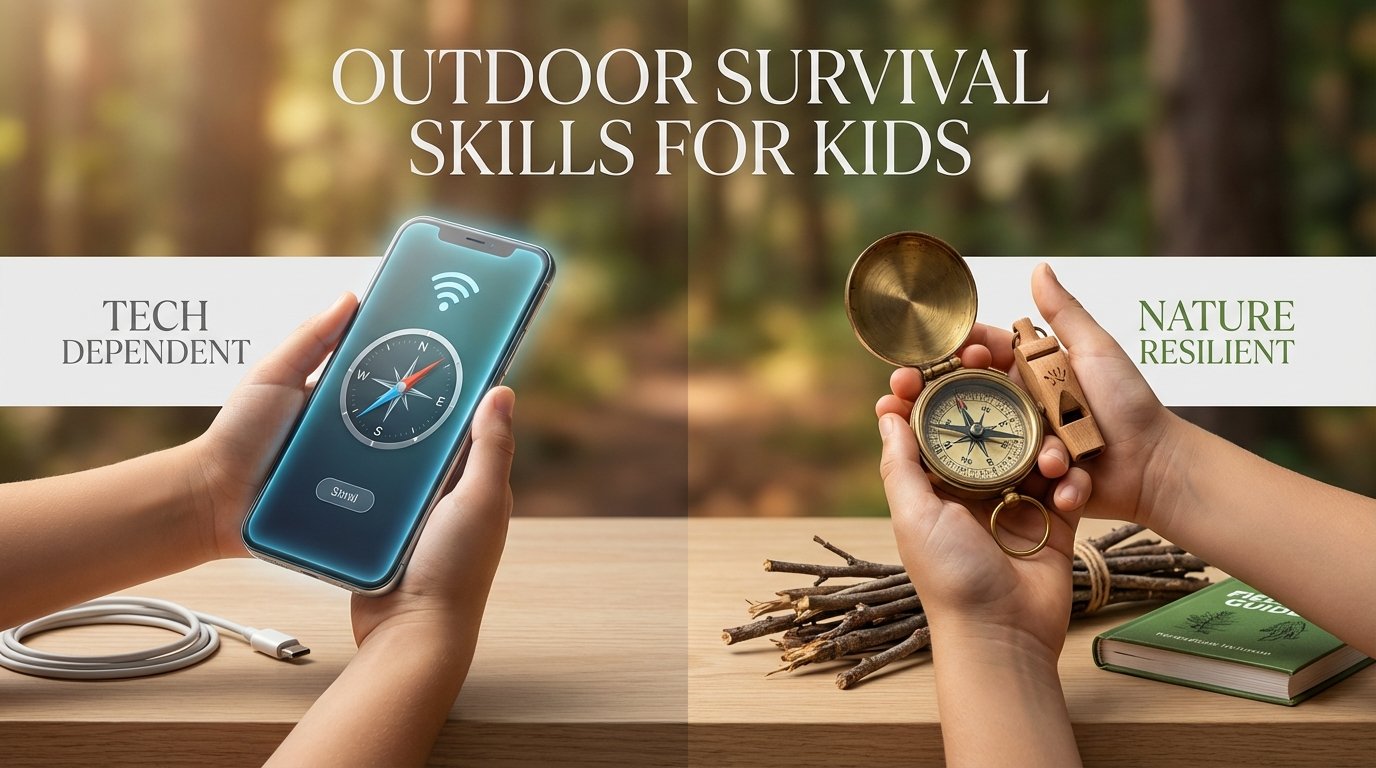
Tech-Dependent vs. Nature-Resilient
Comparing modern technology to traditional survival skills helps highlight why both are important but why the latter is the ultimate safety net.
| Feature | Tech-Dependent (GPS/Phone) | Nature-Resilient (Map/Compass/Skills) |
|---|---|---|
| Reliability | Requires battery and signal. | Works 24/7 in all conditions. |
| Complexity | Easy to use until it fails. | Requires practice and “brain power.” |
| Awareness | Encourages “tunnel vision” on a screen. | Forces observation of surroundings. |
| Cost | Expensive hardware and data plans. | Low-cost tools; free knowledge. |
| Maintenance | Needs charging and software updates. | Only needs occasional practice sessions. |
Practical Tips for Success
Apply these actionable tips to make survival training fun and effective for your family. The goal is to integrate these habits into every outdoor adventure until they become second nature.
- The 10-Second Photo: Before every hike, take a photo of your child. Make sure to capture their clothes and the tread on the bottom of their shoes. If they go missing, search teams will know exactly what footprints to look for.
- Pack an “Always-On” Kit: Give your child a small fanny pack or backpack that never leaves their body. It should contain a whistle, a bright poncho, a snack, and an emergency blanket. If they drop their main pack or get separated, they still have the essentials.
- Turn Skills into Games: Instead of a “lesson,” host a “fire-building race” (with supervision) or a “shelter-building contest.” Children learn faster when they are playing.
- Use Mnemonics: Use rhymes like “Red in the shed” for compass work (the red needle goes into the red orienting arrow) or “Leaves of three, let it be” for poison ivy.
- Practice in “Bad” Weather: Once they know the basics, try building a shelter in a light rain. This shows them why choosing a site with good drainage and thick insulation is actually important.
Advanced Considerations for Serious Practitioners
For older children or those who have mastered the basics, you can move into more complex bushcraft techniques that require higher levels of discipline and fine motor control.
Knife Safety and Whittling: Introduce a small, fixed-blade knife with a finger guard. Teach the “blood circle” rule—never use a knife if someone is within an arm’s reach. Start by whittling “feather sticks,” which are essential for starting fires in damp conditions. This builds hand strength and teaches them to respect sharp tools as assets, not toys.
Knot Tying Mastery: Move beyond the square knot. Teach the Bowline (the “king of knots”) for creating a fixed loop, and the Taut-Line Hitch for adjustable tension on a shelter guy-line. Knowing the right knot for the right job is the mark of an experienced woodsman.
Natural Navigation: Show them how to find North without a compass. Use the “shadow-tip method” by placing a stick in the ground and marking the shadow’s movement over 15 minutes. Or, teach them to look for thicker moss on the north side of trees (though warn them this isn’t always 100% accurate) and how to find the North Star (Polaris) using the Big Dipper.
Example Scenario: The “Backyard Bivouac”
To see how these skills come together, let’s look at a practical weekend exercise you can do at home. Tell your child they are “lost” in the backyard forest and have two hours to prepare before “night” (dinner time) falls.
First, they must apply the S.T.O.P. rule. They sit down and assess their resources. Next, they move to Shelter Building. Instead of using a tent, they find a downed log and build a debris lean-to using branches and rake-piled leaves. They test the insulation by crawling inside to see if it feels warmer than the outside air.
After the shelter is secure, they move to Signaling. They use a small mirror to “flash” you at the kitchen window. Finally, they practice Water Purification by setting up a gravity filter using a bandana and a water bottle to remove large sediment from a rain barrel. By the time they come inside for dinner, they haven’t just played; they have rehearsed a sequence of events that could save their life.
Final Thoughts
Teaching our kids outdoor survival skills is about far more than just “not getting lost.” It is about fostering a sense of agency in a world that often feels automated and disconnected. When a child understands how to work with the environment rather than just surviving against it, they develop a profound sense of peace and capability.
Start with the basics: a whistle, a poncho, and the S.T.O.P. rule. As their confidence grows, introduce fire safety, navigation, and advanced bushcraft. These skills don’t just stay in the woods; they manifest as leadership, patience, and resilience in every other part of their lives. Encourage them to experiment, to get their hands dirty, and to trust their own instincts.
The next time you head out on the trail, remember that nature is the ultimate classroom. By equipping your children with these survival essentials, you aren’t just preparing them for a “what if” scenario—you are preparing them for a lifetime of confident adventure. Encourage them to keep learning, stay curious, and always remember that the best survival tool they have is the one between their ears.
Sources
1 outdoorexploringfamily.com (https://www.outdoorexploringfamily.com/blog/how-to-use-a-map-and-compass) | 2 wildlingsforestschool.com (https://www.wildlingsforestschool.com/blog/bushcraft-and-survival-life-skills) | 3 backpacker.com (https://www.backpacker.com/survival/survival-skills/how-to-teach-survival-skills-to-young-kids/?scope=anon) | 4 reserveamerica.com (https://www.reserveamerica.com/articles/camping/how-to-teach-your-kids-wilderness-survival/) | 5 hunter-ed.com (https://www.hunter-ed.com/pennsylvania/studyGuide/S.T.O.P.-Stop-Think-Observe-Plan/20103901_88693/) | 6 hunter-ed.com (https://www.hunter-ed.com/newsouthwales/studyGuide/S.T.O.P.-stop-think-observe-plan/201601_138908/) | 7 reserveamerica.com (https://www.reserveamerica.com/outdoors/wilderness-survival-for-kids.htm) | 8 therusticelk.com (https://www.therusticelk.com/25-survival-skills-for-kids/) | 9 heritageskillsusa.com (https://heritageskillsusa.com/f/backyard-survival-skills-for-kids-a-homeschool-project-guide) | 10 selfrelianceoutfitters.com (https://www.selfrelianceoutfitters.com/blogs/survival-blog/10-benefits-of-youth-survival-training) | 11 campliveoakfl.com (https://www.campliveoakfl.com/the-lifelong-benefits-of-learning-survival-skills-at-camp/) | 12 kindredmedia.org (https://kindredmedia.org/2023/09/why-kids-should-learn-the-original-stem-ancient-survival-skills/) | 13 pgl.co.uk (https://adventureholidays.pgl.co.uk/the-benefits-of-bushcraft-survival-skills-for-kids/) | 14 reddit.com (https://www.reddit.com/r/preppers/comments/14k07wp/what_would_be_some_appropriate_things_to_put_in_a/) | 15 pinemountaintrail.org (https://www.pinemountaintrail.org/survival-list.html) | 16 theoutdoorguide.co.uk (https://theoutdoorguide.co.uk/blogs/get-out-with-the-kids/teaching-kids-map-reading/) | 17 mountainhouse.com (https://mountainhouse.com/blogs/emergency-prep-survival/kids-bug-out-bag) | 18 greatriversscouting.org (https://greatriversscouting.org/2023/12/01/outdoor-skills/) | 19 noc.com (https://noc.com/news/wilderness-survival-tips-for-families/) | 20 calleva.org (https://calleva.org/5-important-outdoor-skills-for-all-children/) | 21 thereadystore.com (https://thereadystore.com/a/blog/post/whats-usually-forgotten-in-kids-survival-kits) | 22 osc.org (https://www.osc.org/outdoor-survival-for-kids-7-safety-tips-for-any-scenario/) | 23 dontdieinthewoods.com (https://dontdieinthewoods.com/blogs/survival-skills/teaching-kids-survival-skills)