Outdoor Movie Night Lighting Tips
High-wattage LEDs are the fastest way to ruin the ‘cinema’ feel of your outdoor movie night. We flood our yards with ‘smart’ lights that actually make our eyes tired. To get that true cinematic depth, you need to master the shadows. Ditch the blue-tinted LEDs and embrace the warm, low-frequency light of a real fire.
Creating a backyard cinema is about more than just a big screen and loud speakers. It is an exercise in atmospheric control. Most people focus entirely on the projector brightness while ignoring the ambient light that eats their contrast for breakfast. If you want your movie night to feel like a high-end theater instead of a lit-up parking lot, you have to understand the science of the glow.
This guide will walk you through the art of outdoor illumination. You will learn why certain colors of light soothe the brain while others trigger alertness. We will cover the technical specs of projectors and screens, the safety of open flames, and the secret “layers” of light that professionals use to create depth.
Outdoor Movie Night Lighting Tips
Outdoor movie night lighting is the strategic use of low-intensity, warm-toned light sources to provide safety and ambiance without washing out the projected image. It exists to bridge the gap between total darkness and the functional need to see your popcorn. In a real-world setting, this means replacing your harsh 5000K security floodlights with sources that mimic the “Golden Hour” of a sunset.
The goal is to maintain a high contrast ratio on your screen. Contrast is the difference between the darkest blacks and the brightest whites that your projector can produce. Every stray photon of light that hits your screen surface raises the “floor” of those blacks, making the image look gray and flat. This is why light placement and color temperature are your two most important tools.
Think of your backyard as a stage. You need enough light to prevent guests from tripping over extension cords, but not so much that you lose the details in a dark thriller or a space odyssey. Successful setups use “layered lighting”—a combination of pathway markers, accent lights for trees, and a central warm glow near the seating area.
How to Design Your Outdoor Cinema Lighting
Step-by-step planning ensures you don’t end up with a washed-out screen. Follow these technical and creative steps to build a balanced environment.
1. Identify Your Light Enemies
Before you turn on a single lamp, walk your yard at night. Look for streetlamps, neighbors’ porch lights, and reflections from glass windows. These are “fixed” light sources. Position your screen so the back of it faces these light polluters. This prevents direct light from hitting the reflective front of the screen.
2. Master the Kelvin Scale
Color temperature is measured in Kelvin (K). High numbers (5000K-6500K) are “cool” and look blue or clinical. These are terrible for movies because they stimulate the brain to stay awake and ruin night vision. Aim for “warm” light in the 2000K to 3000K range. This mimics candlelight or a sunset, which allows the eyes to stay adjusted to the dark.
3. Use Indirect Illumination
Direct light creates glare. Instead of pointing a flashlight at the ground, use “wash” lighting. Aim a small, low-wattage LED spotlight at a brick wall or a large tree trunk. The light that bounces off the surface will be soft, diffused, and much less likely to cause screen interference.
4. Install Pathway Markers
Safety is non-negotiable. Use low-voltage or solar-powered stake lights to line the paths to the seating area and the snacks. Ensure these are “hooded” lights that point the beam strictly downward. This keeps the light on the grass and out of the viewers’ eyes.
Benefits of Proper Cinematic Lighting
The right lighting setup transforms the experience from a “TV in the yard” to a professional-grade event.
Reduced Eye Fatigue: Watching a bright screen in total darkness can cause “eye strain” because the pupils are constantly dilating and contracting to adjust to the flickering light. A soft, warm background glow provides a reference point for your eyes, making long double-features much more comfortable.
Enhanced Immersion: When you use natural fire glow or very warm LEDs, the surroundings “melt” away. Blue light draws attention to the objects it hits, while warm light creates a sense of depth and mystery in the shadows. This keeps the focus entirely on the narrative of the film.
Psychological Comfort: Humans are biologically wired to feel safe around the warm glow of a fire. This “low-frequency” light triggers the release of melatonin, helping guests relax and enjoy the evening. It creates a “cocoon” effect that high-wattage smart bulbs simply cannot replicate.
Challenges and Common Mistakes
Even experienced hosts often fall into these traps. Awareness is the first step toward a perfect screening.
The “Light Washout” Error
The most frequent mistake is placing a string of bright “Edison” bulbs directly above or next to the screen. Even if they are warm, the proximity to the screen surface will drastically reduce image quality. Always keep a “dark zone” of at least 10 feet around the screen itself.
Ignoring Reflectivity
Light doesn’t just come from bulbs; it bounces off surfaces. Light-colored patio furniture or white fences can reflect light back onto your screen. If you have a permanent outdoor theater setup, consider using dark, matte-finished furniture or painting nearby walls in dark, neutral tones like charcoal or forest green.
Over-Lighting the Audience
Your guests need to see their drinks, but they don’t need to be under a spotlight. Avoid overhead lights. Use “bias lighting” instead—place a dim, warm light source *behind* the audience’s seating or behind the screen itself to provide a soft halo that doesn’t hit the screen surface directly.
Limitations of Outdoor Lighting
No matter how good your lights are, certain factors remain out of your control. Understanding these boundaries helps you set realistic expectations.
Projector Lumens vs. Ambient Light: If you are starting your movie at dusk, you need a projector with at least 3,000 ANSI lumens. Anything less will be invisible until the sun is completely gone. Lighting tricks cannot fix a weak projector; they can only preserve the quality of a strong one.
Screen Material Constraints: Standard white fabric screens reflect light from all directions equally. If you live in an area with heavy light pollution (like a city center), a standard screen will struggle. In these cases, you might need an “Ambient Light Rejection” (ALR) screen, which uses special micro-textures to reflect only the projector’s light toward the audience.
Environmental Hazards: Open flames (like fire pits or tiki torches) are beautiful but produce smoke. Smoke particles in the air can catch the projector beam, creating a “shimmer” effect on the screen. Always position fire sources downwind from the projector’s light path.
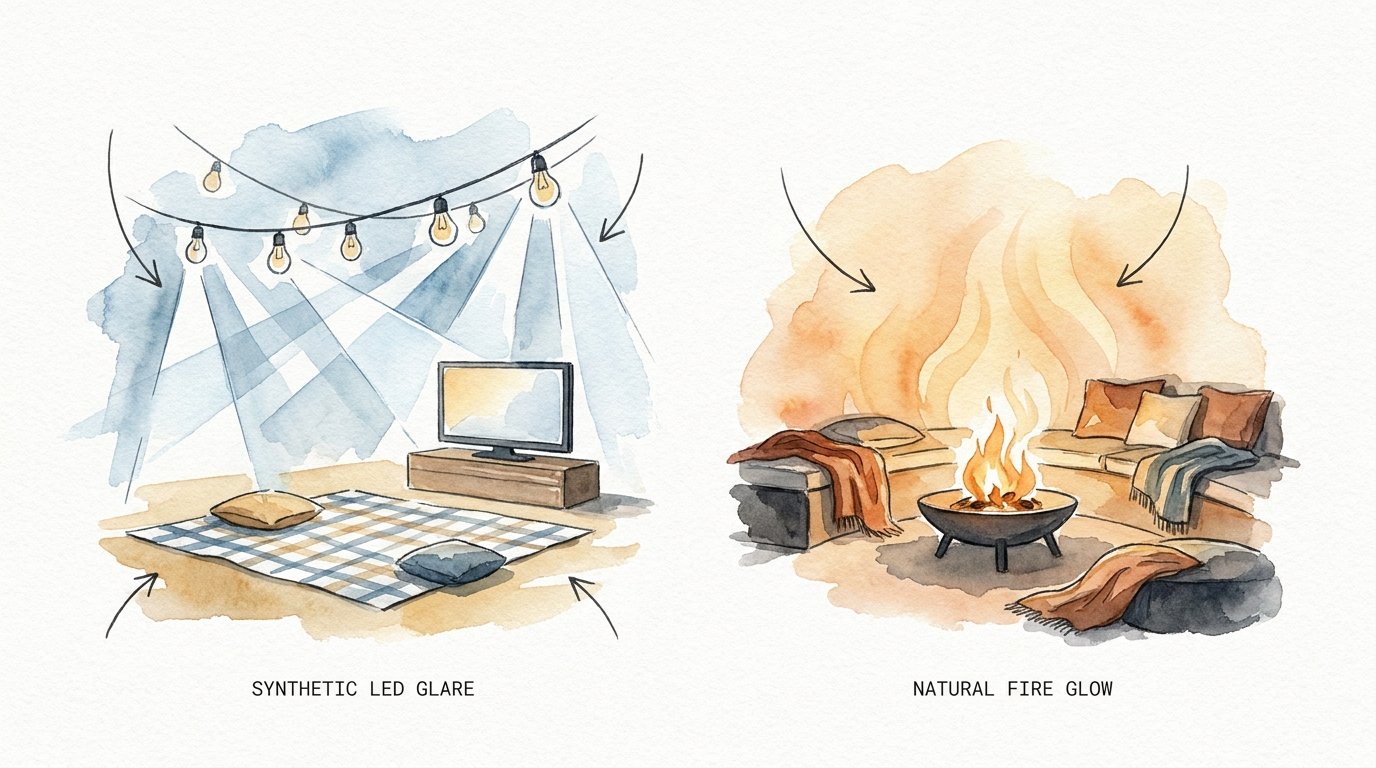
Synthetic LED Glare vs. Natural Fire Glow
Understanding the difference between these two sources is vital for creating the right mood.
| Feature | Synthetic LED Glare (Cool) | Natural Fire Glow (Warm) |
|---|---|---|
| Color Temperature | 5000K – 6500K | 1500K – 2000K | Night Vision Impact | High (Resets dark adaptation) | Low (Preserves night vision) |
| Immersion Level | Distracting / Clinical | Deep / Cinematic |
| Flicker Frequency | High (Can cause headaches) | Organic / Rhythmic |
While LEDs are convenient and energy-efficient, they often lack the “full spectrum” richness of fire. If you must use LEDs, choose “High CRI” (Color Rendering Index) bulbs with a rating of 90 or higher. These bulbs more accurately represent colors and feel more natural to the human eye.
Practical Tips and Best Practices
Apply these “pro secrets” to elevate your next movie night immediately.
- Use Dimmers: If your outdoor lights are hardwired, install a dimmer switch. This allows you to keep the lights at 100% during seating and snacks, then drop them to 10% when the opening credits roll.
- Black Out Windows: If your house windows face the yard, the interior lights will act as giant softboxes. Close the curtains or turn off the lights in those rooms before the show starts.
- Bug-Friendly Lighting: Insects are attracted to the UV and blue light emitted by standard LEDs. Switching to warm, yellow “bug lights” or using a real fire pit will significantly reduce the number of flying pests near your screen.
- Cord Safety: Use only 12-gauge, outdoor-rated extension cords for long runs. Secure them to the ground with gaffer tape or small lawn staples to prevent tripping in the dark.
- Sound-Light Sync: Some smart lighting systems can sync with the audio of your movie. Avoid “flashing” modes, but a subtle “color wash” that matches the dominant color on the screen can expand the visual field.
Advanced Considerations for Enthusiasts
If you are ready to move beyond the basics, consider these professional-grade techniques.
The McCandless Method
In theater lighting, the McCandless Method uses two lights at 45-degree angles to illuminate a subject. You can adapt this for your seating area. Place one very dim warm light and one very dim “moonlight” (4000K) light on opposite sides of the lounge area. This creates natural-looking shadows and gives the space a three-dimensional feel without being overly bright.
Moonlighting in Trees
Professional landscape designers use “moonlighting” to create a magical effect. Place a cool-white LED (around 4000K) high up in a tree, pointing downward through the branches. This creates a soft, dappled light pattern on the ground that looks exactly like a full moon. It provides enough light for guests to move around but is subtle enough not to interfere with the movie.
Optimizing Contrast Ratios
To truly master contrast, you must control the “bounce.” If your screen is set up on a light-colored concrete patio, the projector’s own light will hit the screen, bounce to the floor, and reflect back up, washing out the bottom of the image. Placing a dark, non-reflective outdoor rug in front of the screen can drastically improve your black levels.
Examples and Realistic Scenarios
How do these principles look in practice? Here are two common setups.
Scenario A: The Romantic Date Night
In this setup, the focus is on intimacy. The host uses a small portable 1080p projector and a 100-inch folding screen. To light the area, they place four flameless LED candles (2000K) on a low coffee table and two tiki torches 20 feet away at the perimeter. The fire sources are positioned downwind. The result is a warm, flickering atmosphere that feels private and cozy, with zero light hitting the screen surface.
Scenario B: The Neighborhood Block Party
For a group of 20 people, the host uses a high-brightness 4000-lumen projector and a 150-inch inflatable screen. Because there is more movement, they use solar-powered stake lights to create a clear “runway” to the food station. They use “bias lighting”—a long LED strip set to a dim amber glow—attached to the back of the screen frame. This makes the screen appear to “float” in the dark and reduces eye strain for the large group without washing out the high-action visuals of the movie.
Final Thoughts
Mastering the shadows is the final step in the evolution of an outdoor cinema host. High-wattage LEDs may be convenient, but they strip away the mystery and depth that make film such a powerful medium. By embracing warm color temperatures and strategic light placement, you turn your backyard into a sanctuary for storytelling.
The most successful movie nights aren’t the ones with the most expensive gear; they are the ones where the environment has been carefully curated. Every light source should have a purpose, whether it is for safety, accentuating the landscape, or providing that essential warm glow.
Experiment with your setup. Try moving your fire pit, dimming your string lights, and seeing how the black levels on your screen respond. Once you see the difference that “natural” lighting makes, you will never want to go back to the synthetic glare of a floodlit yard. Grab your popcorn, strike a match, and let the masterclass in shadows begin.
Sources
1 awolvision.com | 2 daisyco.com | 3 soundcore.com | 4 perthpopupmovies.com.au | 5 lightingdistinctions.com | 6 rcfacadelighting.com | 7 ledlightexpert.com | 8 soundcore.com | 9 alconlighting.com | 10 erickimphotography.com