Organizing Toddler Craft Spaces For Focus
Visual clutter is the fastest way to kill a toddler’s focus; see how subtraction and sorting creates an invitation to master the hand. It’s not the activity that’s boring them; it’s the visual noise. When materials are dumped in a pile, the brain sees “trash.” When they are sorted by texture and size, the brain sees “opportunity.”
Imagine walking into a room where every surface is covered in neon colors, half-finished projects, and tangled yarn. You would feel a spike in your stress levels immediately. For a toddler, whose brain is still learning to filter out background noise, this environment is a total focus-killer. Research shows that high levels of visual stimulation can actually increase cortisol in young children, making it physically harder for them to concentrate.
You can change this dynamic today. By shifting your approach from “storing” to “curating,” you turn a messy corner into a high-powered learning lab. This guide will show you how to strip away the distractions and set the stage for deep, meaningful play.
Organizing Toddler Craft Spaces For Focus
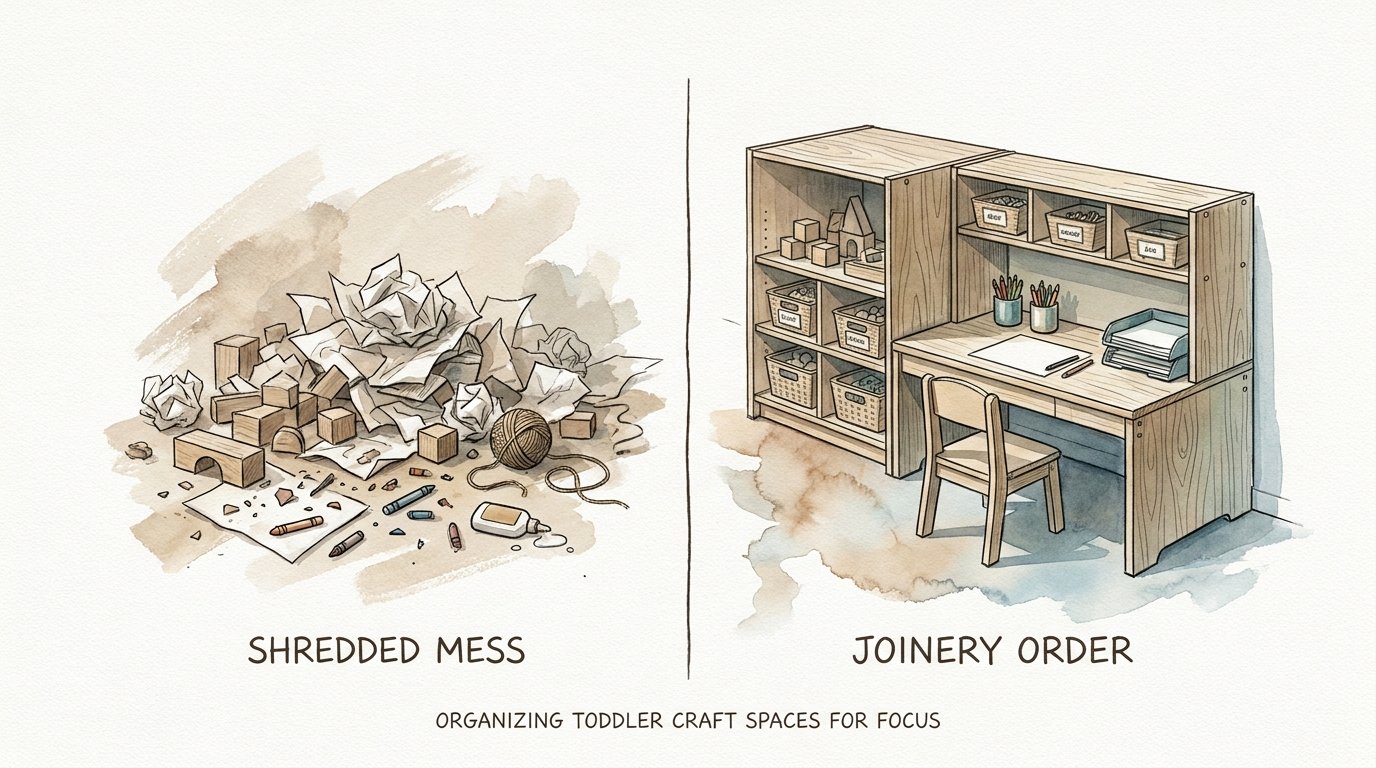
Organizing for focus means creating a “prepared environment” where every item has a clear purpose and a dedicated home. In this setup, we prioritize quality over quantity. Instead of a deep bin filled with random crayons, markers, and stickers, we offer a small tray with three specific colors and one type of paper. This is the difference between a SHREDDED MESS and a JOINERY ORDER.
This method exists because toddlers are naturally driven by a “sensitive period” for order. They crave predictability. When they know exactly where the glue stick lives, they don’t have to waste mental energy searching for it. That energy is instead redirected into the act of creating.
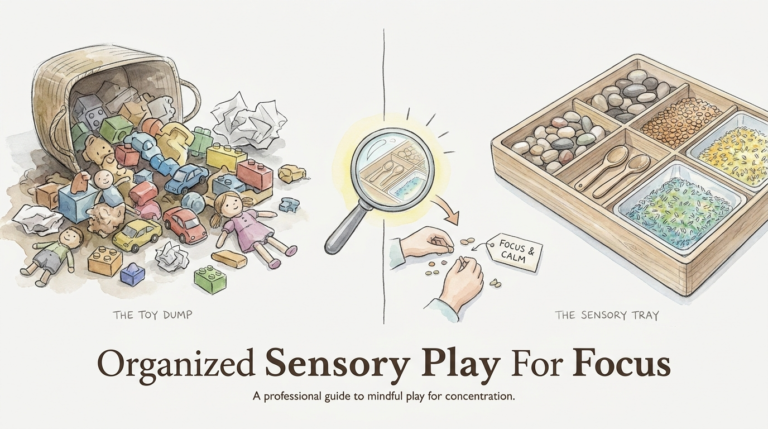
In the real world, this looks like low, open shelves where a child can see their options at a glance. It means using transparent containers so the materials themselves—not a colorful plastic box—are the star of the show. When a child sees a jar of smooth blue pebbles next to a tray of soft white cotton balls, their brain begins to categorize and compare before they even touch the materials.
How to Do It: The Subtraction Method
Subtraction is your most powerful tool. Most parents think they need more storage bins, but what they actually need is fewer items on the floor. Follow these steps to rebuild your space from the ground up.
First, clear the room entirely. You cannot organize a mess while you are standing in the middle of it. Take every craft supply and move it to a “neutral zone” like a kitchen table or the hallway. This gives you a blank canvas to work with.
Second, categorize your supplies ruthlessly. Group items by their physical properties rather than their “brand.” Put all the “sticky” things together (tape, glue, stickers). Group all the “marking” tools (crayons, chalk, pencils). This allows you to see exactly how much of each category you own.
Third, select only 10% of those items to put back. This is the hardest part. Choose one type of marking tool, one type of paper, and one “loose part” like pom-poms or feathers. Place these on a low shelf in separate, shallow trays. The rest goes into “deep storage”—a closet or high shelf that the child cannot reach.
Fourth, set up a rotation schedule. Every two weeks, swap the pom-poms for buttons or exchange the crayons for watercolor paints. This keeps the environment “new” without adding clutter. It ensures the child’s interest remains high because the invitation to play is constantly evolving.
Benefits of an Orderly Craft Space
The most immediate benefit is a massive increase in independent play. When a toddler can see and reach their own supplies, they don’t need to ask you for help every thirty seconds. They become the masters of their own creative process. This builds a deep sense of autonomy and confidence that stays with them long after the craft is finished.
Developmentally, a sorted space is a powerhouse for fine motor skills. Picking up a single sequin from a shallow tray requires more precision than grabbing a handful of junk from a box. These small, intentional movements prepare the hand for writing and more complex tasks later in life.
You are also teaching pre-math concepts without saying a word. Sorting by size, color, and texture is the foundation of algebraic thinking. When a child puts the “big” buttons in one jar and the “small” buttons in another, they are practicing categorization and logical reasoning. This is how the brain learns to make sense of a complex world.
Finally, an organized space reduces parental burnout. It is much easier to “reset” a shelf with three trays than it is to shovel a mountain of toys back into a toy box at the end of the day. You’ll find yourself saying “yes” to art more often because the cleanup is no longer a dreaded chore.
Challenges and Common Mistakes
The biggest mistake parents make is the “Too Much, Too Soon” trap. You might be tempted to put out all the beautiful supplies you just bought. Resist this urge. Too many choices lead to “choice paralysis,” where the child simply dumps the bins and walks away. If you see your child dumping more than they are playing, it is a clear sign that there are too many items on the shelf.
Another challenge is the lack of “defined work boundaries.” Without a specific place to work, the craft project will naturally migrate across the entire house. This creates a new kind of visual clutter that can feel overwhelming. Use a small child-sized table or a dedicated floor mat to signal where the “work” happens.
Consistency in the “reset” is also a frequent hurdle. An organized system only works if it is maintained. Many parents wait until the end of the week to clean up, but for a toddler, the mess becomes “white noise” within hours. Aim for a quick five-minute reset every evening to ensure the invitation is fresh for the next morning.
Limitations and Practical Boundaries
This method requires physical space for “backstock” storage. If you live in a tiny apartment, you might struggle to find a place to hide the 90% of supplies that aren’t in use. In these cases, you have to be even more ruthless with your initial purchases. Focus on multi-use materials that don’t take up much room.
High-energy toddlers may also struggle with this setup initially. If a child is in a “maximum effort” phase where they need to run, jump, and throw, a quiet sorting tray might not hold their attention. You have to meet their physical needs for gross motor movement before you can expect them to sit down for fine motor work.
Environmental factors like siblings can also disrupt the order. A younger baby who still mouths objects makes small “loose parts” like beads or buttons a safety hazard. You may need to use vertical space—placing the more complex trays on a higher shelf that only the older toddler can reach while keeping “baby-safe” items down low.
Comparing Storage Approaches
| Feature | The Dump Bin | The Invitation Tray |
|---|---|---|
| Visual Noise | High – Overwhelming | Low – Calming |
| Independence | Requires adult help to find things | Child-led and autonomous |
| Cleanup Time | Long and frustrating | Fast (under 2 minutes) |
| Focus Duration | Short – Child flits between items | Long – Deep engagement |
Practical Tips for Immediate Impact
Use low, open shelving that is at the child’s eye level. If they have to look up at a shelf, they can’t see the “invitation” you’ve set out. When the materials are right in their line of sight, the environment itself does the work of inviting them to play.
Swap plastic bins for baskets or wooden trays. Natural materials provide a better sensory experience and look much cleaner than brightly colored plastic. If you must use plastic, choose crystal-clear containers so the colors of the art supplies can shine through.
Labels are your best friend, but use pictures instead of words. A small photo of a crayon taped to the shelf helps a toddler understand exactly where that item belongs. This reinforces the “external order” that eventually becomes “internal order.”
Limit your color palette. Instead of putting out a box of 64 crayons, put out three that complement each other. This reduces the cognitive load of making a choice and allows the child to focus on the marks they are making rather than which color to pick next.
Advanced Considerations: The Theory of Loose Parts
Once your child is comfortable with the sorted environment, you can introduce “Loose Parts.” This theory, coined by architect Simon Nicholson, suggests that materials with no fixed purpose provide the greatest potential for creativity. Unlike a toy car that is always a car, a wooden ring can be a wheel, a donut, or a telescope.
In a craft space, loose parts look like collections of “bits and bobs.” Think of river stones, pinecones, metal washers, or fabric scraps. When these are sorted by texture and size into a tinker tray, they become an open-ended invitation to explore engineering and design.
The key to success with loose parts is the presentation. If you dump 100 sticks in a box, it’s a mess. If you stand 10 sticks upright in a heavy glass jar, it’s a sculpture. The way you “offer” the material dictates how the child will value and use it.
Example Scenario: The Button Sorting Invitation
Imagine you have a toddler who is currently obsessed with “matching.” You take a simple muffin tin and a small bowl of assorted buttons. Instead of just handing them the bowl, you place one red button in the first cup, one blue button in the second, and one yellow button in the third.
You place the tin and the bowl on a tray on their low shelf. You don’t say a word. You simply walk away.
Your toddler enters the room and sees the tray. Because the environment is clear and uncluttered, the muffin tin stands out like a beacon. They notice the single buttons in the cups and instinctively realize the “goal.” They spend twenty minutes carefully selecting buttons from the bowl and placing them in the matching cups. Because the task was presented clearly, their focus is locked in.
Final Thoughts
Subtracting the excess and sorting the essentials is not just about aesthetics. It is a strategic move to protect your child’s developing mind from the chaos of modern overstimulation. When you lower the visual noise, you raise the volume on their curiosity.
Start small. You don’t need to buy an expensive Montessori shelf system today. Just take one corner, remove the clutter, and set out one beautiful invitation to create. Watch how your child’s behavior changes when they are given the space to truly see what they are doing.
The goal is not a perfect house; the goal is a child who is deeply engaged with the world around them. By mastering the art of subtraction, you are giving them the greatest gift of all: the ability to focus. Experiment with your space this week and see how much more “opportunity” your child finds in the simple act of sorting.
Sources
1 theoldschoolhouse.com | 2 clearspaceliving.com | 3 sandwichmontessori.org | 4 irvinemontessoripreschool.com | 5 roselounsbury.com | 6 imthecheftoo.com | 7 monkibox.com | 8 learnquebec.ca | 9 gowriensw.com.au | 10 kvmontessoriacademy.com | 11 montessoribymom.com | 12 thegeniusofplay.org | 13 wordpress.com | 14 improvemotorskills.com | 15 toddlerapproved.com