Minimalist Daily Routine Charts For Adhd Kids
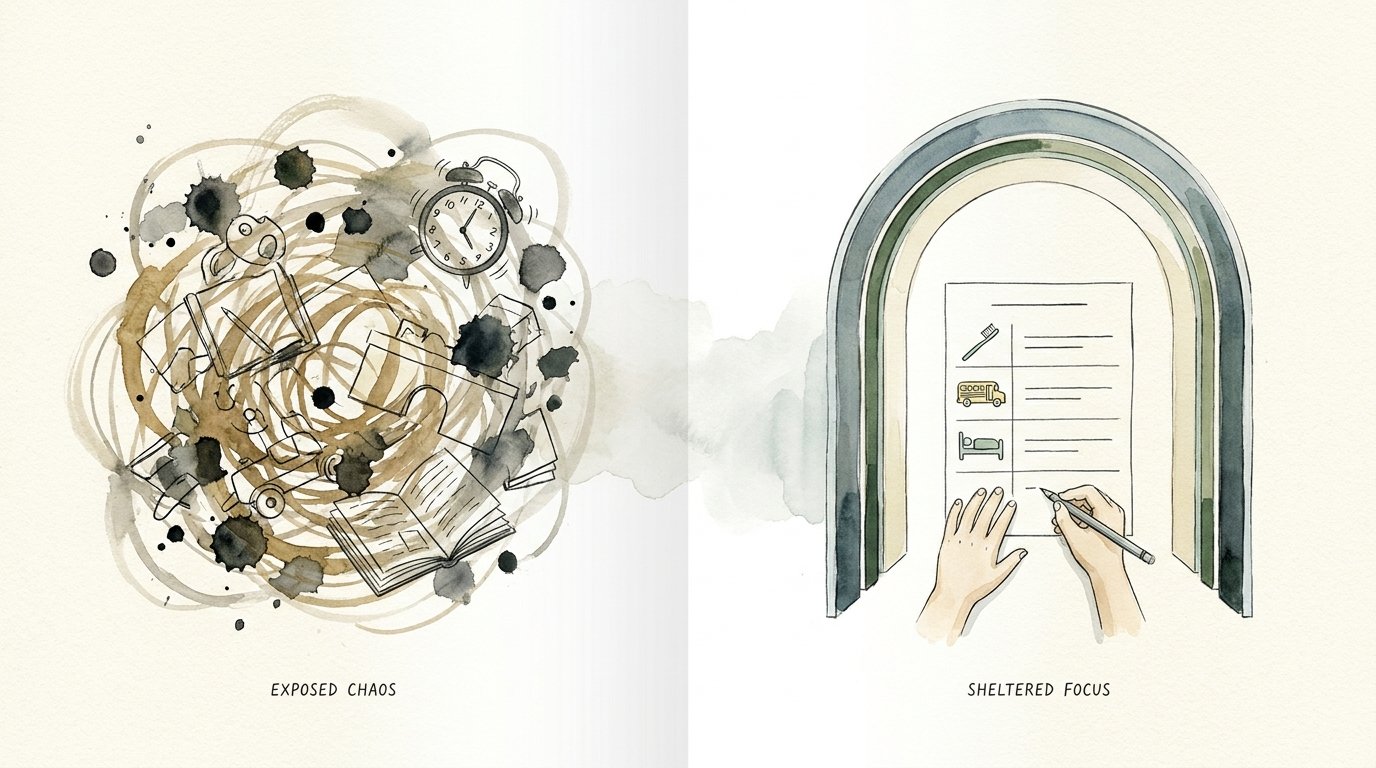
Is your routine chart helping them focus, or is it just adding to the visual noise of their day? When a child is ‘Exposed’ to too much information, their brain shuts down. Most routine charts are cluttered disasters. Sheltering their focus with a three-card system provides a cognitive sanctuary. Subtraction is the ultimate parenting hack.
Parenting a child with ADHD often feels like managing a constant storm of “What’s next?” and “I forgot.” You might have tried every colorful, 20-step wall calendar on Pinterest. Usually, those charts end up as background noise within a week. The reason is simple: ADHD brains struggle with filtering. If a chart has too many colors, too many steps, and too much text, the child’s executive function collapses under the weight of the information.
Minimalism isn’t just an aesthetic choice for neurodivergent families. It is a biological necessity. Reducing the “visual tax” on a child’s brain allows them to allocate their limited mental energy toward actually doing the tasks. Moving from a broad, overwhelming schedule to a tight, focused system changes the dynamic from nagging to guiding.
This guide explores the transition from chaotic, over-engineered schedules to streamlined, high-impact routine charts. You will learn how to build a system that works with the ADHD brain’s natural preference for triggers over time. We will dive deep into the specific mechanics of “Sheltered Focus” and why three simple cards can outperform a wall-sized whiteboard every single day.
Minimalist Daily Routine Charts For Adhd Kids
A minimalist daily routine chart is a visual tool stripped of everything except the absolute essentials. Most traditional charts try to map out the entire 24-hour cycle. They include times, durations, icons for every single brush stroke, and motivational quotes. For an ADHD child, this is a “cluttered disaster” that creates a sense of “Exposed Chaos.” Their brain sees the 15 items remaining and shuts down before task one even begins.
Minimalist charts focus on triggers and sequences rather than clocks. Because many children with ADHD experience “time blindness,” a chart that says “7:30 AM: Brush Teeth” is often useless. They don’t feel the 7:30 approaching. A minimalist chart replaces the clock with an “If-Then” logic. “If I finish breakfast, then I check my card.” This shifts the burden of time management from the child’s internal clock to an external physical prompt.
These systems usually exist in small, portable formats. Think index cards, small clipboards, or “First-Then” boards. The goal is to limit the child’s field of vision to only the immediate next steps. By “Sheltering” their focus, you are physically preventing their brain from wandering to the homework they have to do six hours from now. They only need to worry about what is on the card in front of them.
In the real world, this looks like a single card on the bathroom mirror with three icons. No more, no less. It exists at the “point of performance”—the exact place where the task needs to happen. This eliminates the need for the child to travel back and forth to a central “command center” in the kitchen, which is where most distractions live. The minimalist approach recognizes that every foot of travel is an opportunity for a child with ADHD to lose the “thread” of their intent.
How to Implement the Three-Card System
The transition to a three-card system requires a mindset shift from “more is better” to “less is powerful.” You are not just listing chores; you are designing a low-friction path for their brain. Follow these steps to build a system that sticks.
Step 1: Identify the Critical Zones
Divide the day into three high-stress “Zones.” For most families, these are Morning Launch, After-School Transition, and Wind-Down. Do not attempt to chart the entire day. Focus only on the windows where executive function typically fails. Each zone gets exactly one card. This physical separation prevents the child from feeling the “weight” of the evening during the morning rush.
Step 2: The Rule of Three
Each card should have a maximum of three tasks. If a routine requires seven steps, group them into three “clusters.” For example, “Hygiene” can be one cluster that includes brushing teeth, washing face, and hair. ADHD brains process “three” as a manageable set. “Four” often starts to feel like an endless list. If they finish the three tasks, they are done with that card. This provides a frequent and hit of dopamine that keeps them engaged.
Step 3: Use Visual Triggers
Replace as much text as possible with icons or photos. High-energy colors should be used sparingly to highlight the most important action. A photo of the child actually doing the task—like sitting at their desk with their backpack—is more effective than a generic icon. This uses “pattern recognition” rather than “active reading,” which places less demand on their working memory.
Step 4: Create a “Done” Action
The system must be interactive. Moving a card from a “To-Do” slot to a “Done” slot, or flipping a card over, provides physical feedback. This kinesthetic movement signals to the brain that a cycle has been completed. Without this physical reset, the chart eventually becomes just another piece of paper on the wall that the child “looks through” rather than “at.”
Benefits of Sheltered Focus
Adopting a minimalist approach provides measurable improvements in both child behavior and parent stress levels. The primary benefit is the reduction of Cognitive Load. Every choice a child has to make—like “What do I do first?”—depletes their limited reserve of self-regulation. Minimalist charts remove the need for decision-making.
Independence is the long-term goal. When a child follows a simple, three-step card, they are practicing “self-cueing.” They stop looking at the parent for the next instruction and start looking at the tool. This breaks the cycle of “prompt dependency,” where a child only moves when a parent nags. Over time, the physical card builds a mental “track” that the child can eventually follow without the aid.
Anxiety reduction is another critical advantage. ADHD often comes with a side of “anticipatory anxiety”—the fear of the unknown or the feeling that there is too much to do. A cluttered chart reinforces the “too much” feeling. A minimalist card reinforces the “I can handle this” feeling. Knowing exactly what is expected—and seeing that it is only three things—lowers the heart rate and reduces the likelihood of a morning meltdown.
Family harmony improves because the chart becomes the “boss.” Instead of the parent saying, “I told you three times to put your shoes on,” the parent can simply point to the card and ask, “What does the card say?” This shifts the conflict away from the parent-child relationship. The parent becomes a coach helping the child follow the system, rather than an adversary enforcing a list.
Challenges and Common Mistakes
The most common mistake is “Scope Creep.” Parents start with three tasks, but then think, “Well, they should also feed the dog, and clear their plate, and check their folder.” Suddenly, the minimalist card is a cluttered disaster again. You must guard the “Rule of Three” fiercely. If you add something, something else must come off. The goal is success, not total coverage of every possible chore.
Another pitfall is “Set it and Forget it.” No system is a magic wand. An ADHD child will still need initial support to learn how to use the cards. Parents often get frustrated when the child ignores the new chart after three days. This “novelty fade” is a hallmark of ADHD. To combat this, you must keep the system “live” by checking in, offering praise for using the card, and occasionally swapping out the icons to keep the visual fresh.
Focusing on Time rather than Task is a frequent error. Setting a hard time like “7:45 AM” creates a high-pressure environment that often leads to “shutdown.” If the child gets “behind” the clock, they may give up entirely. Minimalist charts should focus on the sequence. “First this, then that.” Using a visual timer (like a shrinking red disk) is a better way to handle time than a digital clock, as it makes the concept of “remaining time” tangible.
Limitations of Minimalist Charts
Minimalist charts are not a “cure” for executive dysfunction. They are a scaffold. This method may not work well for children who are in a state of high emotional dysregulation. If a child is having a sensory meltdown, showing them a card will not help; they need co-regulation first. The chart is for the “steady state,” not the “crisis state.”
Environmental factors can also limit effectiveness. If the home is physically cluttered, even the most minimalist chart will struggle to stand out. The “Sheltered Focus” of the card needs a relatively “Sheltered” environment to be effective. If the card is placed next to a loud TV or a pile of distracting toys, the visual cue will lose the battle for the child’s attention.
For some children, especially those with comorbid conditions like PDA (Pathological Demand Avoidance), any chart can feel like a direct threat to their autonomy. In these cases, the “Rule of Three” might still feel like “Three Demands.” These children may require a more collaborative approach where they help design the cards or where the cards are framed as “reminders for the brain” rather than “orders from the parent.”
Comparison: Traditional vs. Minimalist Routines
| Feature | Traditional Routine Chart | Minimalist 3-Card System |
|---|---|---|
| Visual Density | High (10-20 items, many colors) | Low (3 items, high contrast) |
| Primary Focus | The whole day (Macro) | The current zone (Micro) |
| Time Management | Clock-based (Digital/Analog times) | Trigger-based (If-Then sequences) |
| Cognitive Tax | High (Requires filtering and planning) | Low (Requires only execution) |
| Success Rate | High initial interest, fast fade | Sustainable through habit loops |
Practical Tips for Setup and Maintenance
Creating the physical cards is a one-time investment that pays off for months. Use heavy cardstock and laminate the cards if possible. Lamination allows you to use dry-erase markers for “checking off” boxes, which adds a tactile element to the routine. If you don’t have a laminator, clear packing tape over the card works just as well.
Velcro is your best friend. Use “hook and loop” dots to attach the cards to specific locations. One set of dots goes on the bathroom mirror, another on the back of the front door, and another on the desk. The child can move the “Morning Card” from the mirror to the door as they progress through the house. This physical movement of the chart itself keeps the child’s attention anchored to the goal.
- Place cards at eye level for the child, not for you.
- Use high-contrast colors (Black on Yellow or White on Blue) for maximum readability.
- Include one “blank” slot on the card for a “Wildcard” task that changes daily.
- Pair the card with a specific song. When the “Morning Playlist” starts, the card is activated.
- Keep a “Backup Stack” of cards for unusual days (like “No School” or “Doctor Visit”).
Maintenance is about “The Sunday Reset.” Every Sunday evening, spend five minutes with your child reviewing the cards. Ask them, “Which part of this was hard last week?” If they consistently struggle with step two, move it to step one or break it down further. Involving the child in the “system engineering” gives them a sense of agency and reduces the feeling of being controlled.
Advanced Considerations for Scaling
As the child grows, the minimalist system can evolve into a digital format, but the principles of “Sheltered Focus” must remain. Digital tools often introduce more distractions (notifications, other apps). If moving to a tablet or phone, use an app that allows for a “Focus Mode,” where only the current three tasks are visible. The goal is to avoid the “Exposed Chaos” of a full digital calendar.
Scaling for multiple children requires individual systems. Do not put two children on the same card. ADHD brains need a 1:1 relationship with their cues. You can color-code the cards (e.g., Sarah is Green, Leo is Blue) so they can quickly identify their own “Sanctuary” of focus amidst the family noise. This individualization respects each child’s specific executive function level.
Think about the “Transition Buffers.” For older kids, the three tasks on a card might be more complex. You might include a “Buffer Task” as the third item, such as “5 minutes of listening to music.” This builds a reward and a transition period directly into the routine. This advanced technique helps the brain decompress between “Zones” and reduces the likelihood of “transition shock.”
Example Scenario: The Tuesday Morning Rush
Imagine a typical Tuesday. In the “Exposed Chaos” model, the child wakes up to a kitchen wall calendar with 12 items. They see “Pack Lunch,” “Math Homework,” and “Soccer Practice” all at once. Their brain fixates on the soccer game that is 8 hours away. They forget to put on socks. The parent yells from the kitchen. The child gets defensive. The day starts in a state of high cortisol.
In the “Sheltered Focus” model, the child wakes up and sees one Morning Card on their nightstand. It has three icons: 1. Clothes On, 2. Bed Made, 3. Go to Kitchen. They don’t see anything about soccer or math yet. They put on their clothes and move the card to the “Kitchen Dot.”
Once in the kitchen, they flip the card (or check the back) for the next three: 1. Eat Breakfast, 2. Shoes On, 3. Backpack at Door. Because the “horizon” of their day is limited to just these three actions, they move through them with less friction. They arrive at the door with their backpack. The parent doesn’t have to yell. The child feels successful because they “cleared” two cards before even leaving the house.
Final Thoughts
Minimalist daily routine charts are not about doing less; they are about making “doing” possible. By shifting from a cluttered, time-based schedule to a trigger-based three-card system, you provide your child with the “Sheltered Focus” their brain craves. You are moving from a world of “Exposed Chaos” to one of predictable, manageable success.
Implementing this system requires discipline from the parent to keep things simple. Resist the urge to add “just one more thing.” Trust the “Rule of Three” and the power of subtraction. When you reduce the visual noise, you amplify the child’s ability to succeed. Start with one zone—perhaps just the morning—and watch how a small change in layout leads to a massive change in behavior.
Experiment with different visuals and physical setups. Every ADHD brain is unique, and the “perfect” minimalist chart is the one your child actually uses. Stick to the principles of triggers, sequences, and limited items. You aren’t just organizing their day; you are building their confidence, one card at a time.
Sources
1 theladdermethod.com | 2 substack.com | 3 rivetalabs.com | 4 thruday.com | 5 betweensessions.com | 6 kidsinmotiontherapies.com | 7 busybudgeter.com | 8 myskylight.com | 9 summitcounseling.org | 10 lifestance.com