Dynamic Routine Charts For Children Vs Static Lists
Does your routine break the moment you’re 5 minutes late? Most routine charts fail because they are ‘static’—one glitch in the morning and the whole day is ruined. A dynamic rhythm chart focuses on the sequence of events, not the hands on the clock. It teaches your child to follow the flow of life, not the pressure of the deadline.
Imagine a morning that doesn’t end in a shouting match because the bus is coming in three minutes. Think about a bedtime that feels like a gentle slide into sleep rather than a high-stakes negotiation. This shift from “what time is it” to “what comes next” is the secret to a peaceful home. You are about to discover how to move from rigid lists to a living, breathing daily rhythm.
Rhythm is more than just a schedule; it is the heartbeat of your household. It provides the structure your child’s nervous system craves while offering the flexibility your actual life demands. Whether you are managing a neurodivergent household or just trying to survive the toddler years, this approach changes everything.
Dynamic Routine Charts For Children Vs Static Lists
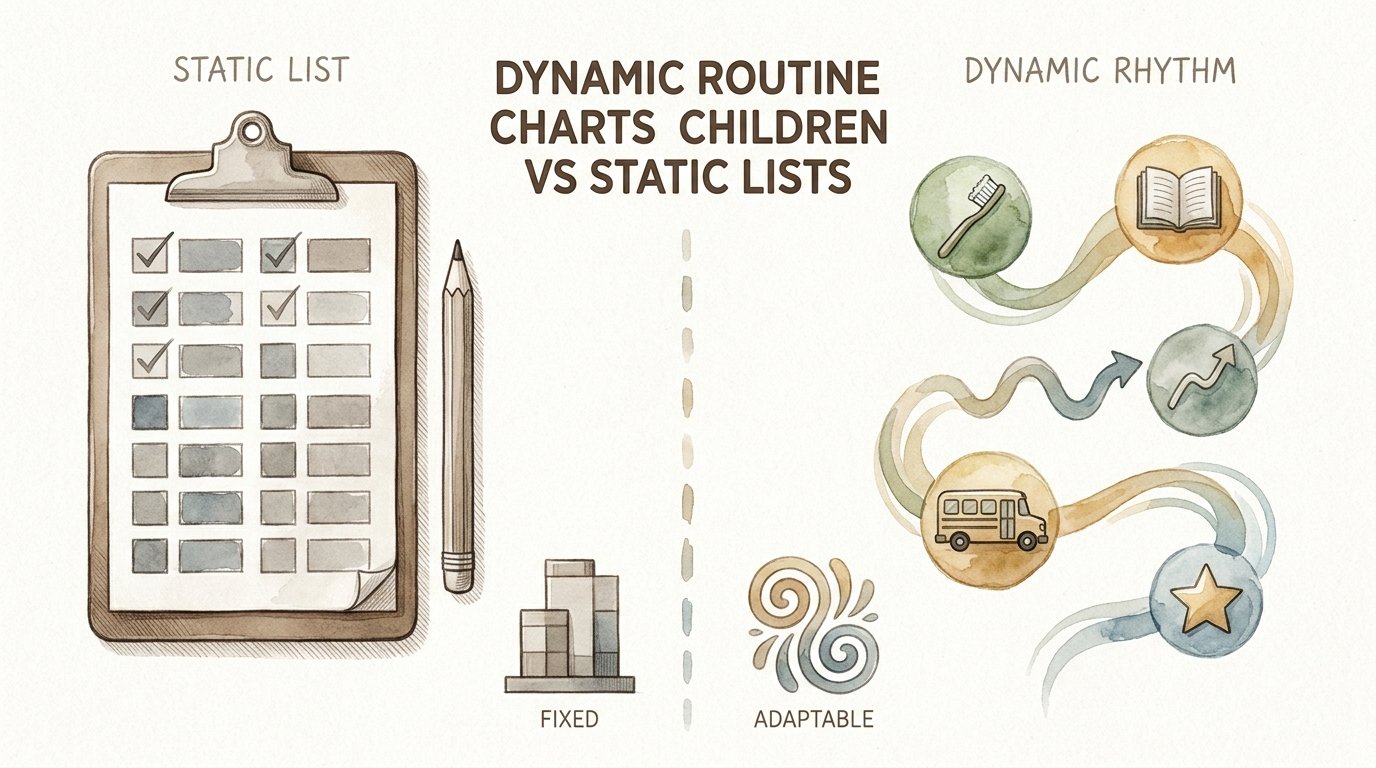
A static list is a rigid snapshot of what “should” happen. It usually looks like a series of checkboxes or a strict timetable pinned to the fridge. “7:00 AM: Wake up. 7:15 AM: Eat breakfast. 7:30 AM: Brush teeth.” If your child wakes up at 7:10 AM, the static list immediately signals a failure. The pressure begins before the day has even started.
A dynamic rhythm chart, on the other hand, is a flow-based system. It prioritizes the sequence of events over the exact time they occur. Instead of looking at the clock, your child looks at the flow. They know that breakfast always follows waking up, and teeth brushing always follows breakfast. The order remains the same, even if the timing shifts.
Think of it like a playlist versus a live radio broadcast. A static list is the radio—if you tune in late, you missed the song. A dynamic rhythm is the playlist—you can hit play whenever you are ready, and the songs still follow the same beautiful order. This flexibility reduces “ambient anxiety,” which is the low-level stress children feel when they aren’t sure what is expected of them.
Real-world applications of dynamic rhythms are found in Montessori and Waldorf classrooms. These environments rarely use loud bells to signify transitions. Instead, they use “anchor points” and “bridge activities.” In a home setting, this means your “Morning Rhythm” card is a sequence that travels with you, whether you start at 6:00 AM or 8:30 AM on a Saturday.
How to Create a Dynamic Rhythm Chart
Creating a dynamic system requires a shift in how you view your day. You aren’t just listing chores; you are mapping out energy flows. Start by observing your family’s natural patterns for three days. Note when the energy is high (usually after a meal) and when it is low (usually mid-afternoon).
Identify your “Anchor Points.” These are the non-negotiable events that keep the day grounded. Common anchors include mealtimes, nap times, and the “outside time” transition. Once you have these anchors, you build your rhythm around them. You don’t need a hundred steps; five to seven clear stages are often enough for a powerful rhythm.
Step 1: Choose Your Format. For young children, use photos of them actually doing the task. Seeing their own face brushing teeth is much more powerful than a cartoon icon. Use a “Move-Over” system. A simple way to do this is with a board that has a “To Do” side and a “Done” side. When the task is finished, the child physically moves the card. This provides a hit of dopamine and a clear visual of progress.
Step 2: Sequence by Energy. Avoid putting two high-energy or high-resistance tasks back-to-back. If putting on shoes is a struggle, follow it with a high-value “bridge” like a quick morning song or a snack. This creates a “First, Then” psychological flow. “First we put on shoes, then we go to the park.”
Step 3: Define the “Bridge.” Transitions are where meltdowns happen. A bridge is a ritual that signals one activity is ending and another is beginning. This could be a specific song you play during cleanup or a five-minute “warning cuddle” before the bedtime rhythm starts. These bridges make the dynamic chart feel like a natural progression rather than a series of demands.
Step 4: Introduce the System. Don’t just hang the chart and expect it to work. Walk through it together. Use the language of “What’s next?” instead of “Go do this.” This subtle shift in phrasing puts the chart in charge, not the parent. It reduces power struggles because the “rhythm” is the boss.
The Measurable Benefits of Rhythmic Flow
The most immediate benefit is a significant reduction in transition-related meltdowns. Most children resist change because it feels abrupt and out of their control. When they can see the sequence on a dynamic chart, they feel a sense of agency. They know exactly what is coming, which lowers the “threat-monitoring” state of their brain.
Executive function skills are another major win. Executive function is the “air traffic control” of the brain—it handles planning, focus, and multi-tasking. For children with ADHD or autism, these skills are often delayed. A dynamic rhythm acts as an external executive function. It holds the “plan” so the child doesn’t have to waste mental energy trying to remember what they are supposed to do next.
Independence grows naturally in this environment. When a child doesn’t need to ask “What do I do now?” ten times a morning, they start to trust their own ability to navigate the day. This builds self-esteem and competence. Parents often find they can finally drink a hot cup of coffee while their child moves through the first three steps of the morning rhythm autonomously.
Family connection improves when you stop being a drill sergeant. When the chart handles the “nagging,” you are free to be the support system. Instead of “Did you brush your hair yet?” you can say, “I see you’re on the grooming step—do you want the blue brush or the green one?” You move from a position of opposition to one of partnership.
Common Challenges and Pitfalls to Avoid
The biggest mistake is making the rhythm too complicated. If your chart has 15 steps for a three-year-old, it will fail. Toddlers can generally handle 3 to 5 steps in a sequence. Older children can handle more, but even then, “clumping” tasks into groups (like “The Morning Three”) is more effective than a granular list.
Another pitfall is being too rigid with the “dynamic” part. If you start treating the sequence as an unbreakable law, you’ve just created a static list without the times. The beauty of a rhythm is that it can “breathe.” If your child is deeply engaged in creative play, the rhythm allows you to delay the next step without “breaking” the day. The sequence remains, but the timing is elastic.
Avoid “The Empty Fridge” syndrome. This happens when parents create a beautiful chart but forget to keep the supplies ready. If the rhythm says “Art Time,” but the markers are dried up and the paper is gone, the flow breaks. A dynamic rhythm requires the environment to be prepared in advance.
Failing to model the rhythm is a common error. Children follow your energy, not just your instructions. If you are rushing around frantically while telling them to follow their “calm morning rhythm,” they will absorb the frantic energy. You must embody the flow you want them to adopt.
When a Dynamic Rhythm Might Not Be Ideal
While rhythms are incredibly powerful, there are times when they require a different approach. Highly scheduled environments, like a day with multiple back-to-back therapy appointments or sports practices, might require a hybrid model. In these cases, you still follow a sequence, but the “clock” becomes a more prominent anchor.
Environmental limitations also play a role. If you are traveling or living in a temporary space, a physical chart might be hard to maintain. In these situations, “Micro-Rhythms”—short, memorized 3-step sequences—are better than a full-scale chart.
Some children with extreme “Demand Avoidance” (PDA) may initially resist any form of visual structure, even a flexible one. For these children, the rhythm needs to be even more collaborative and choice-based. The chart should be presented as a “menu of options” or a “game board” rather than a set of expectations.
Static Lists vs. Dynamic Rhythms Comparison
| Feature | Static List | Dynamic Rhythm |
|---|---|---|
| Primary Focus | Clock Time / Deadlines | Sequence / Flow |
| Flexibility | Low; easily broken | High; adapts to daily needs |
| Psychological Impact | Pressure and potential “failure” | Security and predictability |
| Independence | Dependent on parental reminders | Promotes self-guided navigation |
| Best For | One-off events or appointments | Daily life and habit building |
Best Practices for Long-Term Success
Consistency is the foundation. It takes about two weeks for a child to fully internalize a new rhythm. During this period, be a “gentle guide.” Stay near the chart and offer verbal cues that point back to the visuals. “Let’s see what the chart says is next!” is your most powerful tool.
Use “In-Between” cards. Sometimes life happens—a phone call, a package at the door, or a minor injury. Have a “Pause” or “Wait” card that you can place on the chart. This teaches the child that life can be interrupted, but the rhythm will always be there to come back to. This is a vital skill for emotional regulation.
Involve the child in the creation of the visuals. If they help draw the pictures or choose the stickers, they will have “buy-in.” They aren’t just following your rules; they are following *their* plan. For older kids, let them decide the order of certain blocks. “Do you want to do homework first, or go outside for 20 minutes first?”
Update the rhythm seasonally. A “Summer Rhythm” should look very different from a “School Year Rhythm.” In the summer, the anchors might be more fluid, and the blocks of “Free Play” or “Nature Exploration” might be longer. This prevents the system from becoming stale or irrelevant.
Advanced Considerations: Co-Regulation and Brain State
For a dynamic rhythm to work, you must understand the concept of co-regulation. A chart is a tool, but you are the engine. If a child is in a “Red Zone” brain state (meltdown or fight-or-flight), they cannot process the information on a chart. In these moments, you put the rhythm on pause and focus on connection.
Once the child is regulated, you use the rhythm to bring them back to safety. The predictability of the “what’s next” acts as a tether. This is why rhythms are so effective for neurodivergent children—they provide a “scaffold” for a brain that is easily overwhelmed by the environment.
Think about “Sensory Stacking.” If your child has sensory processing needs, build those into the rhythm. For example, if “School Work” is a mentally taxing task, the step immediately following it should be a sensory “reset,” like jumping on a trampoline or heavy work like carrying laundry. This ensures the child’s brain is primed for the next task.
Realistic Examples and Scenarios
Let’s look at a “Slow Morning” versus a “Fast Morning.” In a static world, the Fast Morning is a disaster. In a dynamic world, it’s just a faster version of the same song.
Scenario 1: The Standard Morning. The child wakes up at 7:00 AM. They follow the cards: Wake Up -> Toilet -> Dress -> Breakfast -> Pack Bag -> Shoes -> Out the Door. Everything is calm.
Scenario 2: The Late Start. The child wakes up at 7:45 AM due to a late night. Instead of panic, you skip the “Free Play” block but keep the sequence. They still go Toilet -> Dress -> Breakfast. Because the sequence is familiar, the child doesn’t feel the “chaos” of being late. They just feel the flow moving a little faster.
Scenario 3: The Sick Day. The child is unwell. You don’t throw the chart away. You simply swap out the “Park Time” card for a “Movie/Rest” card. The sequence—Lunch -> Rest -> Snack—remains intact. The child feels safe because the “rules of the day” still apply, even though the activities have changed.
Final Thoughts
Moving from static lists to dynamic rhythms is more than an organizational hack; it is a lifestyle shift. It requires you to trade the illusion of control for the reality of connection. By focusing on the flow of your family’s life rather than the ticking of a clock, you create an environment where children can thrive, learn, and grow.
This system respects the developmental stage of the child while providing the structure needed for a functional home. It reduces the need for constant verbal instructions and replaces them with a visual roadmap that empowers your child. You will find that as your child masters their rhythm, the entire atmosphere of your home becomes lighter and more joyful.
Start small. Choose one part of your day—perhaps the morning or the hour before bed—and create a simple 3-step dynamic sequence. Watch how your child responds. Be patient with the process and with yourself. You are building a foundation of security and independence that will serve your child for a lifetime. If you’re interested in more ways to support your child’s growth, consider exploring visual timers or sensory-friendly home setups to further enhance your daily flow.
Sources
1 alabamawaldorf.org | 2 ourhomespunhappiness.com | 3 caratyrrell.com | 4 montessoriinreallife.com | 5 educatly.com | 6 sensorypoodle.com.au | 7 starglowmedia.com | 8 rayzkidz.com | 9 hopekidsot.com.au | 10 magnoliabehaviortherapy.com | 11 livingmontessori.com | 12 snipits.com | 13 discerningparenting.com