Child Screen Withdrawal Tantrums
If their emotional stability dies at 0% battery, the device isn’t a toy—it’s a tether. We thought we were buying a tool for quiet, but we might have been building a fragile nervous system. True resilience isn’t found in an app; it’s found in the ability to sit with one’s own thoughts without a digital escape hatch.
When a child’s world revolves around the next level or the next video, the real world starts to feel dull. This isn’t just about bad behavior. It is about how the brain responds to high-speed stimulation. Understanding this shift is the first step toward reclaiming your home and your child’s focus.
In practical terms, we are seeing a generation that struggles to transition. They are wired for instant feedback. When that feedback stops, the system crashes. This article explores why this happens and how to fix it without losing your mind.
Child Screen Withdrawal Tantrums
Child screen withdrawal tantrums are intense emotional outbursts that occur when a digital device is removed. These aren’t your typical “I want a cookie” meltdowns. They are physiological reactions to a sudden drop in stimulation. Researchers often refer to this as “Gadget Separation Distress.”
When a child is immersed in a screen, their brain is flooded with dopamine. This is the “feel-good” neurotransmitter responsible for reward and motivation. The device provides a constant, predictable stream of this chemical. When you take the tablet away, the dopamine supply is cut off instantly. The brain experiences a “crash,” leading to irritability, aggression, and deep frustration.
Think of it like a physiological cliff. One moment they are at an emotional high; the next, they are in a neurochemical valley. This is why a child who was perfectly calm two minutes ago can suddenly scream as if they are in physical pain. They aren’t just being defiant—they are experiencing a form of withdrawal.
These tantrums often appear in children as young as one year old. As screens become more integrated into daily life, these episodes become more frequent. They happen because the child’s prefrontal cortex—the part of the brain responsible for self-control—is still under construction. They literally do not have the hardware yet to handle the “come down” from high-intensity digital play.
The Neurobiology of the Digital High
How do these devices hold such a grip? It starts with the reward system. Digital content, especially short-form videos and games, is engineered to be hyper-stimulating. Every “ding,” every new level, and every “next” video triggers a small dopamine hit. This creates a loop.
Over time, the brain becomes desensitized. It begins to require more stimulation to feel the same level of “normal.” This is known as tolerance. When a child isn’t on a screen, the real world feels slow and unrewarding. Homework, chores, and even traditional play can’t compete with the rapid-fire feedback of an algorithm.
The Prefrontal Cortex vs. The Amygdala
The prefrontal cortex handles “top-down” regulation. This includes planning, focus, and emotional control. Excessive screen time has been linked to a thinning of this area in young children. Meanwhile, the amygdala, which handles “bottom-up” emotional responses, stays highly active.
When you pull the plug, the amygdala takes over. The child enters a “fight-or-flight” state. Their heart rate increases, and their muscles tense. They are reacting to an “imagined peril”—the loss of their primary source of regulation.
How to Navigate the Digital Transition
Ending a screen session shouldn’t feel like a surprise attack. You need a bridge between the digital world and reality. Here is how to build it:
Set Clear Expectations Before You Start
Always define the “end” before the “beginning.” Don’t just say “a little bit.” Say, “You can watch two episodes” or “You have thirty minutes.” Visual timers are incredibly helpful here. Seeing the red sliver of time disappear helps a child internalize that the end is coming.
Use Tech-Mediated Transitions
Research shows that transitions are smoother when the technology ends the session, not the parent. If a show ends naturally, the child is more likely to accept it. Setting an automatic “sleep” timer on the TV or tablet can take the “villain” role off the parent and put it on the device.
The “Bridge” Activity
Never transition from a high-dopamine activity (gaming) to a low-dopamine chore (cleaning the room). Use a middle-ground activity. This could be a snack, a quick walk outside, or five minutes of rough-and-tumble play. This helps the brain slowly recalibrate to a normal speed.
Co-Engagement
When you can, watch or play with them. This turns a solitary, passive experience into a social one. It keeps the child’s “social brain” online, making it easier for them to pull back into the real world when time is up.
The Resilience Dividend: Benefits of Boundaries
Setting strict limits on screen time isn’t about being “mean.” it’s about neuro-protection. When you successfully manage the digital intake, you see measurable improvements in several areas:
- Improved Emotional Regulation: Children who aren’t constantly “spiked” by dopamine learn to manage boredom and frustration.
- Better Sleep Quality: Reducing blue light exposure, especially in the hour before bed, allows melatonin to rise naturally. This leads to faster sleep onset and fewer night wakings.
- Increased Focus: Real-world tasks require sustained attention. By limiting rapid-fire content, you allow the child’s focus to “stretch” and strengthen.
- Enhanced Social Skills: Screens are a one-way street. Real life requires reading faces and taking turns. Reducing screen time creates more space for these vital interactions.
Parents often report that after an initial “detox” period of 3 to 7 days, their children become more imaginative and less prone to random outbursts. The “boredom” they once feared becomes the fuel for creative play.
Common Mistakes in Managing Screens
Even well-meaning parents fall into traps that make tantrums worse. Recognizing these pitfalls is half the battle.
Using Screens as a “Pacifier”
When a child is already having a meltdown and you hand them a phone to quiet them, you are reinforcing the behavior. The brain learns: “If I scream loud enough, I get the dopamine.” This creates a vicious cycle of more tantrums to get more screen time.
The “Five More Minutes” Trap
Inconsistency is the enemy of regulation. If you say “five minutes” and then let it slide to twenty, the child learns that your boundaries are negotiable. This leads to more arguing and “bargaining” every time the device needs to go away.
Ignoring the Content Quality
Not all screen time is equal. Passive scrolling (YouTube Kids, TikTok) is significantly more draining and dysregulating than active creation (coding, digital art, or strategic games). Watching “junk” content is like feeding the brain sugar; it results in a massive crash later.
The Limitations of a “Screen-Free” Ideal
While a total digital detox sounds great in theory, it isn’t always practical or ideal. We live in a digital world. Completely shielding a child can sometimes lead to “forbidden fruit” syndrome, where they gorge on technology the moment they are out of your sight.
Environmental factors matter. If you live in a tiny apartment during a blizzard, a tablet might be a temporary necessity for your own mental health. That is okay. The goal isn’t perfection; it’s balance.
Additionally, children with certain neurodivergent profiles (like ADHD or Autism) may find screens to be a legitimate tool for sensory regulation. In these cases, the “withdrawal” might be more intense because the screen was serving a specific therapeutic function. Always consult with a specialist if you feel the behavior is beyond standard developmental limits.
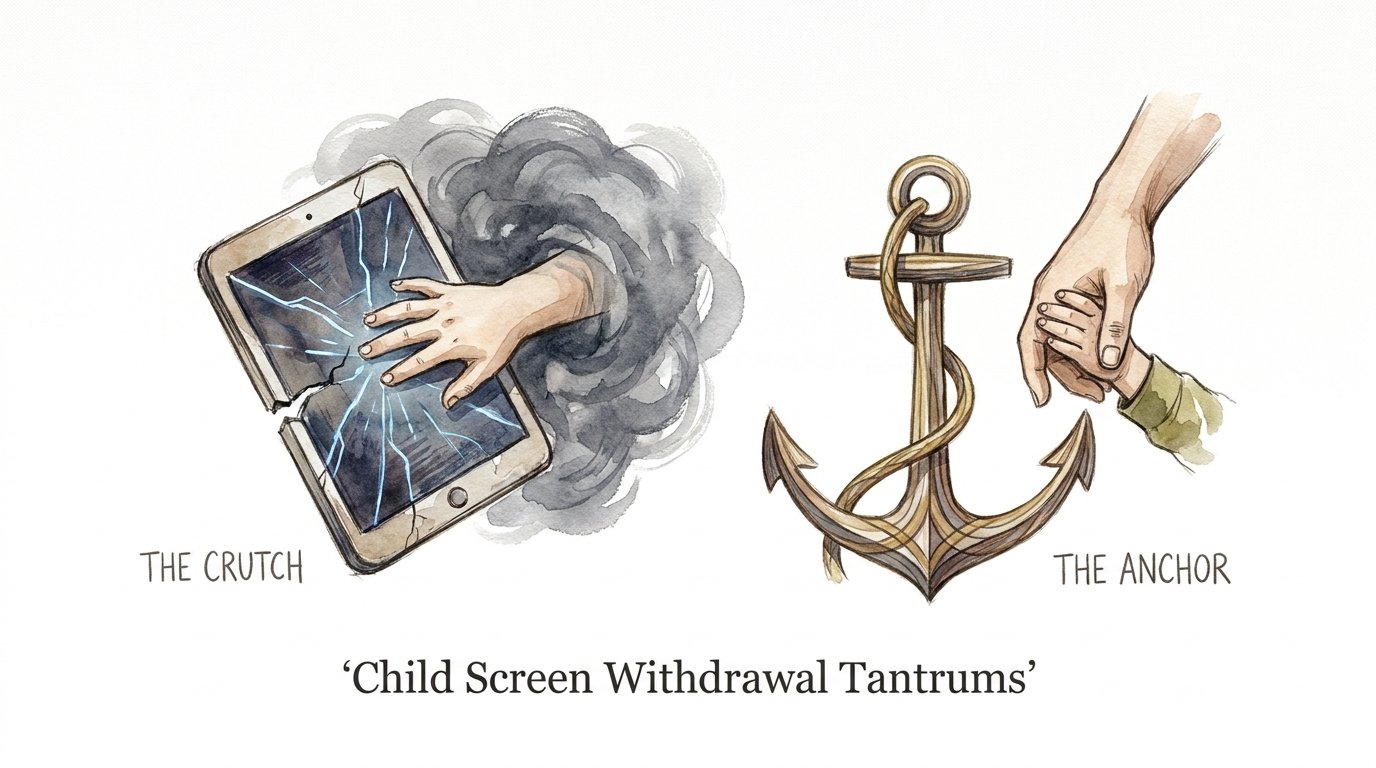
The Crutch vs. The Anchor: A Comparison
In parenting, we often choose between the “crutch” and the “anchor.” A crutch helps you get through a difficult moment but leaves you weaker in the long run. An anchor holds you steady by connecting you to something solid.
| Feature | The Crutch (The Screen) | The Anchor (Real-World Skills) |
|---|---|---|
| Immediate Effect | Instant quiet and compliance. | Initial resistance or effort. |
| Long-Term Result | Fragile nervous system; low tolerance. | Resilience; emotional maturity. |
| Maintenance | Requires constant updates and battery. | Requires parental time and patience. |
| Skill Level | Passive consumption. | Active problem solving. |
The screen is the ultimate crutch. It stops the crying now but guarantees a harder battle tomorrow. The anchor—teaching them to sit with their feelings—is harder today, but it builds a child who can handle the storms of life.
Practical Tips for Immediate Implementation
Ready to change the dynamic? Start with these actionable steps today:
- Create “No-Tech” Zones: The dining table and bedrooms should be sacred. No exceptions. This builds a natural rhythm of “on” and “off” times.
- The “One-In, One-Out” Rule: For every 30 minutes of screen time, require 30 minutes of “Green Time” (outdoors) or physical activity.
- Model the Behavior: If you are constantly on your phone, they will see it as a necessity. Put your phone in a “parking lot” basket when you walk through the door.
- Narrate the Exit: Five minutes before the time is up, walk over and say, “I see you’re on the last level! That looks hard. When this level is over, we are going to set the table.” This helps their brain begin to “detach” before the physical removal.
These small adjustments shift the power dynamic. You are no longer the person “taking away” their fun; you are the person guiding the daily flow.
Advanced Considerations: Algorithmic Engineering
For parents of older children, it’s important to understand that these devices are not neutral tools. They are designed by “attention engineers” who use intermittent reinforcement schedules—the same mechanism used in slot machines.
Algorithms are designed to keep the user scrolling. The “Auto-play” feature is a direct attack on the child’s ability to stop. By explaining this to older kids, you give them “digital literacy.” You move from being the “boss” to being a teammate helping them fight against a system designed to “addict” them.
Scaling the Detox
If you are dealing with a severe case of withdrawal, consider a “Dopamine Reset.” This involves 48 to 72 hours of zero screens. This allows the brain’s receptors to start resetting. The first 24 hours will be difficult, but by day three, you will often see a different child emerge—one who is more present and less “foggy.”
Real-World Scenario: The Grocery Store Stand-Off
Imagine you are in the checkout line. Your four-year-old is exhausted and starts to whine. You reach for your phone to give them “just five minutes” of a cartoon so you can pay in peace.
The Theory in Action:
In this moment, the screen is a crutch. The child learns that whining leads to digital reward.
The Better Approach:
Instead of the screen, give them a job. “Can you help me put the lemons in the bag?” or “How many blue boxes do you see on the shelf?” This uses the prefrontal cortex for a task rather than bypassing it with a dopamine spike. It takes more work from you in the short term, but it builds the “anchor” they need to handle public spaces without a digital pacifier.
Final Thoughts
The screen isn’t the enemy, but the *habit* of using it as an emotional escape hatch is. We are raising children in a world that never stops moving, and our job is to teach them how to be still. If they can’t handle the silence of a car ride or the boredom of a waiting room, they are at the mercy of whatever device is in their hand.
Real resilience is a muscle. It is built every time a child feels a “big emotion” and learns to breathe through it rather than swiping it away. By managing the withdrawal tantrums and setting firm, loving boundaries, you aren’t just managing behavior—you are protecting their brain’s development.
Start small. Be consistent. Reclaim the quiet moments. Your child’s nervous system will thank you for it in the years to come. Encourage them to explore the world with their eyes, not just their thumbs.
Sources
1 healthychildren.org | 2 techhealthyfamilies.com | 3 childrenandscreens.org | 4 daar.com.au | 5 nurture.is | 6 americanbehavioralclinics.com | 7 youtube.com | 8 drroseann.com | 9 thejacobsladdergroup.org | 10 utah.edu | 11 expressable.com | 12 thejacobsladdergroup.org | 13 screenstrong.org | 14 choc.org | 15 childcareed.com | 16 cincinnatichildrens.org | 17 nih.gov | 18 thevoiceofearlychildhood.com | 19 childrenandscreens.org | 20 apa.org | 21 nih.gov