kids screen time post
Are you paying for digital pacifiers or investing in real imagination? Digital entertainment feels cheap until you calculate the cost of tablets, apps, and lost attention spans. Here is how to swap expensive tech for free developmental play.
The modern home has become a battlefield of blinking lights and dopamine loops. While we often view a $500 tablet as a one-time purchase for a “quiet afternoon,” the long-term price tag on a child’s cognitive development and a family’s budget is far higher than most realize.
Recent data from 2026 indicates that children aged 5 to 8 now average 3.5 hours of screen time daily, with many owning their own devices by age four. This shift isn’t just about money; it is about the “displacement hypothesis,” where digital consumption crowds out the tactile, high-impact experiences needed for a healthy brain.
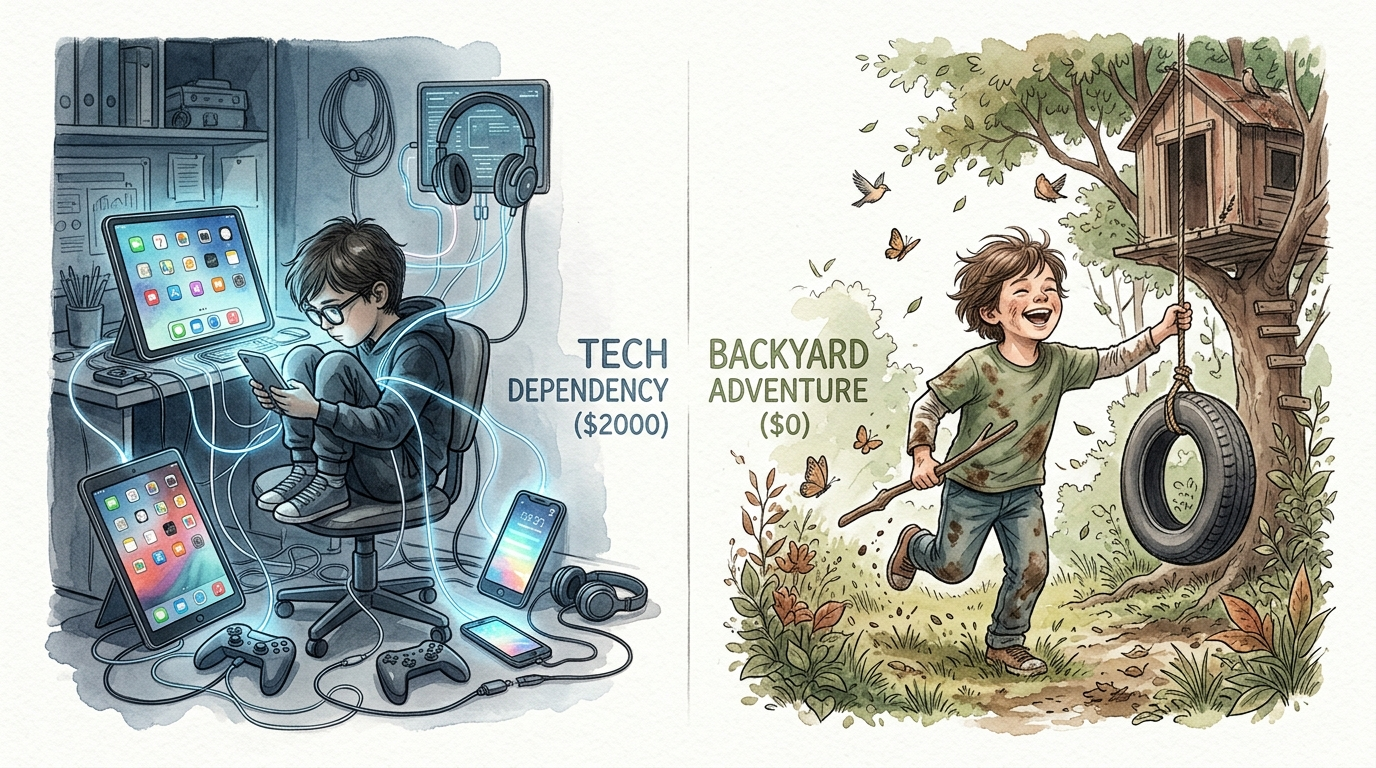
You do not need an expensive STEM subscription or a “smart” doll to raise a brilliant child. In fact, the most powerful developmental tools are often found in your recycling bin or the local park. This guide will show you how to move from a $2,000 Tech Dependency toward a $0 Backyard Adventure.
kids screen time post
The “kids screen time post” is a cultural touchpoint for a reason: it represents the collective anxiety of a generation raising “digital natives.” Screen time refers to any time spent using a device with a screen, such as a smartphone, tablet, computer, or television, primarily for entertainment rather than active creation.
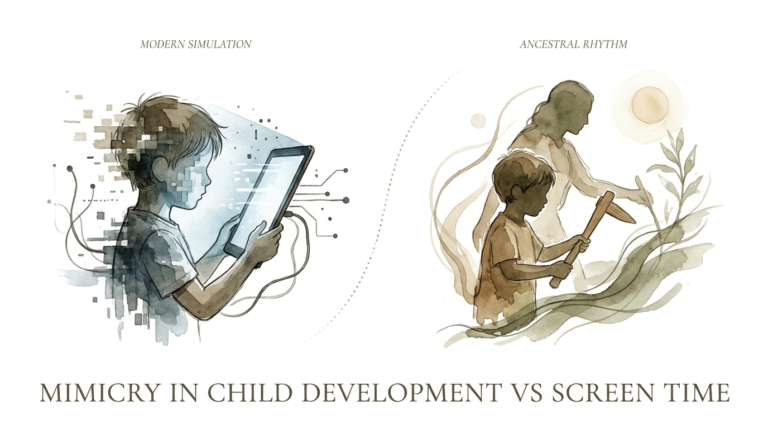
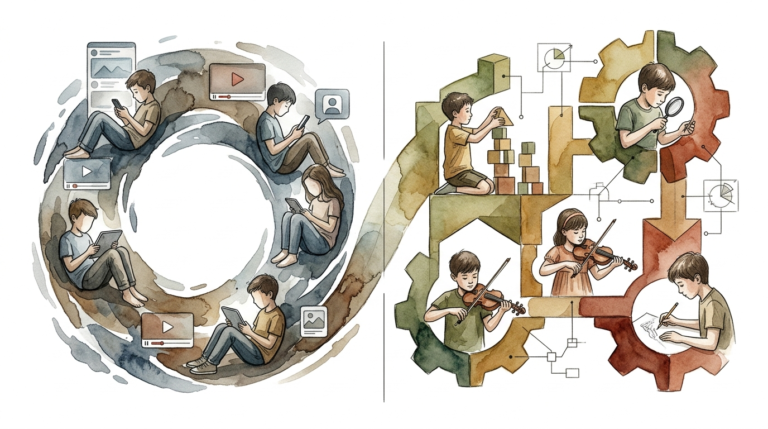
At its core, excessive screen time acts as a “digital pacifier.” It is a tool used by exhausted parents to manage behavior or provide a temporary “quiet” that feels like a win in the moment. However, research highlights that high levels of screen use are linked to reduced physical activity, poorer sleep, and significant challenges in emotional regulation.
In the real world, this looks like a child who can swipe before they can speak, but struggles to hold a pencil or bounce a ball because their fine and gross motor skills have not been challenged. Understanding this post means recognizing that digital play is often “closed,” meaning the outcomes are pre-determined by a programmer, whereas real-world play is “open-ended.”
How the Transition to Free Play Works
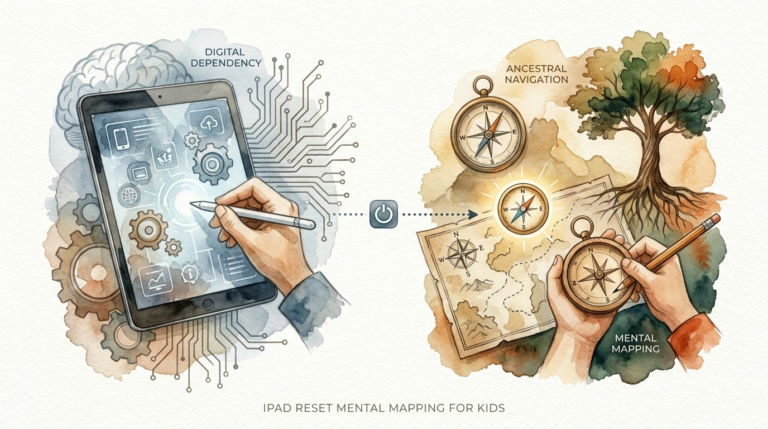
Swapping tech for developmental play is a process of “brain-rewiring.” Digital devices are designed with persuasive elements that trigger frequent dopamine releases, making reality feel “boring” by comparison. To fix this, you must lower the baseline for stimulation.
The process works by re-introducing unstructured play—play that is created and conducted by the child with minimal adult interference. This forces the prefrontal cortex to engage in executive functions like planning, material organization, and initiative. Unlike an app that tells a child what to do next, a pile of cardboard boxes requires the child to decide what those boxes are.
Start by implementing a “Screen Reset.” This involves a period—typically one to two weeks—where digital entertainment is significantly reduced to help the child’s nervous system regulate. During this time, you fill the environment with “loose parts” (sticks, stones, fabrics, blocks) that invite exploration without a right or wrong answer.
Benefits of Swapping Tech for Tactile Play
Moving away from the $2,000 tech dependency cycle offers immediate and measurable rewards for both the child’s brain and the parent’s peace of mind.
- Executive Function Boost: Active play improves “inhibitory control”—the ability to suppress impulsive responses—which is crucial for social success and academic focus.
- Physical Literacy: Real-world play involves “big-body movement” like jumping and climbing, which builds the hand strength and coordination that many kindergarteners currently lack.
- Social-Emotional Mastery: Traditional play with peers or parents involves “conversational turns” and reading facial expressions—skills that digital avatars cannot replicate.
- Financial Freedom: Swapping $80 “smart toys” for free nature-based activities saves thousands over a childhood, reducing the pressure to constantly upgrade hardware and subscriptions.
Challenges and Common Mistakes
The biggest hurdle in this transition is the “Post-Screen Blues.” When the tablet goes away, many children experience a period of intense boredom or irritability. This happens because their brains are temporarily under-stimulated compared to the high-frequency rewards of a video game.
One common mistake is trying to be the “Cruise Director.” Parents often feel they must entertain their children every second they aren’t on a screen. This actually prevents the child from developing the “boredom-to-creativity” bridge. Another error is the “Abrupt Cutoff” without a plan; simply taking the device away without providing “loose parts” or nature access usually leads to a battle of wills.
Limitations: When Tech is Necessary
We cannot ignore the reality that we live in a digital world. Screens aren’t inherently “evil,” and for older children, certain digital tools—like Minecraft or digital art apps—can offer “digital loose parts” that allow for unique creation impossible in real life. Constraints such as living in highly urbanized areas without safe parks or having a child with specific sensory needs may make a 100% screen-free life impractical.
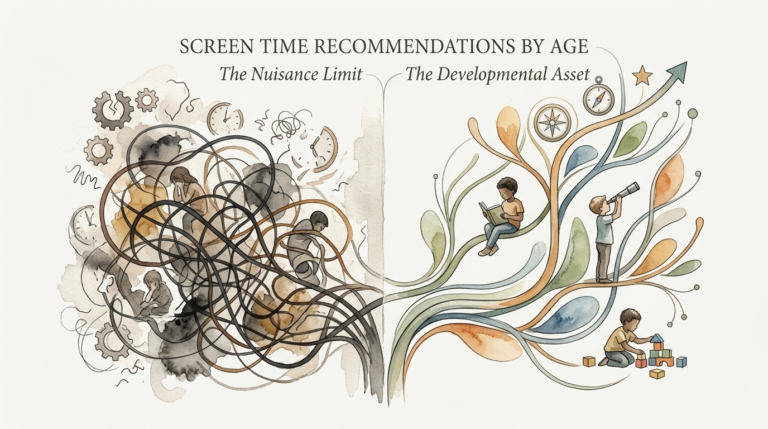
The goal is not total elimination but avoiding the “displacement” of essential human experiences. If digital time is preventing a child from sleeping, moving, or talking to real people, the balance has shifted too far.
Comparison: Tech Dependency vs. Backyard Adventure
| Feature | $2,000 Tech Dependency | $0 Backyard Adventure |
|---|---|---|
| Main Driver | Algorithm-led entertainment | Child-led imagination |
| Typical Cost | High (Devices, Apps, WiFi) | Zero to Low (Nature, Recyclables) |
| Social Interaction | Passive or Para-social | High (Peer negotiation/Family bonding) |
| Cognitive Impact | Fragmented attention | Deep focus and problem-solving |
| Physical Movement | Sedentary | Active (Gross/Fine motor) |
Practical Tips for Immediate Implementation
If you want to start today, you don’t need a complete lifestyle overhaul. Small, consistent shifts are more effective than one-time “bans.”
- The “Boredom Jar”: Fill a jar with scraps of paper listing 5-minute tasks (e.g., “Build a tower higher than your knees,” “Find three different leaf shapes”). When a child says “I’m bored,” they draw a task.
- Practice the 15-Second Rule: When observing your child playing outside, wait 15 seconds before intervening or offering “safety” advice. This allows them to assess their own risks and build “risk competence.”
- The “Clean Cut” Transition: Instead of letting a child walk to the dinner table while finishing a game, make the transition an event. Use a physical timer and have a “holding bin” where the device “goes to sleep” before the next activity begins.
- Curate “Loose Parts”: Keep a bin of open-ended materials like old sheets, PVC pipes, stones, and cardboard. These are the most valuable developmental toys you will ever “buy.”
Advanced Considerations: Risky Play and Nature
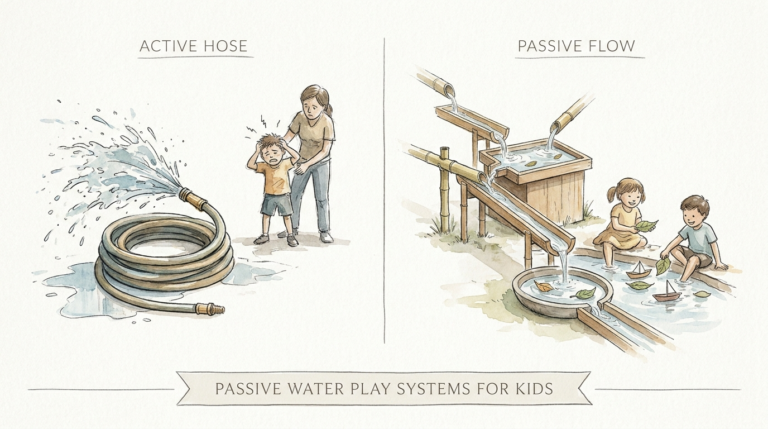
For parents ready to go deeper, consider the concept of Risky Play. Research suggests that children who engage in challenging play—climbing trees, using tools under supervision, or playing near “dangerous” elements like water—actually have lower injury rates long-term. This is because they develop an internal sense of their own limits and physical capabilities.
Nature-based “Forest Schools” have shown that spending the majority of a day in a rich, natural environment significantly improves self-regulation and social skills. You can scale this by designing a “Yes Space” in your yard or home where everything is safe for exploration, allowing the child total agency without the constant “No” that stunts creative flow.
Examples of Theory in Practice
Consider the difference between a “Smart Kitchen” app and a real mud kitchen in the backyard. In the app, the child taps a button to “mix” ingredients; the outcome is always the same, and the sensory input is limited to a glass screen. In a $0 mud kitchen (old pots, water, and dirt), the child experiences the resistance of the mud, the smell of the earth, and the physics of volume and weight. They must problem-solve when the “soup” is too runny. The real-world version provides exponentially more neural connections for the same amount of play time.
Final Thoughts
The true cost of digital entertainment isn’t found on a credit card statement; it’s seen in the fading ability of children to entertain themselves and navigate the physical world. By choosing developmental play over digital pacifiers, you aren’t just saving money—you are giving your child the tools to build their own world rather than just consuming someone else’s.
Experiment with a screen-light weekend. Watch what happens when you replace an iPad with a pile of sticks and the freedom to be “bored.” You might find that the $0 backyard adventure is worth more than all the tech in the world.
Sources
1 thenoteninjas.com | 2 michiganmedicine.org | 3 nih.gov | 4 mdpi.com | 5 mcm.org | 6 katiedavisresearch.com | 7 maqio.com | 8 sparkandstitchinstitute.com | 9 betterscreentime.com | 10 childrenandnature.org