Best Bubble Activities For Child Development
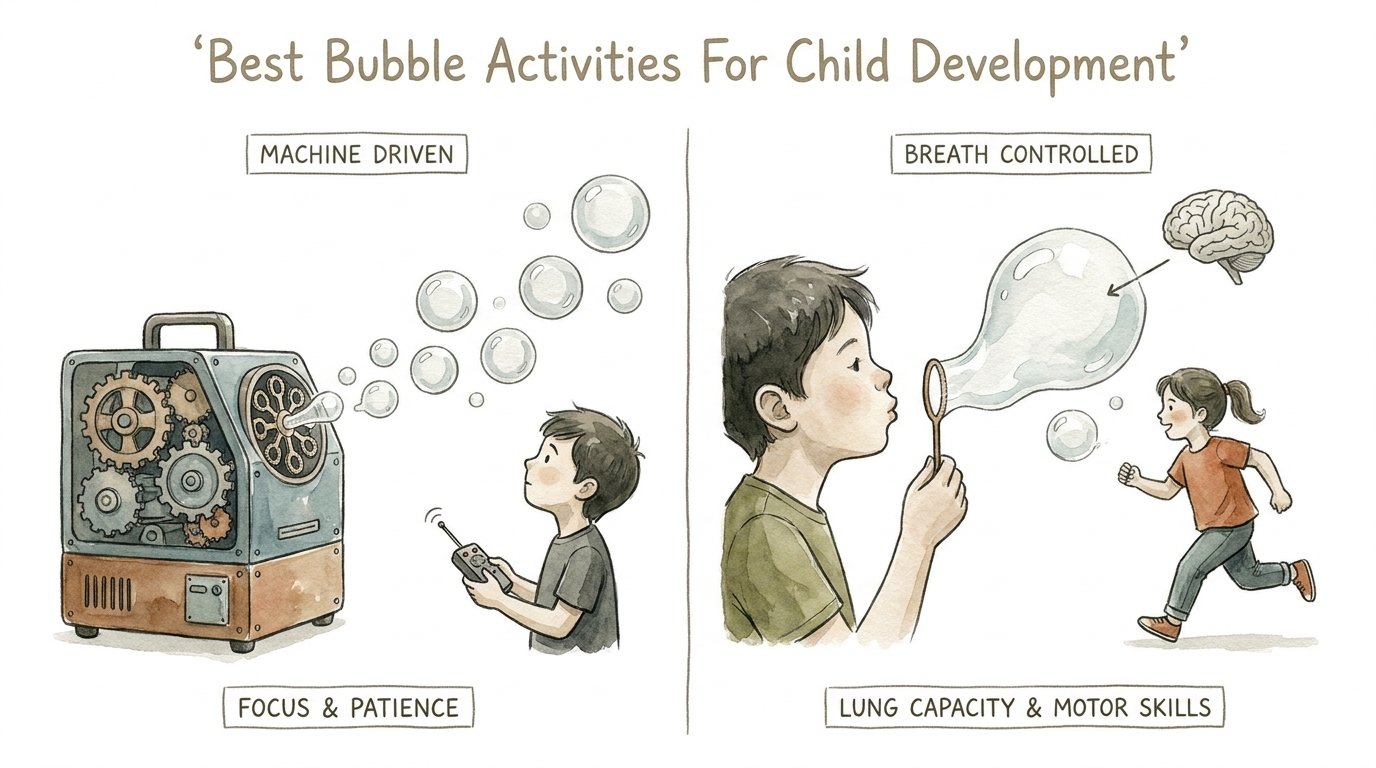
One toy provides a show your child watches; the other provides a skill your child masters through the physics of wind and breath. We often buy bubble machines to keep kids ‘entertained,’ but we are accidentally robbing them of a profound developmental opportunity. A machine is a passive show. A giant hand-blown bubble is a lesson in fluid dynamics, wind-reading, and breath control. When the child creates the magic themselves, the dopamine hit is earned, not just delivered.
Every parent knows the sight of a bubble machine churning out hundreds of tiny spheres. It creates a chaotic, high-energy environment where children scream and scramble to pop as many as possible. While there is a time and place for that excitement, it is often a hollow experience compared to the intentionality of blowing a single, perfect bubble. When a child picks up a wand and prepares to blow, they are engaging their brain and body in a complex, multi-system coordination task.
This is the difference between being a spectator and being a creator. In a world of instant gratification, the slow, deliberate process of dipping a wand and managing airflow is a radical act of focus. It teaches a child that their own actions—their breath, their steady hand, and their patience—can produce something beautiful and fleeting. This article explores why bubble play is much more than a backyard distraction and how you can use it as a powerful tool for growth.
Best Bubble Activities For Child Development
Bubble activities for child development are structured or open-ended play sessions that use soap-and-water solutions to target specific milestones. At its core, bubble play is a multisensory experience. It engages a child’s vision as they track moving objects, their touch as they feel the sticky film, and their proprioception as they adjust their body to reach or blow. Educators and therapists have used these activities for decades because they are high-value and low-cost.
Speech therapists use bubbles to help children who struggle with articulation or low muscle tone in the face. Occupational therapists use them to bridge the gap between fine motor control and sensory processing. Even physical therapists find value in the way bubbles encourage toddlers to pivot, reach, and balance on uneven surfaces like grass. It is a rare tool that hits almost every developmental domain simultaneously.
Think of a bubble as a “learning orb.” It exists at the intersection of science and play. It is an accessible gateway to physics, chemistry, and biology. When a child watches a bubble float, they are seeing air density in action. When they see the rainbow colors on the surface, they are witnessing light interference. In a real-world setting, these activities turn a simple afternoon in the park into a masterclass in how the world works.
For example, a toddler who is a “late talker” might find the motivation to speak when they see a bubble. The word “pop” or “more” becomes a functional tool to keep the magic happening. An older child might learn about the environment by observing how wind patterns carry bubbles over a fence or into the trees. The applications are as vast as the bubbles themselves.
How to Master the Physics of Breath Control
Learning to blow a bubble is a sophisticated motor planning task. It begins with the “dip.” The child must understand how to submerge the wand without creating excessive foam, which is the enemy of a strong bubble. This requires steady hands and a basic understanding of cause and effect. If they move too fast, the film breaks; if they move too slow, the solution drips off.
Once the wand is ready, the “breath control” phase begins. This is where the magic happens. A child must form their lips into a “pucker” or “O” shape, which therapists call lip rounding. They then have to exhale with a steady, consistent flow of air. Too much force will burst the film instantly, while too little will fail to overcome the surface tension of the soap.
There are two primary ways to create a bubble manually. The first is the “Quick Puff” method. This is best for creating several small bubbles at once. The child uses short, sharp bursts of air. The second is the “Steady Stream” method. This is used for creating larger, long-lasting bubbles. It requires deep diaphragmatic breathing and a sustained exhale. Mastery of this second method is a significant milestone in respiratory control.
Common pitfalls during this stage include “tongue thrusting,” where the child pushes their tongue against the wand, or “shallow breathing,” where the child only uses the air in their mouth rather than their lungs. To help a child overcome these, you can model the behavior by taking a deep, visible breath and exhaling slowly. This provides a visual and auditory cue they can mimic.
Physical and Cognitive Benefits of Bubble Play
The practical benefits of blowing bubbles are measurable across several categories. In terms of speech development, the repetitive act of lip rounding strengthens the orbicularis oris muscle. This muscle is essential for producing sounds like “p,” “b,” “m,” and “w.” Without sufficient strength here, a child’s speech can sound muffled or unclear. Controlled blowing also improves breath support, which allows children to speak in longer, more complex sentences.
From a motor skill perspective, popping bubbles is a premier activity for hand-eye coordination. A child must visually track a moving target, judge its distance in 3D space, and then move their finger or hand to a precise point to pop it. This is the foundation for later skills like catching a ball or writing with a pencil. Gross motor skills are also engaged as children jump, stomp, and run to chase bubbles, which improves their balance and core strength.
Cognitive benefits are equally impressive. Bubble play introduces basic scientific inquiry. A child might ask, “Why did that one pop so fast?” or “Why is this bubble bigger than the last one?” This leads to experimentation. They might try blowing softer or dipping the wand differently. They are practicing the scientific method before they even know what it is. This hands-on experimentation builds critical thinking and problem-solving skills.
Finally, bubbles are a powerful tool for emotional regulation. The act of taking long, deep breaths is naturally calming to the nervous system. Many therapists use “bubble breathing” as a grounding technique for children who feel overwhelmed or anxious. Watching the slow, rhythmic movement of a floating bubble can help lower a child’s heart rate and bring them back to a state of focus and calm.
Common Challenges and Troubleshooting
The most frequent frustration in bubble play is the “no-bubble” scenario. This usually happens when the solution has been shaken too much, creating a layer of foam on top. Foam consists of tiny air pockets that disrupt the surface tension of the larger bubble you are trying to make. If your child is struggling, use a spoon to scoop the foam off the top or simply let the solution rest for ten minutes.
Environmental factors also play a huge role. Low humidity is a bubble killer. When the air is dry, the water in the soap film evaporates quickly, causing the bubble to pop almost instantly. On very hot, dry days, you might find it nearly impossible to blow large bubbles. To fix this, try bubbling early in the morning or after a rainstorm when the air is saturated with moisture.
Dirty hands or wands are another silent culprit. Oils from skin, dirt from the ground, or residue from other toys can break down the chemical bonds of the soap film. Teach children to rinse their wands if they drop them in the grass. Keeping the equipment clean ensures that the surface tension remains strong enough to support giant structures.
Lastly, some children may struggle with the “suction” reflex. Instead of blowing air out, they might try to suck the bubble solution in. This is a common developmental stage, but it can be unpleasant if they swallow the soap. Using a “bubble trumpet” or a straw with a small hole poked near the top can prevent the liquid from traveling up into the mouth, making the experience safer and more successful.
Environmental and Practical Limitations
While bubbles are a fantastic tool, they do have realistic constraints. The biggest limitation is the mess. Professional-grade solutions often contain polymers or glycerine that can leave a slippery residue on indoor floors. This creates a slip hazard, especially for toddlers who are still perfecting their gait. It is always best to keep bubble play as an outdoor activity or restricted to the bathtub.
There is also the “sticky factor.” High-quality bubble juice is designed to be durable, which means it is also tacky. If bubbles pop on clothing, they can leave faint spots or attract dirt. While most solutions are water-soluble and wash out easily, it is a trade-off for the performance. If you are in a situation where cleanliness is a priority, bubbles might not be the ideal choice.
Wind is the ultimate double-edged sword. A light breeze is wonderful for carrying bubbles away and creating a “show,” but a gusty wind will shred a soap film before it can even leave the wand. Professional bubble artists often seek out “dead air” zones behind buildings or under trees to perform. For a casual play session, understand that a windy day will shift the focus from blowing bubbles to chasing the ones the wind creates.
Machine Driven vs. Breath Controlled
It is worth examining the fundamental difference between a battery-operated bubble machine and the manual act of blowing. While both use the same solution, they serve entirely different purposes in a child’s development. One focuses on high-volume entertainment, while the other focuses on individual skill and mastery.
| Feature | Machine Driven | Breath Controlled |
|---|---|---|
| Primary Goal | Sensory Overload / Entertainment | Skill Mastery / Development |
| Physical Effort | Passive (Watching/Running) | Active (Oral-Motor Coordination) |
| Breath Work | None | High (Teaches Regulation) |
| Focus Level | Low / Scattered | High / Intentional |
| Dopamine Hit | Instant / Passive | Earned / Achievement-Based |
A machine is excellent for a birthday party where the goal is to get twenty kids running around. It creates a “bubble storm” that is visually stunning. However, the machine does all the work. The child does not learn how to pucker their lips, how to regulate their exhale, or how to handle a wand with care. They are simply consumers of the effect.
In contrast, breath-controlled play is an intimate, focused experience. When a child successfully blows their first bubble, they experience a genuine sense of pride. They have mastered a physical law. This earned dopamine helps build confidence and persistence. If you want to support your child’s development, prioritize the wand over the motor.
Practical Tips for Better Bubbles
If you want to elevate your bubble game, start with the solution. Most store-bought bubbles are thin and watery. You can “charge” them by adding a few drops of glycerine or a teaspoon of white corn syrup. These ingredients slow down the evaporation process, making the bubbles thicker and much harder to pop. They might even bounce off a wool sweater or a patch of grass.
Use a “slow dip” technique. When you submerge the wand, pull it out slowly to allow the excess liquid to drain off without creating bubbles in the container. A clean, clear film on the wand is the best starting point. If the wand is dripping, the weight of the extra liquid will pull on the bubble as it forms, often causing it to pop before it detaches.
Experiment with different wands. You don’t have to stick to the plastic ones that come in the bottle. A slotted spoon, a strawberry basket, or even a loop made from a pipe cleaner can create fascinating results. For giant bubbles, a “tri-string” wand made from two sticks and a loop of cotton string is the industry standard. Cotton is essential because it absorbs the solution, acting as a reservoir that feeds the bubble as it grows.
Finally, watch the sun. Bubbles are most beautiful when light hits them at an angle. Early morning or late afternoon light creates the most vibrant “interference colors” on the surface. These colors are actually a map of the bubble’s thickness. As the water evaporates and the film gets thinner, the colors will shift from blue and green to yellow and pink, eventually turning a metallic silver just before they pop.
Advanced Considerations for Enthusiasts
For those who want to take bubble play into the realm of art or serious science, there is much more to learn. One advanced concept is the “Marangoni Effect.” This is the mass transfer along an interface between two fluids due to a gradient of surface tension. In simpler terms, it’s why a bubble “heals” itself when it moves. Understanding this allows you to create bubbles that are incredibly resilient.
Advanced practitioners often use “Guar Gum” or “J-Lube” in their recipes. These are long-chain polymers that create a “stretchy” web within the soap film. This is the secret behind those massive, car-sized bubbles you see in professional street performances. These chemicals change the viscosity of the water, allowing it to stretch much further than soap and water alone could ever manage.
You can also experiment with “Smoke Bubbles.” By exhaling vapor from a fog machine or a vape through a bubble wand, you can create opaque, white orbs. When they pop, they release a dramatic cloud of smoke. This is a fantastic way to demonstrate how air is trapped inside the liquid film. It provides a visual representation of the “pocket of gas” that defines a bubble.
Example Scenario: The “Bubble Bridge” Game
Let’s look at how to put these theories into a practical game that targets multiple developmental areas. We call this the “Bubble Bridge.” You will need a large wand, a high-quality solution, and two children (or a parent and a child). One person blows a large, slow-moving bubble. The goal of the second person is to “catch” that bubble on their own wet wand without popping it.
This game requires incredible focus and hand-eye coordination. The “catcher” must move their wand at the exact same speed as the floating bubble to prevent a high-velocity impact. It also teaches the science of surfaces: a dry wand will pop a bubble instantly, but a wet wand will merge with it. This is a lesson in surface tension and molecular attraction.
If the children succeed, they have created a “bridge” between their two wands. They must then work together to move the bubble back and forth. This requires verbal communication and synchronized physical movement. In ten minutes of this game, children are practicing physics, social cooperation, and fine motor control—all while having a blast. This is the “earned magic” we talked about at the beginning.
Final Thoughts
Bubble play is one of the most underrated tools in the parenting and educational kit. It is easy to dismiss it as a simple toy, but when you look closer, it is a complex system of development. From the oral-motor muscles required for speech to the visual tracking required for reading, bubbles provide the “scaffolding” for a child’s most essential skills. By choosing breath-controlled play over passive machines, you are giving your child the chance to master their own body and environment.
The next time you reach for a bottle of bubbles, remember that you aren’t just entertaining your child. You are giving them a lesson in fluid dynamics, a session in speech therapy, and a moment of mindfulness. Encourage them to blow slowly, to watch the colors change, and to try again when a bubble pops too soon. These small moments of persistence and observation are the building blocks of a curious, capable mind.
Don’t be afraid to get your hands messy and join in. The physics of wind and breath is just as fascinating for adults as it is for children. Experiment with your own recipes, build your own wands, and see how large you can make the magic grow. When we play alongside our children, we validate their curiosity and show them that the world is a place worth exploring, one shimmering sphere at a time.
Sources
1 thenoteninjas.com | 2 foxfarmhome.com | 3 theethicalist.com | 4 therapyinnovationsnc.com | 5 collaborativeotsolutions.com | 6 todays-woman.net | 7 listeningears.in | 8 innobaby.com | 9 msu.edu | 10 youtube.com | 11 silviaangel.com | 12 kiwico.com | 13 shinetherapyservices.com