Benefits Of Rainy Day Outdoor Play
A tablet needs a charger; a child needs a storm. We’ve been taught to ‘protect’ our kids from the elements by keeping them indoors with screens. But the rain is a physics laboratory, the mud is a sensory feast, and the wind is a challenge to be met. Resilience isn’t built in a climate-controlled living room; it’s built in the puddle.
Stepping outside when the sky turns gray feels counterintuitive to many parents. We worry about colds, laundry, and the general mess that follows a wet afternoon. However, the modern obsession with staying dry is robbing children of essential developmental milestones. When we open the door and let them embrace the downpour, we are opening a door to a world of high-speed learning and deep sensory satisfaction.
Rainy day outdoor play is more than just a way to burn off energy. It is a fundamental shift in how a child perceives the world. Instead of seeing a “bad” day as a reason to stop, they see it as a reason to adapt. This mindset is the bedrock of emotional intelligence and grit.
Benefits Of Rainy Day Outdoor Play
Rainy day outdoor play is the act of engaging with the natural environment during or immediately after precipitation. While many see rain as a barrier to activity, it is actually a catalyst for unique physical and cognitive experiences. It transforms a familiar backyard into a shifting landscape of new textures, sounds, and challenges.
This type of play exists because nature is rarely static. In real-world situations, we cannot always control our environment. Children who play in the rain learn early on that “unfavorable” conditions are simply different conditions. They begin to understand that with the right gear and the right attitude, any weather is “good” weather.
Think of it like a sensory upgrade. On a sunny day, the ground is predictable. In the rain, grass becomes slick, mud becomes viscous, and puddles create varying depths. This requires a child’s brain to work overtime to calculate balance and force.
How To Master The Rainy Day Experience
Mastering the rain starts with preparation. You aren’t just sending them out to get soaked; you are equipping them for an expedition. The goal is to keep the core dry and warm while allowing the extremities to explore the wetness.
The 3-Layer Gear System
A successful rainy day depends on layering. Experts recommend a three-layer approach to ensure the child stays comfortable for hours rather than minutes.
The base layer sits directly against the skin. Its primary job is moisture management. Avoid cotton at all costs, as it absorbs water and stays cold. Instead, choose merino wool or high-quality synthetic fibers that wick sweat away from the body.
The mid-layer provides insulation. This is where you trap body heat. Fleece is the gold standard here because it remains lightweight and effective even if it gets slightly damp. Synthetic puffer jackets are also excellent for colder rain.
The outer layer is the weather shield. This must be a waterproof shell. Look for garments with sealed seams and “breathable” ratings. Bib-style rain pants are superior to standard pants because they prevent water from sneaking up the back during deep puddle jumps.
Creating a Mud Station
Designate a specific area for “messy” play. A mud kitchen equipped with old pots, pans, and wooden spoons provides an anchor for imaginative play. Having a defined space helps parents manage the cleanup process and gives children a “laboratory” for their experiments.
Activities That Spark Curiosity
Encourage activities that take advantage of the water’s movement. Building dams in the gutter, racing toy boats down a sloping driveway, or using a rain gauge to measure the downpour are all ways to turn play into a lesson.
Benefits Of Rainy Day Outdoor Play
The advantages of rain play extend far beyond simple fun. The developmental gains are measurable and often superior to those found in indoor settings.
Advanced Physical Coordination
Slippery surfaces are actually a workout for the vestibular and proprioceptive systems. Children must adjust their center of gravity and use smaller stabilizing muscles to stay upright. This builds a level of physical confidence and balance that is rarely challenged on a dry, rubberized playground.
Immune System Fortification
Exposure to soil microbes during rainy play can actually strengthen a child’s defenses. A specific soil bacterium called Mycobacterium vaccae has been found to stimulate the immune system. Research suggests that inhaling or coming into contact with this “friendly” bacteria can trigger the release of serotonin, improving mood and potentially reducing the risk of asthma and allergies.
Cognitive Science and Physics
The rain is a living textbook. When a child watches a puddle evaporate over a few hours, they are witnessing the water cycle in real time. They learn about surface area—why a shallow puddle disappears faster than a deep one—and the mechanics of erosion as they watch water carve paths through the dirt.
Challenges And Common Mistakes
The biggest challenge isn’t the rain itself; it’s the preparation and the parent’s mindset. Avoid these common pitfalls to ensure the experience remains positive.
The Cotton Trap
One of the most frequent errors is dressing a child in denim or cotton hoodies under a raincoat. Once cotton gets wet—from rain or sweat—it loses its ability to insulate. The child will quickly become chilled, leading to a shorter and less enjoyable play session.
Over-Interference
Parents often hover too closely, constantly warning children to “be careful” or “don’t get too dirty.” This undermines the primary benefit of the activity: risk assessment. Let them figure out if a rock is too slippery. Let them feel the mud between their fingers. Self-directed play is where the real growth happens.
Ignoring the “After-Play” Routine
The fun ends abruptly if the transition back inside is chaotic. A common mistake is not having a “transition zone” or “mudroom” strategy. Without a plan for wet clothes and muddy boots at the door, the stress of the mess can discourage parents from letting the play happen again.
Limitations Of Rainy Day Play
While rain is beneficial, there are realistic boundaries. Safety must always come first, and environmental conditions can occasionally cross the line from “challenging” to “dangerous.”
The Threat of Lightning
Thunderstorms are a hard limit. Lightning can strike even when it isn’t raining directly on you. Use the 30/30 Rule: if you see lightning and hear thunder within 30 seconds, the storm is close enough to be dangerous. You should wait at least 30 minutes after the last sound of thunder before heading back outside.
Temperature Extremes
Cold rain (near 32°F or 0°C) carries a much higher risk of hypothermia than a warm summer downpour. In near-freezing conditions, the time outdoors should be strictly monitored, even with professional-grade gear. If a child begins to shiver or their speech becomes slightly slurred, they must come inside immediately.
Urban Pollution
In some heavily industrial urban areas, “first flush” rainwater can carry high levels of pollutants from roofs and roads. In these specific environments, it is better to wait until the rain has been falling for a while to “wash” the air and surfaces, or stick to green spaces like parks rather than street-side gutters.
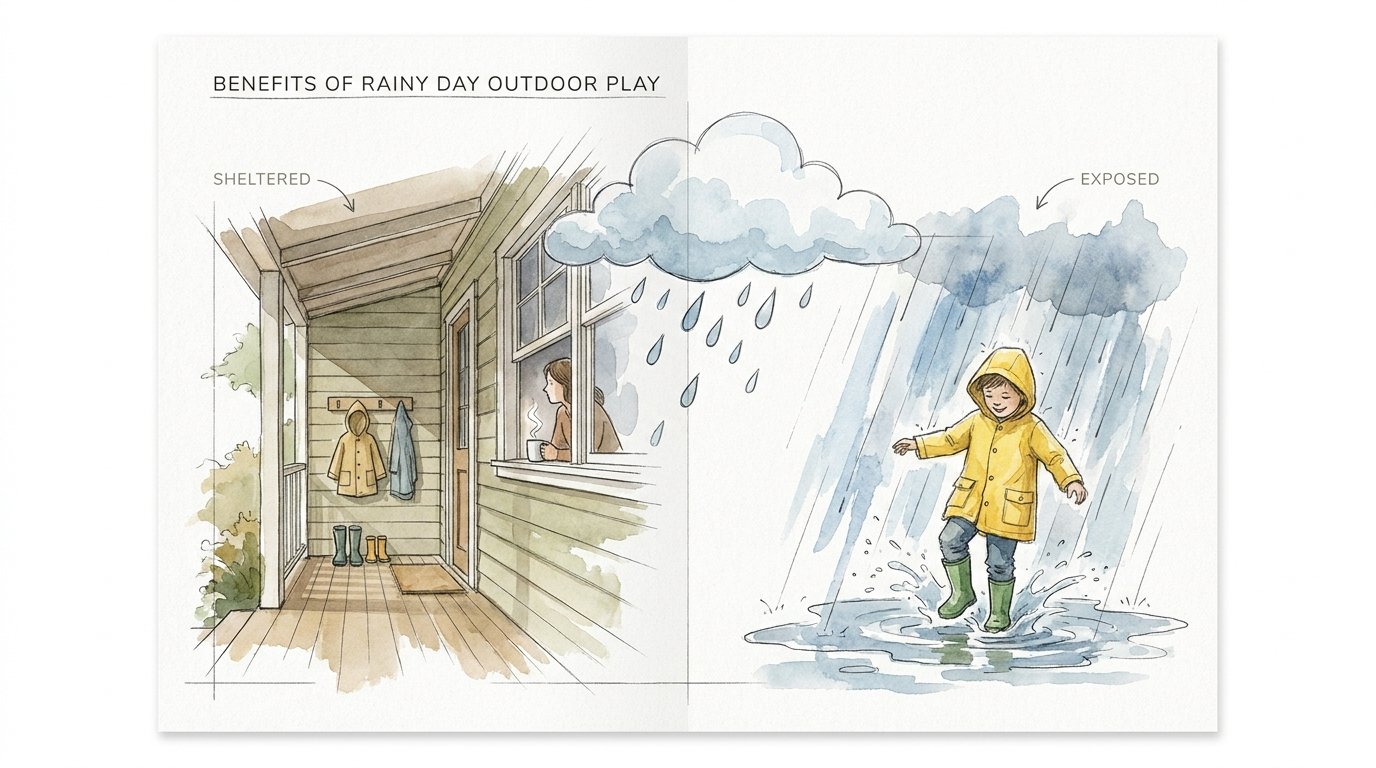
Sheltered vs. Exposed Environments
Choosing where your child plays can significantly change the outcome. While “sheltered” play has its place, “exposed” play is where resilience is forged.
| Feature | Sheltered (Indoor/Covered) | Exposed (Outdoor/Rain) |
|---|---|---|
| Predictability | High; surfaces stay dry and level. | Low; surfaces change constantly. |
| Sensory Input | Limited; controlled lighting and temp. | Extreme; sound, touch, and smell are heightened. |
| Microbial Diversity | Low; sanitized environment. | High; exposure to beneficial soil bacteria. |
| Risk Assessment | Pre-calculated by adults. | Real-time; calculated by the child. |
Practical Tips For Parents
You can make rainy day play a seamless part of your family culture with a few simple adjustments.
- Keep a “Go-Bag”: Have rain gear, extra socks, and a towel packed and ready. This removes the “mental friction” of getting ready when the rain starts.
- The Warm-Up Reward: Create a tradition of hot cocoa or a warm bath immediately after coming inside. This reinforces a positive association with the rain.
- Focus on the Feet: Wet socks are the fastest way to end a play session. Invest in high-quality, insulated rubber boots and wool socks.
- Join the Fun: Your attitude dictates theirs. If you stand under an umbrella looking miserable, they will eventually mirror that. Put on your own boots and splash once or twice.
Advanced Considerations For Nature Educators
For those looking to take rainy day play to a professional level, such as in a Forest School setting, focus on Long-Term Observation.
Encourage children to map how the landscape changes over weeks of rain. Use markers to show where water pools and where it drains. This builds an intuitive understanding of topography and hydrology.
Consider the Microbiome Effect deeply. Research into the “Hygiene Hypothesis” suggests that our modern, sterile environments may be contributing to the rise in autoimmune disorders. By deliberately allowing children to interact with wet soil, we are providing their immune systems with the “data” they need to function correctly.
Scenario: The Puddle Detective
Imagine a six-year-old named Leo. It has been pouring for two hours. Instead of staying inside with a movie, his parents help him into his bibs and boots.
Leo heads to the driveway with a piece of chalk. He draws a circle around the largest puddle. This is his baseline. He then places three different objects in the puddle: a heavy rock, a dry leaf, and a plastic toy.
He observes that the leaf floats on the surface tension, while the rock sinks instantly. He notices the toy moves toward the edge of the puddle as the wind picks up. Two hours later, after the rain stops, he goes back out. He sees the puddle has shrunk, leaving a ring of fine silt behind.
In this one session, Leo has practiced physics (buoyancy), meteorology (evaporation), and geology (sedimentation). He didn’t need a textbook; he just needed a storm.
Final Thoughts
The rain is not an obstacle to be avoided; it is a resource to be utilized. When we allow our children to step out into the “exposed” world, we are giving them the tools to navigate any environment with confidence and curiosity.
Rainy day play builds a specific kind of internal strength. It teaches a child that they are not fragile. It shows them that they can be cold, wet, and messy, and not only survive but thrive. This resilience will follow them long after they outgrow their rain boots.
Encourage the mess. Embrace the pitter-patter on the roof as a call to adventure. The next time the clouds roll in, remember that a tablet needs a charger, but your child needs a storm. Open the door and let the learning begin.
Sources
1 curiousworld.com | 2 playgroundprofessionals.com | 3 patpat.com | 4 wildhavenwools.com | 5 mcm.org | 6 pentagonplay.co.uk | 7 preschoolsteam.com | 8 wildlingsforestschool.com | 9 ijrar.org | 10 rethinkbacteria.org | 11 melindamyers.com | 12 nwf.org | 13 healthychildren.org | 14 childrenscolorado.org | 15 nih.gov | 16 unicef.org | 17 bienenstockplaygrounds.com | 18 natureplaywa.org.au | 19 ncsu.edu