Best Free Stem Activities For Kids Without Screens
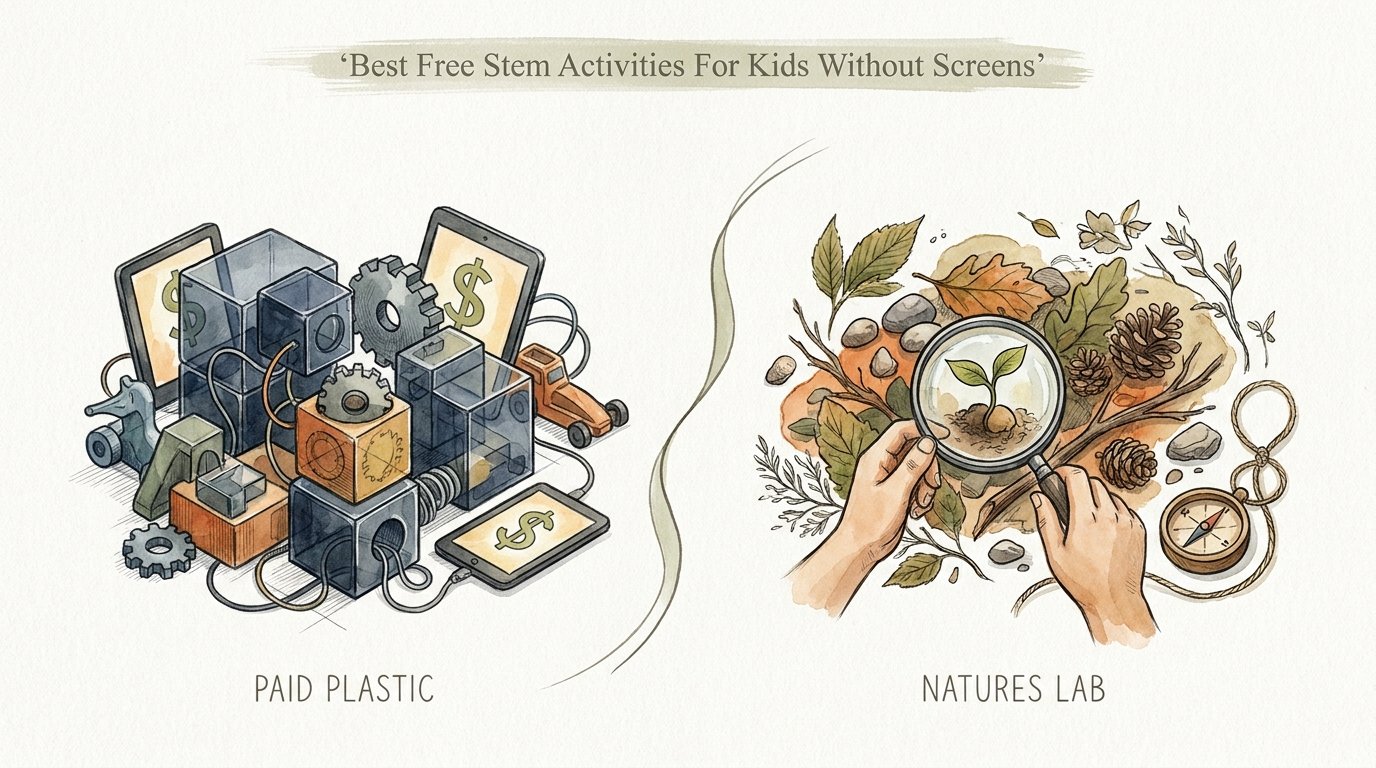
Why are we paying for ‘educational’ plastic when the greatest laboratory on earth is currently in your backyard for free? Silicon Valley wants you to believe that ‘learning’ requires a subscription and a screen. But a child learns more about physics from a mud puddle and a stick than they ever will from a 2D animation. Nature doesn’t have a monthly fee, and its resolution is infinite.

You might be wondering how a pile of dirt and some twigs can compete with a high-definition coding app. The truth is that nature provides a multi-sensory experience that no digital interface can replicate. When a child balances a rock on a branch, they aren’t just playing. They are calculating gravity, torque, and structural integrity in real-time.

This guide will help you reclaim your child’s education from the screen. We are going to look at how the simplest natural materials offer the most profound scientific lessons. You do not need a lab coat or a high-speed internet connection to raise a genius. You just need to step outside and look at the world through a scientific lens.
Best Free Stem Activities For Kids Without Screens
Screen-free STEM is the practice of exploring Science, Technology, Engineering, and Math using only natural or repurposed materials. It exists because the world itself is a giant machine governed by predictable laws and complex systems. Real-world STEM learning happens when children interact with the physical environment to solve problems or satisfy their curiosity.
In a backyard setting, science is found in the way water carves paths through soil after a rainstorm. Technology is the application of knowledge to create tools, such as using a hooked stick to reach a high fruit. Engineering is the process of building a dam across a small stream or a shelter from fallen branches. Math is the symmetry found in a maple leaf or the Fibonacci sequence spiraling within a pinecone.
These activities are used everywhere from elite forest schools to remote research outposts. They matter because they build “cognitive flexibility.” A child who can build a bridge out of river stones is learning to adapt to irregular variables. This is a far more valuable skill than following a rigid set of instructions in a pre-packaged plastic kit.
How to Turn Your Backyard into a Science Lab
The first step is to change how you view “mess.” A muddy patch of ground is not an eyesore; it is a fluid dynamics laboratory. Start by designating a “wild zone” where digging, splashing, and building are encouraged. This area should be rich in loose parts like rocks, sticks, leaves, and soil.
To begin an investigation, encourage your child to follow the scientific method without using the jargon. Ask them what they think will happen if they add more water to a pile of sand. This is a hypothesis. Let them test it and observe the results. This is the experiment. Finally, have them explain why the sand collapsed or held its shape. This is the conclusion.
You can facilitate engineering by introducing simple challenges. Ask them to build a structure that can support the weight of a heavy stone using only sticks and mud. They will naturally discover the strength of triangles and the importance of a solid foundation. These principles are the exact same ones used to build skyscrapers and bridges in the real world.
Benefits of Choosing Nature Over Paid Plastic
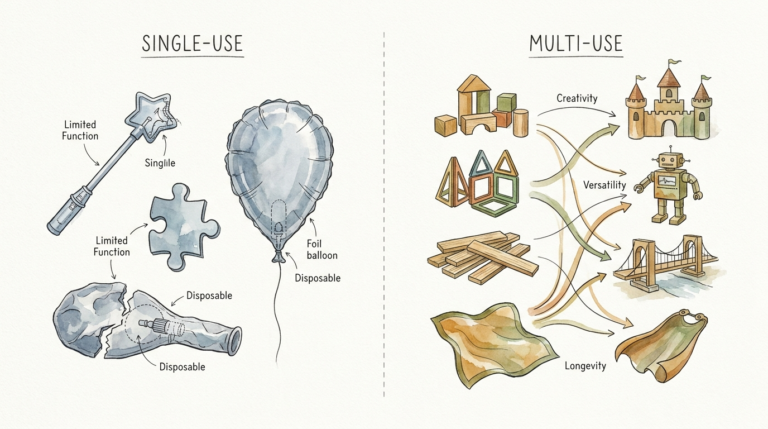
Nature-based STEM activities offer a level of sensory input that plastic toys simply cannot match. Every rock has a different texture, weight, and temperature. This variety forces the brain to process more complex information, which strengthens neural pathways. Plastic kits often provide identical, sterile parts that limit a child’s problem-solving requirements.
One of the greatest advantages is the development of resilience. In a digital game, you can press “undo” if you make a mistake. In the backyard, if your stick fort falls down, you have to analyze the failure and try again. This teaches children that failure is a data point, not a dead end. It builds the grit necessary for high-level scientific research.
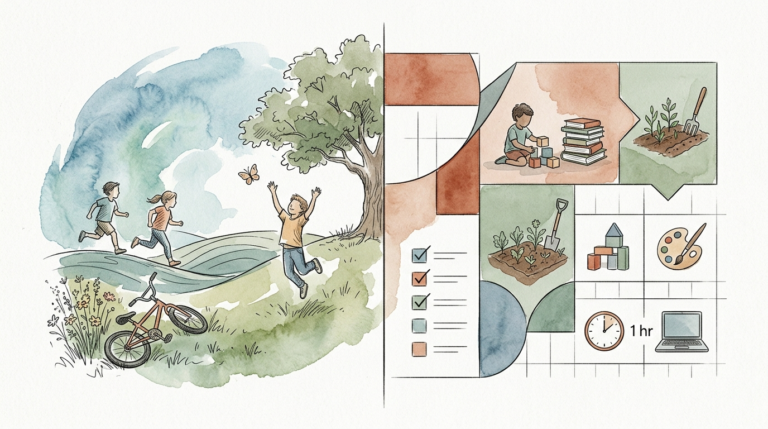
Cost and sustainability are also major factors. Nature-based learning is entirely free and generates zero plastic waste. While a $50 subscription box might keep a child busy for an hour, a mud puddle provides hours of entertainment every time it rains. You are teaching your child that they don’t need to buy a solution to be creative; they can build it themselves.
Challenges and Common Mistakes
The most frequent error parents make is over-structuring the experience. If you provide a step-by-step manual for a nature walk, you are turning discovery into a chore. Science is driven by wonder, not by worksheets. Let the child lead the way and only intervene when they hit a plateau in their thinking.
Another pitfall is the “fear of the wrong answer.” Many adults feel they need to know the name of every tree and the genus of every bug to “teach” STEM. This is not true. It is actually better to say, “I don’t know, let’s look closer and see what we can find out.” This models the behavior of a real scientist who is always searching for the unknown.
Avoid cleaning up the “lab” too quickly. If a child is halfway through building a complex stick structure, let it stay up for a few days. Observing how natural forces like wind or rain affect their creation provides a second layer of learning. Constant intervention can stifle the long-term observation skills that are crucial for biology and ecology.
Limitations and When Screens May Be Useful
While nature is the best primary classroom, it does have physical constraints. You cannot easily observe the microscopic world or the vast reaches of space with the naked eye. This is where technology can serve as a powerful supplement rather than a replacement. A digital microscope or a star-tracking app can expand the boundaries of the backyard lab.
Environmental factors like extreme weather or urban living can also limit access to natural spaces. If you live in a high-rise apartment, your “backyard” might be a window box or a local park. In these cases, you have to be more intentional about bringing natural elements indoors. Potted plants, terrariums, and stone collections can serve as miniature study sites.
Real-world science also relies on data sharing and global collaboration. Screens allow children to see how their backyard observations fit into a larger context. They can participate in “citizen science” projects by uploading photos of local birds or tracking the first blooms of spring. This connects their local play to a global scientific community.
Nature’s Lab vs. Subscription STEM Kits
| Feature | Nature’s Lab (Backyard) | Subscription STEM Kits |
|---|---|---|
| Cost | Free | $20 – $60 per month |
| Resolution | Infinite (Micro to Macro) | Limited by kit materials |
| Durability | Self-renewing | Often one-time use plastic |
| Problem Solving | High (Irregular materials) | Low (Pre-fitted parts) |
| Sensory Input | Full spectrum | Mostly visual and tactile |
Practical Tips for Success
Keep a simple “investigation kit” near the back door. This could include a magnifying glass, a roll of twine, a trowel, and an old notebook. Having these tools ready makes it easier to transition from casual play to scientific exploration. You don’t need expensive equipment; even a clear glass jar can be a powerful tool for observing soil layers or insect behavior.
Adjust your activities based on the seasons. Spring is perfect for biology and life cycles as seeds sprout and insects emerge. Summer is ideal for physics and water play. Fall offers lessons in decomposition and chemistry as leaves change color. Winter provides unique opportunities to study the physics of ice and the geometry of snowflakes.
Encourage “documentation” without making it feel like homework. Let your child draw what they see or take photos of their structures. This helps them notice small details they might have missed during the initial build. Over time, these drawings become a record of their growing understanding of the natural world.
Advanced Considerations for Serious Practitioners
For older children, you can introduce the concept of “systems thinking.” An ecosystem is a perfect example of a complex system where every part affects the others. Have them track how a change in the weather affects the activity in an ant hill or the growth of a specific plant. This develops the ability to understand interdependencies, which is vital for engineering and economics.
Explore the mathematics of nature through fractals and the Golden Ratio. You can find these patterns in everything from the branching of trees to the spirals of a snail shell. Measuring the angles of branches or the spacing of leaves introduces geometry in a tangible way. It shows that math is not just a series of numbers on a page, but the very language of the universe.
Physics can be taken to a higher level by building simple machines from natural materials. Challenge your child to create a pulley system to lift a heavy log or a lever to move a large rock. These projects require a deep understanding of force, load, and mechanical advantage. They are the foundation of all mechanical engineering.
Real-World Scenario: The Great Mud Dam
Imagine a group of children playing in the backyard after a heavy storm. They notice a small stream of water eroding a path through the garden. Instead of stopping them, you encourage them to “save the soil” by building a dam. This immediately shifts the play into a high-stakes engineering challenge.
First, they try using only mud, but the water washes it away instantly. This is their first failure and their first lesson in material science. They realize they need a “skeleton” for their structure, so they gather large stones and thick sticks. They are now learning about reinforcement and structural integrity.
As they build, they observe that the water pressure builds up behind the dam. They have to engineer a “spillway” to control the flow and prevent a total collapse. By the end of the afternoon, they have mastered concepts of hydrodynamics, erosion control, and civil engineering. They did all of this without a single instruction manual or a battery-powered device.
Final Thoughts
Nature is the ultimate teacher because it never simplifies the truth. A screen can only show you what someone else has programmed, but a forest shows you the raw complexity of reality. When we choose free, outdoor STEM activities, we are giving our children the tools to think for themselves. We are teaching them that the world is something to be explored, not just consumed.
The skills learned in a backyard lab—observation, resilience, and creativity—are the exact same skills needed for the careers of the future. Whether they become an astronaut, a doctor, or a coder, the foundation remains the same. They need to know how to look at a problem, analyze the variables, and build a solution from the ground up.
Do not feel pressured to buy the latest “educational” gadget to give your child a head start. The most sophisticated learning tool ever created is currently sitting in your yard, waiting for someone to pick it up. Go outside, find a stick, and let the real learning begin. Your child’s curiosity is the only subscription you will ever need.
Sources
1 littlebinsforlittlehands.com | 2 imthecheftoo.com | 3 friendlyhobbies.com | 4 acceleratelearning.com | 5 thecuriosityapproach.com | 6 raniyer.com | 7 kidsrkids.com | 8 sciencebysinai.com | 9 iambbinc.com | 10 imthecheftoo.com