Signs Of Screen Withdrawal In Children
Does your child’s happiness have a battery life?

The ultimate sign of overuse isn’t the hours spent; it’s the state of the child when the power goes out. If emotional stability vanishes at 0% battery, the device isn’t a tool—it’s a life-support system for their mood. True resilience is built when the screen is off.
We live in a world where digital saturation is the default. Parents often find themselves stuck between the convenience of a “digital pacifier” and the growing dread of the next inevitable meltdown. It is a modern-day tug-of-war where the stakes are your child’s brain development and emotional health.
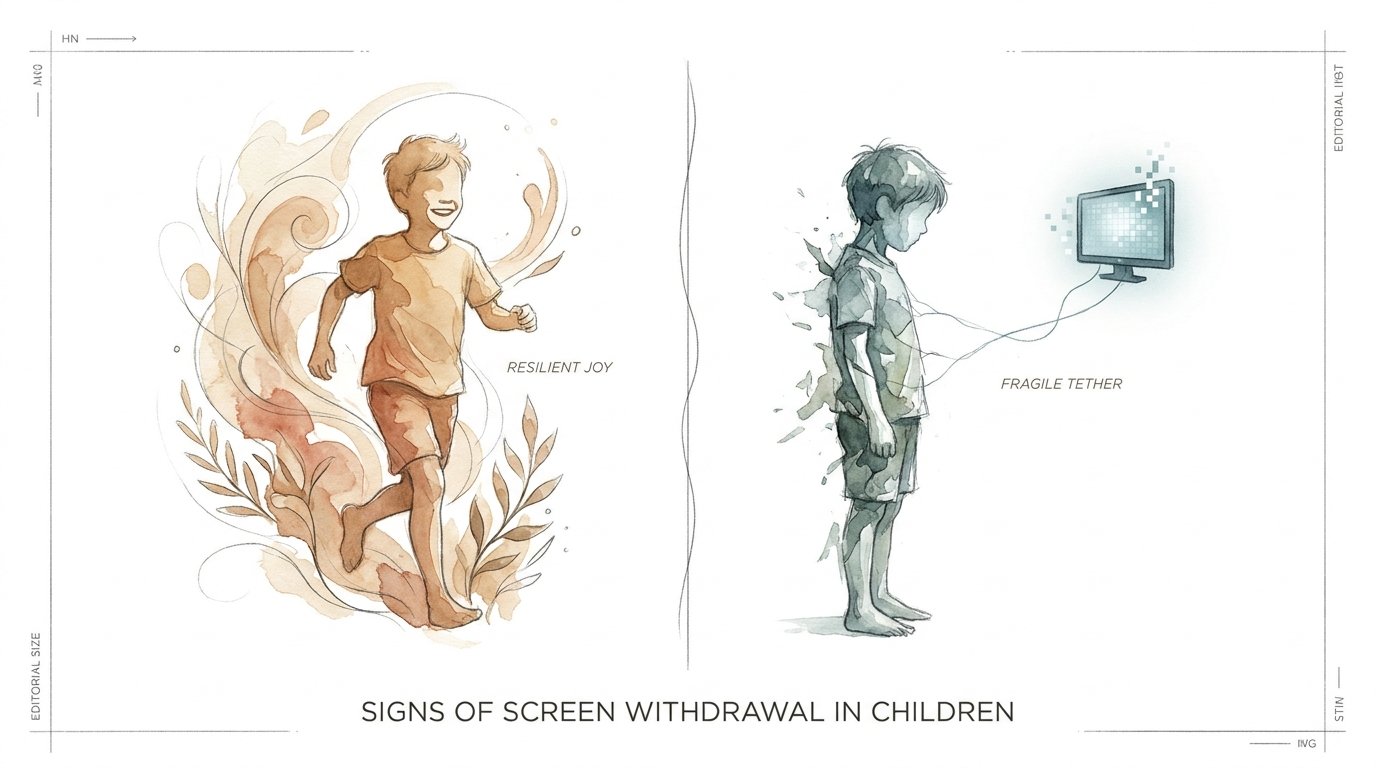
Understanding this phenomenon isn’t about shaming technology use. It is about recognizing when a healthy interest turns into a Fragile Tether. When a child’s joy is tied exclusively to a charging cable, they lose the ability to generate Resilient Joy—the kind of happiness that comes from within. This guide explores how to identify, manage, and reverse the effects of screen-based emotional dependency.
Signs Of Screen Withdrawal In Children
Screen withdrawal is a physiological and emotional response that occurs when a high-stimulation digital activity ends. It exists because digital media—especially short-form videos and games—is designed to exploit the brain’s reward system. When the device is removed, the brain experiences a sudden drop in neurochemicals, leading to visible distress.

You might see this in your living room every day. It often starts with a “glazed look” while they are watching and ends with an explosive reaction the moment the screen goes dark. This isn’t just “bad behavior.” It is a brain-level reaction to a perceived loss of a primary pleasure source.
Common signs of screen withdrawal include:
- Intense Irritability: A child who was calm two minutes ago becomes suddenly aggressive, tearful, or defiant when the device is taken away.
- Loss of Interest: Traditional toys, books, or outdoor play seem “boring” or “too slow” compared to the high-speed input of a tablet.
- Sleep Disruption: Difficulty falling asleep or staying asleep, often due to the suppression of melatonin by blue light and mental hyper-arousal.
- Constant “Ask” for Screens: The child seems unable to think about or discuss topics that aren’t related to their digital content.
- The 1000-Yard Stare: A state of lethargy or “mental fog” immediately after screen use where the child seems disconnected from their surroundings.
Research shows that excessive tablet use at age three is significantly associated with more frequent anger outbursts by age four. This creates a cycle where parents use screens to calm a child, which then reduces the child’s ability to self-regulate, leading to more outbursts and more screen time.
How The Digital Dopamine Loop Works
To fix the problem, you have to understand the engine under the hood. The human brain is wired for survival, which means it rewards us for “discovering” new information. Technology companies hire neuroscientists to ensure their apps trigger this reward system as often as possible.
Every notification, “level up,” or auto-playing video releases a hit of dopamine in the brain’s nucleus accumbens. Dopamine is the “feel-good” neurotransmitter responsible for motivation and reward. In a natural environment, dopamine is earned through effort—climbing a tree, finishing a puzzle, or talking to a friend.
Digital environments provide “fast dopamine.” The reward comes without the effort. When a child spends hours in this loop, their dopamine receptors become desensitized. They need more stimulation just to feel “normal.” When the screen turns off, their dopamine levels plummet below their baseline. This “dopamine crash” is what fuels the screaming and physical aggression often seen during transitions.
The prefrontal cortex—the part of the brain responsible for impulse control and emotional regulation—is not fully developed until the mid-20s. Children are effectively fighting a war against professional-grade algorithms with a brain that isn’t yet equipped to say “no.”
Step-by-Step: How to Manage Screen Transitions
Managing screen withdrawal isn’t about a single “no.” It is about engineering the environment to make transitions easier. Use these techniques to bridge the gap between the digital and physical worlds.
1. Use the PREP Method
Toddlers and school-aged children thrive on predictability. Use the PREP method to remove the “surprise” element of the screen turning off.
- Plan: Decide exactly how much time is allowed before the device is even touched.
- Remind: Give warnings at 10 minutes, 5 minutes, and 2 minutes.
- Expect: Tell them exactly what will happen when the time is up (“When the timer rings, we put the iPad in the drawer”).
- Proceed: Move immediately to the next physical activity without negotiation.
2. The “Soft Bridge” Activity
Never go from a high-intensity screen straight to a “boring” task like cleaning or homework. The brain needs a bridge. After the screen goes off, engage in a sensory activity for 5–10 minutes. This could be a quick dance party, a snack, or throwing a ball. These “micro-bursts” of movement provide a natural hit of endorphins that cushions the dopamine drop.
3. Visual Timers
Children often have a poor sense of time. Telling a child they have “five minutes” is meaningless. Use a visual timer—a physical clock where the red section disappears as time runs out. This makes the concept of “time’s up” concrete and non-negotiable. It shifts the “villain” role from the parent to the clock.
4. Environmental Design
The best way to win a battle is to avoid it. Out of sight is out of mind.
- Charging Stations: Keep devices in a common area, not in bedrooms.
- No-Tech Zones: Establish the dining table and bedrooms as 100% tech-free.
- Device “Bedtime”: All screens should be off at least one hour before bed to allow melatonin levels to normalize.
Benefits of Reducing Digital Dependency
Breaking the tether isn’t just about stopping tantrums. It is about reclaiming your child’s potential. When digital input is limited, the brain is forced to engage in “slow play.” This is where the real work of development happens.
Observable benefits include:
- Enhanced Focus: Children regain the ability to concentrate on deep tasks like reading or building complex Lego sets.
- Emotional Resilience: Without a digital crutch, children learn to navigate boredom and frustration. They build the “muscles” needed to handle life’s disappointments.
- Improved Social Skills: Real-world play requires negotiation, empathy, and reading body language—skills that are absent in passive screen consumption.
- Physical Health: Less screen time leads to more movement, reducing the risk of childhood obesity and improving motor skill development.
- Better Sleep: Removing screens from the evening routine leads to faster sleep onset and deeper, more restorative rest.
Common Challenges and Pitfalls
Parents often fail in their digital detox efforts because of a few common mistakes. Consistency is the only way through the “extinction burst”—the final, most intense tantrum a child throws when they realize a boundary is firm.
1. The “Just One More” Trap
When a child screams and the parent gives in for “just five more minutes,” they are accidentally training the child to scream. The child learns that the limit is a suggestion, and the “real” limit is only reached after a certain level of protest.
2. Using Screens as an Emotional Regulator
Giving a child a phone because they are acting out in a restaurant is an effective short-term fix. However, it is a long-term disaster. The child never learns how to sit with discomfort or entertain themselves. They become emotionally dependent on the device to stay calm.
3. Inconsistent Rules
If the rules change depending on how tired the parent is, the child will constantly test the boundary. Clear, written rules that apply every day create a sense of safety and reduce the need for testing.
Limitations: When This Approach May Not Work
Screen time management is not a one-size-fits-all solution. There are specific scenarios where standard “detox” advice might need modification.
- Neurodivergent Children: Kids with ADHD or Autism often find screens to be a necessary tool for sensory regulation or communication. For these children, screen time transitions may require much longer “bridge” periods and specialized visual supports.
- Educational Necessity: In the modern school system, screens are required for homework and research. You cannot “detox” a child from their primary learning tool. The focus must remain on recreational vs. productive use.
- Environmental Stress: If a family is going through a major transition (moving, divorce, illness), the child may use screens as a temporary coping mechanism. Strict limits during high-stress periods can sometimes backfire, though the goal should still be a return to balance once the stress subsides.
Resilient Joy vs. Fragile Tether
How do you know if your child is thriving or just “plugged in”? This comparison helps identify where your child sits on the spectrum of digital health.
| Feature | Resilient Joy (Desired) | Fragile Tether (Warning) |
|---|---|---|
| Source of Happiness | Intrinsic (Creative play, social interaction) | Extrinsic (Content consumption, gaming) |
| Boredom Response | Curiosity and invention | Irritability and agitation |
| Transition Ability | Easy movement between activities | Severe meltdowns or withdrawal symptoms |
| Attention Span | Able to focus on low-stimulus tasks | Requires constant rapid feedback |
| Social Interaction | Values face-to-face connection | Prefers digital avatars over real peers |
Practical Tips for a Screen-Free Reset
If you feel your child has reached a point of “digital saturation,” it might be time for a reset. This isn’t a punishment; it’s a recalibration of the brain’s reward system.
- The “Digital Sabbath”: Pick one day a week (like Sunday) where no recreational screens are allowed for the entire family. Use this day for hiking, board games, or visiting family.
- Audit the Content: Not all screens are equal. High-speed, fast-cut “brain rot” content is much more addictive than slow-paced educational shows or building games like Minecraft. Shift the diet toward higher-quality, slower content.
- Model the Behavior: If you are scrolling through social media while telling your child to put their tablet away, they will never respect the rule. Children do what you do, not what you say.
- Curate a “Boredom Box”: Fill a bin with activities that are only brought out when screens are off—new art supplies, kinetic sand, or intricate puzzles.
Advanced Considerations: Neuroplasticity and Recovery
The good news is that the brain is incredibly plastic. This means the negative effects of screen overuse are not permanent. Studies on digital detoxes show that even a few days without devices can significantly improve a child’s ability to read human emotions and focus on tasks.
For serious practitioners, consider a “Dopamine Fast.” This involves a 7-to-14-day period of minimal stimulation to allow dopamine receptors to reset. During this time, the “boredom” will be intense. However, this is exactly what the brain needs to start finding pleasure in simple activities again.
Neurofeedback therapy is another emerging tool for children who struggle with severe digital addiction. It helps retrain brainwave patterns to improve focus and emotional regulation without relying on external stimulation.
Example Scenario: The Dinnertime Transition
Consider 6-year-old Leo. Every evening, he plays on his tablet while his mom, Sarah, cooks dinner. When Sarah says, “Dinner’s ready, turn it off,” Leo screams, throws the tablet, and refuses to eat.
The Problem: Leo is moving from a high-dopamine state (gaming) to a low-dopamine, high-demand state (sitting still and eating). This is a recipe for a crash.
The Solution:
1. Sarah gives a 10-minute warning.
2. At 5 minutes, she asks Leo what he is doing in the game, engaging his prefrontal cortex.
3. At 0 minutes, she sets a physical timer. When it rings, Leo puts the tablet in a specific “charging dock.”
4. Instead of sitting immediately at the table, Sarah asks Leo to help her “toss the salad” or “set the napkins.” This physical task is the “soft bridge.”
5. By the time they sit to eat, Leo’s brain has transitioned out of the digital loop and into the physical world.
Final Thoughts
Building a healthy relationship with technology is one of the most important parental responsibilities of the 21st century. Screens are not going away, but they do not have to be the primary source of your child’s emotional stability. By understanding the science of screen withdrawal, you can move from reactive parenting to proactive guidance.
Focus on building Resilient Joy. This is the goal—a child who can enjoy a video game but is equally happy building a fort in the woods. This balance is where true developmental success lies.
Experiment with these strategies today. Start small with a single tech-free zone or a consistent transition ritual. You will likely face resistance at first, but remember: the tantrum is proof that the brain is recalibrating. Stay firm, stay calm, and help your child find their joy offline once again.
Sources
1 ourtinythinks.com | 2 biglittlefeelings.com | 3 hmd.com | 4 texascounseling.center | 5 drshimikang.com | 6 healthywithin.com | 7 healthychildren.org | 8 nurture.is | 9 drstankovich.com | 10 childrenandscreens.org | 11 afterbabel.com | 12 thejacobsladdergroup.org | 13 utah.edu | 14 potsdam.edu | 15 compasschildcare.com | 16 strong4life.com | 17 copeandlive.foundation | 18 strong4life.com | 19 thoughtfulparent.com