Sensory Development Vs Screen Time Stats
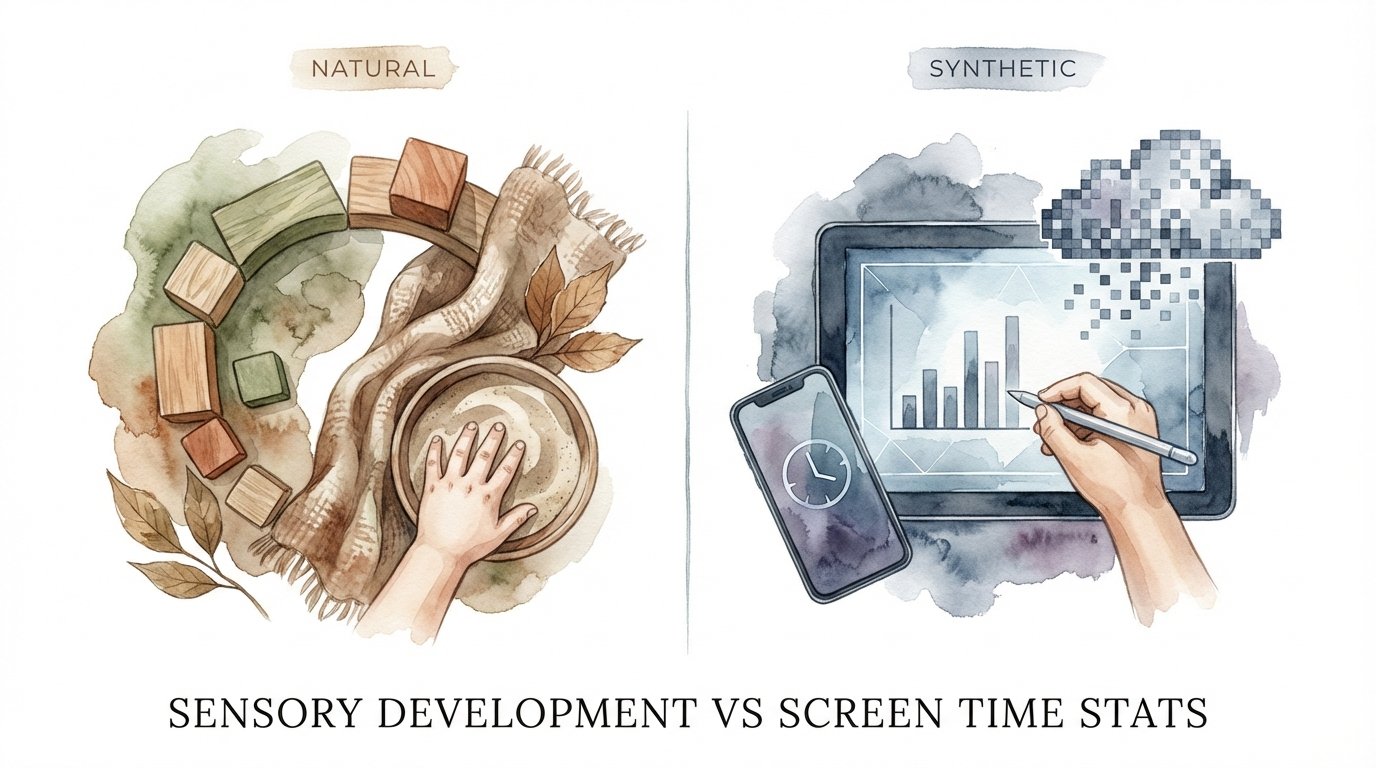
Your screen has 4K resolution, but mud has infinite depth. Digital screens offer a synthetic version of the world that lacks the 3D texture, smell, and tactile feedback necessary for deep neural development. True sensory intelligence isn’t found in a retina display; it is found in the dirt.

For decades, we have traded the chaotic richness of the outdoors for the sanitized glow of tablets. This trade comes with a steep price. The human brain is a sensory-processing machine that requires high-fidelity, multi-dimensional input to wire itself correctly. When we replace a handful of soil with a glass screen, we starve the nervous system of the complexity it craves.

Understanding the difference between synthetic and natural environments isn’t just about “getting fresh air.” It is about how our neurons connect, how our immune systems calibrate, and how we perceive the world around us. This guide explores the science of sensory intelligence and how to rewild your brain in a digital-first world.
Sensory Development Vs Screen Time Stats
Sensory development is the process by which our brain learns to interpret signals from our environment. It involves five primary senses—sight, sound, touch, taste, and smell—plus two “hidden” systems: the vestibular (balance) and proprioceptive (body awareness) systems. In the real world, these systems work in harmony. On a screen, they are largely ignored.
Recent data highlights a growing crisis in how we develop these critical pathways. According to 2024 research from the Journal of JAMA Pediatrics, babies and toddlers exposed to television or video viewing are significantly more likely to exhibit atypical sensory behaviors by age three.
- 105% Increase: 12-month-olds with any screen exposure are twice as likely to develop “low registration” behaviors, meaning they fail to notice or respond to stimuli in their environment.
- 20-25% Risk Spike: Each additional hour of daily screen time at age two correlates with a 20% higher risk of sensation seeking, sensitivity, and avoidance by age three.
- The 9-Hour Zenith: Current averages show that while the AAP recommends less than two hours of screen time for older children, the average teen now spends 7 to 9 hours daily in front of a screen.
- Developmental Delays: A 2025 study found that children with high screen usage showed slower motor and language development compared to those with high “green time” exposure.
These statistics reveal a fundamental mismatch between our evolutionary biology and our modern lifestyle. The “displacement hypothesis” suggests that every hour spent on a screen isn’t just passive; it actively replaces the complex physical interactions required for a healthy nervous system.
How It Works: The Neuroscience of Tactile Intelligence
The brain develops through a process called synaptic pruning and neural integration. In the first few years of life, the brain creates millions of connections. Sensory experiences act as the “instruction manual” for which connections to keep and which to prune.
Natural environments provide what scientists call “high-entropy” input. When you walk on uneven ground, your vestibular system (inner ear) calculates balance, your proprioceptive system (joints and muscles) adjusts for terrain, and your tactile system (feet) feels texture and temperature. This is a massive, real-time computational task that builds a robust neural architecture.
Screens, conversely, offer “low-entropy” input. A tablet screen is always flat, always smooth, and always at the same focal distance. This lack of variation can lead to atypical sensory processing. The brain becomes “bored” or under-stimulated, leading to sensation-seeking behaviors (constant movement) or sensation-avoiding behaviors (becoming overwhelmed by normal sounds or textures).
Proprioception and the 3D World
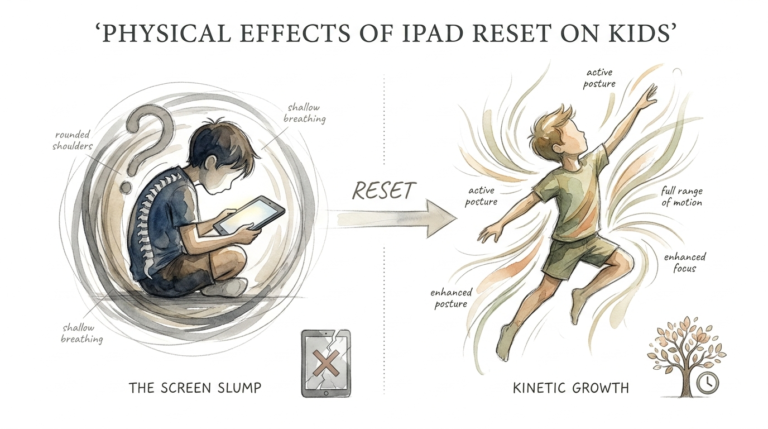
Proprioception is your “six sense.” it tells you where your body is in space without you looking at it. Digital environments offer zero proprioceptive feedback. When a child swipes a screen to move a digital block, their brain doesn’t learn the weight, friction, or spatial volume of that block. This creates a disconnect between visual intent and physical execution, often manifesting as clumsiness or poor motor coordination.
The Biological Benefits of Natural Interaction
Choosing dirt over displays provides measurable physiological advantages. Nature isn’t just a backdrop for play; it is a complex chemical and physical laboratory that tunes the human body.
The “Happy Bacteria”: Soil contains a microscopic bacterium called Mycobacterium vaccae. Research shows that exposure to this bacterium stimulates the immune system and triggers the release of serotonin in the brain. This natural antidepressant effect improves mood and enhances cognitive function.
Immune Calibration: The “Hygiene Hypothesis” suggests that our modern, sanitized environments are contributing to the rise in allergies and asthma. Exposure to the diverse microbes found in mud and natural debris helps “train” the immune system to distinguish between actual threats and harmless particles.
Visual Health: Longitudinal studies demonstrate that children who spend more time outdoors are significantly less likely to become nearsighted (myopic). Natural light and the need to switch focus between near and distant objects provide the exercise necessary for healthy eye development.
Attention Restoration: Digital screens demand “directed attention,” which is fatiguing for the prefrontal cortex. Nature provides “soft fascination,” allowing the brain to recover from the cognitive load of constant notifications and rapid-fire visual edits.
Challenges and Common Pitfalls
The shift toward a “synthetic childhood” isn’t usually a conscious choice; it is often a result of modern constraints. Recognizing these pitfalls is the first step toward correcting them.
- The Convenience Trap: Screens are highly effective “digital pacifiers.” They provide instant quiet, but they do so by overstimulating the dopamine system, making transition back to the real world difficult and often leading to meltdowns.
- Fear of “Risky Play”: Parents often avoid mud or rough terrain due to safety concerns or hygiene. However, avoiding these experiences prevents children from learning to assess risk and develop the physical competence needed to stay safe.
- The “Too Clean” Culture: Constant use of hand sanitizers and indoor-only play environments prevents the natural microbial exchange necessary for immune health.
- Passive Consumption: Relying on “educational” apps. While some content is high-quality, it still lacks the 3D tactile feedback that anchors learning in the long-term memory.
Limitations: When Nature Isn’t Enough
While natural sensory input is superior for development, it isn’t always accessible or sufficient on its own. It is important to acknowledge the practical boundaries of “green time.”
Urban Barriers: Many families live in “nature deserts” where safe, green spaces are miles away. In these cases, sensory development must be intentional, using indoor materials like sand trays, water tables, or indoor climbing structures.
Digital Necessity: We live in a digital economy. Completely removing screens is often impossible and may even be counterproductive for older children who need digital literacy for future careers. The goal is balance, not total elimination.
Safety and Pollution: Not all “dirt” is created equal. Soil in some urban areas may contain heavy metals or contaminants. Practitioners must ensure that outdoor play areas are tested or located in areas free from industrial runoff.
Synthetic Vs Natural: A Comparison
The following table breaks down the fundamental differences between the sensory input provided by screens versus the natural world.
| Feature | Digital (Synthetic) | Natural (Real World) |
|---|---|---|
| Dimension | 2D (Flat glass) | 3D (Infinite textures/depth) |
| Input Density | Low (Visual/Auditory only) | High (All 7 sensory systems) |
| Neural Load | Passive/Directed Attention | Active/Soft Fascination |
| Motor Skills | Fine motor (Tapping/Swiping) | Gross & Fine motor (Climbing/Grasping) |
| Biological Feedback | Blue light (Melatonin suppression) | Microbial exposure (Serotonin boost) |
Practical Tips for a Nature-Based Sensory Diet
You don’t need to move to the wilderness to improve sensory intelligence. Small, intentional changes can significantly shift the balance of your “sensory diet.”
- Implement the 1-Hour Rule: For children under five, limit screen time to one hour of high-quality, interactive content, and match it with at least two hours of outdoor play.
- Create a “Mud Kitchen”: Give children a designated space to mix soil, water, and plants. This unstructured play builds creativity and fine motor skills simultaneously.
- Go Barefoot: Walking on grass, sand, or dirt activates the thousands of nerve endings in the feet, providing massive proprioceptive and tactile input.
- Introduce “Loose Parts”: Instead of pre-fabricated toys, give children sticks, stones, pinecones, and water. These “open-ended” materials force the brain to invent uses, building executive function.
- Audit Your Environment: Look for opportunities to introduce texture indoors. Use sensory bins with rice, beans, or kinetic sand to supplement outdoor time.
Advanced Considerations: Rewilding the Brain
For serious practitioners or parents of children with sensory processing challenges, “rewilding” goes beyond occasional park visits. It involves a systemic change in how we view the relationship between environment and biology.
Neuro-Architecture: Consider how your home environment is structured. Are there “sensory stations”? Can you replace some plastic surfaces with wood or stone? Natural materials provide subtle tactile variety that keeps the nervous system “awake.”
Vestibular Rehabilitation: If a child (or adult) has been sedentary for too long, their vestibular system may be “sleepy.” Activities like swinging, spinning, or balancing on logs are not just fun; they are therapeutic exercises that recalibrate the brain’s sense of gravity and motion.
Microbiome Diversity: Intentional exposure to diverse natural environments—forests, beaches, and mountains—exposes the body to different suites of beneficial bacteria. This “environmental inoculation” is a key component of long-term health and emotional resilience.
Example Scenario: The Forest School Shift
Consider the difference between two learning environments. In Scenario A, a child uses an iPad app to “sort” leaves by color and shape. The child taps the screen, a bell rings, and they receive a digital star. This engages the visual system but ignores everything else.
In Scenario B (a Forest School), the child must find real leaves. They feel the crunch of dry oak versus the waxiness of holly. They smell the decomposing forest floor. They have to navigate a slippery slope to reach a specific tree.
The child in Scenario B isn’t just learning about leaves; they are developing spatial reasoning (how far to reach), risk assessment (is the branch stable?), immune resilience (exposure to soil), and emotional regulation (managing the frustration of a dropped leaf). The neural “footprint” of Scenario B is vastly deeper and more permanent than the fleeting engagement of the screen.
Final Thoughts
Screens are powerful tools for communication and information, but they are poor substitutes for the physical world. The human brain was not designed to interact with the universe through a pane of glass. It was designed to grasp, climb, squelch, and explore.
Prioritizing natural sensory experiences isn’t an act of rejecting technology; it is an act of protecting our biological heritage. By ensuring that “green time” outweighs screen time, we provide the nervous system with the high-fidelity data it needs to build a foundation of intelligence, resilience, and health.
Experiment with your environment. Let the kids get dirty. Take your shoes off. Reconnect with the infinite depth of the real world. Your brain will thank you for the input it was always meant to receive.
Sources
1 movingtolearn.ca (https://movingtolearn.ca/understanding-proprioceptive-and-vestibular-systems-to-optimize-student-attention-and-learning/) | 2 communityplaythings.com (https://www.communityplaythings.com/resources/articles/the-benefits-of-mud-play) | 3 gbchildrensmuseum.org (https://www.gbchildrensmuseum.org/mud-hut) | 4 parentmap.com (https://www.parentmap.com/article/mud-play-rainy-day-fun) | 5 natureplaysa.org.au (https://natureplaysa.org.au/wp-content/uploads/2023/11/Nature-Play-Downloads-Mud-Info-Sheet.pdf) | 6 tinylearns.com (https://tinylearns.com/blogs/learn/how-much-screen-time-does-the-average-child-get) | 7 barodeducation.in (https://barodeducation.in/why-touching-matters-the-science-behind-tactile-learning-vs-educational-apps-2/)