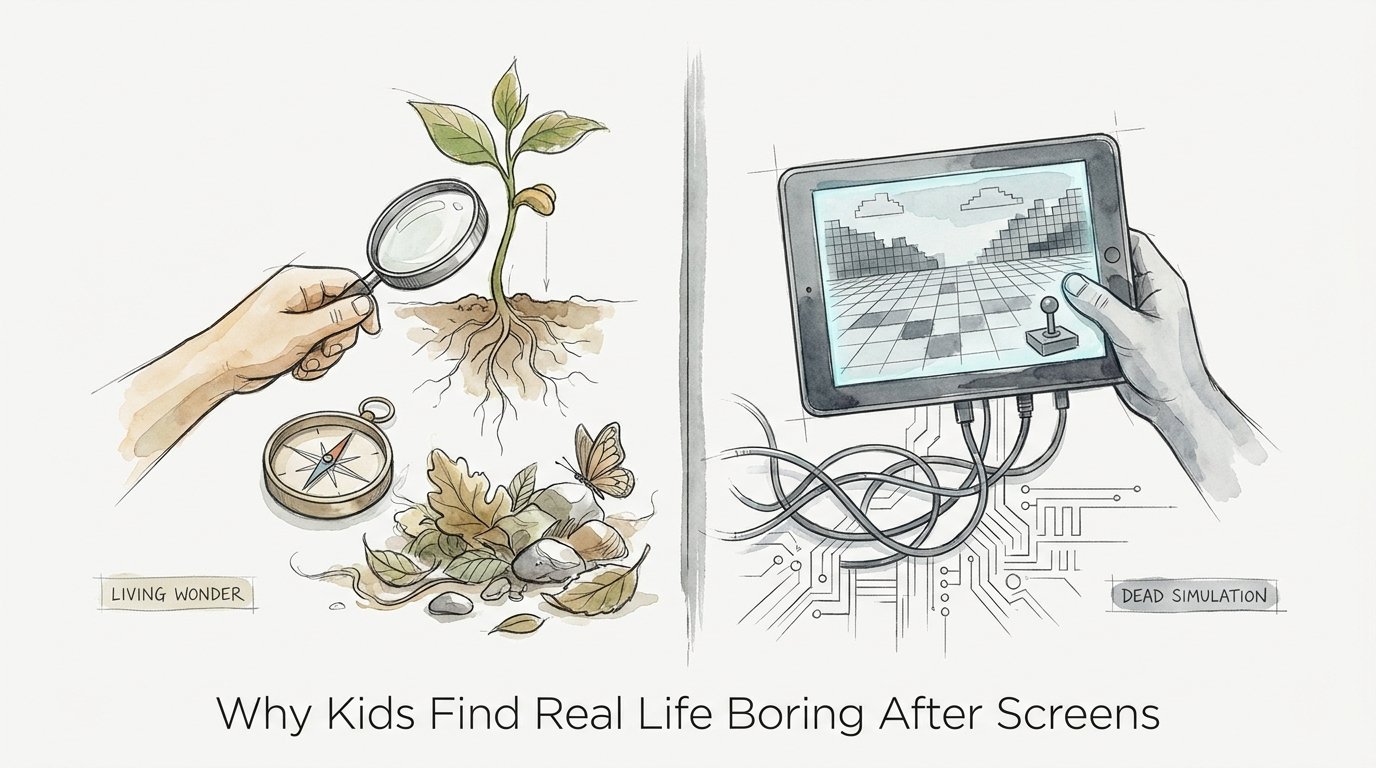
Why Kids Find Real Life Boring After Screens
When 4K resolution makes the infinite depth of a mud puddle look ‘boring,’ something is wrong. We are feeding our children a synthetic version of life that is louder, brighter, and faster than nature. If your child walks past a real butterfly to look at one on a tablet, they aren’t just ‘using’ technology—they are being conditioned to find life inadequate.
This is the digital dilemma of the modern parent. We see our children losing interest in the very world that was once their greatest playground. A stick is no longer a sword; it is just a piece of wood. A rainy afternoon is no longer a chance for adventure; it is a period of withdrawal. Understanding this shift is the first step in reclaiming their sense of wonder.
The gap between living wonder and dead simulation is growing. We are witnessing a fundamental change in how the developing brain processes reality. It is not just about “screen time” as a number. It is about the quality of the stimulus and the biological price our children pay for constant connectivity.
Why Kids Find Real Life Boring After Screens
The core reason children find reality dull after digital immersion is a phenomenon known as supernormal stimuli. In the digital world, colors are more saturated, movements are faster, and rewards are instantaneous. When a child transitions from a high-octane video game to a quiet living room, their brain experiences a sudden sensory vacuum. Real life does not flash, beep, or offer “level up” notifications every thirty seconds.
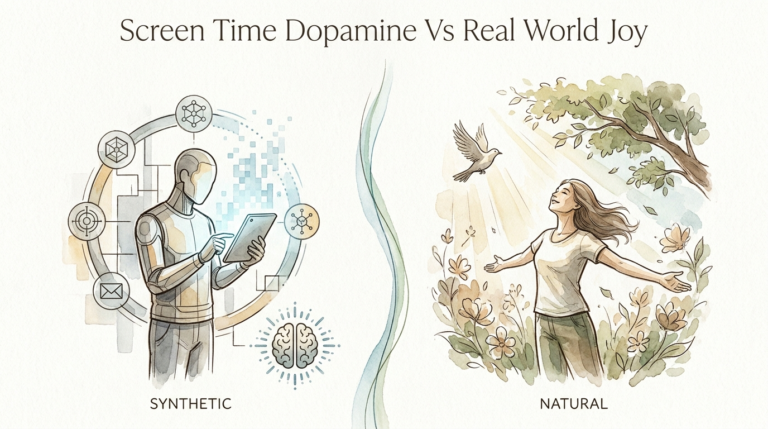
Recent research indicates that excessive screen use disrupts the brain’s dopamine cycle. Dopamine is the neurotransmitter responsible for motivation and pleasure. Screens deliver “micro-hits” of dopamine at a rate that nature cannot match. Over time, the brain’s reward system becomes desensitized. This means the child needs higher and higher levels of stimulation just to feel “normal.”
This exists as a biological adaptation. The brain is incredibly efficient at tuning into whatever environment it spends the most time in. If that environment is a hyper-speed digital landscape, the “slow” pace of physical reality becomes frustrating. It feels like trying to read a book while someone is shouting in the other room. The quiet signal of curiosity is drowned out by the loud noise of digital overstimulation.
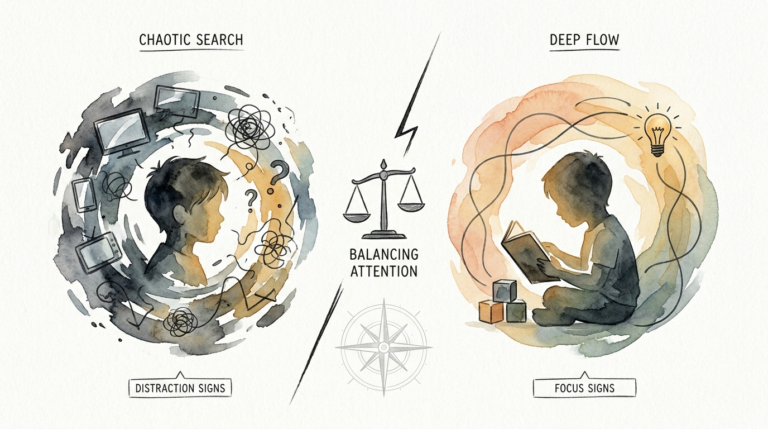
We see this in classrooms, at dinner tables, and on hiking trails. A child conditioned by screens often lacks the “attentional muscle” to find interest in things that don’t immediately grab them. They have been trained to be passive consumers of excitement rather than active creators of it. This is why the phrase “I’m bored” often follows the turning off of a device within minutes.
The Mechanics of Digital Overstimulation
To understand the “boredom” response, we have to look at the neuroscience of the dopamine loop. When a child plays a game or scrolls through videos, the nucleus accumbens—the brain’s reward center—is flooded. This creates a state of hyper-arousal. The child is not just “having fun”; they are in a high-stakes neurological state of anticipation.
When the screen goes dark, dopamine levels don’t just return to a healthy baseline. They often crash below it. This is known as a reward prediction error. The brain was expecting a constant stream of high-value rewards, and when it stops, the resulting “dopamine cliff” feels physically uncomfortable. This discomfort manifests as irritability, tantrums, and the deep conviction that “there’s nothing to do.”
Another critical factor is the pace of media. Research by Dr. Christakis has shown that fast-paced media—shows or games that cut between scenes every few seconds—can lead to increased inattention. In one study, children watching fast-paced cartoons were 60% to 110% more likely to experience attention issues immediately afterward compared to those watching slower, “real-life paced” programming like Mr. Rogers’ Neighborhood.
Finally, there is the issue of cognitive load. Screens do the “attentional work” for the child. The bright lights and fast motion trigger the orienting response, which is an involuntary reflex. In the real world, attention must be “voluntary.” The child has to decide to focus on a bug or a building block. After hours of involuntary focus, the voluntary attention system is exhausted and “shuts down,” leading to the perception of boredom.
Benefits of Reclaiming the Real World
Stepping away from the “dead simulation” and back into “living wonder” offers profound developmental advantages. When children engage with the physical world, they are forced to use their executive functions. They must plan, organize, and solve problems that don’t have a “reset” button. This builds the prefrontal cortex—the part of the brain responsible for self-control and long-term success.
Restoration of the Default Mode Network (DMN): This is a specific brain network that activates when we are “bored” or daydreaming. It is the engine of creativity and self-reflection. Screens suppress the DMN by keeping the brain in a constant state of external focus. Without downtime, children never learn how to talk to themselves or process their own emotions.
Sensory Integration: Real life provides a 360-degree sensory experience. Touching dirt, feeling the wind, and hearing the nuances of birdsong helps the nervous system stay “regulated.” Digital stimulation is often “impoverished”—it focuses only on sight and sound, leading to a sensory imbalance that can cause anxiety and restlessness.
Development of Resilience: In a video game, failure is temporary and often lacks stakes. In the real world, if a block tower falls, the child must deal with the frustration and decide to try again. This builds emotional resilience that a digital environment simply cannot replicate. Real-world “boredom” is actually the fertile soil in which curiosity grows.
Challenges and Common Pitfalls for Parents
The transition from a high-tech lifestyle to a balanced one is rarely smooth. One of the most common mistakes is attempting a “cold turkey” approach without providing a transition period. A brain accustomed to 100 mph cannot suddenly enjoy 5 mph. Parents often give up when the initial withdrawal symptoms—the whining and the “I’m bored” complaints—become too much to handle.
Another pitfall is using screens as a “digital pacifier.” When we hand a child a tablet to keep them quiet at a restaurant, we are effectively teaching them that they do not need to develop the internal tools to manage their own restlessness. We are outsourcing their emotional regulation to an algorithm. While this provides short-term peace, it creates long-term dependency.
Parents also frequently struggle with “technological hypocrisy.” If we tell our children to go play outside while we sit on our own phones, the message is lost. Children are biologically wired to mimic their caregivers. If they see us seeking constant digital hits, they will view screens as the ultimate “adult” reward, making the “real world” seem like a second-class experience.
Finally, many parents mistake “educational” content for “harmless” content. Just because an app teaches phonics doesn’t mean it isn’t also triggering the dopamine loop. The “bright lights and fun sounds” of educational apps can be just as overstimulating as a mindless game, leading to the same post-screen boredom and irritability.
Limitations and Realistic Constraints
It is important to acknowledge that we live in a digital age. Total elimination of screens is often neither practical nor desirable. Technology provides tools for connection, creativity, and learning that are genuinely valuable. The goal is not to live in the 19th century, but to ensure that the “digital” serves the “human,” not the other way around.
Environmental limitations also play a role. Not every family has access to a safe backyard or a forest. In urban environments, “nature” might just be a single tree on a sidewalk or a small community park. Recognizing these constraints means we have to be more creative about how we provide “living wonder” in a concrete world.
There are also developmental trade-offs. Some children, particularly those who are neurodivergent, may find the predictability of digital environments helpful for self-regulation in a world that feels too chaotic. In these cases, screens aren’t just “entertainment”; they are a tool for managing sensory overwhelm. A balanced understanding recognizes that “one size fits all” screen limits don’t work for every family.
Comparison: Living Wonder vs. Dead Simulation
| Feature | Real-World (Living Wonder) | Screen-World (Dead Simulation) |
|---|---|---|
| Dopamine Hit | Slow, sustained, earned through effort. | Fast, intense, delivered instantly. |
| Attention Required | Active/Voluntary (Top-Down). | Passive/Involuntary (Bottom-Up). |
| Sensory Input | Full spectrum (Touch, Smell, Multi-focal). | Limited (Sight/Sound, Flat-focal). |
| Creative Role | Child is the protagonist and creator. | Child is the observer of someone else’s vision. |
| Post-Activity Effect | Calm, regulated, tired but satisfied. | Restless, irritable, “bored” by reality. |
Practical Tips for Digital Recalibration
Reconnecting a child to the real world requires a period of “dopamine recalibration.” You are essentially helping their brain lower its baseline for stimulation. This doesn’t happen overnight, but consistent changes can yield massive results in as little as two weeks.
- Establish “Green Time” Minimums: For every hour of screen time, require an equal (or double) amount of outdoor time. Nature is the ultimate sensory regulator. The complexity of a forest or even a neighborhood garden is “organized chaos” that calms the overstimulated nervous system.
- Create a “Transition Buffer”: Never go straight from a tablet to a chore or homework. After a screen is turned off, provide 15 minutes of “low-intensity” activity like Lego, drawing, or a snack. This allows the dopamine levels to settle without a massive emotional crash.
- Involve the Senses: If a child says they are bored, offer a sensory activity. Kinetic sand, water play, or even helping with “heavy work” like carrying groceries can help “ground” the body back into physical reality.
- Model the “Gift of Boredom”: When you are bored, don’t reach for your phone. Let your child see you daydreaming, looking out a window, or tinkering with a physical object. Say, “I’m feeling a bit bored, so I’m going to see what I can find in the garden.”
- Curate the Content: If screens are used, opt for “slow media.” Choose shows that have long takes, natural lighting, and realistic pacing. Avoid “high-cut” editing that triggers the orienting response every three seconds.
Advanced Considerations: The Long-Term Brain Impact
For serious practitioners of “digital wellness,” it is important to understand the structural changes that occur with chronic overstimulation. Research published in 2024 has linked high early-life screen exposure to atypical sensory processing. This means the child’s brain may actually struggle to filter out unimportant sounds or light, leading to a state of chronic “high alert.”
Furthermore, studies using MRI technology have shown that children with excessive screen use (over 7 hours a day) exhibit “premature thinning” of the cerebral cortex. This is the area of the brain responsible for processing sensory information and higher-order thinking. While the brain is highly plastic, these early developmental windows are critical. We are essentially “wiring” the brain for a world that doesn’t exist outside of a black mirror.
Another advanced concept is the “Screen-Free Bedroom” policy. The blue light emitted by screens suppresses melatonin, the hormone that tells the brain to sleep. But even more importantly, a bedroom with a screen is a bedroom that is never truly quiet. The brain stays in a state of “potential engagement,” preventing the deep, restorative REM sleep needed for memory consolidation and emotional regulation.
Scenario: The Butterfly vs. The Tablet
Imagine a seven-year-old child named Leo. Leo has spent two hours playing a fast-paced battle royale game. His heart rate is elevated, his pupils are dilated, and his brain is swimming in dopamine. His mother tells him it’s time to go for a walk. He resists, whines, and eventually trudges out the door, complaining that “outside is stupid.”
Five minutes into the walk, a vibrant Monarch butterfly lands on a nearby flower. Leo looks at it for a split second and then looks away. To Leo’s current brain state, that butterfly is “low-value data.” It isn’t moving at 60 frames per second. It doesn’t explode. It doesn’t give him “experience points.” His brain, currently tuned to a “supernormal” frequency, literally cannot find the interest in the butterfly.
Now, compare this to Leo after a week-long camping trip with no devices. On day seven, Leo sees the same butterfly. Without the digital noise, his voluntary attention is restored. He notices the patterns on the wings. He wonders where it’s going. He follows it for ten minutes. He has moved from being a “consumer” of artificial excitement to a “creator” of his own wonder. This is the goal of digital recalibration.
Final Thoughts
The “boredom” our children feel after screen time is not a lack of imagination; it is a biological hangover. We are asking them to transition from a world of hyper-stimulation to a world of subtle, living beauty, and their brains simply aren’t ready for the leap. By understanding the dopamine loop and the power of supernormal stimuli, we can stop blaming the child and start fixing the environment.
We must be the guardians of their attention. This doesn’t mean we have to be “anti-tech,” but it does mean we must be “pro-reality.” Every minute spent in the “living wonder” of the real world is an investment in their future cognitive health, emotional resilience, and ability to find joy in the simple things.
The next time your child says “I’m bored” after you put the tablet away, don’t panic. Don’t rush to fill the void. That boredom is the sound of their brain recalibrating. It is the necessary silence before the music of their own curiosity begins to play again. Stay the course, get outside, and let the real world work its slow, magnificent magic.
Sources
1 youtube.com | 2 artfulparent.com | 3 schreiberpediatric.org | 4 thejacobsladdergroup.org | 5 myneurobalance.com | 6 fierceparenting.com | 7 psychologytoday.com | 8 coordikids.com | 9 horizonhealthnews.com | 10 biglifejournal.com | 11 imaginedbyra.com | 12 harvard.edu | 13 braintasticscience.com | 14 buildingbrains.ca | 15 uvpediatrics.com | 16 second-nature.com | 17 compasschildcare.com | 18 ascendbh.com