Child Attention Span And Screen Time Signs
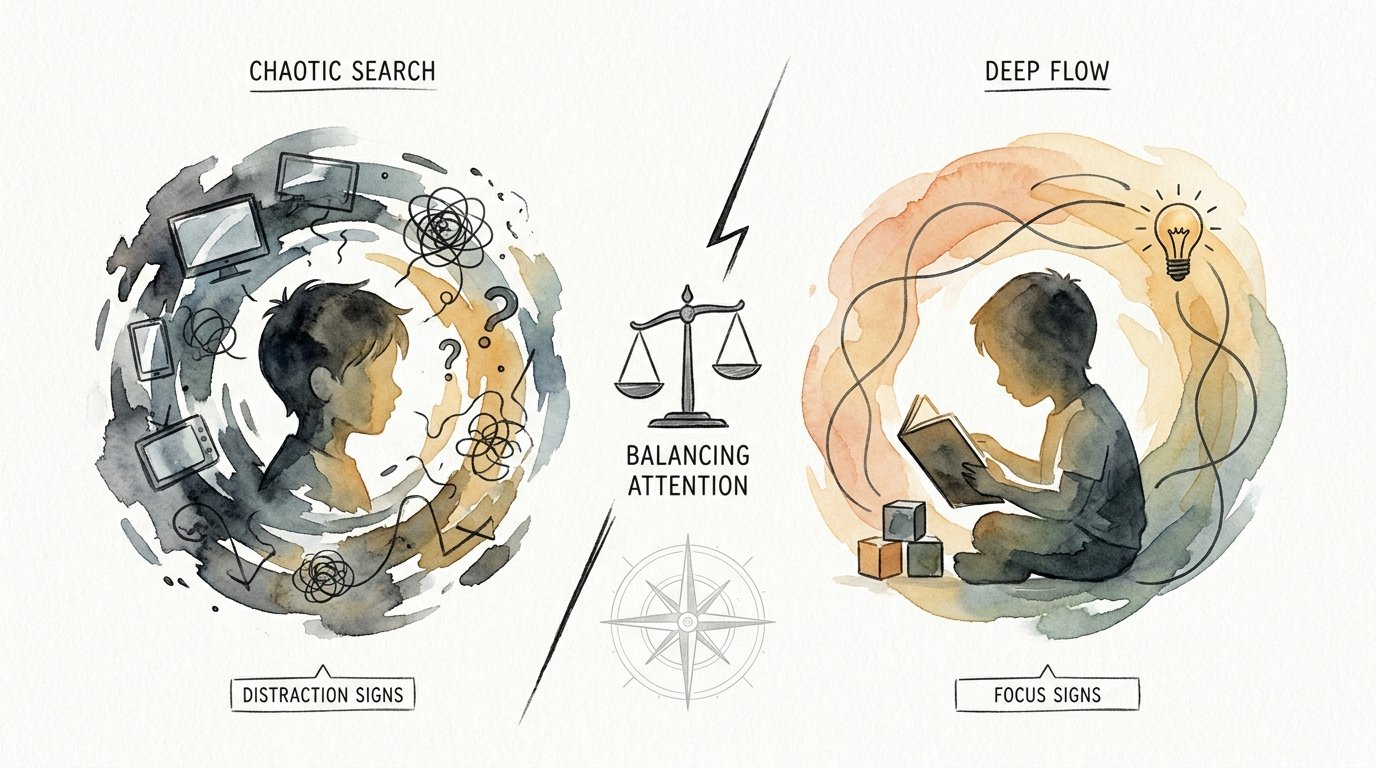
If your child views 10 minutes of silence as an emergency rather than an opportunity, the screen has hijacked their inner focus. High-speed digital content trains the brain to discard information every few seconds. If your child can’t settle into a single activity for more than a minute, they are suffering from the ‘Chaotic Search’—and it’s time for a reset.

Modern parenting often feels like a battle against an invisible current of dopamine. You hand over a tablet for five minutes of peace, but you pay for it later in tantrums and “zoning out” behaviors. This cycle isn’t just about discipline; it’s about how the developing brain responds to high-frequency stimulation.

Understanding the difference between the frantic pulse of a digital feed and the calm rhythm of deep engagement is the first step toward reclaiming your child’s cognitive health. We are moving from a state of constant distraction to a state of mastery.
This guide explores the transition from the Chaotic Search to Deep Flow. You will learn the neurological signs of overstimulation and practical strategies to rebuild a shattered attention span.
Child Attention Span And Screen Time Signs
The Chaotic Search is a state of mind where the brain is perpetually hunting for the next hit of novelty. In this state, a child cannot find satisfaction in one toy or one book. They flip from one thing to another, never diving deep, because they have been conditioned to expect a new “reward” every few seconds.
Recent research highlights a sharp rise in what experts call Electronic Screen Syndrome (ESS). This is essentially a state of nervous system overstimulation. When a child’s brain is flooded with the rapid-fire transitions of social media or short-form videos, their internal “arousal” levels skyrocket.
You can spot the signs of this digital overload easily if you know what to look for. It often presents as a “wired and tired” look—where the child is physically exhausted but mentally hyperactive. Their pupils might stay dilated even after the screen is off, and they may struggle to make eye contact.
Common behavioral red flags include extreme irritability when devices are removed. If your child treats a dead battery like a personal tragedy, their brain is likely struggling with a dopamine deficit. They may also show a lack of interest in creative play, preferring the passive consumption of a screen over the active effort of building with blocks.
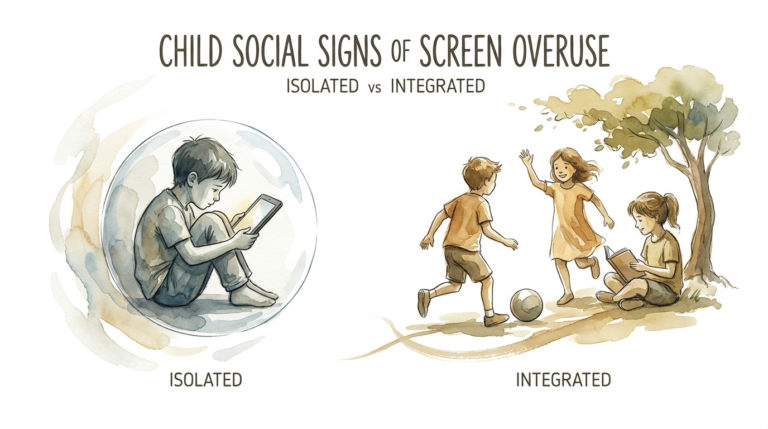
Another major sign is the loss of independent play. A child in the Chaotic Search needs constant external stimulation. Without a screen, they feel a sense of “boredom” that is actually closer to a withdrawal symptom. They have forgotten how to use their own imagination to fill the silence.
How the Digital Dopamine Loop Rewires Focus
The mechanics of a shrinking attention span are rooted in the brain’s reward system. Apps are designed to exploit “variable rewards,” meaning the user never knows when the next exciting thing will appear. For a child, this creates a loop of anticipation that is incredibly hard to break.
Every time a child swipes or sees a new bright transition on a screen, the brain releases a small burst of dopamine. This chemical is responsible for motivation and pleasure. Over time, the brain’s baseline for what is “interesting” rises. Real life, which moves slowly, begins to feel painfully dull in comparison.
Neurologically, this impacts the executive function system. This is the part of the brain located in the prefrontal cortex responsible for planning, impulse control, and sustained attention. High-speed content essentially bypasses this system, favoring the quicker, more primitive “orienting” system that reacts to movement and sound.
When the orienting system is overworked, the executive function system weakens. It is like a muscle that has atrophied from lack of use. The child becomes reactive rather than proactive. They can react to a flashing screen, but they cannot proactively decide to sit and finish a puzzle.
This process also affects the brain’s white matter pathways. These are the “highways” that allow different parts of the brain to communicate. Studies have shown that excessive screen time in early childhood can lead to lower connectivity in areas related to language and literacy, making it harder for children to process complex information.
Benefits of Reclaiming a Child’s Attention
Rebuilding a child’s focus is not just about reducing “bad” behavior; it is about unlocking their full cognitive potential. When a child moves out of the Chaotic Search and into Deep Flow, they regain the ability to learn efficiently.
One of the most immediate benefits is emotional regulation. A child who can focus on a single task is naturally calmer. Their nervous system is no longer in a state of high alert, waiting for the next digital stimulus. This leads to fewer meltdowns and a greater capacity to handle minor frustrations.
Academic performance also sees a significant boost. Success in school requires the ability to sustain attention on tasks that are not inherently “exciting,” such as reading a paragraph or solving a math problem. By strengthening the “focus muscle” at home, you are giving your child the tools they need to thrive in a classroom environment.
Creativity flourishes in the absence of constant input. Boredom is often the gateway to original thought. When a child is forced to sit with their own thoughts, they begin to invent games, draw pictures, and build worlds. This internal creativity is far more satisfying and developmentally beneficial than any “educational” app.
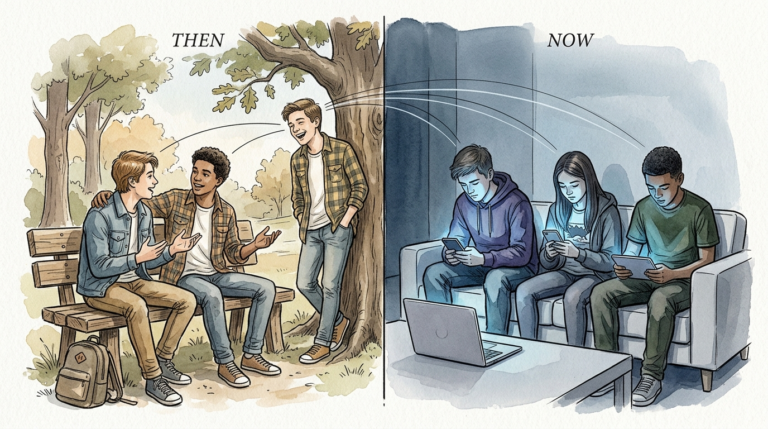
Finally, social skills improve. Deep focus allows for better listening and more meaningful eye contact. A child who isn’t constantly looking for a digital distraction is more present with their peers and family members. They become better at reading social cues and engaging in the back-and-forth of real conversation.
Challenges and Common Pitfalls in Digital Resets
The path to reclaiming focus is rarely a straight line. The most common challenge is the “Withdrawal Phase.” When you first limit screen time, your child’s behavior will likely get worse before it gets better. They may become more aggressive, whiny, or lethargic as their brain adjusts to lower dopamine levels.
Parental guilt is another major obstacle. We live in a world where screens are everywhere, and using them as a “digital babysitter” is often a survival tactic for busy parents. Many feel like they are “punishing” their child by taking away the tablet, but it is helpful to view it as “detoxing” rather than punishing.
A common mistake is replacing screens with other forms of high-intensity entertainment. If you take away the iPad but immediately start performing like a circus act to keep the child happy, you are still teaching them to rely on external stimulation. The goal is to teach them to find their own “flow.”
Another pitfall is the “Cold Turkey” approach without a plan. Simply removing devices without providing an environment conducive to play often leads to chaos. You must have a strategy for what the child will do during the newly opened time blocks, especially in the first few weeks of a reset.
Consistency is the hardest part. It is easy to set a rule on a Saturday morning when you have energy, but much harder on a Tuesday evening after a long workday. Inconsistency teaches the child that if they scream long enough, the screen will eventually return. This reinforces the very behavior you are trying to change.
Limitations of Universal Screen Time Rules
While guidelines are helpful, it is important to recognize that one size does not fit all. Some children are naturally more sensitive to digital stimulation than others. A child with ADHD, for example, may experience the “Chaotic Search” much faster and more intensely than a neurotypical sibling.
Environmental factors also play a role. A family living in a small apartment during a cold winter has fewer “Green Time” options than a family with a large backyard in the summer. Your strategy must be realistic based on your physical space and the resources available to you.
The quality of content matters as much as the quantity. There is a vast difference between a fast-paced, “brain-rotting” social media feed and a slow-paced documentary or an interactive video call with a grandparent. Categorizing all screen time as “bad” can lead to unnecessary stress and missed opportunities for high-quality learning.
We also cannot ignore the reality of a digital world. Completely shielding a child from technology until adulthood is neither practical nor helpful. The goal is “digital literacy” and “self-regulation,” not total abstinence. The limitation of a total ban is that it doesn’t teach the child how to handle the device when they eventually get one.
Finally, the age of the child dictates the strategy. What works for a toddler (total removal) will not work for a teenager who uses their phone for social connection and schoolwork. The limitations of parental control increase as the child grows, shifting the focus from “imposing rules” to “mentoring habits.”
Comparing Chaotic Search vs. Deep Flow
Understanding the contrast between these two states helps you identify where your child is spending their mental energy.
| Feature | Chaotic Search (Screen Hijack) | Deep Flow (Natural Focus) |
|---|---|---|
| Primary Driver | External Novelty / High Dopamine | Internal Curiosity / Mastery |
| Mental State | Reactive, Jumpy, Easily Distracted | Proactive, Immersed, Calm |
| End Result | Exhaustion / Irritability | Satisfaction / Skill Growth |
| Activity Type | Short-form video, Infinite scrolling | Building, Reading, Open-ended play |
| Boredom Tolerance | Zero; perceived as an emergency | High; viewed as an invitation to create |
Practical Tips for a Brain Reset
Reversing the Chaotic Search requires a deliberate shift in the home environment. You aren’t just taking something away; you are making room for something better. Start by implementing a “Digital Sunset.” All personal screens should be turned off at least two hours before bed to allow the brain’s melatonin production to kick in.
Introduce the “One-Task Rule.” Encourage your child to finish one activity before starting another. If they are building with LEGOs, they shouldn’t have a TV on in the background. Reducing ambient “noise” (visual and auditory) helps the brain settle into a single channel of focus.
Use the “Boredom Reset” as a tool. Instead of rushing to entertain your child the moment they say they are bored, acknowledge the feeling and wait. Set a timer for 15 minutes of “unstructured time” where they have no directed activity. Most children will eventually find something to do, and this is where true Deep Flow begins.
Optimize the physical environment for focus. Keep toys in “invitations to play.” Instead of a giant bin of mixed-up toys, set out a few blocks on a table or a couple of open books. This reduces the “visual noise” that can trigger a Chaotic Search and makes it easier for a child to choose one thing and stick with it.
Focus on “Green Time” over “Screen Time.” Physical activity outdoors has been shown to improve executive function and self-regulation. Movement helps “burn off” the hyper-arousal caused by screens, grounding the child in their physical body and the real world.
Advanced Considerations for Long-Term Focus
For those who want to go deeper, consider the role of neuroplasticity. The brain is incredibly resilient, especially during childhood. By changing the daily habits of your household, you are physically rewiring the neural pathways in your child’s brain. This is a long-term investment in their cognitive “hardware.”
Monitor the “Pace” of the media your child does consume. High-speed, jump-cut editing is the most damaging to attention spans. If they are going to watch something, choose “Slow Media”—shows with long scenes, natural pacing, and a clear narrative arc. This mirrors the pace of real-life learning and doesn’t overload the orienting system.
Teach “Living Life Out Loud.” This is a technique where you narrate your own use of technology. For example, say, “I am putting my phone in the drawer now so we can play together.” This models the “executive control” that you want your child to develop. It shows them that technology is a tool to be picked up and put down, not a master to be followed.
Consider the “Cognitive Load” of different tasks. Learning a new skill requires more mental energy than practicing an old one. When your child is tired or hungry, their ability to maintain Deep Flow is lower. Schedule high-focus activities for times when they are well-rested, and save simpler, low-stress play for the end of the day.
Understand the impact of “Background TV.” Even if a child isn’t actively watching, a television on in the background has been linked to lower quality play and shorter attention spans. The constant flickering and noise prevent the brain from reaching a state of deep immersion in whatever else the child is doing.
A Realistic Scenario: Tablet vs. Lego
Imagine a typical Saturday morning. In Scenario A, the child wakes up and is immediately handed a tablet. They spend 45 minutes swiping through “Surprise Egg” videos. By the time breakfast is ready, they are hyper-stimulated. They can’t sit still, they refuse to eat their eggs, and they scream when the tablet is taken away. This is the Chaotic Search in action.
In Scenario B, the morning starts with a “Low-Dopamine” environment. There are no screens. The child initially whines about being bored but eventually notices a half-finished LEGO tower from the night before. They spend 30 minutes carefully searching for the right pieces and adding to the structure.
When it’s time for breakfast, the transition is smoother. Because they were in a state of Deep Flow, their nervous system is calm. They have a sense of accomplishment from building something real. Even if they felt frustrated by a difficult piece, they practiced “problem-solving” rather than “novelty-seeking.”
The difference between these two mornings isn’t just about the 45 minutes of time. It’s about the “mental set” for the rest of the day. Scenario A sets the brain for a day of chasing the next hit. Scenario B sets the brain for a day of engagement and learning.
You don’t have to be perfect. Even small shifts toward Scenario B can have a compounding effect over weeks and months. The goal is to make Deep Flow the “default” state of your home rather than a rare occurrence.
Final Thoughts
The struggle with screen time is one of the defining challenges of modern parenting. It is easy to feel overwhelmed by the sheer volume of digital content competing for your child’s attention. However, remember that the brain is designed for focus, not distraction. By creating boundaries and fostering an environment of Deep Flow, you are giving your child back their own mind.
Focus is the foundation of everything—from academic success to emotional health. Reclaiming it requires patience, consistency, and a willingness to embrace the occasional quiet moment. You aren’t just managing “screen time”; you are protecting the development of a human being’s most valuable asset: their ability to think deeply.
Start small today. Turn off the background TV, put the phones in a basket, and see what happens when the silence isn’t treated like an emergency. You might be surprised at the creativity and focus that emerge when the Chaotic Search finally stops.
Sources
1 kidslox.com | 2 psychologytoday.com | 3 shichida.com.au | 4 allprodad.com | 5 nyp.org | 6 childrenandscreens.org | 7 piqe.org | 8 austintrinity.org | 9 cedars-sinai.org | 10 kidsmentalhealthfoundation.org | 11 youtube.com | 12 kidkraft.com | 13 childrenandscreens.org | 14 myhspediatrics.com | 15 theguardian.com | 16 juliebilliartschool.org