weekly family plan to cut screen time
Trade the scroll for the tool and watch their confidence grow. Stop consuming other people’s lives and start producing your own. This weekly plan helps your family trade screen hours for skill-building hours.
Most families feel the digital pull every single day. The average child spends several hours staring at a glowing rectangle, often passively soaking up content they will forget in minutes. This habitual consumption creates a quiet gap where hands-on skills used to live. It is time to bridge that gap.
This guide is not a lecture about “bad technology.” It is a blueprint for a better lifestyle. We are moving from a world of watching to a world of doing. By the end of this week, your living room will feel less like a theater and more like a workshop. Your children will stop asking what is on TV and start asking where the hammer is.
Real confidence does not come from high scores in a mobile game. It comes from the tangible pride of making something with your own hands. Whether it is baking a loaf of bread, coding a basic script, or fixing a leaky faucet, these skills build a foundation that lasts a lifetime. Let’s look at how to make the shift.
weekly family plan to cut screen time
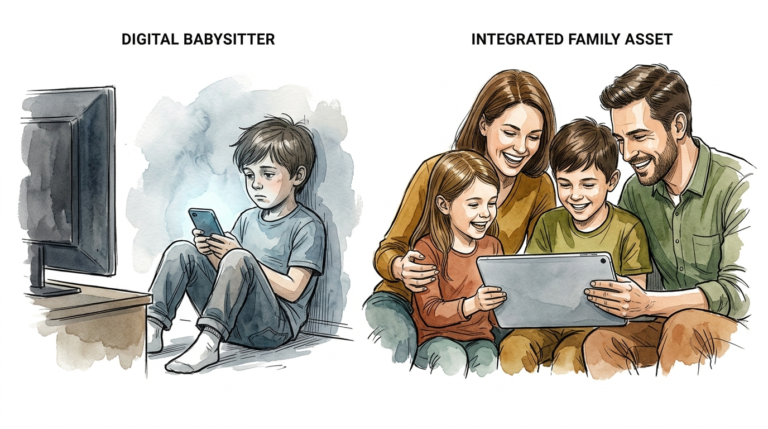
A weekly family plan to cut screen time is a structured schedule designed to replace passive digital consumption with active skill-building activities. It is a commitment to “producer” energy over “consumer” energy. Instead of just taking away the phone, we are giving the child a reason to put it down.
This plan exists because modern technology is designed to be addictive. Apps use variable reward schedules to keep users scrolling. This creates a high dopamine threshold, making real-world activities feel boring by comparison. A structured plan helps reset the brain’s reward system by reintroducing the slow, satisfying burn of mastery.
You can find these plans in homes that prioritize resilience, creativity, and self-reliance. Think of it like a nutritional diet for the mind. You wouldn’t let your family eat candy for every meal, so why let them consume digital junk food for every free hour? The plan provides the “vegetables” of skill-building in a way that eventually tastes better than the “candy” of the scroll.
Examples include “Maker Mondays” for building, “Technical Tuesdays” for digital creation, and “Survival Saturdays” for outdoor skills. These themes give kids a framework. They know what to expect. They know that during these hours, the screen is a tool for learning, not a portal for escaping.
How to Implement Your Skill-Building System
Transitioning a family requires more than just a new rule. It requires a system. You cannot simply pull the plug and expect a child to suddenly start woodworking. You must set the stage for success. Here is the step-by-step process to get started.
The 48-Hour Dopamine Reset
The first two days are the hardest. The brain is literally “hooked” on the quick hits of social media and video games. Start with a weekend of zero screens. This is a total detox. Explain to the family that the goal is to “clear the pipes.” Expect some irritability and complaints of boredom. This is actually a sign that the brain is starting to reset.
Defining the “Producer” Categories
Sit down and list activities that count as “producing.” This helps clarify the rules. If a child wants to use a screen to watch a tutorial on how to play the guitar, that is production. If they want to watch a “Let’s Play” video of someone else playing a game, that is consumption. Categorize activities into groups like Physical Creation, Digital Mastery, and Domestic Life Skills.
The “Earn to Learn” Schedule
Create a ratio. For every 60 minutes spent building a skill, the child might earn 15 minutes of leisure screen time. This shifts the mindset. The screen becomes a reward for effort rather than a default state of being. Eventually, you may find they stop caring about the “earned” time because they are too deep into their project.
Building the Home Maker Space
You need a physical location for the work to happen. This doesn’t require a whole room. A dedicated corner with a sturdy table and organized supplies will do. If the tools are hidden away in a basement, they won’t be used. Keep the “Producer” tools visible and accessible. This might mean a drawer for electronics, a box for art supplies, or a shelf for cookbooks.
The Practical Benefits of the Shift
The advantages of cutting screen time in favor of skills are measurable and immediate. This isn’t just about “behaving better.” It is about cognitive and emotional development. When you trade the scroll for the tool, several things happen at once.
Increased Executive Function: Building a birdhouse or following a recipe requires planning, working memory, and impulse control. These are the building blocks of executive function. Screens often do the thinking for us. Skills force us to think for ourselves.
Biological Reward Reset: Real-world success releases dopamine more slowly than a digital “like” button. This teaches the brain to value long-term effort over short-term gratification. This is the secret to grit and perseverance. It helps children stay focused on difficult tasks later in life.
Physical Mastery and Fine Motor Skills: Many digital-native children struggle with manual dexterity. Working with tools, needles, or kitchen utensils sharpens the connection between the brain and the hands. This physical competence translates into overall confidence.
Strengthened Family Bonds: Screen time is usually an isolating activity. Skill-building is often collaborative. When a parent teaches a child how to change a tire or sauté an onion, they are sharing more than just information. They are sharing a legacy of competence.
Challenges and Common Pitfalls
You will face resistance. That is a guarantee. Understanding the hurdles will help you clear them without losing your momentum. Most families fail because they treat the plan like a punishment instead of an opportunity.
The “Boredom Wall” is the biggest obstacle. When the screen goes away, the child will feel a vacuum. They might say they have “nothing to do.” This is the critical moment. Do not provide the solution immediately. Allow them to be bored for a while. Boredom is the precursor to creativity. If you jump in with a suggestion too fast, you steal their chance to discover their own interests.
Parental hypocrisy is another major trap. You cannot expect your children to trade the scroll for the tool if you are constantly checking your email or social media. You are the primary model for behavior. If they see you producing—writing, gardening, or fixing things—they will naturally want to follow. If they see you consuming, they will resent the rules.
Setting the bar too high is also dangerous. If you start with a project that is too complex, the child will get frustrated and quit. Start with “quick wins.” A simple craft that takes 20 minutes is better than a week-long project that never gets finished. Success builds on success.
Limitations and Realistic Boundaries
While the goal is to maximize skill-building, we live in a digital world. A “zero-screen” life is rarely sustainable or even desirable in the long run. There are times when this method needs to be flexible.
School requirements are a non-negotiable reality. Most students need a laptop for homework and research. In these cases, the screen is a required tool. The plan should distinguish between “obligatory digital use” and “leisure digital use.” Don’t count a 30-minute essay session against their “earned” screen time.
Long-distance family connections are another exception. Using a tablet to video call a grandparent is a high-value use of technology. It fosters social connection and verbal skills. These activities should be viewed as “Active Consumption” or social production, rather than passive scrolling.
Environmental factors also play a role. If you live in a small apartment during a rainy week, “outdoor survival skills” might be off the table. You must adapt the plan to your current surroundings. Always have a “Plan B” list of indoor skills like drawing, coding, or learning a new language via audio lessons.
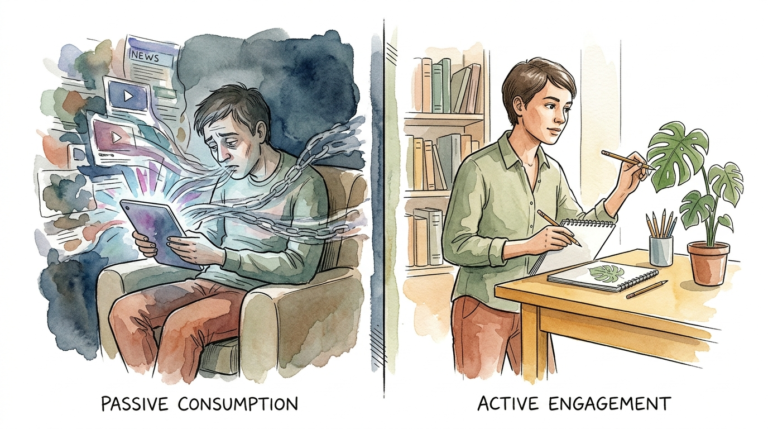
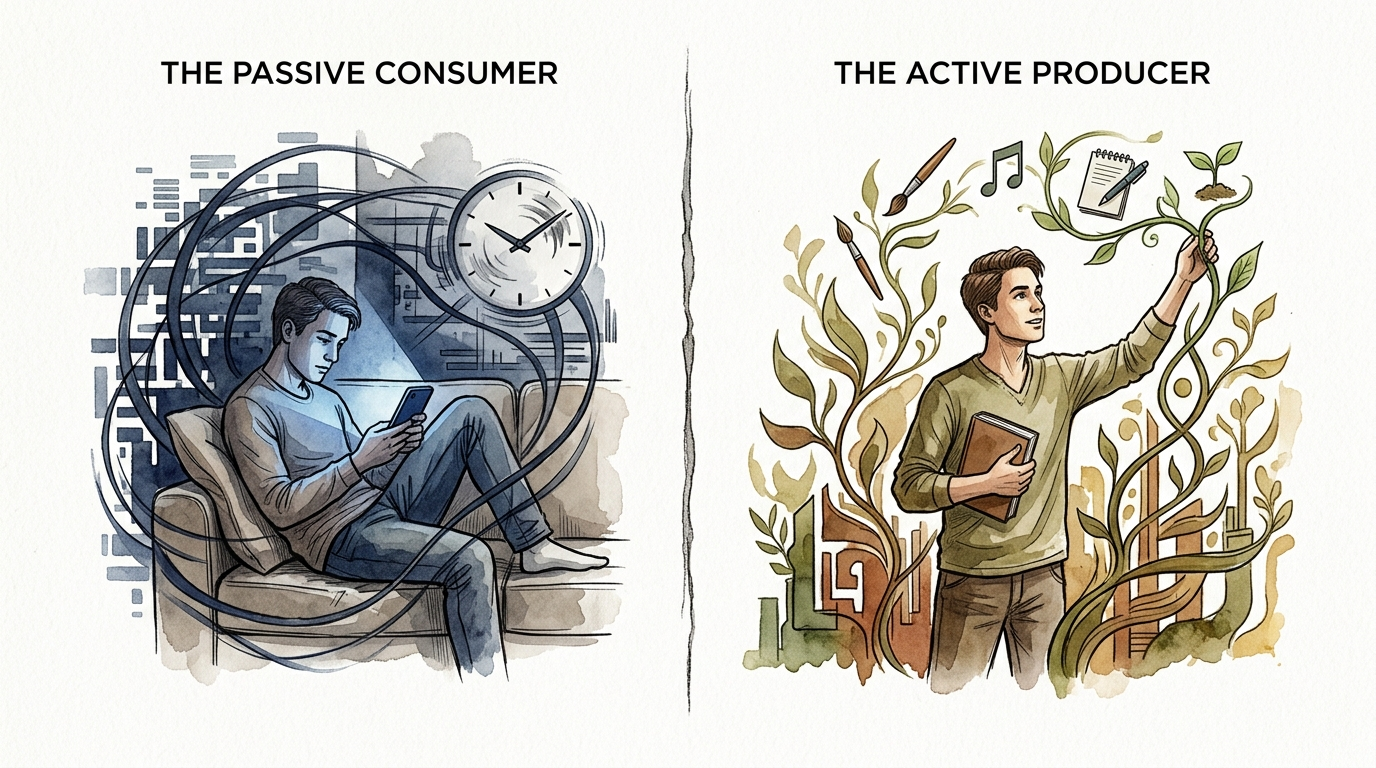
Passive Consumer vs. Active Producer
Understanding the difference between these two states is the key to maintaining the weekly plan. One leads to a life of reacting; the other leads to a life of creating.
| Feature | Passive Consumer | Active Producer |
|---|---|---|
| Attention Span | Short, fragmented by rapid cuts. | Long, sustained by deep work. |
| Reward System | Instant hits of dopamine. | Delayed, meaningful satisfaction. |
| Skill Acquisition | Observational only; no retention. | Experiential; builds muscle memory. |
| Mental State | Often leads to comparison and envy. | Leads to pride and self-efficacy. |
| Economic Value | You are the product being sold to. | You create products of value. |
Practical Tips for a Maker Home
To keep the momentum going, you need to make the “active” choice the “easy” choice. Design your environment to encourage production without you having to nag.
- The 30-Second Rule: If it takes more than 30 seconds to find the supplies for a project, a child probably won’t do it. Keep kits ready to go. A “watercolor kit” should have the paper, brush, and paints all in one bin.
- Display the Work: Create a “Gallery Wall” or a “Project Shelf.” When a child sees their creation being valued and displayed, they feel a massive surge of “producer” pride. It validates the effort they put in.
- Focus on Utility: Teach skills that have an immediate payoff. Making their own snack, fixing their own toy, or sewing a button onto their favorite shirt makes the skill feel “real.” It isn’t just a hobby; it is a superpower.
- The “Body Double” Technique: Sometimes kids just need you to be in the room. You don’t have to help them, but your presence as you do your own work (like reading or folding laundry) helps them stay focused on their task.
Advanced Considerations: The Neurobiology of the Scroll
For parents who want to go deeper, it is helpful to understand what is happening inside the developing brain. The “scroll” is a specific type of visual stimulation that triggers the orienting reflex. This reflex is an ancient survival mechanism that forces us to pay attention to sudden movement or change.
Digital content is engineered to trigger this reflex every few seconds. This keeps the brain in a state of high arousal but low engagement. Over time, the brain becomes “lazy.” It expects to be stimulated from the outside rather than generating interest from the inside. This is why kids seem “zombified” after two hours of YouTube.
Skill-building engages the prefrontal cortex—the part of the brain responsible for high-level decision making and long-term planning. By forcing the brain to solve a physical problem (like how to balance a tower of blocks or how to tie a knot), you are literally thickening the neural pathways in the executive center. You are “leveling up” the hardware of the brain.
Example Scenario: A Week of Production
How does this look in a real home? Let’s follow a hypothetical family—The Millers—as they implement their first full week of the plan. They have a 7-year-old and a 12-year-old.
Monday (The Mechanical Shift): The goal is to understand how things work. After school, the screens stay off. The 12-year-old is given an old, broken toaster and a set of screwdrivers. Their job is to take it apart and identify the parts. The 7-year-old works with a Lego set, following a complex manual without help. Total screen time: 0 minutes.
Wednesday (The Culinary Challenge): The kitchen becomes the classroom. The kids are responsible for planning and prepping a simple meal. They learn to measure ingredients and use a stove safely. While the food cooks, they listen to an educational podcast. Total screen time: 15 minutes (to look up a recipe).
Saturday (The Outdoor Masterclass): The family goes to a local park. They use a physical map—not a GPS—to find a specific trail. They learn to identify three types of local trees and practice basic knot-tying for a gear bag. In the evening, they “earn” a 45-minute family movie as a reward for a week of high-level production.
Final Thoughts
Switching your family from a consumer mindset to a producer mindset is one of the most powerful gifts you can give. It is not just about reducing eye strain or avoiding social media drama. It is about reclaiming the human capacity for creation. It is about proving to your children that they have agency in the physical world.
Start small. Don’t try to change every habit overnight. Pick one hour this week where the devices go into a drawer and the tools come out. Watch the initial frustration turn into curiosity, and then into focus. That moment of “deep work” is where the magic happens.
Encourage your family to keep experimenting. Some skills will stick, and others won’t. The specific skill matters less than the act of building it. By following this weekly plan, you are raising people who don’t just watch the world happen—they make the world happen. Trade the scroll for the tool today.
Sources
1 benjweinberg.com | 2 kidkraft.com | 3 marbleandmud.com | 4 brainbalancecenters.com | 5 verizon.com | 6 mayoclinichealthsystem.org | 7 childrenshospital.org | 8 bklynlibrary.org | 9 bklynlibrary.org | 10 peakvista.org | 11 screenstrong.org | 12 healthychildren.org | 13 kidsusamontessori.org | 14 sittercity.com | 15 priorityhealth.com | 16 sbm.org