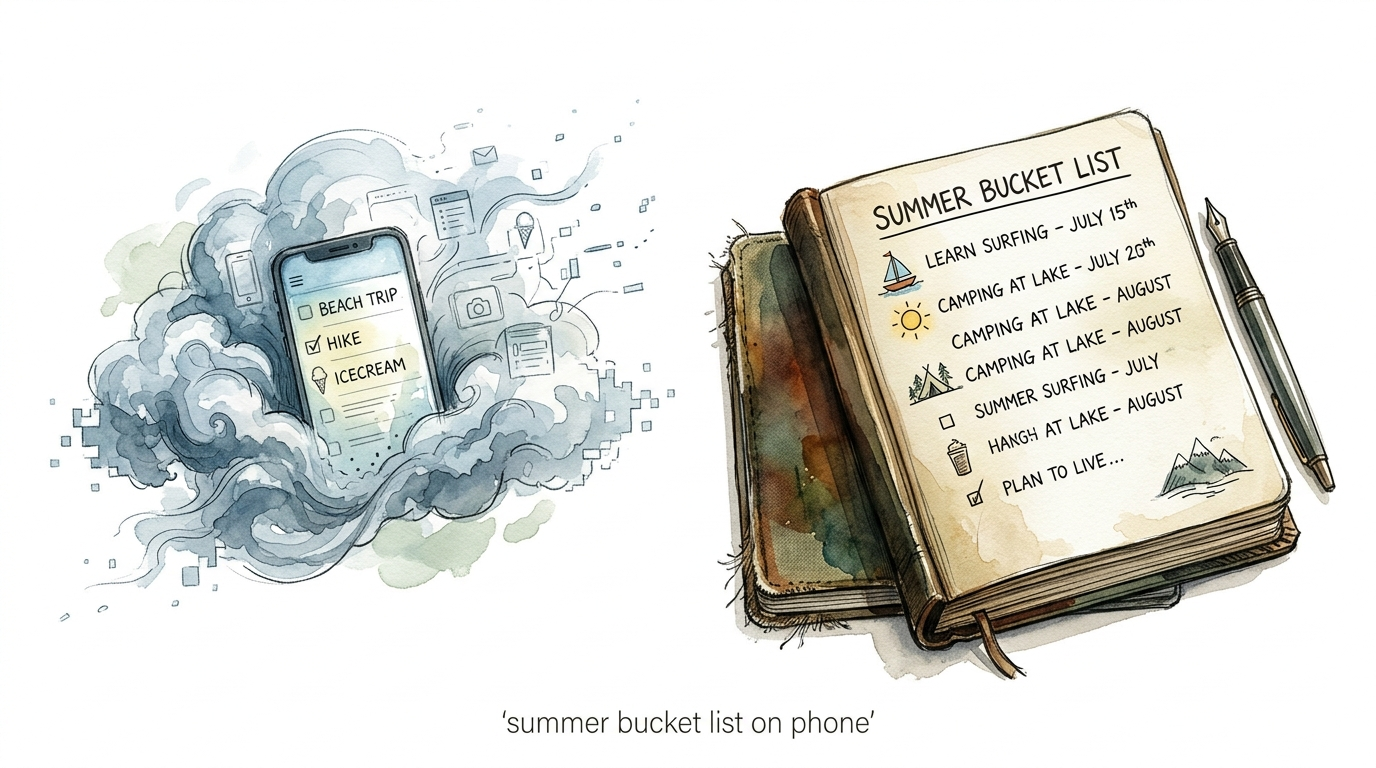
summer bucket list on phone
Your memories shouldn’t depend on an internet connection or a glass screen. Digital lists are easily forgotten and easily lost. A physical bucket list becomes a tangible artifact of your life. Make your summer resilient.
Every year, the heat rolls in with a promise of endless adventure. You feel the pull of the sun and the desire to make every moment count. Most people start this journey with a quick search on their mobile device. They look for inspiration and hope to capture the magic of the season in a digital note. But there is a hidden danger in relying solely on a screen. A list tucked away in an app is a list that rarely sees the light of day.
Think about your current digital life. You have screenshots of dream destinations you will never visit. You have bookmarked recipes you will never cook. The digital cloud is fragile and cluttered. To truly reclaim your summer, you need something you can touch. You need a record that lives in your physical space, standing as a silent invitation to go outside and play. This guide will help you bridge the gap between digital inspiration and physical reality.
Creating a resilient summer means building systems that work when the Wi-Fi fails. It means having a plan that greets you every morning from your kitchen wall. We are moving beyond the swipe and the scroll. We are moving toward a summer that is etched in ink, captured in Polaroids, and celebrated in the real world. Let’s explore how to take those digital dreams and turn them into a summer you will actually remember.
summer bucket list on phone
The concept of a summer bucket list on phone is the modern starting point for almost every adventurer. It is the digital sandbox where ideas first take shape. Whether you use a basic notes app or a specialized tracking tool, your phone is likely the repository for every “must-do” activity you encounter while scrolling social media. It serves as a high-speed capture device for the fleeting sparks of inspiration that hit you in the middle of a workday.
In the real world, a summer bucket list on phone is used to aggregate data. You might have a dedicated folder in your Instagram “Saves” or a Pinterest board filled with “Summer 2026” aesthetics. Apps like Söka use artificial intelligence to help users generate personalized lists based on their location and interests. Meanwhile, tools like Wanderlog allow you to map out routes and destinations with pin-point accuracy. This digital phase is essential for research and organization, acting as the bridge between “I wish” and “I will.”
However, the phone is also a place of distraction. While you are checking your list, you are also seeing work emails, news alerts, and social notifications. The “summer bucket list on phone” often becomes just another item on your digital to-do list. It lives alongside grocery lists and appointment reminders. This creates a psychological barrier where fun feels like a chore. To avoid this, successful planners use their phones as a temporary staging ground rather than a final destination.
Visualizing the concept is easy. Imagine a “summer bucket list on phone” as a digital mood board. It is a collection of links to local festivals, screenshots of hiking trail maps, and notes about the best ice cream shops in the next town over. It is incredibly portable and easy to share with friends for collaborative planning. But without a physical counterpart, these digital files often remain dormant, waiting for a “someday” that never arrives.
How to Transition from Digital to Physical
Moving your ideas from a screen to a physical surface requires a deliberate process. Start by performing a digital audit of your phone. Open your notes, your saved photos, and your browser tabs. Look for recurring themes. Are you leaning toward outdoor adventure, culinary experiments, or quiet relaxation? Group these ideas into categories to make the transition easier and more organized.
The next step involves choosing your physical medium. Some people prefer a large poster board that the whole family can see. Others choose a dedicated summer journal or a “Bucket of Fun” pail filled with handwritten wooden sticks. Use your digital list as the source material. Write down the top 10 to 15 items that truly excite you. Focus on a mix of “Big Wins,” like a weekend road trip, and “Micro-Adventures,” like watching a sunset from your porch.
Handwriting these items is a critical part of the process. Science suggests that the act of forming letters with a pen engages the brain more deeply than tapping a screen. As you write “Go to the farmers market,” your mind begins to visualize the colors and smells of the produce. You are no longer just storing data; you are creating a mental commitment. This physical act transforms a vague digital wish into a concrete plan of action.
Once your list is written, display it in a high-traffic area. The refrigerator door, the entryway, or a dedicated command center are perfect spots. The goal is to make the list unavoidable. Every time you walk past it, your brain receives a small nudge. Unlike a phone app that requires you to unlock your screen and navigate to a specific page, a physical list is always “on.” It becomes part of your home’s environment and a constant reminder of your intentions.
Building a Collaborative Family Board
Get everyone involved in the physical creation. Lay out a large sheet of butcher paper and provide colorful markers. Ask each family member to contribute two “must-do” items. This creates shared ownership of the summer’s goals. When children see their own handwriting on the wall, they feel a sense of agency and excitement. It moves the planning process away from a parental directive and toward a collective adventure.
The “Stick” Method for Spontaneity
Write individual activities on popsicle sticks and place them in a glass jar. This adds an element of surprise to your summer. When you have a free Saturday morning, pull a stick at random. This prevents decision fatigue. Your digital list on your phone might feel overwhelming with 50 options, but a single stick pulled from a jar provides a clear, singular focus for the day.
Benefits of a Tangible Summer Record
One of the primary benefits of a physical list is the measurable boost in goal achievement. Research from the Dominican University of California shows that people who write down their goals are 42% more likely to achieve them. This isn’t magic; it’s a result of increased focus and the “Zeigarnik Effect,” where our brains remain focused on unfinished tasks until they are physically crossed off. A digital list is easy to ignore, but a physical line through a written word provides a massive dopamine hit.
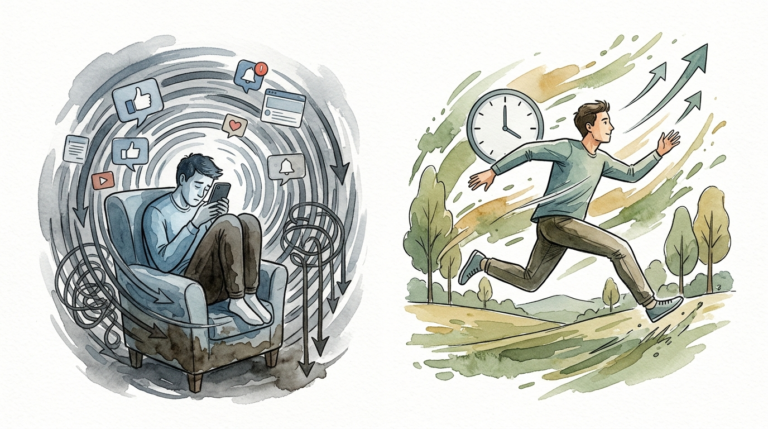
A physical list also acts as a digital detox tool. When you are looking for something to do, your first instinct is usually to pick up your phone. This often leads to an hour of mindless scrolling. Having a visible bucket list allows you to find inspiration without ever touching a screen. It encourages you to remain present in your surroundings and reduces the gravitational pull of the digital world. This is essential for a “resilient” summer that prioritizes human connection over digital consumption.
Handwriting your plans improves memory and cognitive connectivity. A 2024 study in Frontiers in Psychology found that handwriting produces widespread brain connectivity associated with memory and learning. Typing on a keyboard or tapping a screen does not produce the same neurological effect. By physically writing your summer bucket list, you are literally wiring your brain to remember and prioritize those experiences. You are creating a “motor memory” of your intentions.
Finally, a physical record becomes a keepsake. At the end of the season, a checked-off list or a filled journal is a tangible artifact of your life. It is something you can hold in your hands five years from now to remember the “Summer of ’26.” Digital notes are often deleted or lost during phone upgrades. A physical list survives. It serves as a historical document of your joys, your growth, and the time you spent with the people you love.
Challenges and Common Mistakes
One of the biggest mistakes people make is creating a list that is too long. They fill a poster with 50 different activities, which quickly leads to “bucket list burnout.” When the list feels like a second job, the joy of summer evaporates. The goal is not to stay busy; the goal is to be intentional. Keep your physical list lean and focused on activities that truly resonate with your current season of life.
Mistakes often happen when people prioritize “Instagrammable” moments over genuine experiences. You might add a trendy, expensive destination to your list because it looks good on a screen, even if you don’t actually enjoy that type of activity. This is the danger of the “summer bucket list on phone” being influenced by algorithms. When you transition to a physical list, ask yourself: “Do I actually want to do this, or do I just want the photo of me doing it?”
Another common pitfall is a lack of flexibility. Life happens. Rain cancels the picnic. A local event gets postponed. If your physical list is too rigid, these changes can feel like failures. To avoid this, include a mix of weather-dependent and indoor activities. Leave room for spontaneous “wildcard” entries. A resilient list is one that can adapt to the unpredictable nature of summer without losing its spark.
Poor placement of the list is a subtle but frequent error. If the list is tucked away in a drawer or at the back of a planner, it will be forgotten. It must be in your line of sight. Visibility is the engine that drives action. If you find yourself ignoring the list, it might be time to move it to a more prominent location or refresh the design to make it more visually appealing and engaging.
Limitations of Physical Lists
Physical lists are not as portable as a phone. If you are out running errands and suddenly have a free hour, you may not remember exactly what was on the poster at home. This is where the “summer bucket list on phone” serves as a useful backup. While the physical list is your primary driver, keeping a digital photo of it ensures you always have access to your plans when you are on the move.
Durability is another realistic constraint. A paper list on a kitchen wall can be splashed with water, torn by pets, or faded by the sun. If you want your record to last, you may need to use more durable materials like a chalkboard, a whiteboard, or a high-quality journal. For outdoor lists, such as those kept in a garden or a shed, consider laminating the paper or using waterproof ink.
Editing a physical list is significantly harder than updating a digital one. You can’t just “delete” a written entry without leaving a mark. This permanence can be intimidating for some. However, this limitation can also be viewed as a strength. It forces you to think more carefully about what you add. If you make a mistake, embrace the messiness. A summer with some crossed-out lines and scribbled notes is more authentic than a sterile digital file.
Comparison: Digital Tools vs. Physical Records
| Feature | Digital (Phone App) | Physical (Poster/Journal) |
|---|---|---|
| Portability | High. Always in your pocket. | Low. Usually stays in one room. |
| Brain Engagement | Low. Tapping is a simple motor task. | High. Writing engages more neural pathways. |
| Visibility | Low. Hidden behind an unlock screen. | High. Constantly present in your environment. |
| Distraction Risk | High. Surrounded by notifications. | Zero. It is a single-purpose object. |
| Longevity | Medium. Subject to cloud errors/lost passwords. | High. Can be saved as a physical heirloom. |
Practical Tips and Best Practices
Create a “Living List” that evolves with you. Instead of trying to finish the entire list in June, add new items as they occur to you. Leave a few blank spots on your poster for spontaneous ideas. This keeps the list feeling fresh and exciting throughout the entire three-month season. It also reduces the pressure to have everything figured out before the solstice.
Use visual cues to denote progress. Don’t just check a box; add a sticker, a small doodle, or the date the activity was completed. If you have a Polaroid camera, tape a photo of the event directly onto the list. This transforms your bucket list into a mini-scrapbook. It provides a visual reward that is far more satisfying than a digital checkmark in a “summer bucket list on phone” app.
Keep your supplies nearby. If you want to add to your list or check things off, make it easy. Keep a specific set of markers or a favorite pen attached to the board with a string. Reducing friction is the key to maintaining any habit. If you have to go hunting for a pen every time you want to interact with your list, you are less likely to do it.
Categorize by “Energy Level” rather than just by activity type. Some days you will have the energy for a 5-mile hike. Other days, you just want to sit in a lawn chair with a cold drink. Label your activities as “High Energy,” “Medium Energy,” or “Restful.” This allows you to choose an activity that fits your current mood and physical state, making the list much more practical for daily use.
- The 5-Minute Rule: Include at least five items that take less than five minutes to start.
- Location Tags: Group activities by neighborhood to save on travel time.
- Budget Coding: Use a simple “$” system to know which activities are free and which require planning.
- The “Guest Spot”: Invite a friend to add one item to your list to ensure you socialize.
Advanced Considerations for Serious Practitioners
Serious practitioners often integrate their bucket list into a broader seasonal rhythm. This might involve a “Summer Manifesto” that outlines not just what you will do, but how you want to feel. Instead of just “Go Swimming,” your list might say “Feel the cold water at the lake at least four times.” This shift from task-oriented to experience-oriented planning deepens the impact of the list on your overall well-being.
Consider the “1980s Summer” approach, which is trending for 2026. This method focuses on “unstructured” time. Your bucket list items might be intentionally vague, such as “Get bored in the backyard” or “Ride bikes until the streetlights come on.” This combats the modern tendency to over-schedule every minute. It uses the physical list to protect your free time rather than fill it with chores.
Scaling your list for multi-year tracking is another advanced technique. Some people use a “Perpetual Summer Journal.” They list the same five core traditions every year and then add five new ones. This allows you to track how your family or your own interests change over time. It provides a sense of continuity and builds a rich history of seasonal celebration that a simple digital note could never replicate.
Performance tracking can even be applied to a bucket list for those who love data. You can track “Success Rates” for different types of activities. Do you always finish your “Food” goals but skip the “Exercise” ones? This insight helps you plan a better, more realistic summer next year. It turns your bucket list into a tool for self-discovery and lifestyle design.
Example Scenarios
Let’s look at a realistic example of how this works in practice. Imagine “Alex,” who has a busy corporate job. Alex starts with a “summer bucket list on phone” by saving pins on Google Maps while commuting. By June 1st, Alex has 40 pins. Recognizing the overwhelm, Alex buys a large piece of foam board and some colorful twine.
Alex selects the top 12 ideas. Five are “Local Delights” (like the new taco truck), four are “Nature Breaks” (a specific trail), and three are “Big Trips” (a weekend in the mountains). Alex prints out a small photo for each destination and pins it to the board. Next to each photo is a small handwritten description of *why* this matters.
Throughout July, Alex’s phone stays in the kitchen while Alex interacts with the board. When the taco truck visit is done, Alex moves the pin to the “Completed” section. The visual progress is motivating. By the end of August, Alex has a board filled with photos and memories. The “summer bucket list on phone” served its purpose as a research tool, but the physical board was the engine that actually got Alex out of the house.
Contrast this with “Jordan,” who kept everything on a phone. Jordan frequently forgot the list existed. When Jordan did remember, the phone’s battery was often dead or a work notification distracted Jordan before a choice could be made. Jordan ended the summer with 40 saved pins and zero completed adventures. The difference isn’t the ideas; it’s the delivery system.
Final Thoughts
Your summer is too valuable to be managed by a machine. While a summer bucket list on phone is a fantastic way to capture initial ideas and coordinate with friends, it lacks the staying power of a physical record. To make your memories resilient, you must move them into your physical world. Writing things down, displaying them prominently, and physically crossing them off creates a cycle of engagement that screens cannot replicate.
The transition from digital to physical is a small investment of time that pays massive dividends in joy and presence. It turns a “to-do” list into a “want-to-do” adventure. Whether you choose a simple piece of paper or an elaborate wall display, the goal remains the same: to live a summer that is intentional, memorable, and entirely your own. Don’t let your best ideas disappear into the digital cloud.
Start today by looking at your phone. Pick three things you’ve been meaning to do and write them on a piece of paper. Tape that paper to your mirror. You have just taken the first step toward a more resilient, tangible, and exciting summer. The sun is waiting, and now, so is your list.
Sources
1 stonegableblog.com | 2 knoxvillemoms.com | 3 danielle-moss.com | 4 crazylifewithlittles.com | 5 cyberguy.com | 6 spacedaily.com | 7 u-createcrafts.com | 8 betweencarpools.com | 9 archerandolive.com | 10 persnicketyprints.com | 11 apartmenttherapy.com | 12 mamitalks.com | 13 dailygrindplanner.com | 14 economictimes.com | 15 alanastern.com | 16 thestayathometeacher.com | 17 lemon8-app.com