Travel Journaling For Kids Vs Digital Photos
We’ve traded the deep observation of our ancestors for the convenience of a 12-megapixel blur—which one does your child actually remember? Modern travel has become a race to capture the ‘perfect shot’ for a cloud server that will never be opened again. Ancestral journaling isn’t about the art; it’s about the neural pathways built when a child has to translate 3D reality onto a 2D page. One is a digital dependency; the other is a lifetime skill.

Travel Journaling For Kids Vs Digital Photos
Travel journaling for kids is the practice of documenting a journey through handwritten notes, sketches, and physical mementos. It is a slow, tactile process that forces a child to engage with their surroundings. Instead of pointing a lens and clicking a button, the child must decide what matters most about a moment and figure out how to represent it on paper.

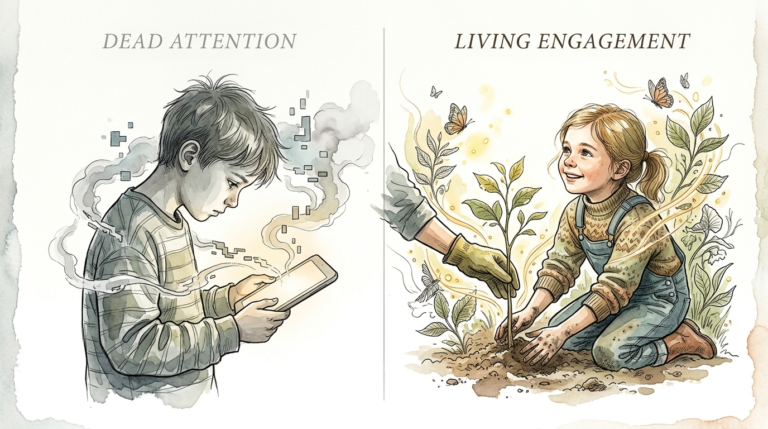
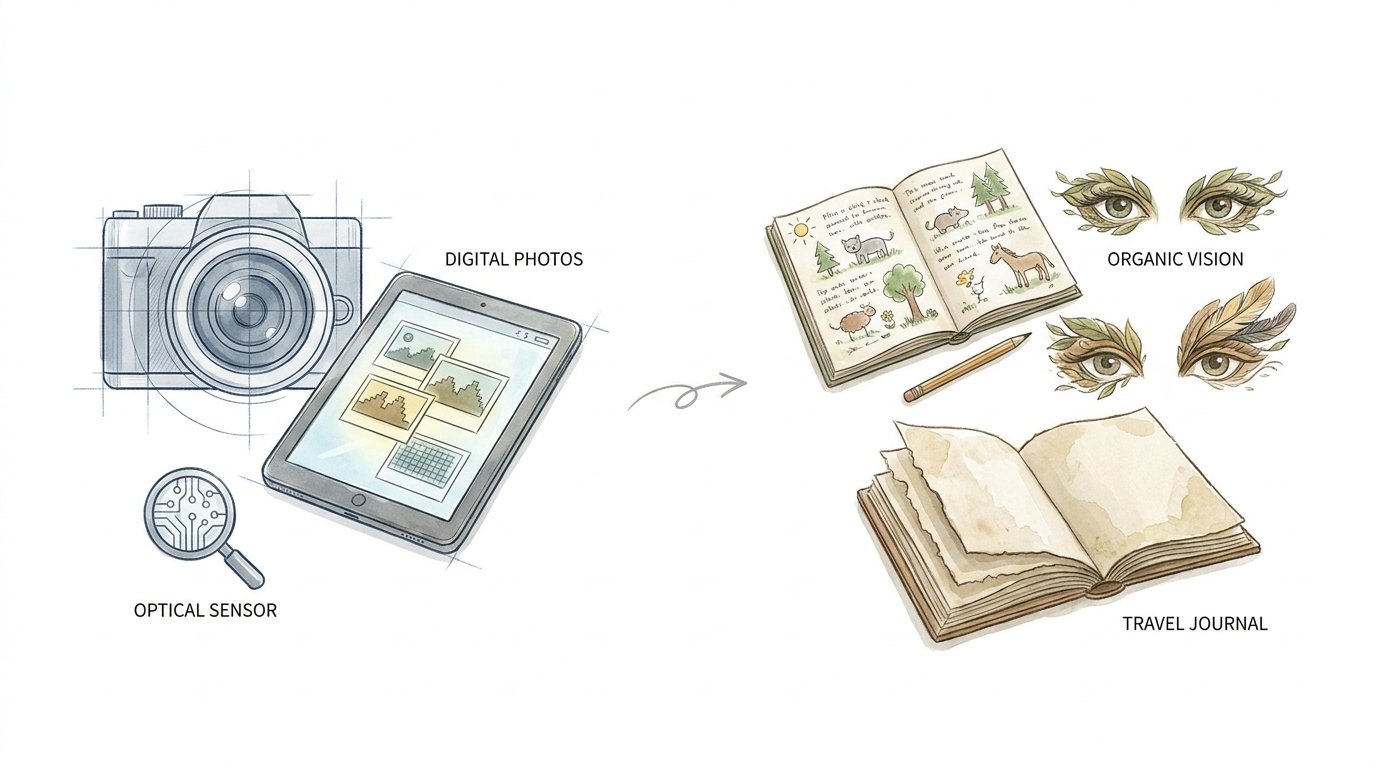
Digital photos, by contrast, are often passive. When we take a photo, our brain often “outsources” the memory to the device, a phenomenon known in neuroscience as the photo-taking impairment effect. Research shows that people who take photos of objects often remember fewer details about those objects later because the brain assumes the camera has “saved” the information.
Journaling flips this script. It uses organic vision—the process of truly seeing, analyzing, and interpreting a scene—rather than relying on an optical sensor to do the work. This method is used by explorers, scientists, and artists to build a deep, permanent connection to a location. In a real-world family vacation, a journal becomes a living record of feelings, smells, and sounds that a flat JPEG simply cannot capture.
How to Start Travel Journaling With Your Kids
Getting started does not require expensive art supplies or professional writing skills. The goal is to create a low-friction system that encourages daily participation. You want the journal to feel like a treasure chest, not a homework assignment.
Building the Essential Kit
To make journaling easy on the go, assemble a small, portable kit. A simple A5-sized blank notebook is usually best because it fits easily into a backpack. Include a few high-quality tools that feel “special” to the child, such as a fine-liner pen, a small set of watercolor pencils, and a glue stick for attaching ticket stubs or pressed leaves.
Age-Appropriate Techniques
Tailor the approach to your child’s developmental stage. For toddlers and preschoolers (ages 3–5), focus on visual dictation. Have them draw a “scribble” of their favorite part of the day and then tell you what it is while you write their words at the bottom of the page. This connects the image to the language in their growing brain.
For elementary-aged children (ages 6–10), encourage them to collect ephemera. This includes sugar packets from a local cafe, museum maps, or even a unique bus ticket. Pasting these items into the book provides immediate “texture” to the journal and makes it feel like a physical artifact of their trip.
Middle and high schoolers can move into reflective journaling. Ask them to describe one person they met or one cultural difference they noticed. This moves beyond “what we did” and into “how I felt,” which builds emotional intelligence and critical thinking skills.
The Measurable Benefits of the Journaling Approach
The move from digital to analog provides significant cognitive advantages. Scientists at the University of Waterloo have found that drawing is one of the most effective ways to boost memory. This is called the “drawing effect,” and it works because it forces the brain to process information in three distinct ways: visually, kinesthetically (the movement of the hand), and semantically (the meaning of the object).
Enhanced Memory Retention
When a child draws a cathedral or a mountain, they are encoding that memory twice as effectively as if they had just looked at it. They must notice the angles, the shadows, and the scale. This deep observation creates a “context-rich” representation in the hippocampus, making the memory much easier to retrieve years later.
Fine Motor Skill Development
The physical act of handwriting and sketching activates the prefrontal cortex and the motor cortex. In an age where children spend hours swiping on glass screens, the “messy” process of forming letters and shapes by hand is vital for brain development. It strengthens the hand-eye-brain connection that is essential for literacy and spatial reasoning.
Emotional Regulation and Mindfulness
Travel can be overstimulating. Sitting down for ten minutes at the end of a busy day to journal acts as a “brain dump.” It allows the child to process the “big emotions” of the trip—excitement, fatigue, or even homesickness. This practice of expressive writing has been shown to lower stress levels and improve overall well-being.
Challenges and Common Mistakes to Avoid
The biggest pitfall is making journaling feel like a chore. If a parent insists on “perfect” handwriting or “accurate” drawings, the child will quickly lose interest. The journal should be a safe space for mistakes, smudges, and weirdly shaped stick figures.
The “Perfectionism” Trap
Many children get frustrated when their drawing doesn’t look like the real thing. Remind them that a journal is a “field note,” not a museum piece. Encourage them to draw “quick gestures” rather than detailed portraits. The goal is the neural pathway being built, not the aesthetic quality of the page.
Consistency Over Complexity
Don’t wait for a “big moment” to journal. A common mistake is only writing about the major landmarks. Some of the best entries come from the “boring” parts of travel—the snacks in a foreign convenience store, the funny sign at the train station, or the way the rain felt during a walk. Small, frequent entries are much more sustainable than one long essay at the end of the week.
When Digital Photos Might Be Necessary
While journaling is superior for memory and growth, digital photography still has its place. It is important to recognize the trade-offs. If you are witnessing a fast-moving event, like a local parade or a wildlife sighting, a camera is the only way to capture the action.
Digital photos are also excellent for documentation. They help you remember the name of a specific restaurant or the exact price of a ticket. Use the camera as a “digital assistant” to support the journal, not replace it. You can even print small “Zink” photos during the trip to paste directly into the journal, combining the best of both worlds.
Comparing Journaling and Digital Photography
| Feature | Travel Journaling (Organic Vision) | Digital Photos (Optical Sensor) |
|---|---|---|
| Memory Retention | High; deep encoding through drawing. | Low; often leads to memory impairment. |
| Skill Required | Manual dexterity and observation. | Minimal; point and click. |
| Cognitive Load | Active; requires focus and interpretation. | Passive; minimal brain engagement. |
| Physical Result | Tactile heirloom; unique to the child. | Digital file; often identical to others. |
| Long-term Value | Grows in value as a personal history. | often lost in large, unorganized folders. |
Practical Tips for Success
To make journaling a natural part of your family culture, try these simple adjustments to your travel routine.
- The 10-Minute Sunset Rule: Set aside the last ten minutes of the day, perhaps while waiting for dinner, for “quiet journal time.” If the adults do it too, the children are much more likely to follow suit.
- Use “Sensory Prompts”: Instead of asking “What did we do today?”, ask “What was the loudest sound you heard today?” or “What was the strangest thing you tasted?”.
- The “Found Object” Challenge: Give the child a small envelope and challenge them to find one flat object each day (a leaf, a flyer, a stamp) to glue into their book.
- Don’t Correct Spelling: Let the journal be authentic. The phonetic spelling of a seven-year-old is a precious snapshot of their development that you will cherish later.
Advanced Considerations for Serious Practitioners
For those who want to take journaling to the next level, consider introducing Nature Journaling techniques. This involves “I Wonder” prompts. When looking at a new bird or plant, have the child write down three questions they have about it. This turns the journal into a scientific tool and builds a mindset of curiosity.
You can also explore watercolor washes. Using a water brush pen (a brush with a built-in water reservoir) allows children to add color to their sketches without the mess of a traditional paint set. This adds a level of sophistication to the journal that makes the child feel like a “real” explorer.
Finally, think about archival quality. If you want these journals to last for decades, use acid-free paper and waterproof ink. This ensures that the record of your family’s journey remains vibrant for your child’s own children to read one day.
Example Scenario: A Day at the Colosseum
Imagine a family visiting the Colosseum in Rome. The typical approach is to take fifty photos of the stone arches and then move on to find gelato. The child sees the monument through a screen, and within three days, the memories of the arches begin to blur with every other ruin they’ve seen.
In the ancestral journaling scenario, the family finds a shady spot on a nearby wall. The child spends fifteen minutes sketching just one archway. They notice that the stones are pitted with holes where iron clamps used to be. They draw the specific way the weeds grow in the cracks.
While drawing, they notice a stray cat sleeping in the shade of a pillar. They add the cat to the sketch. Ten years later, they won’t remember the “perfect” wide-angle shot of the building, but they will vividly remember the heat of the stone they sat on, the smell of the dust, and that specific cat. That is the power of organic vision.
Final Thoughts
We often think of travel as an external experience—the places we go and the things we see. But the true value of travel lies in how it changes the traveler. By encouraging children to put down the phone and pick up a pen, you are teaching them how to process the world with depth and intention.
A travel journal is more than a book; it is a neurological training ground. It builds the “muscles” of attention that are being withered by the instant gratification of digital technology. You are giving your child a way to own their memories, rather than just renting them from a cloud service.
Start small on your next trip. Buy a notebook, grab a pen, and watch how much more your child sees when they aren’t looking through a lens. The messy, hand-drawn pages they create will eventually become the most valuable souvenirs you own.
Sources
1 maltababyandkids.com | 2 medium.com | 3 fstoppers.com | 4 diy.org | 5 medium.com | 6 childmind.org | 7 psychologytoday.com | 8 fairfield.edu | 9 forsomethingmore.com | 10 gonewiththefamily.com | 11 edutopia.org | 12 inspirefamilyhistory.com | 13 teawithmum.com | 14 unl.edu | 15 neurosciencenews.com