How To Remove Ipad Triggers From Home
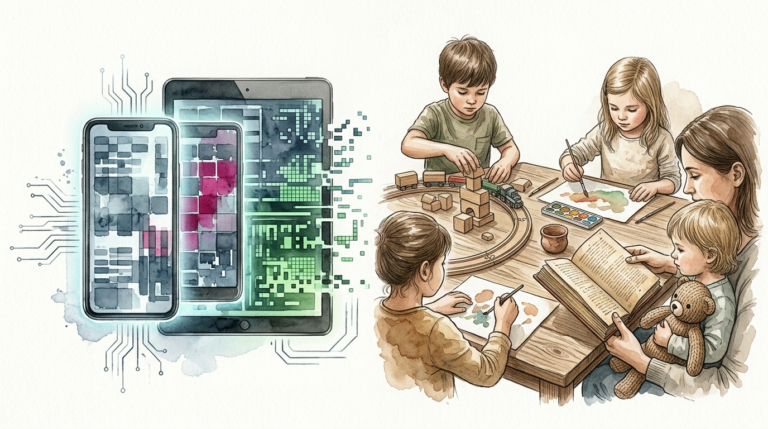
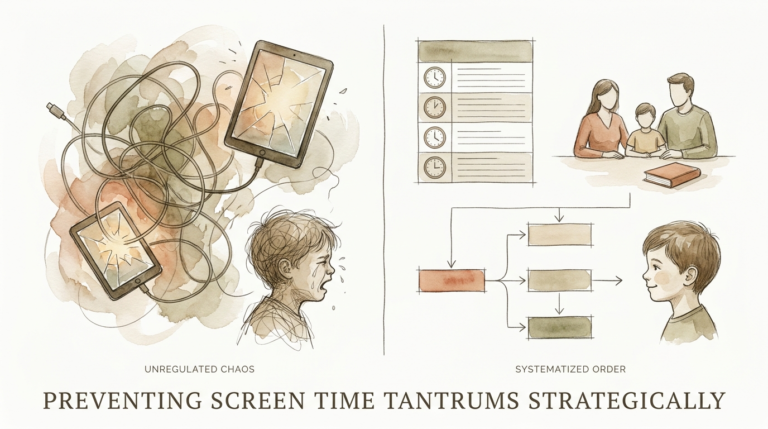
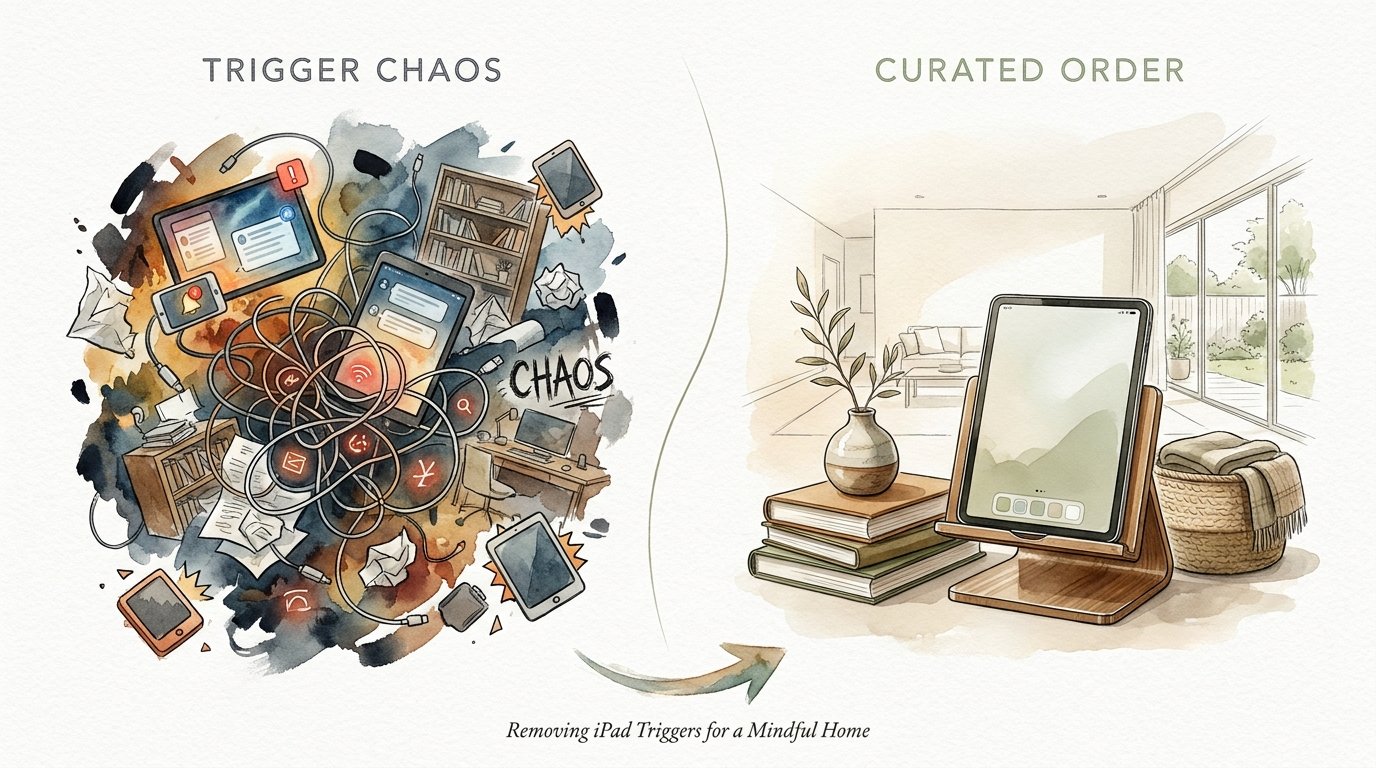
Your living room is accidentally ‘whispering’ about the iPad to your child all day long. The brain is a pattern-matching machine. If the charging cable is visible, the child is mentally ‘loading’ the app. Resetting the iPad habit requires a visual audit. We move from the chaos of ‘hidden but accessible’ to the order of ‘intentional invitations to play.’ Change the view, change the behavior.
This isn’t about blaming parents for a messy house. It’s about understanding that our homes are currently designed by tech companies to keep us connected. Every white cable, every sleek screen on a coffee table, and every “ping” from a nearby phone acts as a neon sign for a child’s dopamine-seeking brain. If you want to change how your child spends their time, you have to change what their eyes see first.
We are going to dive deep into the science of environmental cues. We will look at how to strip away the digital triggers that cause meltdowns and replace them with high-value, analog play opportunities. This is your guide to reclaiming the family home from the gravitational pull of the screen.
How To Remove Ipad Triggers From Home
Removing iPad triggers means identifying every physical object or sensory cue that reminds a child of the digital world. The home environment is the primary driver of behavior for a young child. If the iPad is sitting on the kitchen counter, the child’s brain has already started the “habit loop” before they even touch it. The cue (the sight of the device) leads to a craving (the anticipation of dopamine), which leads to the behavior (asking or crying for the iPad).
In the real world, this looks like a “visual audit.” You aren’t just hiding the tablet; you are removing the infrastructure that supports it. This includes charging cables, headphones, specific “iPad chairs,” and even the sounds of notifications. By cleaning the visual slate, you lower the cognitive load on the child. They no longer have to use their limited willpower to resist the device because the device is no longer part of their immediate reality.
Think of it like a grocery store. Stores place candy at eye level in the checkout lane because they know your willpower is low and the visual cue is strong. Your living room does the same thing with technology. To break the habit, you must redesign the “choice architecture” of your home so that the easiest thing for a child to do is play with blocks, draw, or go outside.
How the Habit Loop Works in Your Living Room
Habits are not formed by willpower. They are formed by repetition and cues. Charles Duhigg’s research on habit loops shows that every habit has a trigger. For a child with an iPad habit, the triggers are often subtle.
The “loading” phase is particularly dangerous. When a child sees a charging cable, their brain begins to expect the reward of a game or video. This is called “anticipatory dopamine.” The brain releases a small amount of dopamine just from seeing the cue. If the child is then told “no,” they experience a massive drop in dopamine, which often results in a tantrum or emotional dysregulation.
To stop the loading phase, you must remove the cues. This involves three layers of environmental design:
1. **The Device Level:** Removing the physical iPad from the line of sight.
2. **The Infrastructure Level:** Removing cables, docks, and cases.
3. **The Associative Level:** Changing the furniture or rooms where the iPad was traditionally used.
How to Perform a Visual Audit of Your Home
Start by walking through your front door and looking at your home from the height of your child. What is the first thing they see? If it’s the television or a charging dock, the digital trigger is already active. Follow these steps to perform a thorough audit.
Step 1: The “Black Hole” Storage Strategy
Don’t just put the iPad in a drawer. Drawers are easily opened, and the child knows exactly which one “owns” the device. Instead, use an opaque, high-shelf container or a locked “tech cabinet” that is located in a room the child rarely uses, like a high pantry shelf or a parent’s office. If they can’t see the container, they are less likely to remember the contents.
Step 2: Clean Up the “Digital Litter”
Charging cables are the “whispers” we mentioned earlier. A white Lightning or USB-C cable snaking across the floor is a constant reminder of the device. Unplug all chargers when not in use. Store them in a dedicated box out of sight. If you have a permanent charging station, move it inside a cabinet or behind a heavy piece of furniture where the cables are completely hidden.
Step 3: Remove Associative Furniture
Does your child have a specific “iPad chair” or a corner of the couch where they always sit to watch videos? The brain associates physical locations with specific behaviors. Move that chair to a different room. Flip the couch cushions. Change the layout of the living room to break the neural association between that spot and the screen.
Benefits of an Environment-First Reset
Focusing on the environment rather than the child’s “behavior” reduces conflict. You aren’t constantly saying “no”; the environment is simply saying “nothing here.” This shift offers several measurable benefits for the whole family.
Lower Cortisol Levels: When children aren’t constantly fighting the urge to reach for a visible device, their baseline stress levels drop. The “itch” for the screen is less frequent when the visual reminder is gone.
Increased “Deep Play”: Without the distraction of digital triggers, children enter “flow states” more easily. They become more engrossed in toys, books, and creative projects because there isn’t a “higher-dopamine” option constantly visible in the corner of their eye.
Parental Sanity: You will find yourself nagging less. When the iPad is truly out of sight and out of mind, the child eventually stops asking for it. This breaks the cycle of the “iPad nag” that many parents find exhausting.
Better Sleep Hygiene: By removing chargers and devices from bedrooms, you eliminate the blue light triggers that interfere with melatonin production. A tech-free bedroom environment is the single most effective way to improve a child’s sleep quality.
Challenges and Common Mistakes
The transition from a tech-saturated home to a curated one isn’t always smooth. Many parents fail because they don’t go far enough with the visual removal.
The “Hidden in Plain Sight” Error: Placing the iPad on top of the refrigerator where the child can still see the edge of the case. This is actually worse than leaving it out, as it creates a “forbidden fruit” effect where the child is constantly looking up and obsessing over the device they can see but can’t reach.
The “One-Sided” Rule: If you tell your child no iPads, but you are constantly scrolling on your phone in the same room, the trigger remains active. Your phone is a “proxy” for their iPad. They see a glowing screen and they want theirs. You must model the behavior by keeping your own tech in a designated “adult tech zone.”
The “Nature Abhors a Vacuum” Problem: If you remove the iPad triggers but don’t add “invitations to play,” the child will simply be bored and frustrated. This leads to increased behavioral issues. You must replace the digital cues with analog ones immediately.
Limitations of Environmental Design
While changing the environment is powerful, it is not a magic wand. There are realistic constraints you must consider.
House Layout Constraints: If you live in a small apartment, creating distinct “zones” is difficult. You may not have a “high pantry shelf” or a separate office. In these cases, you must rely on opaque bins and dedicated storage furniture that looks like regular decor.
External Triggers: You can control your home, but you can’t control the world. Car rides, grandparents’ houses, and restaurants will still have digital triggers. The goal of the home reset is to create a “safe harbor” where the child’s brain can recover and recalibrate, making them more resilient to triggers elsewhere.
Age-Appropriate Resistance: Older children and teenagers will see through environmental “nudges.” For them, environmental design must be a collaborative process. You can’t just hide a 12-year-old’s tablet; you have to agree on a “docking station” where everyone—including parents—leaves their tech at 7 PM.
Comparison: Trigger Chaos vs. Curated Order
| Feature | Trigger Chaos (Standard Home) | Curated Order (Reset Home) |
|---|---|---|
| Device Visibility | iPads on tables, counters, or sofas. | Devices stored in opaque, out-of-reach bins. |
| Charging Cables | Visible in multiple rooms; “snaking” on floors. | Cables hidden in cabinets or unplugged and stored. |
| Play Cues | Toys stored in deep, messy bins (hard to see). | Open-ended toys “staged” on low shelves. |
| Parental Tech Use | Phone use is constant and visible everywhere. | Phones used in “Adult Tech Zones” only. |
| Transitions | Sudden “time’s up” leading to meltdowns. | Natural end of activities; visual timers used. |
Practical Tips for Immediate Implementation
Changing your home environment doesn’t require a renovation. It requires intentionality. Start with these high-impact adjustments.
- Use “Invitations to Play”: Borrow a page from Montessori. Set up a small table with a single tray of playdough, a few animal figurines, or a half-finished puzzle. When a child walks into a room and sees an active “invitation,” their brain matches that pattern instead of the iPad pattern.
- The “One-In-One-Out” Rule for Cues: For every digital trigger you remove, add one sensory-rich analog item. If you hide the iPad, put out a basket of high-quality picture books or a magnifying glass for looking at rocks.
- Audio Cues Matter: Digital triggers aren’t just visual. The “ding” of an email or the startup sound of a console are massive triggers. Turn all devices to silent mode permanently. Use a physical bell or a soft musical timer for transitions instead of a phone alarm.
- Greyscale the iPad: If the iPad must be used for school or specific tasks, turn on the “Greyscale” accessibility setting. Removing the vibrant colors makes the device significantly less “clickable” and reduces the dopamine hit, making it easier for the child to put it down.
Advanced Considerations: Neuroplasticity and Habituation
For those looking to understand the “why” behind these changes, look toward neuroplasticity. The child’s brain is literally building “highways” based on their environment. If the environment constantly points toward the iPad, the “iPad highway” becomes the fastest, easiest path for their brain to take.
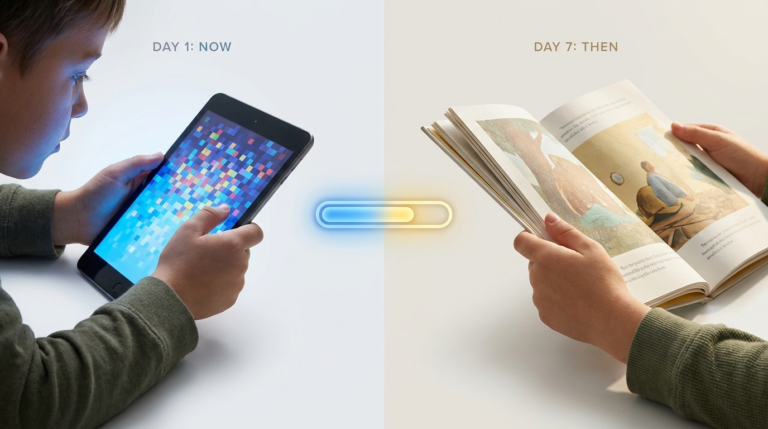
By removing the triggers, you aren’t just stopping a behavior; you are allowing those neural pathways to “prune” through lack of use. Simultaneously, by providing “invitations to play,” you are helping them build new highways for creativity, patience, and problem-solving. This process takes time—usually 21 to 30 days of consistent environmental order—for the “itch” to fully disappear.
Serious practitioners should also consider “Choice Architecture.” This involves making the desired behavior (reading, playing) the path of least resistance. If the books are at eye level and the iPad is behind a locked door in the garage, the choice to read becomes much easier.
Example Scenario: The Sunday Afternoon Reset
Imagine a typical Sunday where the child is constantly asking for the iPad. In a “Trigger Chaos” home, the iPad is sitting on the charger in the kitchen. The child sees it every time they want a snack. The parent says “no,” the child screams, and the parent eventually gives in because they are tired of the noise.
In a “Reset” home, the Sunday afternoon looks different.
1. The iPad was placed in a locked box in the master bedroom on Saturday night.
2. The charging cables were tucked into a drawer.
3. On the coffee table where the iPad usually sits, the parent has placed a large sheet of butcher paper and a set of new markers.
4. When the child enters the room, their brain “matches” the markers and the paper. They start drawing.
5. Because there is no visible iPad or cable to trigger the “loading” phase, the child doesn’t even think to ask for it for the first two hours of the afternoon.
Final Thoughts
Resetting the iPad habit is rarely about the device itself and almost always about the environment that surrounds it. Your home is a silent partner in your child’s development. By performing a visual audit and removing the triggers that “whisper” to their brain, you create the space necessary for them to rediscover the joy of analog play.
Remember that this is a process of moving from chaos to curation. You are the architect of your child’s attention. Every cable hidden and every “invitation to play” staged is a vote for a more balanced, focused, and peaceful family life.
Start small. Hide the chargers today. Move the “iPad chair” tomorrow. Within a few weeks, you will notice the whispers have stopped, and the sounds of imaginative play have taken their place. Encouraging this shift isn’t just about reducing screen time; it’s about giving your child back the freedom to engage with the real world on their own terms.
Sources
1 amityworrel.com | 2 kidslox.com | 3 daar.com.au | 4 compasschildcare.com | 5 chesona.com | 6 earthltd.org | 7 nintendolife.com | 8 boston25news.com | 9 piqe.org