Traditional Fiber Arts For Kids
Your child’s hands were evolved for the loom, not the scroll. Ten thousand years of evolution designed our hands for complex, tactile creation. Modern screens have reduced that heritage to a single-inch swipe. Bringing back ancestral crafts like weaving or knitting doesn’t just pass the time—it re-wires the brain for patience and deep geometric thinking.
Handwork is more than a hobby. It is a neurological workout. When a child manipulates fiber, they engage both hemispheres of the brain. They practice bilateral coordination. They learn that big results come from thousands of tiny, intentional movements. This article explores how traditional fiber arts can transform your child’s development.
Traditional Fiber Arts For Kids
Traditional fiber arts encompass any craft that uses plant, animal, or synthetic fibers to create objects. For children, this usually starts with wool, cotton, or even recycled fabric strips. These crafts include weaving, knitting, crochet, felting, and spinning. Humans have used these techniques for millennia to provide clothing, shelter, and art.
Fiber arts exist because humans need to solve problems. We needed to stay warm. We needed to carry food. Today, we use these same skills to solve internal problems. Crafting helps children manage stress and build confidence. It gives them a physical connection to the world around them.
Think of fiber arts as a slow-motion video game. In a game, you push a button and see an effect. In weaving, you pull a thread and see a row. The feedback loop is tangible. It requires physical strength and mental focus. These skills translate directly to real-world tasks like handwriting, using tools, and complex problem-solving.
How It Works: Getting Started with Ancestral Crafts
Teaching fiber arts requires a shift in perspective. You are not just making a scarf. You are building a mental framework. Start with the simplest forms of manipulation and move toward tool-based crafts.
Finger Knitting and Handwork
Finger knitting is the ultimate entry point. It requires no needles or hooks. A child uses their own fingers as a loom. They wrap yarn around their knuckles and pull loops over to create a long, sturdy chain. This process teaches the basic “stitch” logic without the frustration of dropped needles.
Cardboard Loom Weaving
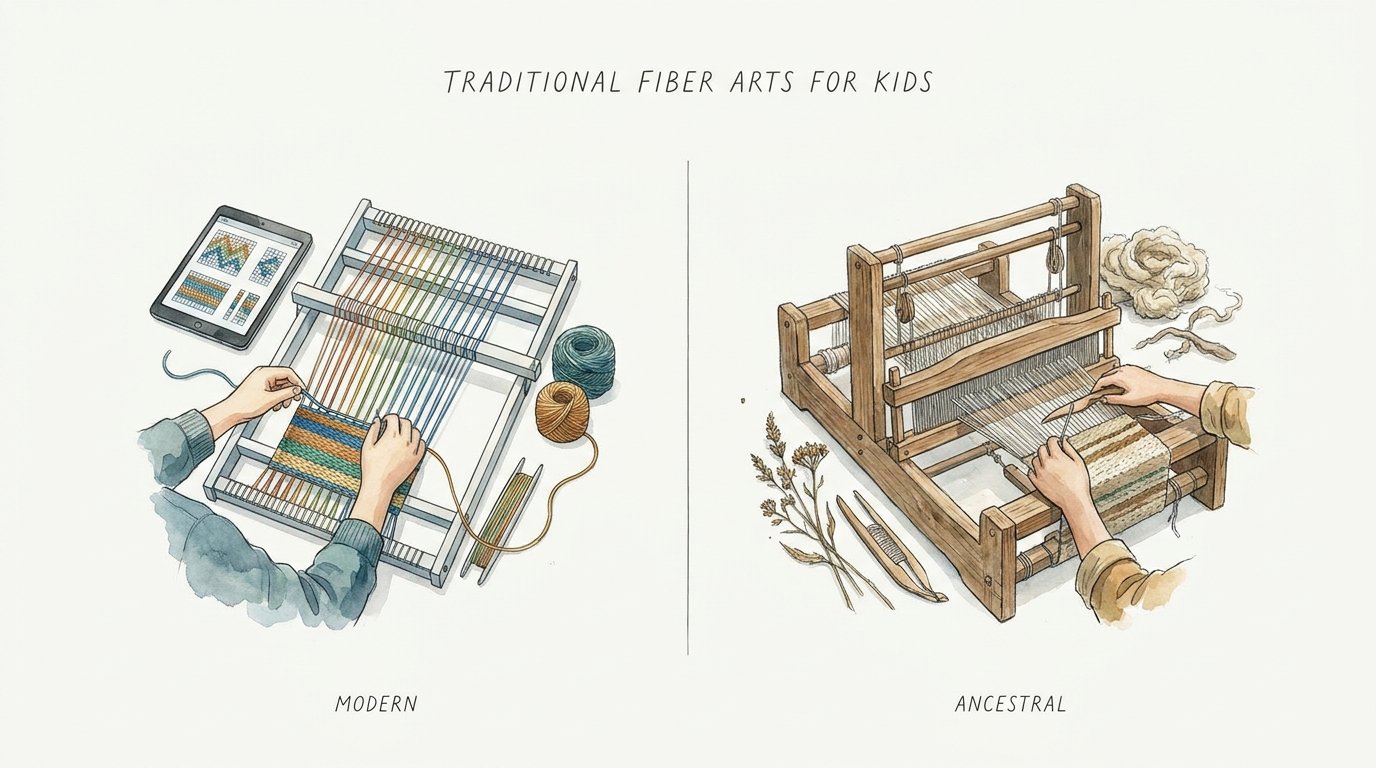
Weaving is about the intersection of the warp and the weft. The warp is the set of stationary vertical threads. The weft is the thread that travels back and forth. You can make a loom out of a simple piece of stiff cardboard. Cut notches into the top and bottom. String your warp thread through these notches.
Once the loom is warped, the child uses a “shuttle” (a small stick or even a popsicle stick) to guide the weft over and under. This repetitive motion creates a fabric. It teaches patterns and spatial reasoning. If they miss a thread, the fabric will have a hole. This provides immediate, non-judgmental feedback.
Introduction to Wet Felting
Wet felting is magical for younger children. It uses wool roving, warm water, and soap. The child agitates the wool until the fibers interlock and become solid felt. This is a sensory-heavy activity. It helps children understand material science in a hands-on way. They see fluffy wool transform into a dense, durable material through friction and heat.
Benefits of Fiber Arts for Developing Minds
The advantages of handwork are measurable and profound. These crafts are not just “busy work.” They are fundamental to cognitive growth.
Bilateral Coordination and Fine Motor Skills
Knitting and weaving require both hands to work together in different ways. One hand holds the tension while the other manipulates the tool. This strengthens the corpus callosum, the bridge between the brain’s two hemispheres. Improved bilateral coordination helps with everything from playing sports to playing musical instruments.
Fine motor coordination is the foundation of academic success. Tasks like writing and drawing depend on the small muscles in the fingers. Manipulating yarn builds these muscles. It increases dexterity and grip strength. Children who craft often find that their handwriting improves naturally.
Mathematical and Spatial Reasoning
Fiber arts are applied mathematics. Knitting involves counting stitches and rows. Weaving involves understanding grids and geometric patterns. Crochet requires an understanding of how shapes are formed through increases and decreases. When a child follows a pattern, they are essentially solving a series of word problems.
Spatial reasoning is another critical benefit. Research shows that fiber arts help children visualize non-rigid transformations. This means they can imagine how a 2D piece of fabric becomes a 3D object like a hat or a toy. This skill is vital for future success in STEM fields like engineering and architecture.
Executive Function and Emotional Regulation
Patience is a muscle. Fiber arts help children flex it. You cannot rush a hand-woven rug. You cannot skip steps in a knitted sweater. This teaches “grit” or the ability to stick with a difficult task. It also provides a healthy outlet for stress. The rhythmic, repetitive nature of stitching has been shown to lower heart rates and induce a meditative state.
Challenges and Common Mistakes
Even the most enthusiastic child will face hurdles. Knowing these pitfalls helps you guide them without stifling their interest.
The Tension Trap
The most common mistake is pulling the yarn too tight. Beginners often fear that the project will fall apart, so they cinch every stitch. This makes the next row impossible to work into. It also causes weaving projects to “hourglass,” where the sides pull inward. Teach children to let the yarn “breathe.” Use the analogy of a soft cloud rather than a tight rope.
Choosing the Wrong Materials
Thin, dark, or fuzzy yarns are the enemies of beginners. Thin yarn takes forever to show progress. Dark yarn makes it impossible to see the stitches. Fuzzy yarn hides mistakes and is hard to undo. Start with “worsted weight” or “bulky” wool in a bright, solid color. Smooth yarns allow the child to see exactly where their tool needs to go.
Safety and Tool Frustration
Metal needles can be slippery and sharp. For young knitters, wooden or bamboo needles are better. They have a “grip” that prevents stitches from sliding off accidentally. If a child is frustrated by needles, switch back to finger knitting or a peg loom. The goal is to build a positive relationship with the craft.
Limitations: When to Wait
While fiber arts are beneficial, they are not a one-size-fits-all solution for every age. Respecting developmental boundaries prevents burnout.
Age Appropriateness
Trying to teach a four-year-old to use knitting needles is usually a mistake. Their fine motor control is often not yet refined enough for the precision required. This leads to frustration and a feeling of failure. Stick to sensory play or finger knitting until they are at least six or seven. Many educators recommend waiting until age eight for formal needle knitting.
Time and Environment Constraints
Fiber arts are slow. In a world of instant gratification, some children may struggle with the long timeline of a project. If you are in a high-stress or rushed environment, handwork may feel like a chore. Ensure you have a dedicated “crafting nook” where projects can sit undisturbed. This allows the child to pick it up and put it down as their energy permits.
Comparison: Weaving vs. Knitting for Beginners
Choosing the right starting point depends on your child’s temperament and goals.
| Feature | Cardboard Weaving | Needle Knitting |
|---|---|---|
| Difficulty Level | Low – Very Accessible | Medium – High |
| Setup Time | Quick (10-15 mins) | Instant (once cast on) |
| Fine Motor Demand | Moderate | High |
| Portability | Good (with small looms) | Excellent |
| Cost | Very Low (recycled materials) | Low to Moderate |
Practical Tips for Teaching Handwork
Use these strategies to ensure a smooth learning process. These tips come from years of traditional craft education.
- Use Stitch Rhymes: For knitting, use a poem like “In through the front door, around the back, peek through the window, and off jumps Jack.” This gives the child a verbal cue for physical movements.
- Select Chunky Yarn: Bulkier yarn provides faster results. A child can see a scarf grow in minutes rather than days. This “quick win” builds the momentum needed for harder projects.
- Model the Behavior: Children do what they see. Sit with them and work on your own project. Don’t make it a “lesson”; make it a shared experience.
- Fix Mistakes Quietly: If they drop a stitch, don’t point it out as a failure. Gently help them pick it back up. In the beginning, the process matters more than the product.
- Embrace Imperfection: A wonky first project is a badge of honor. It shows that the child did the work themselves. Avoid the temptation to “fix” their project until it looks professional.
Advanced Considerations for Young Crafters
Once a child has mastered the basics, you can deepen their understanding by moving into the “source” of the craft. This connects them to history and biology.
Natural Dyeing and Chemistry
Take your child into the garden to find colors. Yellow onion skins, black beans, and turmeric can create vibrant dyes. This introduces them to basic chemistry and pH levels. They learn how different fibers (protein vs. cellulose) react to heat and mordants. It turns a craft project into a scientific experiment.
Spinning with a Drop Spindle
Spinning is the foundation of all fiber arts. A drop spindle is a simple tool that uses gravity to twist raw wool into yarn. This is a high-level skill that requires excellent hand-eye coordination. It teaches the concept of “twist” and structural integrity. Learning to spin gives a child a deep appreciation for the materials they use.
Complex Pattern Reading
Introduce written patterns once they are comfortable with the physical movements. This builds literacy and symbolic reasoning. Reading a crochet chart is like reading a map. It requires decoding symbols and following a sequence of logic. This is an excellent bridge into computer programming and algorithmic thinking.
Example Scenario: The “Ancestor” Wall Hanging
Imagine a child who wants to create a gift. Instead of buying something, they decide to make a wall hanging.
First, they go for a walk and find a sturdy, beautiful stick to serve as the loom’s top. They choose three colors of bulky wool. They spend the first afternoon “warping” a cardboard loom. They spend the next week weaving ten rows a day.
During this time, they aren’t on their iPad. They are sitting by the window, watching the fabric grow. They notice that “over-under” creates a solid sheet, but “over-over” creates a gap. They are experimenting with texture and tension. By the end of the week, they have a physical object they created from nothing. The pride they feel is authentic because the effort was real.
Final Thoughts
Traditional fiber arts are a gateway to a more grounded, intentional childhood. They offer a rare opportunity for children to slow down and engage with the physical world. By moving their hands in the same ways their ancestors did, they tap into a deep well of human capability.
You don’t need expensive equipment to start. A piece of cardboard and a ball of yarn are enough to begin the rewiring process. These skills will serve them for a lifetime, providing both a creative outlet and a mental anchor in an increasingly digital world.
Encourage your child to pick up a hook, a needle, or a loom. Let them make mistakes. Let them feel the wool. Most importantly, let them discover the power of their own hands. The journey from a single thread to a finished masterpiece is one of the most rewarding paths a child can take.
Sources
1 threadcollective.com.au | 2 nspt4kids.com | 3 imthecheftoo.com | 4 playto.com | 5 theartofeducation.edu | 6 craftindustryalliance.org | 7 fabric8.co.za | 8 study.com | 9 redtedart.com | 10 littlelooms.com | 11 better-blocks.com | 12 happyhooligans.ca | 13 lindenwood.edu