Childhood Play Statistics 1990 Vs 2024
We traded scraped knees for digital dopamine—but what was the hidden cost to our social development? In the 90s, boredom was the birthplace of imagination. Today, every micro-moment of boredom is filled with a screen. Statistics show a direct correlation between the rise in screen hours and a decline in spontaneous, unstructured social play. Here is how the landscape of childhood has fundamentally changed.

Understanding this shift requires more than just nostalgia. We are witnessing a massive biological and sociological experiment. Previous generations were raised in a “play-based” childhood, while today’s youth are navigating a “phone-based” existence. This article explores the data, the consequences, and the practical ways we can restore the essential elements of a healthy childhood.

Childhood Play Statistics 1990 Vs 2024
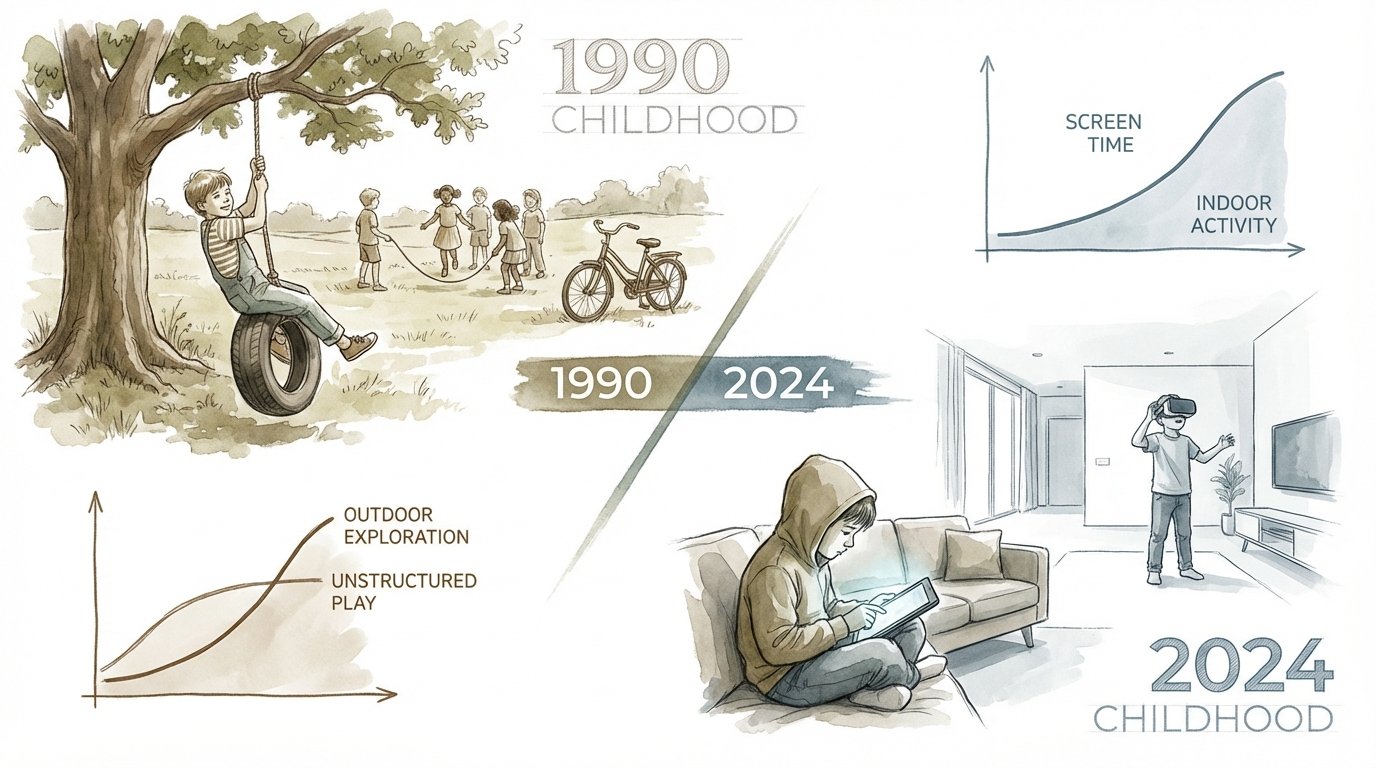
The numbers tell a story of rapid contraction. In 1990, the average child spent significant portions of their day out of sight of adults. Today, the world of the average child has shrunk to the size of a smartphone screen.
Screen Time Explosion: In 1995, preschoolers averaged less than one hour of screen time daily. Young teens averaged roughly 3.5 hours, primarily spent watching television. Fast forward to 2024, and those numbers have more than doubled. Teens now spend an average of 7.5 to 9 hours a day on screens for entertainment alone. This equates to roughly 114 days a year spent in front of a digital device.
The Roaming Radius Collapse: One of the most startling metrics is the “roaming radius”—the distance a child is allowed to travel from home without supervision. In the mid-20th century, this was often miles. Even in the 1990s, children frequently biked across neighborhoods. Current data suggests a 90% reduction in this radius since the 1970s. Many children today are not permitted to leave their own yards or the immediate sight of their front door.
Outdoor Play Frequency: Research indicates that American children spend 35% less time playing outside freely than their parents did. While 65% of adults report playing outside every single day during their childhood, only 30% of children today do the same. In some studies, children are found to spend as little as 4 to 7 minutes in unstructured outdoor play daily.
Physical Health Trends: The decline in movement has had predictable physical consequences. Global adolescent obesity has quadrupled since 1990. In the United States, 1 in 5 children is now considered obese. These physical markers often mirror the decline in spontaneous physical activity that used to be a natural part of social play.
Mental Health Shifts: The rise of the “phone-based” childhood correlates strongly with a mental health crisis. Anxiety and depression rates among youth remained relatively stable through the late 20th century but began a sharp upward climb around 2010—the same time smartphones became ubiquitous. Recent surveys show that nearly 27% of teens report frequent symptoms of anxiety.
How the Childhood Ecosystem Works
Childhood development relies on a complex ecosystem of risks, rewards, and social feedback. This system is fueled by unstructured play, which is any activity that children dream up on their own without adult intervention.
Unstructured play is the primary way children learn self-regulation. When adults are not present to referee a game of tag or settle an argument over a “foul” in a driveway basketball game, children must negotiate. They learn to read facial expressions, tone of voice, and body language to keep the game going. This is the “work” of childhood.
The modern ecosystem has replaced this with structured, adult-led activities. Children move from the classroom to soccer practice to tutoring, all under constant adult supervision. This transition creates “backseat children” who are passively escorted through life rather than active participants in their own development.
Digital environments further alter this ecosystem by providing “asynchronous” social interaction. On social media, you can edit a post or delete a comment. In real-world play, you have to respond in the moment. The “lag” in digital social cues deprives the brain of the high-speed processing practice required for deep social competence.
Benefits of the Play-Based Model
The advantages of a play-based childhood are rooted in neuroscience. Spontaneous play activates thousands of genes in the prefrontal cortex, the area of the brain responsible for executive function, planning, and social behavior.
Executive Function Mastery: Unstructured play requires children to set their own rules and goals. This strengthens the brain’s ability to plan, prioritize, and resist impulses. Children who lead their own play sessions show higher cognitive scores than those who are constantly guided by adults.
Conflict Resolution Skills: Real-world play is messy. Arguments are inevitable. When children are left to solve these disputes themselves, they develop sophisticated negotiation skills. They learn that being a “sore loser” or a “bully” leads to being excluded from the group, which is a powerful natural incentive for social cooperation.
Risk Assessment: “Risky play,” such as climbing trees or riding bikes fast, is essential. It teaches children how to evaluate their own physical limits and the environment around them. This builds genuine confidence—the kind that comes from overcoming a real-world challenge rather than receiving a participation trophy.
Emotional Resilience: Boredom is a vital part of this model. When a child is bored, they are forced to look inward and use their imagination. This process builds the internal resources necessary to handle the quiet moments of life without needing external stimulation from a screen.
Challenges of the Digital Transition
The shift to a screen-centric childhood was not a conscious choice by parents, but a result of “safety creep” and technological allure. This transition has introduced several profound challenges.
The Dopamine Loop: Digital platforms are designed by experts to maximize engagement. They utilize variable reward schedules—the same mechanism used in slot machines—to keep users scrolling. For a developing brain, this “digital dopamine” is much easier to access than the “earned dopamine” of learning a new skill or winning a real-world game.
Social Cue Deprivation: A significant portion of human communication is non-verbal. When social interaction happens through text or short-form video, these cues are lost. This can lead to “social atrophy,” where children find face-to-face interactions stressful or overwhelming because they haven’t practiced the subtle art of conversation.
The Comparison Trap: In the 1990s, you compared yourself to the kids on your block. In 2024, children compare themselves to a curated, filtered world of influencers. This creates a “status treadmill” that contributes to the record-high rates of body dysmorphia and social anxiety seen in modern youth.
Sedentary Lifestyles: The physical challenge is perhaps the most visible. Passive consumption of media displaces the physical movement required for bone density, cardiovascular health, and gross motor skill development. Many physical therapists report seeing “weak cores” and poor balance in children who spend the majority of their time in sedentary screen use.
Limitations of the Comparison
While the 1990s model had significant benefits, it is important to acknowledge the limitations of that era and the unique advantages of 2024. A balanced view strengthens our ability to find a middle ground.
The Myth of Total Safety: The 1990s were not necessarily “safer” in terms of crime or accidents. In fact, many types of child-related accidents and missing person cases have decreased significantly. The modern fear is often driven by “omnipresent news” rather than an actual increase in local danger.
Digital Literacy: Growing up in 2024 provides children with incredible digital skills that will be mandatory for the future workforce. Coding, digital art, and global connectivity are benefits that a 1990s child could only dream of. The challenge is not the technology itself, but the *displacement* of other essential activities.
Information Access: A child in 2024 can learn about any topic—from astrophysics to ancient history—with a few taps. In the 90s, you were limited by the physical books in your local library. The potential for self-directed learning is higher now than at any point in human history.
Parental Connectivity: GPS tracking and instant messaging provide a safety net that allows for some level of independence. While “helicopter parenting” is a risk, these tools can actually be used to *increase* freedom if parents use them as a “digital leash” that allows kids to go further than they otherwise would.
Practical Tips for Restoring Play
We cannot turn back the clock to 1990, but we can intentionally integrate the best parts of that era into modern life. Small shifts in daily habits can yield significant developmental rewards.
- Implement “No-Phone Zones”: Designate specific times or places (like the dinner table or the park) where screens are completely prohibited for both parents and children.
- Encourage “Risky Play”: Allow your children to engage in age-appropriate activities that involve a element of physical risk, such as climbing or exploring nature without an adult standing directly over them.
- The “One-Hour” Rule: Aim for a 1:1 ratio. For every hour spent on a screen, encourage one hour of active, outdoor, or creative play.
- Organize “Free-Range” Meetups: Connect with other parents in your neighborhood to create a safe “zone” where kids can play together unsupervised. Safety often lies in numbers.
- Embrace the Boredom: Resist the urge to hand over a tablet the moment your child says they are bored. Let them sit with the feeling until their imagination takes over.
Focus on unstructured time. The goal is to give the child’s brain the space to lead itself. This might mean leaving a Saturday afternoon completely unplanned or providing “loose parts” like boxes and sticks rather than specific toys with a single purpose.
Advanced Considerations for Practitioners
For educators and child development specialists, understanding the “neuro-ecology” of play is essential for modern intervention. The “social brain” is not a fixed asset; it is a muscle that requires specific types of resistance to grow.
The Role of Mirror Neurons: Social development relies heavily on mirror neurons, which fire when we observe others’ actions and emotions. Digital interfaces often fail to trigger these neurons with the same intensity as physical presence. Practitioners should prioritize activities that require sustained eye contact and shared physical goals.
Play Deprivation and Resilience: Long-term play deprivation is linked to a lack of “social flexibility.” Children who haven’t played enough often become “ideologically fixed”—they have a harder time accepting ambiguity or different perspectives because they haven’t practiced the “give and take” of the playground.
The “Anti-Fragility” Concept: Systems that benefit from shocks and stressors are “anti-fragile.” A child’s social skills are anti-fragile. By over-protecting them from social friction or minor physical risks, we make them more “fragile” in the long run. The goal should be “managed exposure” rather than “total elimination” of discomfort.
Examples of the Shift in Practice
Consider two scenarios of a typical Saturday to visualize how these changes manifest in daily life.
Saturday, 1994: A ten-year-old wakes up, eats cereal, and hops on a bike. They meet three friends at a local creek. They spend four hours building a “fort” out of scrap wood and mud. They have two arguments—one about who gets to be “captain” and one about the fort’s design. They resolve both without adult help. They return home when the streetlights come on, exhausted and covered in dirt, having practiced engineering, negotiation, and physical endurance.
Saturday, 2024: The same ten-year-old wakes up and spends two hours on a tablet watching videos of other people playing video games. They attend a 60-minute structured soccer practice where every movement is directed by a coach. They return home and spend the evening in a “gaming party” on headsets. While they are communicating with friends, they are sitting still and the social interaction is mediated by the rules of the software, not the rules of human interaction.
The 1994 child practiced internal regulation. The 2024 child practiced external consumption. Both spent time with friends, but the developmental “calories” were vastly different.
Final Thoughts
The transition from a play-based to a phone-based childhood is the most significant change in human development in recent history. We have traded the grit of the physical world for the gloss of the digital one, and the statistics suggest the trade has not been in our favor. The loss of unstructured play is not just a loss of fun; it is a loss of the primary training ground for the human social brain.
However, the solution is not to fear technology but to re-prioritize human experience. We can choose to expand the roaming radius of our children. We can choose to let them be bored. We can choose to value a scraped knee as a badge of a lesson well-learned. By intentionally carving out space for unstructured play, we give the next generation the tools they need to be resilient, social, and truly independent.
Childhood is a short window of time designed for exploration and error. Let’s make sure we aren’t filling that window with a screen that only reflects the world back to them, rather than letting them step out and touch it for themselves. Encourage your children to go outside, get lost in a game, and find the magic that only happens when the WiFi signal fades.
Sources
1 horizonhealthnews.com (https://www.horizonhealthnews.com/the-truth-about-children-and-outdoor-play/) | 2 kidscreen.com (https://kidscreen.com/2024/10/28/feature-kids-are-actually-spending-less-time-on-devices/) | 3 slicktext.com (https://www.slicktext.com/blog/2023/01/30-key-screen-time-statistics-for-2022-2023/) | 4 medium.com (https://medium.com/the-storm-of-words-un-said/the-decline-of-outdoor-play-how-the-digital-age-is-changing-childhood-development-b8c227859070) | 5 thedailyeconomy.org (https://thedailyeconomy.org/article/seven-minutes-outside-the-collapse-of-childhood-play/) | 6 freerangekids.com (https://www.freerangekids.com/how-children-lost-the-right-to-roam-in-just-4-generations/) | 7 sciencedaily.com (https://www.sciencedaily.com/releases/2024/09/240926131942.htm) | 8 resilience.org (https://www.resilience.org/stories/2017-11-13/letting-children-roam/) | 9 whiterose.ac.uk (https://eprints.whiterose.ac.uk/id/eprint/94588/1/Woolley%20and%20Griffin%202015%20%20Decreasing%20experiences%20of%20home%20range%20%20%20%20%20%20%20Jan%202016.pdf) | 10 who.int (https://www.who.int/news-room/fact-sheets/detail/obesity-and-overweight) | 11 byu.edu (https://ballardbrief.byu.edu/issue-briefs/childhood-obesity-in-the-united-states) | 12 medium.com (https://medium.com/@manufernandez/the-shrinking-world-of-childhood-free-ranging-9ca11c202064) | 13 magnetaba.com (https://www.magnetaba.com/blog/average-screen-time-statistics) | 14 thegeniusofplay.org (https://thegeniusofplay.org/asicommon/controls/shared/formsauthentication/login.aspx?ReturnUrl=%2fasicommon%2fcontrols%2fshared%2fformsauthentication%2flogin.aspx%3fReturnUrl%3d%252fasicommon%252fcontrols%252fshared%252fformsauthentication%252flogin.aspx%253fReturnUrl%253d%25252fasicommon%25252fcontrols%25252fshared%25252fformsauthentication%25252flogin.aspx%25253fReturnUrl%25253d%2525252fasicommon%2525252fcontrols%2525252fshared%2525252fformsauthentication%2525252flogin.aspx%2525253fReturnUrl%2525253d%252525252fasicommon%252525252fcontrols%252525252fshared%252525252fformsauthentication%252525252flogin.aspx%252525253fReturnUrl%252525253d%25252525252fasicommon%25252525252fcontrols%25252525252fshared%25252525252fformsauthentication%25252525252flogin.aspx%25252525253fReturnUrl%25252525253d%2525252525252fasicommon%2525252525252fcontrols%2525252525252fshared%2525252525252fformsauthentication%2525252525252flogin.aspx%2525252525253fReturnUrl%2525252525253d%252525252525252fasicommon%252525252525252fcontrols%252525252525252fshared%252525252525252fformsauthentication%252525252525252flogin.aspx%252525252525253fReturnUrl%252525252525253d%25252525252525252fasicommon%25252525252525252fcontrols%25252525252525252fshared%25252525252525252fformsauthentication%25252525252525252flogin.aspx%25252525252525253fReturnUrl%25252525252525253d%2525252525252525252fasicommon%2525252525252525252fcontrols%2525252525252525252fshared%2525252525252525252fformsauthentication%2525252525252525252flogin.aspx%2525252525252525253fReturnUrl%2525252525252525253d%252525252525252525252fasicommon%252525252525252525252fcontrols%252525252525252525252fshared%252525252525252525252fformsauthentication%252525252525252525252flogin.aspx%252525252525252525253fReturnUrl%252525252525252525253d%25252525252525252525252fasicommon%25252525252525252525252fcontrols%25252525252525252525252fshared%25252525252525252525252fformsauthentication%25252525252525252525252flogin.aspx%25252525252525252525253fReturnUrl%25252525252525252525253d%2525252525252525252525252ftgop%2525252525252525252525252fgenius%2525252525252525252525252fexpert-advice%2525252525252525252525252farticles%2525252525252525252525252fthe-decline-of-unstructured-play.aspx) | 15 childandfamilyblog.com (https://childandfamilyblog.com/play-deprivation-early-child-development/) | 16 reddit.com (https://www.reddit.com/r/CasualUK/comments/v8cyi7/map_comparing_four_generations_of_kids_how_far/)