Soil Science Worksheets For Elementary
Stop paying for what your kitchen produces for free. Industrial agriculture has convinced us that we need to buy ‘fertility’ in a plastic bag. The truth? Your kitchen scraps and a few printables can teach your child how to build the most nutrient-dense soil on the planet. Turn ‘waste’ into wealth and education simultaneously.

Most people see a pile of old potato peels and eggshells as trash. They toss them in a bin, and the garbage truck hauls away potential gold. Meanwhile, those same people drive to a big-box store to buy heavy bags of sterilized, dead “dirt.” This cycle is expensive and keeps children disconnected from the magic of biology.
Teaching your children about soil health changes everything. It transforms a boring chore into a high-level science lab. When a child sees a worm turning a banana peel into dark, rich humus, they aren’t just looking at dirt. They are witnessing the literal foundation of life. This guide will show you how to use soil science worksheets for elementary students to bridge the gap between “gross” waste and garden wealth.
Soil Science Worksheets For Elementary
Soil science worksheets for elementary students are more than just coloring pages. They are structured tools designed to help children observe, categorize, and understand the complex world beneath their feet. At this age, children are naturally curious about the “ick” factor of worms and mud. These worksheets channel that energy into a scientific framework.
In the real world, soil science is the study of how physical, chemical, and biological processes interact to support life. Agricultural scientists use these principles to feed the world. Engineers use them to build stable bridges. For a second or third-grader, however, it starts with a simple question: What is in this handful of dirt?
Elementary-level worksheets usually focus on three core areas: soil composition, soil horizons, and the soil food web. Composition worksheets teach kids that soil isn’t just one “thing.” It is a mixture of weathered rock (sand, silt, and clay), organic matter (rotting plants), air, and water. A child might use a worksheet to tally how many tiny rocks versus how many pieces of leaves they find in a square foot of garden space.
Soil horizon worksheets introduce the concept of “layers.” Just like a cake, the earth has distinct levels. Children learn about the “O Horizon” (organic layer) at the very top, the “A Horizon” (topsoil) where plants grow, and the deeper layers like subsoil and bedrock. Visualizing these layers helps them understand why we must protect the thin, fragile layer of topsoil that keeps us alive.
Finally, soil food web worksheets introduce the “decomposers.” These are the heroes of the garden. From microscopic bacteria to visible earthworms and pill bugs, these organisms are responsible for turning waste into nutrients. Using a worksheet to identify different “critters” found in a compost pile teaches children that healthy soil is a living, breathing community.
The Mechanics of Building Soil Wealth
Creating soil wealth is a process of controlled decomposition. You are essentially managing a microscopic livestock farm. Instead of cows or chickens, you are raising billions of bacteria, fungi, and protozoa. The goal is to provide them with the perfect environment so they can do the heavy lifting of creating fertility for you.
To start, you need to understand the “Greens” and the “Browns.” Nitrogen-rich materials, or “Greens,” are things like fresh grass clippings, fruit scraps, and vegetable peels. These provide the protein for your microscopic workers. Carbon-rich materials, or “Browns,” are things like dried leaves, shredded cardboard, or straw. These provide the energy and the structure for the pile.
The rule of thumb for a high-functioning soil factory is a ratio of roughly two parts brown to one part green. If you have too many greens, the pile will get slimy and start to smell like ammonia. If you have too many browns, the process will stop entirely because the microbes are “starving” for nitrogen. Using a simple tally worksheet can help a child keep track of what they are adding each day, turning a backyard pile into a real-time math and science experiment.
Oxygen and water are the final pieces of the puzzle. Most beneficial soil organisms are aerobic, meaning they need to breathe. If your pile is too wet and compacted, the “good” microbes die off, and “bad” anaerobic bacteria take over. This is when a compost pile starts to stink. Teaching a child to “turn” the pile with a pitchfork or a small shovel introduces them to the importance of aeration in biological systems.
The Practical Benefits of Soil Science Education
The most immediate benefit is financial. When you learn to produce your own soil wealth, you stop spending money on synthetic fertilizers and bagged potting mixes. These products are often just “junk food” for plants—they provide a quick hit of chemicals but do nothing to build the long-term health of the ecosystem. Home-built soil is a complete, slow-release buffet of micronutrients.
Educationally, this topic is a “STEM” powerhouse. It covers biology (microbes and life cycles), chemistry (pH levels and nutrient cycles), and environmental science (waste reduction). A child who understands how to build soil is lightyears ahead of their peers in grasping how the world actually functions. They aren’t just memorizing facts; they are seeing a system in motion.
There are also physical health benefits that are often overlooked. Recent studies suggest that regular contact with “clean” soil can actually boost a child’s immune system. The diverse bacteria found in healthy, organic soil help train the human microbiome. Getting their hands dirty is literally a way for children to build resilience against allergies and autoimmune issues.
Finally, there is the benefit of stewardship. In a world of “disposable” everything, composting teaches children that nothing is truly wasted in nature. Everything has a purpose. This mindset shifts their perspective from being a consumer to being a caretaker. They begin to see the interconnectedness of their kitchen, their garden, and the planet at large.
Challenges and Common Pitfalls to Avoid
The most common mistake beginners make is treating the compost pile like a trash can. You cannot put everything in there. Meat, dairy, and oily foods will attract rodents and create horrific odors. These materials decompose differently than plant matter and require much higher temperatures to be safe. Stick to fruit, vegetables, eggshells, and coffee grounds to keep things simple and safe for children.
Another pitfall is neglecting the moisture level. Your soil factory needs to stay about as damp as a wrung-out sponge. If it dries out completely, the microbes go dormant and the process stops. If it is soaking wet, it becomes a swampy mess. This is a great opportunity to teach children about monitoring and maintenance. Have them check the pile weekly and record the “moisture feel” on a log sheet.
Pests can be a concern, but they are usually a symptom of a deeper problem. If you see flies or maggots, the pile likely has too many exposed “greens.” The solution is simple: cover the fresh kitchen scraps with a thick layer of “browns” like dried leaves or shredded paper. This acts as a biological filter, trapping odors and making the pile less attractive to unwanted visitors.
Impatience is the final hurdle. High-quality soil wealth doesn’t happen overnight. It can take anywhere from three months to a year depending on the weather and the materials used. This “slow science” is a vital lesson for children who are used to instant gratification. It teaches them that the best things in life—like deep, black, crumbly soil—require time and consistent effort.
Limitations of Home Soil Production
While building soil wealth is incredibly rewarding, it does have practical boundaries. If you live in an apartment or a high-density urban area, a large outdoor compost bin might not be feasible. In these cases, you have to scale down. Vermicomposting (using a worm bin) or Bokashi (a fermenting method) are great alternatives, but they require a different set of skills and expectations.
Climate also plays a major role. In extremely cold winters, the biological activity in an outdoor pile will grind to a halt. The microbes don’t die, but they do go to sleep. This means your “waste to wealth” factory might be closed for four or five months of the year. It is important to explain to children that nature has seasons of rest, and the soil-building process is no different.
Space and volume are the last considerations. To generate enough soil to fill a large vegetable garden, you need a significant amount of organic matter. A small family of three might not produce enough kitchen scraps to keep a large system running. You may need to “import” browns from your neighbors or “greens” from a local coffee shop to reach the volume necessary for high-heat composting.
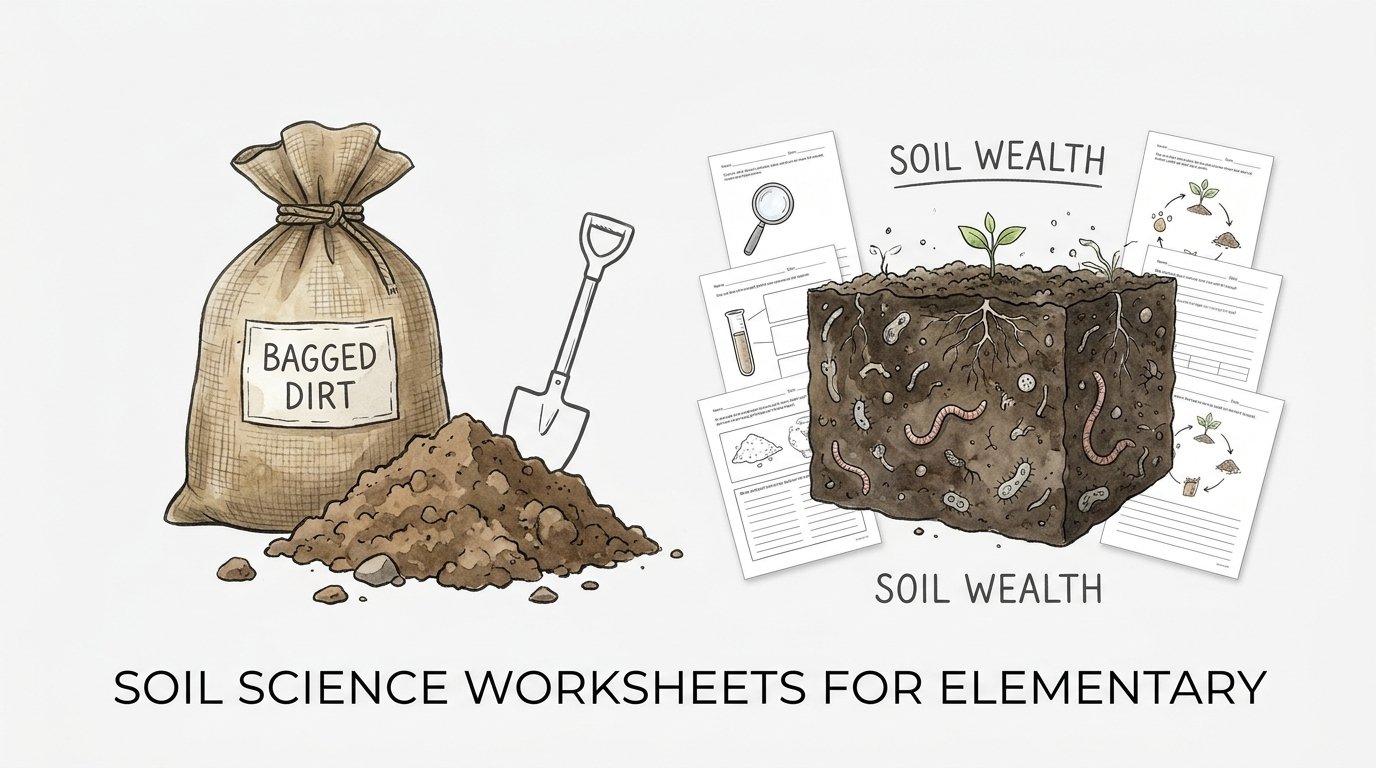
BAGGED DIRT vs SOIL WEALTH
It is helpful to understand the difference between what you buy at a store and what you build at home. Most “bagged dirt” is actually a soilless medium made of peat moss, perlite, and synthetic fertilizers. It is designed for convenience, not for long-term ecosystem health.
| Feature | Bagged Dirt | Homegrown Soil Wealth |
|---|---|---|
| Microbial Life | Mostly sterile/dead | Teeming with billions of organisms |
| Nutrient Profile | High N-P-K, low micronutrients | Diverse, full-spectrum nutrition |
| Cost | $5 – $15 per bag | Free (Uses waste) |
| Environmental Impact | High (Plastic bags, shipping, mining) | Positive (Waste diversion) |
When you use soil science worksheets for elementary, you can have children compare a handful of bagged “potting mix” with a handful of finished compost. Ask them to look for movement, smell the differences, and describe the texture. This sensory comparison is often the “lightbulb moment” where they realize that “soil” is alive, while “dirt” is just a product.
Practical Tips for Elementary Soil Labs
To make the most of your home soil project, incorporate specific hands-on tests. A favorite for elementary students is the “Soil Shake Test.” Fill a glass jar one-third full of soil, add water until it’s almost full, and shake it vigorously. Let it sit for 24 hours. The particles will settle into layers: sand at the bottom, silt in the middle, and clay on top. Use a worksheet to measure and graph the percentages. This is a real-world application of geometry and earth science.
Another excellent activity is the “Underwear Test.” If you have a backyard, bury a pair of 100% white cotton underwear a few inches deep in the soil. Leave it for two months. When you dig it up, the amount of fabric that has been “eaten” by microbes tells you how healthy your soil is. If only the elastic remains, your soil life is thriving! If the fabric is still intact, your soil is “hungry” and needs more organic matter.
Use observation logs for “Worm Counts.” Dig a small hole (one foot square and six inches deep) and count every earthworm you find. High worm counts are a direct indicator of high soil fertility. This turns a simple backyard exploration into a data-collection exercise. Children can track worm populations over several seasons as they add more compost to the area.
Advanced Considerations for Serious Practitioners
If your child becomes deeply interested, you can move beyond simple “rotting” and into the nuances of the soil food web. This involves understanding the different roles of fungi and bacteria. For example, trees and shrubs prefer fungal-dominant soil, while vegetables and grasses prefer bacterial-dominant soil. You can adjust your compost “recipe” to favor one or the other. More “browns” (woody materials) lead to more fungi; more “greens” lead to more bacteria.
You might also explore the concept of “Soil pH.” While elementary worksheets keep it simple, older children can use pH test kits to see how acidic or alkaline their soil is. They can learn how different plants, like blueberries or lavender, have specific pH requirements. This introduces more complex chemistry concepts in a way that is immediately applicable to the health of their garden.
Finally, consider the role of “Cover Crops.” Instead of just adding compost to the surface, you can teach children to grow “fertility.” Planting things like clover or field peas helps pull nitrogen from the air and store it in the soil through a process called nitrogen fixation. When these plants die and rot back into the ground, they provide a massive boost of soil wealth. This is the ultimate lesson in biological efficiency.
Example Scenario: The Weekend Soil Scientist
Imagine a Saturday morning where instead of watching cartoons, a seven-year-old named Leo heads to the backyard with a clipboard. On his “Weekly Soil Health Worksheet,” he records the internal temperature of the compost pile using a long probe thermometer. He sees it is 130 degrees Fahrenheit—hot enough to kill weed seeds and bad bacteria. He notes this down, marveling that a pile of “trash” is generating its own heat.
Next, Leo checks the “Green to Brown” log on the side of the bin. He sees his family added a lot of kitchen scraps (greens) this week, so he spends ten minutes shredding some cardboard boxes (browns) to balance the pile. He uses a spray bottle to add a little water, ensuring the pile feels like a “wrung-out sponge.”
To finish his “lab work,” he pulls a handful of finished soil from the bottom of the bin. He spreads it out on a tray and uses a magnifying glass to find “decomposers.” He finds two worms, a centipede, and several tiny white mites. He draws these in the observation box on his worksheet. By lunch, Leo hasn’t just done a chore; he has practiced biology, chemistry, and data entry. He is building soil wealth, and he is building a scientific mind.
Final Thoughts
Building soil wealth is one of the most radical acts of independence a family can undertake. It breaks the cycle of dependency on industrial products and turns your home into a closed-loop system of fertility. By using soil science worksheets for elementary students, you provide your children with a framework to understand the invisible forces that sustain all life on Earth.
The shift from seeing “dirt” to seeing “soil wealth” is a profound transformation. It replaces the “ick” factor with awe and the “trash” mentality with stewardship. You aren’t just teaching your child how to grow a tomato; you are teaching them how the world recycles itself. This is foundational knowledge that will serve them for the rest of their lives, regardless of whether they become a scientist, a gardener, or a conscious consumer.
Start small. Set up a simple bin, print out a few observation sheets, and let your children lead the way. They will likely be the first to remind you to save your coffee grounds or eggshells. Before you know it, you won’t be paying for fertility in a plastic bag anymore. You will be growing it yourself, one kitchen scrap at a time.
Sources
1 beginhealth.com | 2 thezoofamily.com | 3 bayer.com | 4 plt.org | 5 easyteacherworksheets.com | 6 agclassroom.org | 7 countrygardener.co.uk | 8 scienceiselementary.org | 9 mossyoakproperties.com | 10 hotbincomposting-us.com | 11 kidsgardening.org | 12 littlebinsforlittlehands.com