montessori activities
Trade the ‘Urban’ plastic for ‘Wild’ exploration. Montessori isn’t just about ‘toys.’ It’s about giving children the ‘Wild’—natural textures, real tools, and the freedom to explore the biological world.
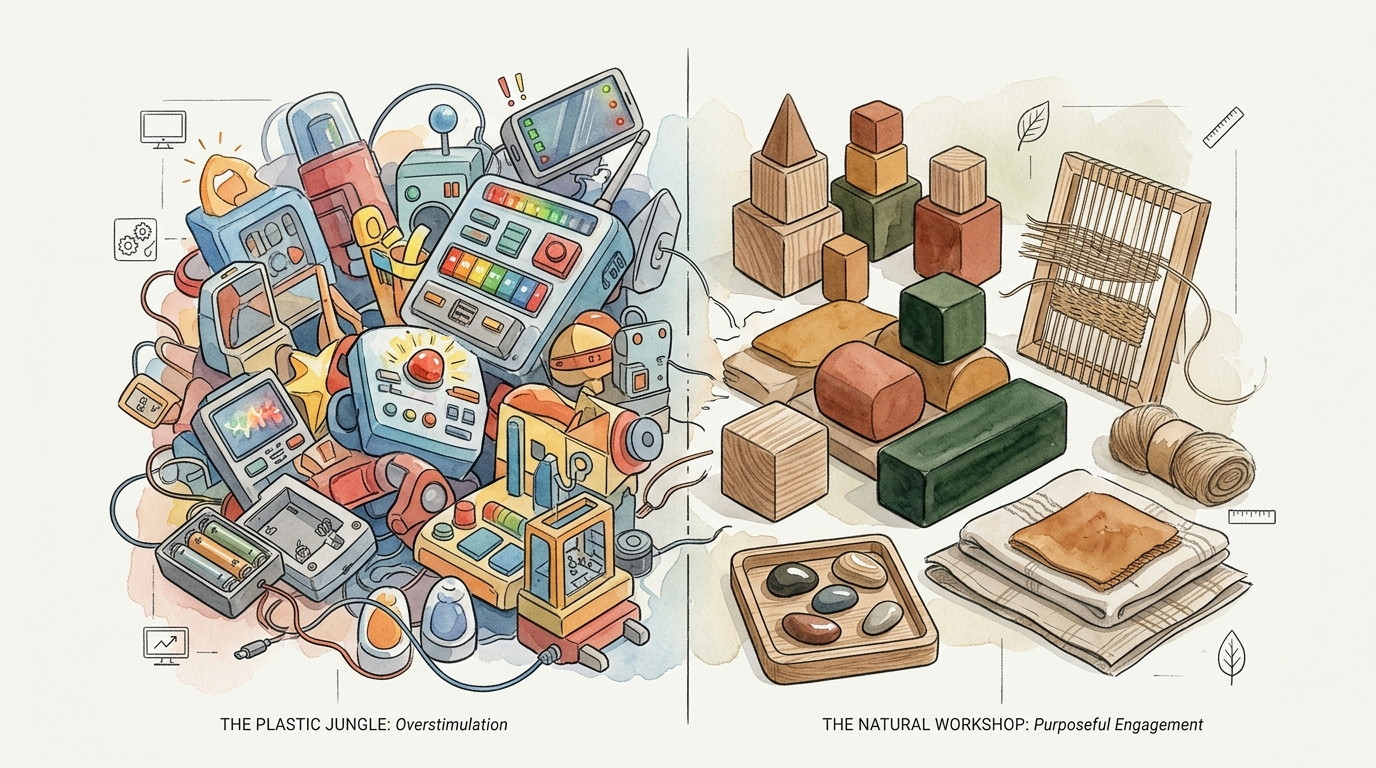
Walking into a modern playroom often feels like stepping into a technicolor factory. Bright primary colors, flashing lights, and smooth, hollow plastic dominate the landscape. While these items are marketed as educational, they often lack the sensory depth a developing brain craves.
This article guides you through the shift from the “Plastic Jungle” to the “Natural Workshop.” You will learn how to integrate the living world into your child’s daily routine using time-tested Montessori principles. It is about fostering a deep, meaningful connection with reality that starts right outside your door.
Every rock, leaf, and puddle is a potential lesson in physics, biology, and patience. By the end of this guide, you will have a roadmap for transforming your environment into a sanctuary of natural discovery. Let’s move beyond the shelf and into the dirt.
montessori activities
Montessori activities are purposeful “works” designed to help children develop independence, concentration, and a sense of order. Unlike traditional play, these activities are rooted in reality and use real materials that provide immediate feedback to the child. In the context of nature, these activities extend the classroom into the biological world.
At their core, these activities exist to bridge the gap between a child’s internal development and the external world. Maria Montessori believed that the outdoors is a natural extension of the prepared environment. Instead of looking at a picture of a tree, the child touches the bark, smells the sap, and watches the leaves change over time.
In a real-world setting, this might look like a toddler using a small metal watering can to care for a garden bed. It could also be a preschooler using a magnifying glass to observe the veins in a fallen leaf. These are not just “games”; they are scientific observations and practical life skills combined into one meaningful experience.
Real-world application is key here. Montessori activities often involve tools like glass pitchers, metal rakes, and ceramic bowls. These materials have weight, texture, and temperature, which provide a rich sensory experience that plastic simply cannot replicate.
Setting Up the Outdoor Learning Environment
Creating a “Wild” Montessori space starts with accessibility and real-world tools. You don’t need a sprawling forest to begin; a small patio or even a balcony can become a thriving hub for discovery. The goal is to provide a space where the child can work independently without constant adult intervention.
Start by providing easy access to water. Whether it is a low outdoor tap, a large jug with a spigot, or a simple basin, water is the lifeblood of many nature-based activities. It allows for pouring, scrubbing, and plant care, all of which build fine and gross motor skills.
Incorporate real, child-sized tools made from metal and wood. A heavy metal rake or a sturdy wooden-handled shovel provides the resistance needed to build physical strength and coordination. Avoid “toy” versions that break easily, as these frustrate the child and fail to teach the proper use of equipment.
Organize the space into clear zones, such as a gardening area, a sensory exploration station, and a quiet observation corner. Use low weather-proof shelves to store items like magnifying glasses, collection baskets, and field guides. This structure allows the child to choose their “work” based on their current interests and developmental needs.
Designing for Sensory Stimulation
A high-quality outdoor space should engage all five senses. Plant a variety of textures, such as soft “lamb’s ear” plants and rough-barked trees, to stimulate the sense of touch. Use aromatic herbs like rosemary, lavender, and mint to create a “smell garden” that provides constant olfactory feedback.
Include auditory elements like wind chimes or a small trickling water feature. These sounds provide a calming backdrop for focused work and encourage the child to stop and listen. Visually, the space should be orderly but diverse, featuring a range of colors and shapes found in the natural world.
How to Implement Nature-Based Montessori Activities
The transition to nature-based learning begins with unhurried observation. Set aside time where your primary goal is simply to follow the child’s lead as they explore. Avoid the urge to teach or correct; instead, wait for the child to express curiosity or hit a roadblock.
Implement “Nature Walks” with a specific purpose, such as a “Texture Hunt.” Give the child a small basket and ask them to find one thing that is rough, one thing that is smooth, and one thing that is fuzzy. This structure provides focus while allowing the child to discover the vast diversity of the local ecosystem.
Gardening is perhaps the ultimate Montessori activity. Start with fast-growing seeds like radishes or mung beans to provide quick feedback for a child’s efforts. Show them how to prepare the soil, plant the seed at the correct depth, and provide just the right amount of water each day.
Animal observation is another powerful tool. Set up a bird feeder or an insect hotel at the child’s eye level. Provide a simple sketchbook and colored pencils so they can document what they see. This encourages the habit of attention and introduces the basics of scientific journaling and biological classification.
Benefits of the “Wild” Approach
The measurable benefits of nature-based Montessori activities are profound. Physically, navigating uneven terrain like hills, logs, and mulch beds builds superior balance and core strength. This “gross motor” development is much harder to achieve on the flat, predictable surfaces found in indoor playrooms.
Emotionally, time spent in nature is a powerful regulator for the nervous system. The sights and sounds of the outdoors—sunlight, rustling leaves, and fresh air—have been shown to reduce stress and improve focus. For a child who feels overwhelmed by the “Plastic Jungle,” the outdoors offers a grounding, calming environment.
Cognitively, nature provides an infinite curriculum. Unlike a plastic toy with one “correct” way to play, natural materials are open-ended. A stick can be a lever, a drawing tool in the dirt, or a support for a climbing plant. This flexibility nurtures high-level problem-solving and creative thinking skills.
Socially and morally, these activities foster a sense of “Cosmic Education.” Children begin to see the interconnectedness of all living things. When they water a plant and see it grow, or refrain from stepping on a beetle, they are developing empathy and a sense of responsibility toward the environment.
Challenges and Common Mistakes
One of the most frequent errors is the “Shelfie Obsession.” Social media often portrays Montessori as a series of perfectly curated trays on a shelf. In reality, a toddler might be more interested in helping you sort laundry or scrubbing a muddy rock than doing a “curated” activity.
Another mistake is providing “toys” disguised as tools. Plastic shovels and flimsy rakes often fail to do the job they are intended for. This leads to frustration, as the child cannot see the results of their effort. Always opt for real, functional tools that happen to be sized for small hands.
Over-supervision can also stifle the benefits of outdoor exploration. If an adult is constantly warning the child about dirt or minor risks, the child stops taking the initiative. The goal is to provide a “freedom within limits” environment where the child can explore safely but independently.
Lastly, many parents feel they need to buy expensive Montessori “kits.” You don’t. Nature is the most comprehensive kit ever created. A handful of acorns and a cup of water can provide more developmental value than a $100 plastic “educational” station if the child is allowed to lead the way.
Limitations and Practical Boundaries
While the “Wild” approach is ideal, it does have realistic constraints. Weather is a major factor; rain, extreme heat, or snow can limit outdoor time. However, the Montessori response is often “there is no bad weather, only bad clothing.” Investing in high-quality rain gear and boots can extend the “outdoor season” significantly.
Urban environments also pose challenges. Not everyone has a backyard or easy access to a forest. In these cases, you must bring the “Wild” inside. Use indoor “miniature biomes,” large window boxes, or frequent trips to local parks to provide the necessary biological connection.
Financial access is another consideration. While real tools are better, high-end “Montessori-branded” furniture can be prohibitively expensive. To overcome this, look for second-hand wooden items or use simple household hacks, like cutting the legs off a standard wooden table to make it child-height.
Time is the final limitation. Nature-based activities often take longer than flipping a switch on a battery-powered toy. It takes time to put on boots, time to wait for a seed to sprout, and time to follow a beetle across the patio. This “slow” education is a feature, not a bug, but it requires a shift in parental mindset.
The Plastic Jungle vs. The Natural Workshop
Understanding the difference between synthetic and natural environments helps you make better choices for your child’s development. Use the table below to compare the two approaches across key measurable factors.
| Factor | The Plastic Jungle | The Natural Workshop |
|---|---|---|
| Sensory Depth | Uniform, smooth, predictable. | Varied textures, weights, temperatures. |
| Durability | Often breaks easily; disposable. | Long-lasting; wood and metal can be repaired. |
| Aesthetic | Overstimulating; bright, neon colors. | Calming; earthy tones, natural beauty. |
| Play Type | Closed-ended; one way to operate. | Open-ended; infinite possibilities. |
| Environmental Impact | High; petroleum-based, non-biodegradable. | Low; sustainable, often biodegradable. |
Practical Tips and Best Practices
The most effective way to start is to observe before you act. Watch which parts of your yard or local park your child gravitates toward. Do they like digging in the dirt, or are they more fascinated by water? Build your activity stations based on these natural inclinations.
Rotate your materials regularly. You don’t need thirty activities available at once; in fact, this often leads to overwhelm. Keep six to eight high-quality items out, such as a nature tray, a set of gardening tools, and a bird-watching kit. Swap them out every few weeks to maintain interest and excitement.
Focus on “Process over Product.” In nature art, the goal isn’t to create a perfect painting. The value lies in the child feeling the texture of the mud, the resistance of the stick, and the way the water changes the color of the dirt. Let them get messy; it is a sign that deep learning is happening.
Model the behavior you want to see. If you want your child to care for the environment, let them see you gently weeding the garden or refilling the bird feeder. Use language that emphasizes respect and curiosity, such as “I wonder why this leaf has holes in it?” or “Let’s be very quiet so we don’t startle the squirrel.”
Advanced Considerations for Deep Learning
For those ready to go beyond basic exploration, consider the concept of “Cosmic Education.” This Montessori principle, usually introduced between ages 6 and 12, focuses on the “Grand Collaboration” of the universe. It teaches that every organism, from the smallest bacteria to the largest tree, has a “cosmic task.”
Introduce the three-domain system of life through phylogenetic trees or simple classification charts. Start with the basics: Is it a plant or an animal? Is it a vertebrate or an invertebrate? This adds a layer of intellectual rigor to their outdoor observations and prepares them for more advanced scientific study.
Scaling these activities for multiple children requires a balance of collaborative and individual work. Create “shared tasks,” like maintaining a large compost bin, alongside “individual plots” where each child is solely responsible for a specific plant. This teaches both teamwork and personal accountability.
Advanced practitioners can also incorporate “Citizen Science” projects. Use apps like iNaturalist or eBird to record sightings and contribute to real-world scientific databases. This transforms local exploration into a global contribution, reinforcing the idea that their work has real-world value beyond the classroom.
Examples and Scenarios
Let’s look at how this works in practice with a “Mud Kitchen” scenario. Instead of a plastic play-set, you provide old metal pots, wooden spoons, a bag of soil, and a jug of water. A three-year-old begins by pouring water into the dirt, discovering the transition from dry dust to sticky mud.
They might decide to “cook” a soup. They gather stones for “potatoes” and clover leaves for “herbs.” In this single session, they are practicing volume and measurement (pouring), botanical identification (picking clover), and imaginative storytelling. They are doing “real work” with “real materials.”
Consider a second scenario: The Miniature Biome. You provide a large glass bowl, a layer of gravel for drainage, and some local soil. The child collects moss, small ferns, and a few interesting rocks to create a “Forest Biome.” They must now research how much light and water this specific micro-environment needs.
This project introduces the concept of an ecosystem in a tangible, manageable way. The child becomes the “steward” of this small world. They learn that if they forget to water it, the moss dries out—a natural consequence that teaches responsibility far more effectively than a lecture ever could.
Final Thoughts
The transition from “Urban” plastic to “Wild” exploration is more than just a change in toys; it is a shift in philosophy. By prioritizing natural materials and real-world tools, you are giving your child the “keys to the universe.” You are fostering a mind that is observant, resilient, and deeply connected to the living world.
Success in this journey doesn’t require a massive budget or a degree in biology. It requires a willingness to slow down, get your hands dirty, and follow the child’s natural sense of wonder. Start small with a single potted plant or a weekly nature walk, and watch as your child’s concentration and independence flourish.
The biological world is the ultimate classroom, and it is open for business every single day. Embrace the dirt, the bugs, and the unhurried pace of the seasons. In doing so, you are not just teaching your child about nature—you are helping them find their place within it.
Sources
1 imamontessori.org | 2 renaissancemontessorischool.org | 3 thekavanaughreport.com | 4 themontessorifamily.com | 5 rockridgemontessori.org | 6 cozytime.ca | 7 montessori-ami.org | 8 montessoriatthepark.net | 9 montessorinorthshore.org | 10 guidepostmontessori.com | 11 dannicowoodworks.com | 12 montessori-ami.org | 13 montessori.org | 14 youtube.com | 15 montessori-ami.org | 16 montessorigeneration.com | 17 montytoystore.com | 18 momontessori.com | 19 reddit.com | 20 peacefulpathwaysmontessori.com