Moon Phase Tracker Printable For Kids
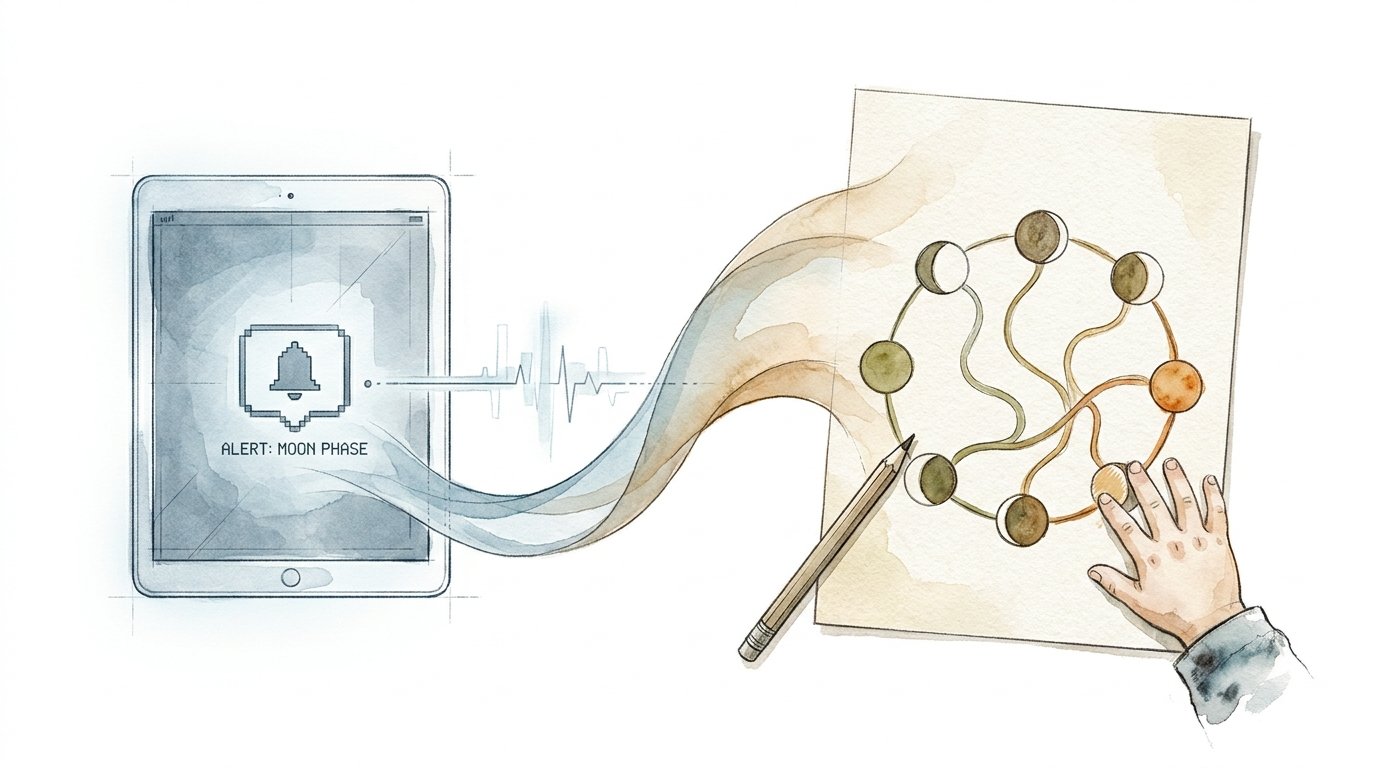
Don’t let a screen tell your child what the sky looks like. In our tech-heavy world, we’ve isolated our children from the natural rhythms of the earth. An app tells them the time, but a shadow-clock teaches them the earth’s tilt. A notification tells them the moon phase, but a printable tracker teaches them to observe. It’s time to integrate their lives back into the real world.

Imagine your child standing in the backyard, looking up at a glowing sliver in the sky. They aren’t just seeing a light. They are seeing a giant rock floating thousands of miles away, illuminated by a distant sun. They are witnessing the mechanics of the universe in motion. This isn’t just “science.” This is wonder.
A physical moon phase tracker printable for kids serves as a bridge. It moves knowledge from the abstract glow of a tablet to the tangible reality of the night sky. It turns a passive screen-user into an active observer. You are giving them a tool to map the cosmos from their own doorstep.
This guide explores why tracking the moon matters. We will dive into the mechanics of the lunar cycle. We will look at how to use these trackers effectively. You will learn how to turn a simple piece of paper into a month-long scientific expedition.
Moon Phase Tracker Printable For Kids
A moon phase tracker printable for kids is a structured observation tool. It usually consists of a calendar or a series of circles representing the moon’s position throughout the month. Children use it to record what they see in the sky each night. This simple act turns the sky into a laboratory.
The tracker exists to simplify the complex. The moon takes about 29.5 days to complete its cycle of phases. For a child, a month is an eternity. Without a way to record their findings, the subtle changes from a waxing crescent to a first quarter are easy to miss. The printable provides a visual history of their progress.
Think of it as a low-tech “natural rhythm” monitor. While a digital alert might pop up saying “Full Moon Tonight,” the tracker requires the child to notice the moon getting “fatter” over two weeks. They learn to anticipate the full moon. They start to understand that the universe follows a predictable, beautiful pattern.
These trackers are used in homeschool settings, traditional classrooms, and kitchen tables everywhere. They provide a focal point for evening routines. Instead of a bedtime story on a device, families step outside. They look up. They sketch. They connect.
How the Lunar Cycle Works
The moon does not produce its own light. It acts like a giant mirror in space. The “moonlight” we see is actually sunlight bouncing off the lunar surface and reaching our eyes. Half of the moon is always lit by the sun, just like half of the Earth is always in daylight.
Phases happen because the moon orbits the Earth. As it moves, our perspective of that lit-up half changes. Sometimes we see the whole lit side (Full Moon). Sometimes we see only a tiny sliver (Crescent). At other times, the moon is between us and the sun, so the lit side faces away from us entirely (New Moon).
The cycle begins with the New Moon. It is there, but it is invisible to us. Then, a tiny Waxing Crescent appears on the right side. “Waxing” means growing. The light grows until we reach the First Quarter, which looks like a half-circle. It continues growing through the Waxing Gibbous phase until it becomes a Full Moon.
After the Full Moon, the light begins to “waning,” or shrinking. We see a Waning Gibbous, then the Third Quarter (the other half-circle), and finally a Waning Crescent on the left side. The entire journey takes roughly one month. This is why the word “month” and “moon” share the same linguistic roots.
How to Use a Moon Phase Tracker
Using a tracker is a process of daily engagement. First, you need to print a high-quality template. Choose one with clear, large circles. Some templates are blank, allowing the child to draw the shape they see. Others have the phases pre-drawn, and the child simply checks them off or colors them in.
Start on the night of a New Moon or a Full Moon. These are the easiest “anchor points” for beginners. If you start on a New Moon, you won’t see anything for a day or two. This is a great time to discuss why the moon is “hiding.” It’s actually just showing its dark side to us.
Observe at roughly the same time each night. This helps children notice that the moon also moves its position in the sky. During the waxing phases, the moon is often visible in the afternoon or early evening. During waning phases, it might not rise until late at night or early morning.
Shade the dark part of the moon on the tracker. If the child sees a crescent on the right, they should leave that sliver white and shade the rest of the circle dark. This reinforces the idea that the whole moon is still there, even if we can’t see all of it. Consistency is the secret to seeing the pattern emerge.
Benefits of Tracking the Moon
The primary benefit is the development of observational skills. In a world of instant gratification, tracking a 29-day cycle requires patience. Children learn to look closely. They notice the difference between a “fat” crescent and a “thin” gibbous. These are the building blocks of scientific inquiry.
Spatial reasoning is another massive win. Understanding phases requires a child to mentally “step off” the Earth. They have to imagine the sun, Earth, and moon in 3D space. This kind of “perspective-taking” is a high-level cognitive skill. It lays the groundwork for geometry, physics, and advanced astronomy.
Pattern recognition becomes second nature. After two weeks of tracking, children will start to predict the next phase. “It was half-full yesterday, so it should be even bigger today!” This is the scientific method in action: observing, identifying a pattern, and making a hypothesis.
Finally, it fosters a deep connection to nature. When a child knows the current moon phase, they feel more in tune with the world. They notice the tides if they live near the ocean. They notice how bright the backyard is during a full moon. They become citizens of the planet, not just consumers of content.
Challenges and Common Mistakes
Weather is the biggest hurdle. Cloudy nights are inevitable. Don’t let a few gray days derail the project. This is a perfect opportunity to teach children how scientists handle missing data. They can look up the phase on a reputable site or wait for the clouds to clear and “catch up” by deducing the shape based on the days before and after.
Timing can be tricky for young children. The moon doesn’t always rise at 7:00 PM. Sometimes it’s up during the day. A common mistake is thinking the moon is “missing” if it isn’t out at bedtime. Use a moon-rise calendar to show them that the moon has its own schedule, independent of their sleep routine.
Confusing phases with eclipses is a frequent error. Many children (and adults!) believe the Earth’s shadow causes the moon’s phases. In reality, the Earth’s shadow only hits the moon during a lunar eclipse. Phases are caused by our viewing angle of the sunlit side. It is important to clarify this early on.
Inconsistent recording is the final pitfall. If a child skips four days, the pattern breaks. Parents can help by making “Moon Time” a non-negotiable part of the evening. Keep the printable on the fridge or near the back door. The more visible the tool, the more likely the child is to use it.
Limitations of Physical Tracking
Physical tracking has its boundaries. It relies heavily on clear skies. If you live in a region with constant overcast weather, a 30-day tracking project might yield only five or six data points. In these cases, the physical tracker should be supplemented with photographs or online lunar calendars.
Light pollution in urban areas can also interfere. While the moon is usually bright enough to see even in big cities, finding it among skyscrapers can be frustrating. You might need to walk to a park or a higher floor to get a clear view. Rural observers definitely have an advantage here.
Daytime phases are often missed. Many children are taught that the moon belongs to the night. When a crescent moon is visible at 2:00 PM, they might not even think to look for it. A physical tracker needs to be paired with the instruction that the moon is a 24-hour traveler.
Lastly, a simple 2D printable cannot fully capture the 3D nature of space. It shows the “result” of the orbit but not the “mechanism.” To truly understand the “why,” you should pair the tracker with a hands-on model, like the classic ball-and-lamp demonstration.
Digital vs. Natural Rhythms
| Feature | Digital App | Physical Tracker (Natural) |
|---|---|---|
| Skill Required | Basic Swiping | Observation & Drawing |
| Retention | Low (Instant Info) | High (Experiential) |
| Patience | None | Daily Commitment |
| Connection | To the Device | To the Sky |
| Depth | Surface Level | Conceptual & Spatial |
While a digital alert is convenient, it removes the “work” of discovery. The physical tracker forces the brain to engage. It requires the child to translate a 3D object in the sky onto a 2D piece of paper. This translation is where the real learning happens.
Digital tools are great for verification. If you aren’t sure if the moon is waxing or waning, an app can tell you instantly. But the printable tracker is about the journey, not just the answer. It’s the difference between taking a taxi to a destination and hiking the trail yourself.
Practical Tips for Best Results
Use a high-quality, heavy-weight paper for the printable. This tracker is going to be handled every day for a month. If it’s on thin printer paper, it will likely tear or get lost. Cardstock is a great choice. You could even laminate it and use dry-erase markers if you want to reuse it every month.
Pair the observation with a “Moon Journal.” Let the child write one sentence about the night. Was it cold? Were there stars? Could they hear an owl? This turns the science project into a literacy exercise. It makes the experience more personal and memorable.
Try the “Oreo Method” to explain the shapes. This is a classic classroom trick. Use the cream of a sandwich cookie to represent the light part of the moon. As the child observes a phase, they can “carve” the cream on a cookie to match. It’s a delicious way to reinforce the visual patterns.
Get a pair of basic binoculars. Even cheap ones can reveal the moon’s craters. When a child sees that the “dark spots” are actually giant holes and mountains, their interest triples. They aren’t just drawing a shape; they are looking at a landscape.
Advanced Considerations for Serious Practitioners
If your child masters the basic eight phases, introduce the concept of “Tidal Locking.” Explain that we always see the same side of the moon because it rotates at the exact same speed it orbits. There is a “far side” of the moon that we never see from Earth. This blows children’s minds.
Discuss the “Terminator Line.” This is the line between the light and dark parts of the moon. It is the best place to look through binoculars because the shadows are longest there, making the craters look 3D. Tracking the terminator line over a week is a fantastic “Phase 2” for the project.
Introduce the “Synodic” vs. “Sidereal” month. The moon takes 27.3 days to orbit Earth (Sidereal), but because the Earth is also moving around the sun, it takes 29.5 days to return to the same phase (Synodic). For older children, this is a brilliant lesson in relative motion and celestial mechanics.
Explore the “Moon Tilt Illusion.” Sometimes the crescent moon looks like a “smiley face” (lit from the bottom) and sometimes it’s lit from the side. This depends on your latitude and the time of year. Tracking this “tilt” adds another layer of complexity for advanced young astronomers.
Scenario: A Month of Lunar Discovery
The Miller family decided to put away their tablets for twenty minutes every night in October. They printed a moon phase tracker and taped it to the glass of their sliding back door. On October 1st, they saw nothing—a New Moon. Their seven-year-old was skeptical. “Is it gone?” he asked.
By October 5th, a tiny “fingernail” of light appeared on the right. They recorded a “Waxing Crescent.” By the middle of the month, the backyard was flooded with light from the Full Moon. They noticed they didn’t even need the porch light to see the dog in the grass.
By the end of the month, the moon was rising later and later. Their daughter noticed it in the sky while waiting for the school bus at 7:30 AM. “The moon is working the day shift!” she joked. They realized that without the tracker, they never would have noticed these patterns. They didn’t just learn about the moon; they learned how to look at their world.
This family didn’t spend a dime on expensive equipment. They used a piece of paper, a pencil, and the sky. They replaced a “Digital Alert” with a “Natural Rhythm.” The children stopped asking for the tablet and started asking, “What does the moon look like tonight?”
Final Thoughts
Tracking the moon is one of the oldest human activities. It is the basis for our calendars, our agriculture, and our stories. By giving your child a moon phase tracker printable, you are connecting them to thousands of years of human history. You are teaching them that the most important things in life don’t require a Wi-Fi connection.
This project is about more than just naming “Waxing Gibbous” or “Third Quarter.” It is about building a habit of curiosity. It’s about teaching a child to look up when the rest of the world is looking down at their palms. The sky is the greatest show on Earth, and it’s free every single night.
Start tonight. Print the tracker. Find a pencil. Step outside. Let the moon be your guide back to the real world. You might be surprised at how much you learn right alongside your child. The sky is waiting—don’t let a screen tell you what it looks like.
Sources
1 monkeyandmom.com | 2 littlebinsforlittlehands.com | 3 lovelearningtpt.org | 4 imthecheftoo.com | 5 spacerangerfred.com | 6 nasa.gov | 7 youtube.com | 8 pricelessponderings.com | 9 teacherspayteachers.com | 10 teachjunkie.com | 11 pbs.org | 12 rainydaymum.co.uk | 13 littlebinsforlittlehands.com | 14 ducksters.com | 15 nasa.gov | 16 generationgenius.com | 17 explorelearning.com | 18 youtube.com | 19 toptenz.net | 20 wral.com | 21 generationgenius.com | 22 onlypassionatecuriosity.com | 23 usra.edu