Signs Your Child Can’t Handle Unstructured Play
When the ‘Next’ button disappears, does your child’s ability to play vanish with it? Overuse often manifests as a ‘Paved Mind’—a child who needs the ‘Urban’ structure of an app to function. If they look at a pile of dirt or a box of blocks and feel bored or lost, the screen has replaced their internal ‘Wild’ imagination with a pre-programmed script. It’s time to re-wild their playtime.

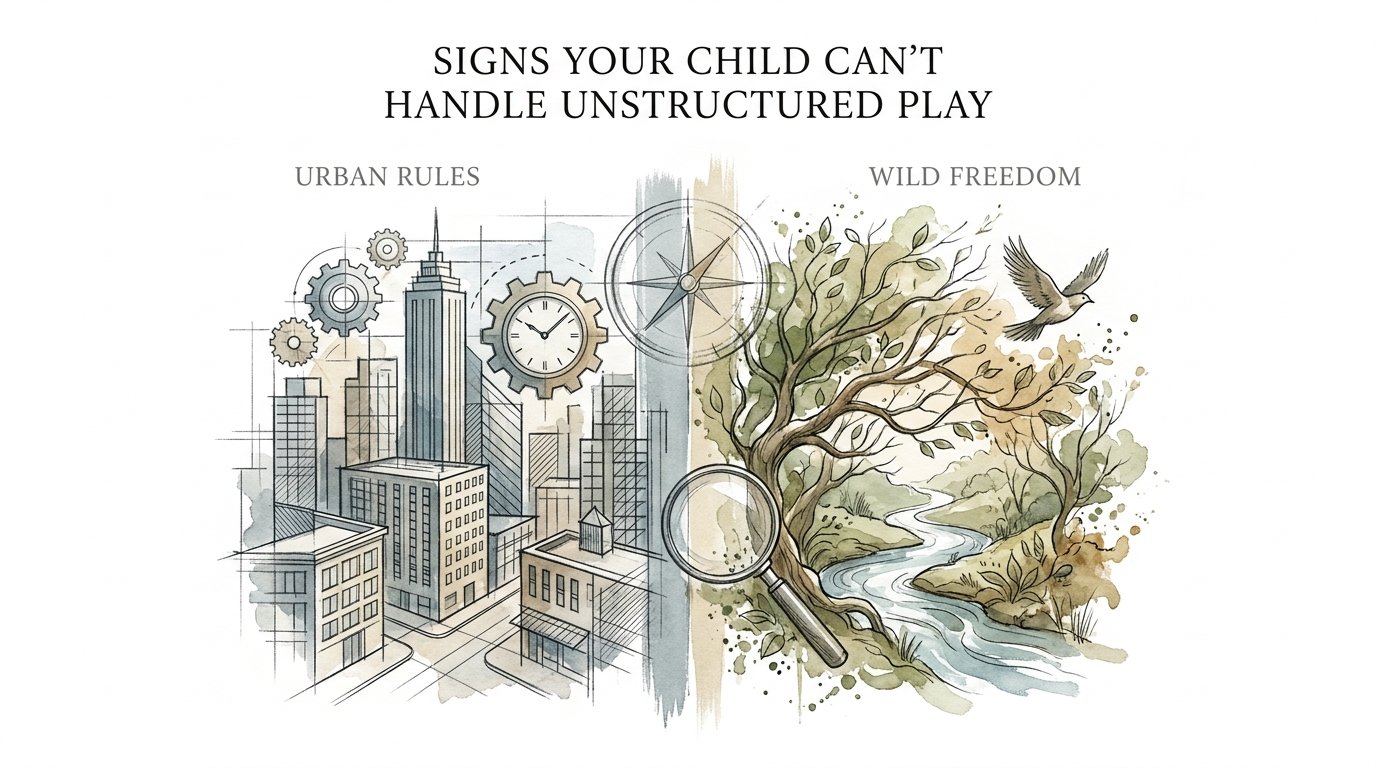
Modern childhood has undergone a quiet but radical transformation. We have moved from the “Wild” freedom of open-ended exploration to the “Urban” rules of digital consumption. This shift isn’t just about the time spent on devices; it is about how those devices change the way a child’s brain approaches the world.

When a child is constantly fed a stream of high-octane, algorithmically perfected entertainment, their brain adapts to a world where the next hit of dopamine is always a click away. This creates a mental “pavement” that is smooth, predictable, and devoid of the messy, creative obstacles that build true resilience.
Signs Your Child Can’t Handle Unstructured Play
Identifying a “Paved Mind” starts with observing how your child reacts when the external structure is removed. If the Wi-Fi goes down and the reaction is closer to a physiological crisis than a minor inconvenience, it’s a red flag.
A child who cannot handle unstructured play often lacks the “inner spark” to initiate an activity. They might stand in a room full of toys and say there is nothing to do. This happens because their brain has become accustomed to being a passenger in someone else’s digital script rather than the director of their own story.
Watch for extreme irritability during transitions. According to pediatric researchers, ending a digital session causes a sharp drop in dopamine, leading to what many parents call the “post-screen blues.” This irritability is a sign that the child’s brain is struggling to recalibrate to the slower pace of the physical world.
Other signs include a complete lack of interest in “real-world” social activities or a struggle to understand social cues. In the “Urban” world of apps, social interactions are often flattened into emojis or likes. When faced with the “Wild” complexity of a playground disagreement, these children may shut down or lash out because they haven’t practiced the nuances of face-to-face conflict resolution.
The Mechanics of Re-Wilding: How to Rebuild Imagination
Re-wilding is the process of stripping back the “pavement” to allow the natural grass of imagination to grow through. This isn’t about banning technology forever, but about restoring the balance between structured consumption and raw creation.
Start by introducing “loose parts” into their environment. These are materials that do not have a single, pre-defined purpose. Think of sticks, cardboard boxes, fabric scraps, or even a pile of dirt. Unlike a digital game with a “Start” and “End” button, these items require the child to supply the rules and the narrative.
Implement a “Boredom Buffer” in your daily schedule. When your child complains about being bored, resist the urge to provide a solution immediately. Boredom is the essential “clearing” where creativity takes root. By allowing them to sit in that discomfort for 15 to 20 minutes, you force their brain to begin searching for internal stimulation.
Use the “Bridge Technique” for transitions. Instead of abruptly turning off the device, spend three minutes watching or playing with them. Ask questions about the digital world they are in. This creates a social bridge that helps pull them back into reality before the “Next” button disappears for good.
Step-by-Step Transition Protocol
1. Forecast the End: Give warnings at 10, 5, and 2 minutes. Use a visual timer so they can see the “Urban” structure winding down.
2. Identify the “Next” Physical Step: Before the screen goes off, decide together what the first “Wild” activity will be. It could be as simple as “Let’s go find three cool rocks outside.”
3. Validate the Drop: Acknowledge that the transition is hard. Use phrases like, “I know your brain is missing the game right now. Let’s help it find a new way to feel good.”
4. Engage the Senses: Immediately move into a sensory-heavy activity like playing with water, clay, or running outside to break the visual “lock” of the screen.
Benefits of the Wild Mind Approach
Moving away from the “Urban” rules of structured play offers measurable developmental advantages. Children with a “Wild” imagination develop stronger executive function—the mental skillset that allows us to plan, focus, and multitask.
Research shows that unstructured play acts as a “neural exercise” for the prefrontal cortex. When a child has to negotiate the rules of a make-believe game with a peer, they are practicing high-level social processing and empathy. These are skills that a tablet, no matter how “educational,” cannot replicate.
Physical resilience is another major benefit. “Wild” play often involves “risky” play—climbing trees, jumping from heights, or balancing on logs. These activities teach children how to calibrate risk and manage fear. A child who knows their physical limits is often more confident in their intellectual and social lives as well.
Emotional regulation improves significantly when children spend more time in child-led play. They learn how to self-soothe and entertain themselves without an external device providing the “fun.” This creates an internal sense of agency that lasts well into adulthood.
Challenges and Common Mistakes
The biggest challenge in re-wilding a child is parental discomfort with the “Boredom Meltdown.” Many parents view their child’s boredom as a failure of their parenting or a sign that they aren’t providing enough enrichment. This leads to the mistake of “overscheduling,” which is just another form of “paving” the mind with adult-led scripts.
Another common pitfall is the “Cold Turkey Trap.” Abruptly removing all screens without providing the “Wild” environment (space, time, and loose parts) often results in a household in constant conflict. Re-wilding is a marathon, not a sprint. It requires a gradual shift in the family culture.
Do not mistake “Educational Apps” for “Active Play.” While some apps are better than others, they are still “Urban” environments where the child is following a path laid out by a developer. True re-wilding requires the absence of a path.
When This Approach May Not Be Ideal
While unstructured play is vital, it is not a cure-all. Some children with neurodivergent profiles, such as those on the autism spectrum, may find the lack of structure in “Wild” play physically and mentally overwhelming. For these children, a hybrid approach is often necessary.
In environments with significant safety concerns—such as high-traffic urban areas or neighborhoods with high crime rates—the “Wild” freedom of unsupervised outdoor play may not be practical. In these cases, re-wilding must happen within the safety of the home or a supervised community space using open-ended indoor materials.
There are also times when “Urban” rules are necessary. Learning to follow directions, respect boundaries, and work toward a specific goal are important life skills. The goal isn’t to eliminate structure, but to ensure it doesn’t become the *only* way a child knows how to function.
Urban Rules vs. Wild Freedom
Understanding the difference between these two systems helps parents find the right balance for their family’s needs.
| Feature | Urban Rules (Structured/Digital) | Wild Freedom (Unstructured/Open-Ended) |
|---|---|---|
| Source of Action | External (The App or Adult) | Internal (The Child) |
| Dopamine Type | Instant/High-Intensity | Slow-Release/Earned |
| Problem Solving | Finding the “Right” Answer | Creating a Solution |
| Risk Level | Low/Controlled | Moderate/Self-Calibrated |
| Primary Skill | Focus and Following Directions | Initiative and Creativity |
Practical Tips for Success
To make re-wilding a reality, you must change the environment as much as the behavior. If the TV is the focal point of the living room, the “Urban” pull will always be stronger than the “Wild” call.
Rotate Toys Regularly: Too many choices can lead to “decision fatigue,” causing a child to give up and ask for a screen. Keep only a few open-ended toys out at a time and swap them every two weeks.
Model the “Wild” Life: If you are always on your phone, your child will view the digital world as the most important space. Show them what it looks like to be “bored” or to engage in a hobby that requires manual effort and time.
Create a “Yes” Space: Designate an area where the child is allowed to be messy. A re-wilded child needs to know they can spill water, dig in the dirt, or build a fort out of every pillow in the house without getting in trouble.
Prioritize “Green Time”: Even 15 minutes of being around trees and grass can significantly lower cortisol levels and reset the brain’s reward system. Make outdoor time a non-negotiable part of the daily routine, regardless of the weather.
Advanced Considerations for Long-Term Growth
As your child becomes more comfortable with unstructured play, you can introduce “Complex Challenges.” These are projects that take days or weeks to complete, such as building a complicated model, growing a small garden, or writing and illustrating a long story.
This helps them move from “Short-Term Play” to “Deep Work.” The ability to stay engaged with a difficult, self-directed task for a long period is the ultimate sign of a re-wilded mind. This is where innovation and true genius are born.
Consider the “Social-Wild” aspect. Once your child can play alone, encourage them to play with children of different ages. Mixed-age play is the most natural way for younger children to learn complex skills and for older children to practice leadership and mentorship.
Scenario: The Dirt Pile Test
Imagine three children sitting in front of a large pile of fresh dirt in a backyard.
Child A has a “Paved Mind.” They look at the dirt, look at their parents, and ask, “What am I supposed to do?” When no answer is given, they become frustrated and ask for an iPad. They cannot see the dirt as anything other than a mess.
Child B has a “Mixed Mind.” They start poking the dirt with a stick. They are interested but keep looking back at the adults for validation. They play for ten minutes but lose interest when they hit a problem they can’t immediately solve.
Child C has a “Wild Mind.” Within seconds, the dirt pile is a volcano. They are using a discarded cup to “mold” lava and have recruited Child B to find “obsidian” (dark rocks) to reinforce the base. They are so engrossed that they don’t even notice when their parents walk away.
Our goal is to give every child the mental tools to be Child C.
Final Thoughts
The “Next” button is a powerful tool for convenience, but it is a poor substitute for a child’s internal engine. When we “pave” a child’s mind with constant structure and digital rewards, we trade their long-term resilience for short-term quiet. Re-wilding is not a rejection of the modern world, but a reclamation of the human one.
By intentionally creating space for boredom, providing loose parts for creation, and allowing for the “messy” reality of unstructured play, you are giving your child a priceless gift. You are teaching them that they are the creators of their own entertainment and the masters of their own attention.
Start small. Turn off the device ten minutes earlier today. Walk outside. Look for a stick. Let the “Wild” back in. Your child’s imagination is still there, waiting just beneath the pavement for the first sign of a crack. Give them the time and the space to let it grow.
Sources
1 parents-together.org | 2 harvard.edu | 3 academyofscholars.com | 4 apa.org | 5 nationalgeographic.com | 6 harvard.edu | 7 childrenandscreens.org | 8 prezi.com | 9 ummhealth.org | 10 thehood.ae | 11 melbournekidsvillage.com | 12 thegeniusofplay.org | 13 northwestspecialtyhospital.com | 14 covenantschools.com | 15 kidsmentalhealthfoundation.org | 16 youngchildrendigitalsociety.com.au | 17 playgroupwa.com.au | 18 hopkinsmedicine.org | 19 msu.edu | 20 melissadinwiddie.com | 21 westsidechildrenstherapy.com