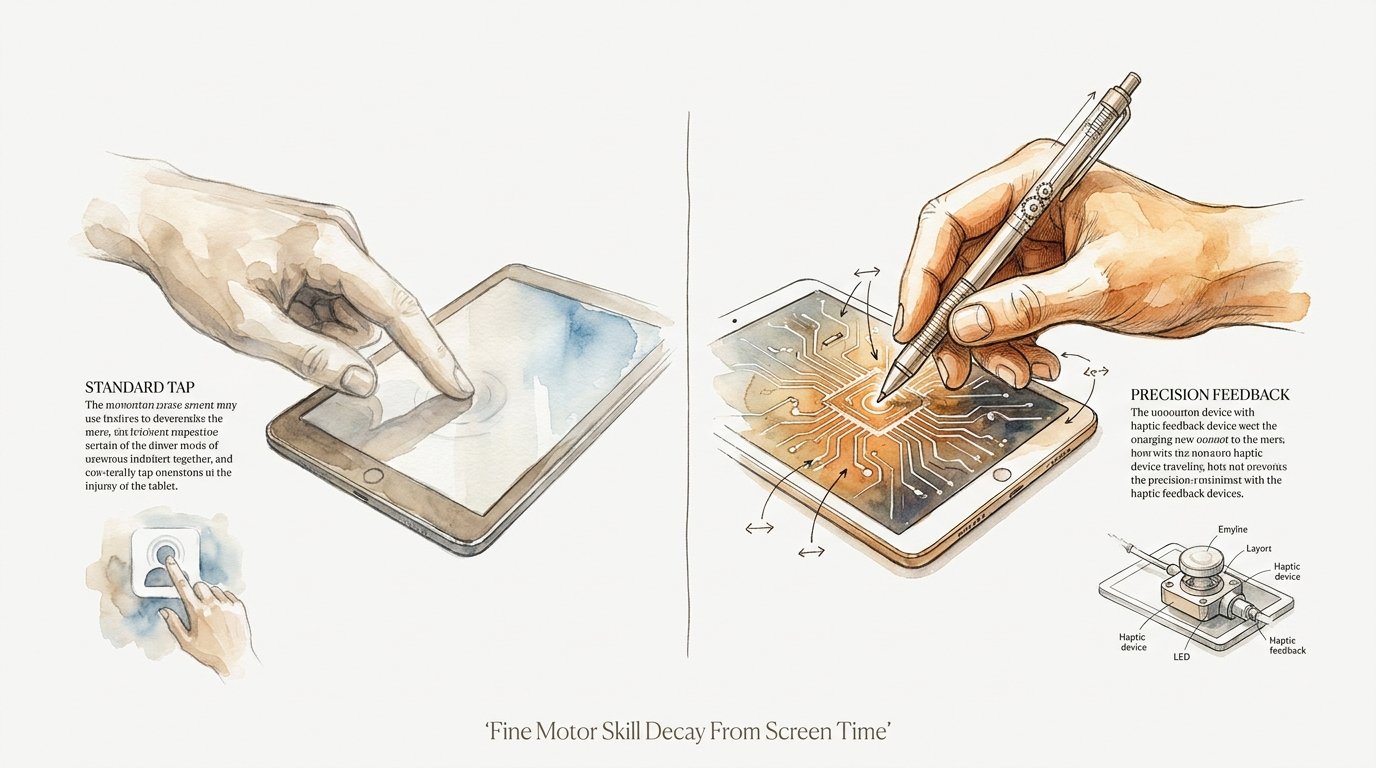
Fine Motor Skill Decay From Screen Time
Glass offers zero resistance; the real world offers the feedback your child’s brain craves. One of the most subtle signs of overuse is the loss of ‘Tactile Intelligence.’ When a child’s hands are only trained for the ‘Standard’ swipe of a tablet, they lose the ‘Precision’ feedback needed for real-world mastery. Their brain needs to feel the weight, texture, and resistance of reality to truly develop.

In a digital-first world, we often celebrate the speed at which a toddler can navigate a YouTube menu. We see the “Standard Tap” as a sign of intelligence. Yet, developmental experts are sounding the alarm. This repetitive, low-resistance interaction is creating a generation of children with “weak hands.”
Tactile Intelligence is the brain’s ability to interpret complex information through the skin and muscles. It is the silent language of the hands. When this language is silenced by smooth, frictionless glass, the brain misses out on the very data it uses to build its internal map of the world.
Fine Motor Skill Decay From Screen Time
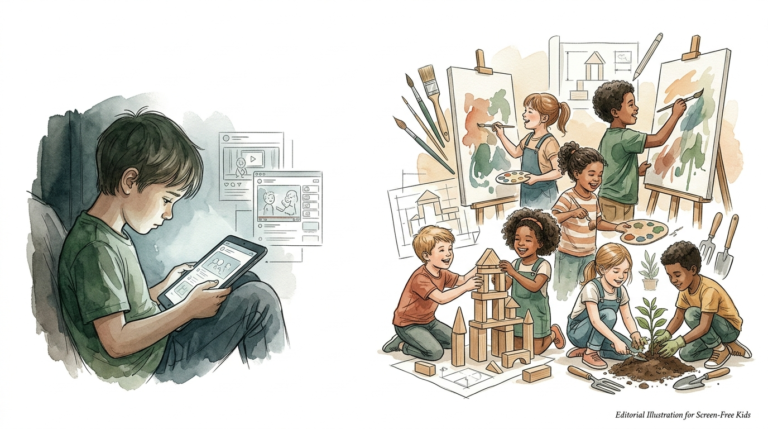
Fine motor skill decay refers to the gradual loss or stunted development of the small muscle movements in the hands and fingers. These muscles are responsible for everything from buttoning a shirt to using a pencil. In the past, children developed these skills through play—stacking blocks, digging in the dirt, and manipulating physical toys. Today, many of those hours are replaced by a flat, glowing surface.
Recent surveys of educators highlight a startling trend. Approximately 77 percent of teachers report that young students now struggle with basic tasks like holding a pen or using scissors. Children are arriving at school with “Standard Tap” hands—fast on a screen, but fumbling in the real world. They often lack the strength to squeeze a glue bottle or the coordination to tie a shoelace.
This decay exists because the brain operates on a “use it or lose it” principle. Screen-based interaction requires only a few repetitive movements: the tap, the swipe, and the pinch-to-zoom. These movements do not challenge the hand’s 27 bones and 34 muscles. Real-world situations, such as building a Lego tower or kneading dough, require “Precision Feedback.” This is the constant adjustment of force and position that keeps a tower from falling or a pencil from breaking.
Imagine a child trying to stack three physical blocks. On a screen, the blocks might snap into place automatically. In reality, the child must feel the weight of the block, align the edges by touch, and manage the micro-tremors in their own fingers. Screen time removes this “resistance,” leading to a decline in manual dexterity that can impact a child’s academic performance and independence.
The Mechanics of Tactile Intelligence
Tactile Intelligence relies on a complex system of sensors called mechanoreceptors. These are located throughout the skin, with the highest concentration found in the fingertips. When your child touches an object, these sensors send high-speed electrical signals to the somatosensory cortex—the part of the brain that creates a “map” of the body.
There are four primary types of sensors involved in this process. Merkel cells detect sustained pressure and texture. Meissner corpuscles respond to light touch and vibrations. Pacinian corpuscles sense deep pressure, and Ruffini endings detect skin stretch. A “Standard Tap” on a glass screen only activates a fraction of these sensors. It is a loud, mono-tonal signal to the brain.
In contrast, “Precision Feedback” is a symphony. When a child handles a rough stone or a piece of sticky clay, all four sensor types fire in complex patterns. This “multimodal” input allows the brain to build a more detailed body schema. This internal map is what tells a child where their hands are in space without them having to look. Without this input, children become clumsy and frustrated by tasks that require “Precision.”
To rebuild this intelligence, children must engage in “stereognosis.” This is the ability to recognize an object’s shape and texture through touch alone. You can practice this by placing common household items in a “mystery bag.” Have your child reach in and identify a spoon, a comb, or a coin without looking. This forces the brain to rely entirely on tactile data, strengthening the neural pathways that screens leave dormant.
Standard Tap vs. Precision Feedback
Understanding the difference between digital interaction and physical manipulation is key to protecting your child’s development.
| Feature | Standard Tap (Screen) | Precision Feedback (Real World) |
|---|---|---|
| Resistance | Zero. Frictionless glass provides no push-back. | Varied. Textures, weights, and tensions push back. |
| Muscle Engagement | Low. Repetitive tapping and swiping. | High. Complex grasping, twisting, and squeezing. |
| Sensory Input | Visual-heavy. Tactile input is binary (touch/no touch). | Tactile-heavy. Provides data on weight, heat, and texture. |
| Error Correction | Automated. Software often “snaps” items into place. | Manual. The child must adjust grip to prevent failure. |
| Neural Impact | Narrows the sensory map (homunculus). | Expands the sensory map and brain connectivity. |
Benefits of Precision Feedback
Prioritizing “Precision Feedback” over “Standard Taps” offers measurable benefits for a child’s cognitive and physical health. These benefits extend far beyond just having strong fingers.
Handwriting proficiency is one of the most direct advantages. When a child has high tactile intelligence, they can control a pencil with less effort. This allows their brain to focus on *what* they are writing rather than *how* to hold the tool. Studies show that children who write by hand have better memory retention and more advanced literacy skills than those who primarily type.
Self-regulation is another hidden benefit. Deep tactile input, such as squeezing play-dough or climbing a rope, has a calming effect on the nervous system. This type of “proprioceptive” input helps children feel grounded. Many children who appear “hyperactive” are actually seeking the sensory feedback their brains are missing. Replacing screen time with heavy-work activities can improve focus and reduce behavioral meltdowns.
Independence and self-esteem grow as a child masters their environment. A child who can zip their own jacket, pour their own milk, and tie their own shoes feels a sense of agency. These “real-world wins” build confidence that no high score in a video game can replicate. By developing “Precision Feedback,” you are giving your child the tools to navigate life without constant adult assistance.
Challenges and Common Mistakes
The biggest challenge in rebuilding Tactile Intelligence is the “Resistance Gap.” Screens provide immediate, high-dopamine rewards with almost zero effort. Real-world tasks, like learning to use scissors or assembling a complex puzzle, require effort and involve frequent failure.
One common mistake parents make is providing too much “scaffolding.” We often jump in to help a frustrated child zip their coat or open a container. While this saves time, it robs the child of the very struggle needed to build muscle and neural connections. To avoid this, try the “hand-over-hand” method where you guide their movement but let them apply the final bit of force.
Another mistake is relying on “Educational Apps” to teach fine motor skills. An app that asks a child to trace a letter with a finger is not teaching them how to write. It is teaching them how to move a finger over glass. There is no resistance, no friction, and no requirement for the tripod grip needed for a pencil. These apps are a poor substitute for a box of crayons and a piece of rough paper.
Finally, many parents underestimate the importance of “Messy Play.” We tend to avoid activities that create a cleanup—like finger painting, sand bins, or mud kitchens. However, these “messy” textures are the richest sources of tactile data. Avoiding them can lead to “tactile defensiveness,” where a child becomes over-sensitive or fearful of new textures.
Limitations of Physical Play
While physical interaction is superior for motor development, there are realistic constraints to consider. In urban environments, access to “wild” outdoor play may be limited. Not every parent has the time for a 1,000-hour-outside challenge or the space for a massive craft room.
Environmental limitations shouldn’t be an excuse for total digital surrender. If you cannot get to a forest, a small bin of dried beans or rice in the kitchen can provide significant tactile input. Trade-offs are inevitable, but the goal is to ensure that the “Standard Tap” is the exception, not the rule.
It is also important to recognize that some children have genuine sensory processing disorders (SPD). For these children, “Precision Feedback” can feel overwhelming rather than stimulating. In these cases, forcing tactile activities can cause trauma. If a child consistently recoils from certain textures, it is best to consult an Occupational Therapist (OT) who can create a personalized “sensory diet.”
Practical Tips for Parents
Rebuilding your child’s Tactile Intelligence doesn’t require expensive therapy equipment. It requires a shift in daily habits.
- Audit Your Wardrobe: Replace some of those elastic-waist pants with clothes that have buttons, zippers, and snaps. These daily “micro-exercises” are essential for finger dexterity.
- The 50/50 Rule: For every hour of screen time, mandate an hour of “Hand-Heavy” play. This could be Legos, drawing, or even helping in the garden.
- Cook Together: Let your child tear lettuce, knead dough, or stir thick batter. These activities provide high levels of resistance and “Precision Feedback.”
- Texture Hunting: Take “texture walks” where the goal is to find something rough, something smooth, something cold, and something fuzzy. Narrating these sensations helps the brain categorize the data.
- Mystery Bag: Put 5-10 common objects in an opaque bag. Have your child identify them by touch. Increase the difficulty by using objects that are similar in shape, like a pen and a chopstick.
Advanced Considerations: Neuroplasticity
For parents who want to go deeper, it is helpful to understand “Neuroplasticity.” A child’s brain is incredibly “soft” and adaptable. The synaptic connections are being formed based on the sensory input they receive most frequently.
When a child spends the majority of their time on a screen, the brain “prunes” away the connections meant for complex hand movements. It optimizes itself for the “Standard Tap.” This is why a 10-year-old might be a master at Minecraft but struggle to write a legible paragraph. The brain has literally rewired itself for the digital environment at the expense of the physical one.
The good news is that this process can be reversed. Because the brain is so plastic, intensive “Precision” work can rebuild those lost connections. Serious practitioners of “Tactile Intelligence” focus on activities that require “bilateral coordination”—using both hands in different ways at the same time. Cutting a piece of paper (one hand holds and turns the paper while the other operates the scissors) is one of the most advanced cognitive-motor tasks a young child can perform.
Scenario: The “Tablet Hand” vs. The “Maker Hand”
Consider two children, Leo and Maya, both six years old.
Leo spends two hours a day on an iPad playing educational games. He is very fast at “matching” shapes on the screen. However, when asked to draw a triangle on paper, his lines are shaky and he grips the pencil with his entire fist. He becomes frustrated and gives up quickly because the paper doesn’t “auto-correct” his mistakes.
Maya spends her two hours in a “Maker Space” corner of her home. She uses scrap cardboard, tape, and blunt scissors to build “spaceships.” She has to figure out how much tape to pull, how to hold the cardboard while she cuts, and how to balance the pieces so they don’t fall.
When these two children reach the classroom, Maya has a massive advantage. Her brain has a high-resolution map of her hands. She can follow complex instructions because her “motor memory” handles the tools automatically. Leo, meanwhile, is using all of his cognitive energy just trying to manage the pencil. This “cognitive load” makes him appear less focused, even though he is just as bright as Maya.
Final Thoughts
Glass is a fantastic tool for information, but it is a terrible tool for development. Every “Standard Tap” is a missed opportunity for the brain to learn the nuances of the real world. By reintroducing “Precision Feedback” into your child’s life, you are doing more than just improving their handwriting. You are sharpening their brain.
The real world is messy, resistant, and heavy—and that is exactly what your child needs. Don’t be afraid of the dirt under their fingernails or the frustration of a difficult puzzle. Those are the signs of a brain that is growing, adapting, and mastering the complex world it was designed to navigate.
Start small today. Turn off the tablet, hand them a ball of clay or a box of blocks, and let their hands do the talking. The results will be visible in their confidence, their independence, and their ability to tackle the challenges of the real world with precision.
Sources
1 littleraysaba.com | 2 sascoriver.com | 3 mother.ly | 4 nationalgeographic.com | 5 writesteps.com | 6 writesteps.com | 7 5senses4kids.org | 8 otperspective.com | 9 wondirfulplay.com | 10 kidsrkids.com