screen time chart
A chart shouldn’t just be a barrier; it should be a roadmap for a balanced life. and Turn screen time into a reward for healthy living. Our ‘Earn-It’ chart makes tech a privilege, not a right.

Managing the digital world inside your living room often feels like a losing battle. You want your kids to be tech-literate, but you also want them to play outside, read books, and help with the dishes. Recent data shows that 55% of parents already use screen time as a bargaining tool to motivate their children. However, verbal promises often lead to confusion, arguments, and broken boundaries.

Using a visual system shifts the dynamic from you being the “bad guy” to the chart being the guide. It creates a predictable environment where children understand the value of their effort. This isn’t just about limiting minutes; it’s about teaching life skills like budgeting, prioritization, and delayed gratification. By the time you finish this guide, you will have a complete framework for reclaiming your family’s schedule.
screen time chart
A screen time chart is a visual tool that allows children to earn digital minutes through positive behaviors and completed responsibilities. It serves as a physical contract between parent and child, clearly defining the “exchange rate” for technology. In a world where 2025 statistics suggest children are clocking over 21 hours of recreational screen time per week, these charts provide a much-needed structural anchor.
Think of it as a simplified economy. Just as adults work to earn a paycheck for leisure activities, children complete “work”—like chores, reading, or physical exercise—to earn their digital leisure. It exists to replace the constant daily negotiation that drains parental energy. When the rules are on the wall, there is no room for “I forgot” or “Just five more minutes.”
Real-world situations often involve a “Responsibility Chart” approach. Parents list daily expectations, such as making the bed or finishing homework, and assign a point value to each. These points then act as currency. For example, 10 points might equal 30 minutes of gaming. This system is used in households globally to transition from passive consumption to active earning.
How to Build Your Earn-It System
Creating a system that actually lasts requires more than a piece of paper and a pen. It requires a strategy that evolves with your child. Start by identifying the “currency” that works best for your family. Some parents use “Screen Bucks,” while others use stickers or simple tally marks on a weekly grid.
Step 1: Define the Earning Activities
Pick tasks that support a balanced lifestyle. Movement should always be a high-priority earning activity because physical activity helps regulate the nervous system before a child sits down for passive viewing. Include a mix of physical, academic, and household tasks to ensure variety.
Step 2: Set the Exchange Rate
Keep the math simple so your child can track their own progress. A common “one-to-one” rule is effective: 15 minutes of reading equals 15 minutes of screen time. For more complex chores like cleaning a bathroom, you might assign a “bonus” value. Consistency is everything here; do not change the rates mid-week.
Step 3: Choose Your Format
A weekly grid format is often superior to a daily one because it allows children to see patterns in their behavior. They can plan ahead, perhaps working harder on Tuesday to save up for a longer movie session on Friday. Ensure the chart is placed in a high-traffic area like the refrigerator to maintain visibility.
Benefits of a Reward-Based Approach
Shifting to a rewards system offers measurable improvements in household harmony. One of the primary advantages is the reduction of power struggles. When a child asks for the tablet, you simply point to the chart. The chart becomes the authority, allowing you to remain a supportive coach rather than a digital warden.
This approach also fosters a sense of autonomy and competence. According to self-determination theory, children are more motivated when they feel in control of their choices. By deciding which tasks to complete to earn their time, they are practicing executive function skills. They aren’t just following orders; they are managing a budget.
Furthermore, it encourages “Work Before Play.” This fundamental life principle is often lost in an age of instant gratification. Earning a privilege teaches children that leisure is more enjoyable when it follows a job well done. Many parents find that children actually help out more around the house when the “payoff” is something they genuinely value.
Challenges and Common Mistakes
One frequent pitfall is making the system too transactional. If children start asking, “What will you give me if I’m nice to my sister?” the baseline expectation of kindness is being eroded. It is vital to separate “baseline expectations” (being respectful) from “earning opportunities” (extra chores or academic effort).
Another common error is failing to enforce the rules consistently. If you cave in because you are tired or need a break, the chart loses its power immediately. Children are experts at finding loopholes. If the chart says 30 minutes, it must mean exactly 30 minutes, or the negotiation cycle will restart.
Sloppy work is also a risk. If a child rushes through their reading or chores just to get to the screen, the quality of their work suffers. To avoid this, you must “verify” the work before awarding the time. A “check-off” system where a parent inspects the chore ensures that the effort remains high.
Limitations and Realistic Constraints
While screen time charts are powerful, they are not a universal solution for every situation. For very young children—those under 18 to 24 months—the American Academy of Pediatrics (AAP) recommends avoiding screen time entirely, except for video chatting. A reward chart for a toddler can be confusing and may not match their developmental stage.
Quality matters more than quantity. A child could earn three hours of screen time, but if they spend those hours watching inappropriate or high-arousal content, the chart has failed in its goal of healthy living. The system should always be paired with parental controls and content monitoring. A chart manages time, but it does not manage safety.
Environmental trade-offs are also a factor. During school breaks or rainy weeks, a rigid chart might feel too restrictive. There should be a “buffer” for special occasions like family movie nights or long car trips where the “Earn-It” rules are temporarily suspended to prevent burnout for both parents and children.
The Static Clock vs. The Multi-Goal Passport
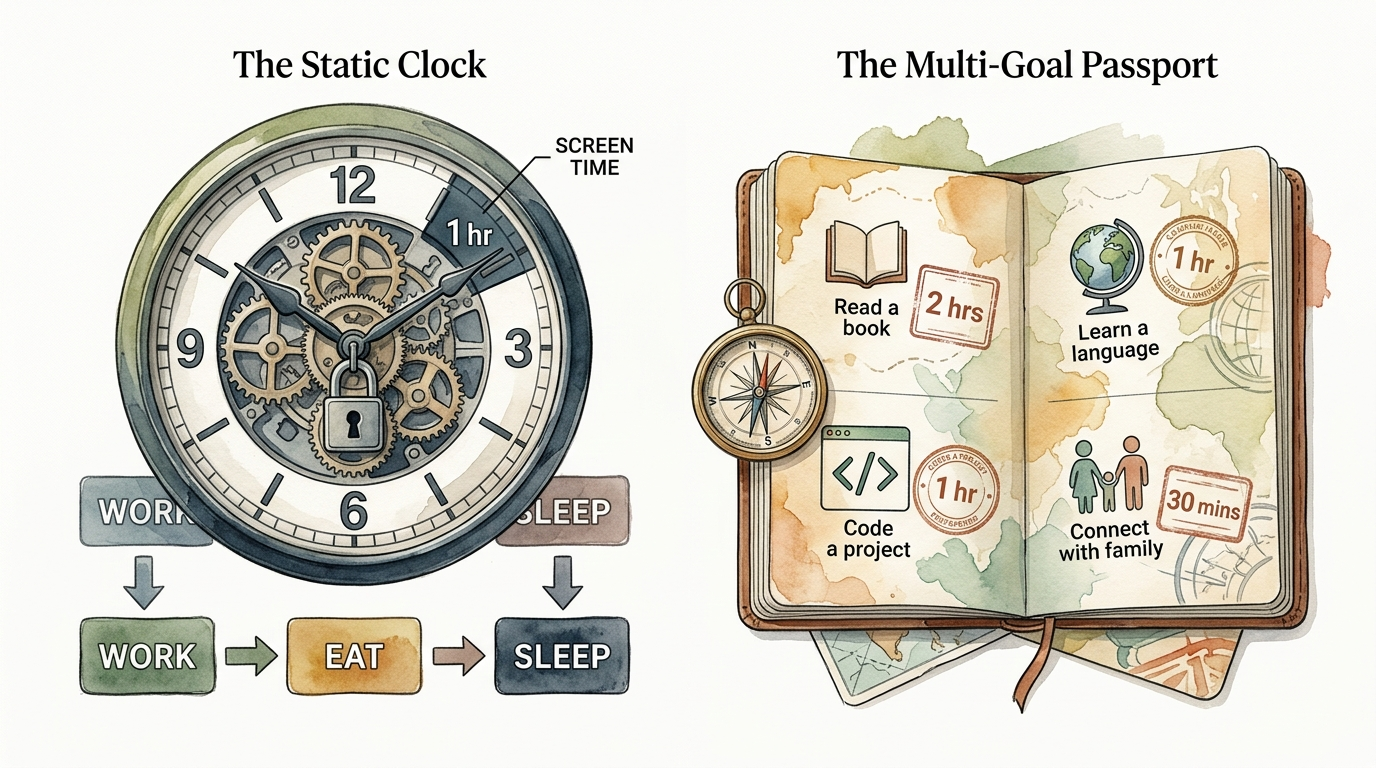
When deciding how to manage time, most parents choose between two main philosophies. The **Static Clock** method provides a fixed daily allowance, regardless of what the child does. The **Multi-Goal Passport** (our “Earn-It” model) requires active participation to unlock time. The differences are clear when looking at long-term skill building.
| Feature | Static Clock (Fixed) | Multi-Goal Passport (Earned) |
|---|---|---|
| Predictability | High – Same time every day | Variable – Depends on effort |
| Effort Required | Low – Time is guaranteed | High – Requires completion of tasks |
| Life Skill Taught | Boundary Following | Budgeting and Work Ethic |
| Conflict Level | Moderate – Fighting when time ends | Low – Rules are self-enforced |
The Multi-Goal Passport approach is generally more effective for children aged 6 and older. It mimics real-world dynamics and scales with their maturity. As they grow, you can add “Advanced Goals” to their passport, such as learning a new coding skill or completing a complex puzzle, ensuring the rewards remain tied to growth.
Practical Tips and Best Practices
Success with an “Earn-It” chart depends on the setup. Start by involving your children in the creation of the list. When they help decide which chores are worth 10 minutes vs. 20 minutes, they are more likely to buy into the system. This reduces the feeling that rules are being “done to them” rather than “made with them.”
Use physical tokens if your child is younger. Handing over a “screen coin” creates a tactile sense of spending that a digital tally cannot match. For older children, a shared digital spreadsheet or a simple whiteboard in their bedroom works better. The key is to keep the “bank balance” visible at all times.
Practice “Tech-Free Transitions.” Even if a child has earned two hours, don’t let them go from a screen straight to bed. Require a 30-minute “buffer zone” of screen-free activity before sleep or meals. This helps reset their brain’s dopamine levels and prevents the irritability often seen after long gaming sessions.
Advanced Considerations for Serious Practitioners
As you become more comfortable with the system, you can introduce more nuanced categories. Distinguish between “Passive Consumption” (watching YouTube) and “Creative Production” (coding, digital art, or making music). You might choose to make creative screen time “cheaper” to earn, or even free, to encourage skill development.
Modeling is the most powerful tool at your disposal. If you are constantly on your phone while telling your children to earn their time, the system will eventually breed resentment. Try creating a “Parent Version” of the chart. If you meet your own goals—like 30 minutes of exercise—you get to enjoy your own leisure time. This builds a family culture of intentionality.
Monitor the “Dopamine Loop.” Fast-paced games and short-form videos like TikTok trigger high levels of dopamine. If you notice your child becomes aggressive or withdrawn after using their earned time, the content may be the problem, not the system. In these cases, limit the “earned” time to high-quality, educational, or slower-paced media.
Example Scenario: A Day with the Earn-It Chart
Consider 8-year-old Leo. Leo wants to play 60 minutes of Minecraft after school. Instead of begging his parents, he looks at the chart on the fridge. He sees that “Reading for 20 minutes” earns 20 minutes of screen time, and “Unloading the dishwasher” earns 15 minutes.
Leo completes his reading immediately after his snack (20 mins earned). He then unloads the dishwasher (15 mins earned). He still needs 25 more minutes. He decides to walk the dog for 15 minutes (15 mins earned) and organizes his shoes in the mudroom (10 mins earned). Total: 60 minutes.
Leo presents his completed tally to his dad. Because the work was verified, Leo gets his hour of gaming guilt-free. Dad doesn’t have to nag about chores, and Leo feels a sense of accomplishment. The transition at the end of the hour is smoother because Leo knows exactly what he did to get there.
Final Thoughts
Implementing a screen time chart is not about restriction; it is about empowerment. It provides children with a clear set of rules that reward effort and promote balance. By turning a high-value privilege into an earned reward, you are teaching the foundational skills of responsibility and self-regulation that will serve them long after they leave your home.
Start small with just three or four tasks and see how your family responds. Be prepared to adjust the “prices” as your children age or as their interests shift. The ultimate goal is to move from an extrinsic reward system (earning for a chart) to an intrinsic one, where they naturally choose a balanced life because they feel better living it.
Consistency will be your greatest ally. Stick to the system, celebrate the small wins, and watch as your household transitions from digital chaos to a roadmap for healthy, intentional living. If you’re looking for more ways to optimize your family’s routine, consider exploring related systems like habit stacking or digital literacy training.
Sources
1 makerkids.com | 2 makerkids.com | 3 makerkids.com | 4 homestoriesatoz.com | 5 dailymom.com | 6 betterscreentime.com | 7 betterscreentime.com | 8 betterscreentime.com | 9 scrolletics.app | 10 medium.com | 11 medium.com | 12 timily.app | 13 medium.com | 14 3blmedia.com | 15 3blmedia.com | 16 verizon.com | 17 myhspediatrics.com | 18 yourmodernfamily.com | 19 edweek.org | 20 mayoclinic.org | 21 ahealthysliceoflife.com | 22 aacap.org | 23 thisroutinelife.com | 24 youtube.com | 25 aap.org | 26 psychologytoday.com | 27 greatcaringdocs.com | 28 cacfp.org | 29 tasksnchores.com