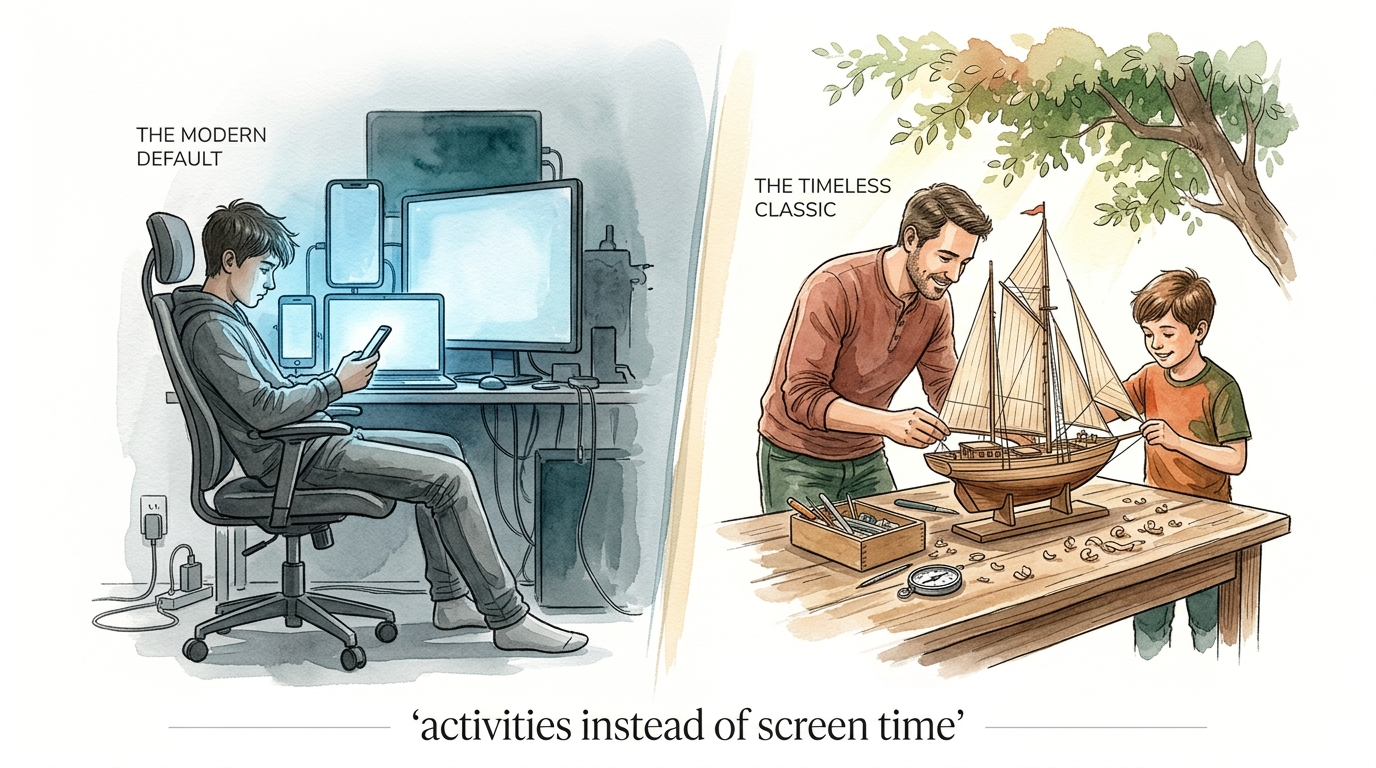
activities instead of screen time
Bring back the activities that shaped us before the algorithm took over. Before tablets existed, we weren’t bored—we were creative. It’s time to re-introduce the timeless activities that build character and patience.
Modern life moves at the speed of a fiber-optic cable. We live in an era where boredom is treated like a disease. Every idle second is filled with a notification, a short-form video, or an infinite scroll. This constant stimulation has a hidden cost. It erodes our ability to wait, to focus, and to build something with our own two hands.
Character isn’t built in a virtual world. It grows through the friction of reality. Real-world skills require us to face frustration and overcome it. When we trade the glass screen for raw materials, we reclaim our attention. This guide explores how to pivot back to the foundational hobbies that actually make us better humans.
You are about to discover more than just a list of chores. These are pathways to mental clarity and emotional resilience. Whether you are a parent looking to ground your children or an adult seeking to escape the digital fog, these methods work. Let’s dive into the world beyond the glow.
activities instead of screen time
Defining this topic is simple. These are “low-frequency” activities that require active participation rather than passive consumption. Screen time is often a one-way street where information is pushed into your brain. Real-world activities are a dialogue between your mind and your environment.
These activities exist to develop “grit”—the passion and perseverance toward long-term goals. In a world of instant downloads, gardening teaches you that growth takes months. In a world of AI-generated art, woodworking teaches you that a single mistake can ruin a project. These are the lessons that stick.
Real-world situations demand these skills every day. A carpenter needs the patience to measure twice and cut once. A surgeon needs the focus to remain calm under pressure for hours. A parent needs the emotional regulation to handle a toddler’s tantrum without reaching for a phone as a pacifier. Offline hobbies are the training ground for these high-stakes moments.
Think of it as “Attention Restoration Theory” in practice. Low-stimulation, non-digital activities help replenish our ability to focus. When you watch clouds roll by or sand a piece of wood, your brain enters a state of restful alertness. This is where original thoughts are born and where true rest happens.
How to Start Building Timeless Skills
Starting a new offline habit requires a shift in mindset. You cannot approach a manual craft with the same expectation of speed that you have for a web browser. The process is the prize. Here is how to begin several character-building activities from scratch.
Mastering the Soil: Gardening for Grit
Gardening is the ultimate lesson in delayed gratification. You start with a seed and a prayer. It requires consistent, quiet work that offers no immediate reward. To begin, find a small patch of earth or a single large pot. Focus on one type of plant that is resilient, like radishes or mint.
Prepare the soil by removing weeds and adding organic compost. This manual labor connects you to the physical world. Plant your seeds at the depth recommended on the packet. Now comes the hard part: waiting. You must water daily, check for pests, and ensure the sunlight is adequate. You are not just growing a plant; you are growing the habit of consistency.
The Art of the Craft: Woodworking or Knitting
Manual crafts build fine motor skills and spatial reasoning. If you choose woodworking, start with a simple project like a birdhouse or a tool box. You will need a handsaw, a hammer, and some nails. Use a measuring tape to mark your lines with precision. Every cut requires your full attention.
Knitting offers a similar rhythmic benefit. The repeated motions involved in knitting or crocheting act as a form of meditation. Start with a basic knit stitch and a chunky yarn. Your goal is not to finish a sweater in a day. Your goal is to keep your tension even. This builds “flow,” a state where you lose track of time because you are fully immersed in the task.
Strategy and Focus: Chess and Board Games
Strategy games teach you to anticipate consequences. Set up a physical board rather than playing on an app. When you move a physical piece, the weight of the decision feels different. Learn the basic openings, but focus on the mid-game where you have to adapt to your opponent’s moves.
Play without a timer at first. Allow yourself the luxury of deep thought. This strengthens the prefrontal cortex, the part of the brain responsible for impulse control. You are training your mind to look three steps ahead before taking action.
Benefits of Offline Engagement
Practical benefits of screen-free time are measurable. Research shows that engaging in hobbies can reduce stress hormone levels by as much as 75%. This isn’t just a “feeling”—it is a physiological shift. When your hands are busy, your heart rate often stabilizes and your cortisol levels drop.
Cognitive protection is another major advantage. Consistent hobby engagement is linked to a 35% lower risk of memory decline. Activities like knitting engage several lobes of the brain simultaneously. You are stimulating neural connections necessary for problem-solving and attention. This keeps the mind sharp as we age.
Social connections become deeper in the physical world. Playing a pick-up game of kickball or attending a gardening club creates face-to-face interaction. These moments build empathy and social cues that are often lost in text-based communication. You learn to read a person’s tone and body language, which are essential for building trust.
Character development is the most profound benefit. You learn that failure is part of the process. A fallen souffle or a crooked shelf isn’t a disaster; it’s a data point. This builds resilience. You develop the “inner grittiness” to try again when things don’t go perfectly the first time.
Challenges and Common Mistakes
Dopamine withdrawal is the first hurdle. Your brain is used to the high-speed hits of social media. When you sit down to read a long book or paint a landscape, you might feel an initial “itch” to check your phone. This is a normal physiological response to a lower stimulation environment.
Many beginners set the bar too high. They try to build a dining room table before they can cut a straight line. This leads to immediate frustration and quitting. Over-ambition is the enemy of consistency. Start with “micro-wins” to build your confidence.
Complexity can also be a trap. If an activity requires too many expensive tools or a 50-step setup, you will find excuses to avoid it. Keep your supplies accessible and your workspace ready. The less friction there is to start, the more likely you are to follow through.
Perfectionism kills creativity. Many people stop a hobby because their first attempt doesn’t look like a professional’s work. Remind yourself that the goal is the development of your character, not the production of a masterpiece. A “bad” painting is still better for your brain than an hour of mindless scrolling.
Limitations and Environmental Constraints
Realistic constraints often dictate which activities you can pursue. Space is a major factor. You cannot easily practice woodworking in a studio apartment without a dedicated shop. However, you can adapt. Miniature model building or leatherworking requires very little space but offers similar character-building benefits.
Time is the most common limitation. Modern schedules are packed. It is difficult to find four hours for a hike or a long-form art project. This is why “integration” is key. Choose activities that fit into the cracks of your life, like carrying a sketchpad or a small book for the bus ride.
Financial boundaries exist for certain hobbies. High-end photography or sailing can be prohibitively expensive. Luckily, the most effective character-building activities—like walking, reading, or basic drawing—cost almost nothing. The value is in the effort, not the equipment.
Weather and geography can limit outdoor pursuits. You cannot garden in the snow or surf in the mountains. This is why having a “portfolio” of hobbies is smart. Have an indoor craft for the winter and an outdoor adventure for the summer to ensure you always have a screen-free outlet.
The Modern Default vs. The Timeless Classic
Understanding the difference between digital consumption and manual creation helps you make better choices. The table below compares the two approaches across key developmental factors.
| Factor | The Modern Default (Screen) | The Timeless Classic (Offline) |
|---|---|---|
| Reward Cycle | Instant (Likes, notifications) | Delayed (Harvest, finished project) |
| Attention Span | Fragmented (30-second clips) | Sustained (Deep work, flow state) |
| Skill Acquisition | Low (Passive viewing) | High (Manual dexterity, logic) |
| Social Impact | Isolation/Comparison | Connection/Collaboration |
| Mental Fatigue | High (Information overload) | Low (Restorative focus) |
Practical Tips for a Screen-Free Life
Actionable advice can help you transition away from the “default” of digital life. Start by creating “no-phone zones” in your home. The dining table and the bedroom are the most important areas to reclaim. When you remove the temptation, the brain naturally looks for other ways to stay engaged.
Schedule your hobbies like you schedule meetings. If you don’t block out time for your craft, the day will be swallowed by errands and emails. Even 20 minutes of drawing or reading after dinner can make a massive difference in your mood and cognitive clarity.
Keep your tools visible. If your guitar is in its case in the back of the closet, you won’t play it. If it’s on a stand in the living room, you’ll pick it up for five minutes while waiting for the oven. Visual cues are powerful triggers for positive habits.
Focus on “active” consumption over “passive” consumption. If you must use a screen, use it to learn a skill. Watch a tutorial on how to tie knots or bake sourdough, then immediately put the device away and do the work. The screen should be a map, not the destination.
- Establish a “Boredom Threshold”—wait at least five minutes before reaching for a phone when you feel idle.
- Use analog tools like a paper planner or a physical watch to reduce the number of times you check your phone for basic info.
- Join a local group or club to add a layer of social accountability to your new hobby.
- Start small—focus on one new activity for a month before adding another.
Advanced Considerations for Serious Practitioners
Deepening your practice requires moving from “hobbyist” to “practitioner.” This means seeking mastery. When you reach a certain skill level in woodworking or music, you encounter a different set of challenges. You must learn to handle the plateau, the period where progress seems to stop despite your efforts.
Flow state is the peak of offline activity. This is the “zone” where the task and the person become one. Reaching this state requires a balance between the challenge of the task and your current skill level. If the task is too easy, you get bored. If it’s too hard, you get anxious. Aim for that “sweet spot” where you are pushed just beyond your comfort zone.
Optimization of your environment is the next step. Serious practitioners build “workshops” or “studios” that are ergonomically designed for their craft. This includes proper lighting, tool organization, and acoustics. Your environment should support the deep work you are trying to do.
Teaching others is the ultimate way to cement your own character. When you show a child how to build a fire or a friend how to crochet, you are forced to break down complex ideas into simple steps. This reinforces your own understanding and builds patience in a new way.
Real-World Scenarios
Consider the “Rainy Saturday Scenario.” In a screen-default home, everyone is in separate rooms on separate devices. The house is quiet, but there is no connection. In a character-building home, the rain is an opportunity. A family might clear the table for a 1,000-piece jigsaw puzzle. They talk while they work, sharing stories and solving a common problem. The “boredom” of the rain is transformed into a memory.
Think about the “Personal Growth Journey.” An individual decides to learn basic auto maintenance. They start with an oil change. They get grease on their hands. They struggle with a stuck bolt. They feel the frustration of a job that takes twice as long as the YouTube video suggested. When the engine finally purrs, the sense of self-reliance they feel is something no video game can replicate. They didn’t just fix a car; they proved they could solve a physical problem.
Imagine the “Waiting Room Transition.” Instead of doomscrolling while waiting for a doctor, a person pulls out a pocket-sized sketchbook. They draw the chair across from them. They notice the grain of the wood and the way the light hits the floor. They have turned ten minutes of “wasted time” into an exercise in mindfulness and artistic growth. They leave the office feeling refreshed rather than drained by the news cycle.
Final Thoughts
Reclaiming the activities that shaped us is an act of rebellion against the digital age. It is a choice to prioritize the slow over the fast, the tangible over the virtual, and the person over the user. These activities are not relics of the past; they are the tools for a more resilient future. They build the patience and character that we need to navigate a world that is increasingly loud and distracting.
You don’t need to quit technology entirely to see the benefits. You simply need to create space for reality. Start with one seed, one book, or one set of knitting needles. Allow yourself to be “bored” for a moment, and watch how quickly your creativity rushes in to fill the void. The world outside the screen is waiting for you to participate in it again.
Take the first step today. Put your phone in a drawer, pick up a physical tool, and build something real. You will find that the satisfaction of manual effort is far more rewarding than any digital dopamine hit. This is how we build character. This is how we find ourselves again.
Sources
1 connectedfamilies.org | 2 youngsproutstherapy.com | 3 brighthorizons.com | 4 daar.com.au | 5 parent.com | 6 biglifejournal.com | 7 artbeat.lk | 8 henryford.com | 9 betterscreentime.com | 10 drcognitivehealth.com | 11 berkeley.edu | 12 betterscreentime.com | 13 betterscreentime.com | 14 substack.com | 15 mhanational.org | 16 reddit.com | 17 parade.com | 18 daar.com.au | 19 impressivetimes.com | 20 afterbabel.com | 21 magnimoo.com | 22 sittercity.com | 23 shswny.org | 24 sparklestories.com | 25 sparklestories.com