ipad tantrums
You are renting peace of mind when you give in. Own it for free by building transitions. Tantrums happen when the dopamine drops. Here is the free strategy to transition your child off screens without the meltdown.

Most parents live in fear of the “Off” button. You know the feeling. Dinner is ready. You ask your child to put the tablet away. Suddenly, the house turns into a war zone. This is not a character flaw in your child. It is a biological reaction. Their brain is responding to a chemical cliff.
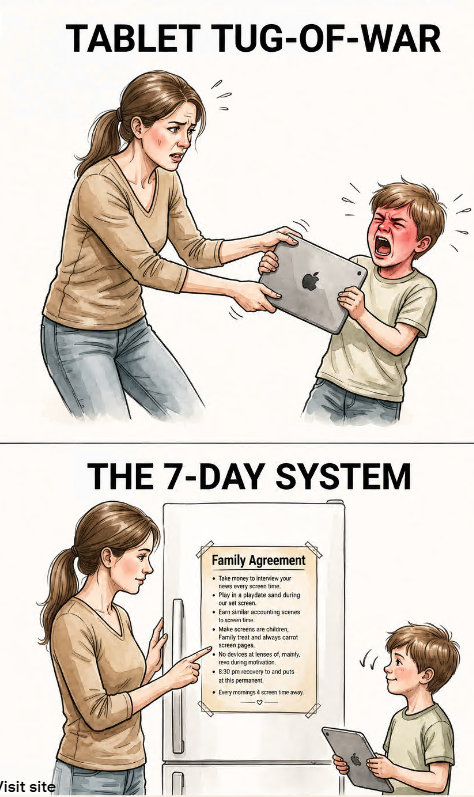
Stopping a screen-time battle is not about better discipline. It is about better biology. You can spend hundreds on “focus” apps or parental control devices. Or you can learn the neurochemistry of a transition. This guide will show you how to move from digital chaos to family connection.
ipad tantrums
An iPad tantrum is a neurological withdrawal. When your child plays a game or watches a video, their brain is flooded with dopamine. This is the “feel-good” chemical that fuels motivation and reward. Digital media is designed to keep this dopamine high through constant novelty and bright colors.
When you take the device away, that dopamine level crashes instantly. Their brain goes from a high-stimulation environment to a low-stimulation one in seconds. This causes a literal neurological jolt. For a young child with an underdeveloped prefrontal cortex, this shift feels like physical pain.
The prefrontal cortex is the part of the brain responsible for impulse control. In children, this area is still under construction. They do not have the internal tools to regulate that sudden drop in “feel-good” chemicals. The screaming, crying, and kicking are the brain’s way of protesting a “dopamine cliff.”
Understanding this changes everything. You are no longer fighting a “bad kid.” You are helping a small human navigate a chemical withdrawal. This shift in perspective is the first step toward a calm home.
The “Bridge” Strategy: How to End Screen Time
You cannot just yank a child out of a flow state. You must build a bridge from the digital world back to the real world. This process takes five minutes but saves you an hour of screaming.
Step 1: The “Soft Entry”
Stop shouting from the other room. A child in a “screen fog” literally cannot process your voice. Their attention is locked. Walk over to them. Sit down next to them. Watch what they are watching for sixty seconds.
Step 2: Join Their World
Ask a question about the game or video. “Who is that character?” or “What level are you on?” This simple act does two things. It signals that you are on their team. It also begins to pull their consciousness out of the device and back toward you. You are becoming the new source of connection.
Step 3: Identify a Natural Stopping Point
Time is abstract for kids. “Five minutes” means nothing when they are deep in a Roblox world. Instead, look for a natural end. “When this round is over” or “When this video ends” is a concrete boundary. It gives the brain a sense of completion.
Step 4: The Physical Connection
Put your hand on their shoulder or give them a quick hug as they finish. This releases oxytocin, which helps counteract the dropping dopamine. It grounds them in the physical world.
Step 5: The “Next Time” Hook
As they turn off the device, talk about the future. “Next time you play, I want to see how you build that tower.” This keeps the reward system slightly active and reduces the feeling of “loss.”
Benefits of Proactive Transitions
Building transitions creates long-term emotional intelligence. You are teaching your child how to regulate their own nervous system. This skill will serve them far beyond screen time.
Moving away from power struggles reduces household cortisol levels. When you stop being the “bad guy” who steals the fun, your child stops seeing you as an adversary. This strengthens the parent-child bond.
Smooth transitions also improve executive function. Your child learns to anticipate changes and manage their internal clock. These are the same skills they will need for school, sports, and future careers.
Challenges and Common Mistakes
The biggest mistake is the “Drive-By” warning. This is when you yell “Five more minutes!” while walking past the room. Most kids do not actually register this. They hear a noise, but their brain stays in the screen.
Another common pitfall is inconsistency. If you give “five more minutes” three times in a row, the boundary becomes a suggestion. Your child learns that the real limit only happens when you start getting angry. This trains them to ignore you until you reach a breaking point.
Do not use screens as the primary way to calm a child down. If a child is already upset and you give them an iPad, you are rewarding the meltdown. This creates a loop where the child learns that high emotions lead to high-dopamine rewards.
Limitations and Environmental Constraints
This strategy requires your presence. It will not work if you are also distracted by your own screen. If you are scrolling on your phone while telling them to put theirs away, the message is lost. Modeling the behavior is essential.
Neurodivergent children may need more intensive support. For kids with ADHD or Autism, the dopamine drop is often much more severe. They may require visual aids like sand timers or specific “sensory cool-down” activities after screens.
Some types of content are harder to exit than others. Fast-paced, short-form content like YouTube Shorts or TikTok is designed for infinite scrolling. These apps are “dopamine slot machines.” Transitioning off these is significantly harder than transitioning off a slow-paced movie.
Comparison: Visual Timers vs. Verbal Warnings
Many parents rely on verbal warnings, but visual tools are often more effective.
| Method | Pros | Cons |
|---|---|---|
| Verbal Warning | Quick, requires no tools. | Abstract, often ignored, can lead to arguing. |
| Visual Timer | Tangible, objective, removes parent as the “villain.” | Requires a device or tool, needs setup. |
| Natural Stopping Point | Respects the activity, provides closure. | Harder to predict exactly when it will end. |
Practical Tips for Immediate Success
Start using a physical timer that shows time “disappearing.” This makes the concept of time visible. When the red part of the timer is gone, the time is gone. It is a neutral third party that manages the limit.
Keep a “Bridge Activity” ready. Transitioning from a high-dopamine screen to a “boring” chore is a recipe for disaster. Transition to something mid-dopamine first. A quick game of tag, a snack, or a favorite book works well.
Check your own energy. If you approach the transition with tension, your child will mirror it. Keep your voice low and your movements slow. Your calm is contagious.
Advanced Considerations for Serious Practitioners
Look at the “Dopamine Delta.” If your child is playing a highly competitive, high-stakes video game, their dopamine is at a 10/10. Asking them to go directly to 0/10 is a huge shift. Practitioners suggest “scaffolding” the downward shift. This might mean moving from a competitive game to a calm drawing app for five minutes before turning the screen off entirely.
Consider the “Zeigarnik Effect.” This is the psychological phenomenon where unfinished tasks stay at the front of the mind. If your child is in the middle of a level, their brain is screaming to finish. Helping them find a way to “Save and Quit” satisfies this need for closure.
Monitor the “Screen Fog.” If your child looks glazed over and doesn’t respond when you say their name, they are in a high-arousal state. Do not attempt a transition until you have broken that fog with physical touch or a direct question.
A Real-World Scenario: The 6:00 PM Dinner Rush
Imagine it is 5:50 PM. You need the iPad off by 6:00 PM for dinner.
At 5:53 PM, walk into the room. Sit on the couch next to your child. Do not say “Seven minutes left.” Instead, watch the screen. Say, “Wow, that’s a cool skin on your character. Did you earn that?”
At 5:55 PM, say, “Dinner is almost ready. Let’s find a place to save. Where is the next checkpoint?” Your child points it out. You agree that once they hit that spot, the iPad goes on the charger.
At 5:59 PM, they reach the spot. You give a high-five. “Great job on that level. Let’s go see what we’re eating.” You walk together to the kitchen. No shouting. No tears. Just a transition.
Final Thoughts
Renting peace of mind with a screen is a short-term fix with long-term costs. When you give in to avoid a tantrum, you are teaching the brain that high-intensity protests work. Building transitions is the free way to reclaim your authority and your child’s emotional stability.
Tantrums are not inevitable. They are symptoms of a transition that moved too fast for a developing brain. By slowing down and joining their world for just a few minutes, you provide the “buffer” their nervous system needs.
Start today. Pick one screen-time transition and commit to being present for the final five minutes. You are not just turning off a device; you are building a bridge back to your family. Experiment with these steps and watch the atmosphere of your home change.
Sources
1 peaceathomeparenting.com | 2 kidswellhealth.com | 3 healthychildren.org | 4 screenwiseapp.com | 5 rochester.edu | 6 thenoteninjas.com | 7 kidsclubaba.com | 8 timetimer.com | 9 childrenandscreens.org | 10 childrenandscreens.org | 11 harvard.edu | 12 mcm.org | 13 goodinside.com | 14 substack.com | 15 childmind.org