reduce screen time challenge
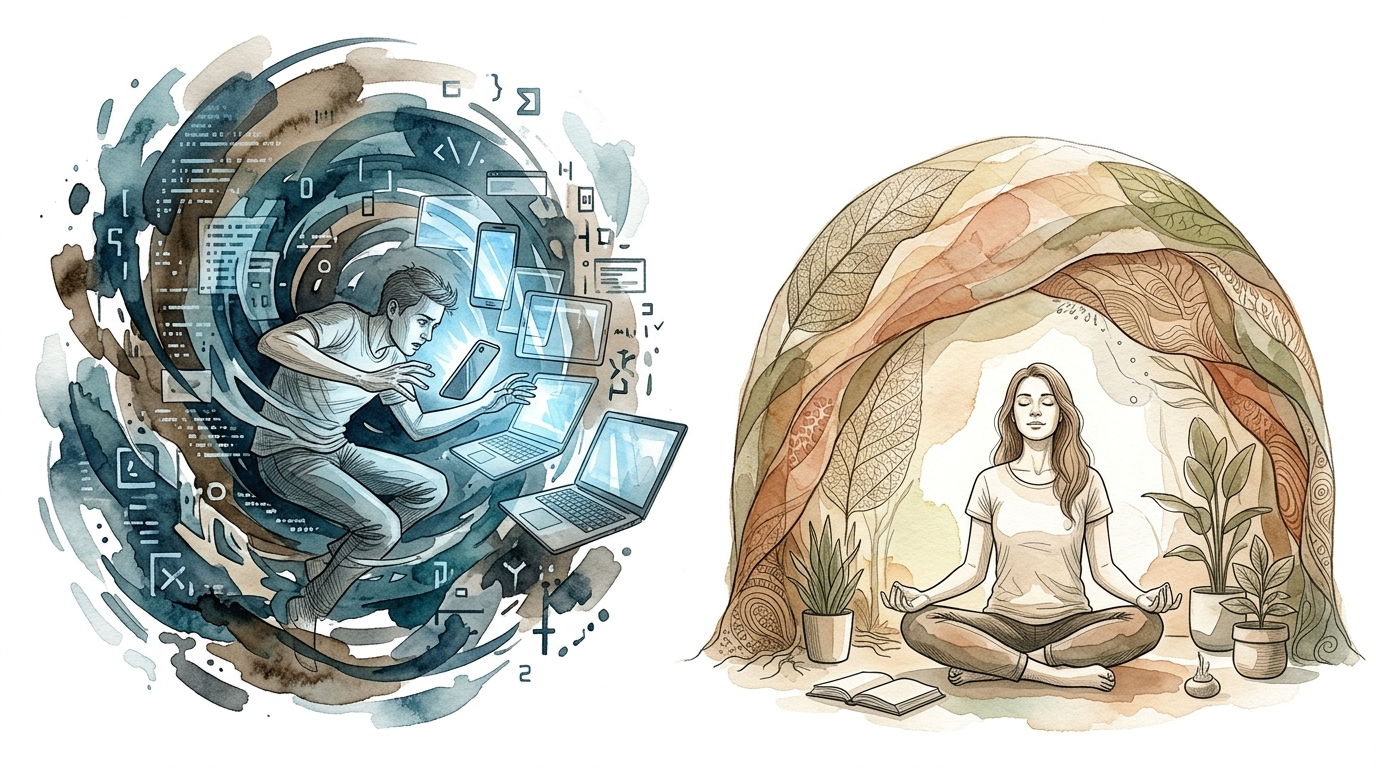
Shelter your mind from the digital storm.

Your brain wasn’t built for 24/7 notifications. It was built for deep thoughts and quiet moments. Reduce your screen time and build a shelter for your soul. Every ping and buzz is a tiny hammer striking the foundation of your focus. If you feel like your attention is fragmented, you are not alone. Millions of people now live in a state of continuous partial attention. This article explores how to break the cycle of digital exhaustion and reclaim your mental landscape.

The modern world runs on the attention economy. Giant corporations hire neuroscientists to make their apps as addictive as possible. They use variable reward schedules to keep you scrolling long after you intended to stop. This constant stimulation rewires your brain’s reward system, making real-life experiences feel dull by comparison. Breaking free requires more than just willpower. It requires a systematic approach to restructuring your relationship with technology.
reduce screen time challenge
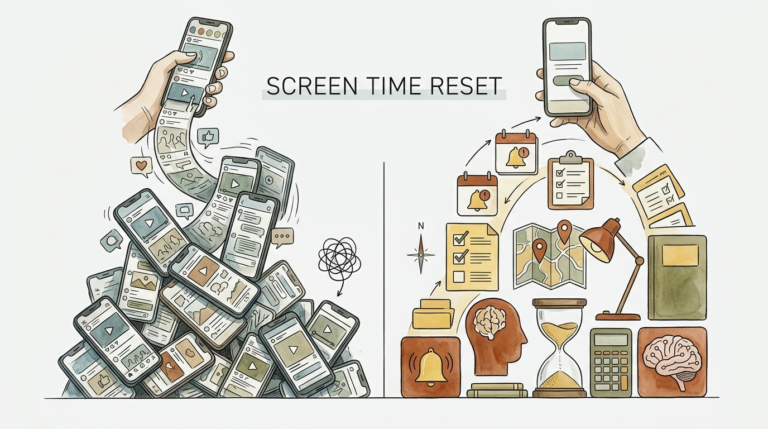
The reduce screen time challenge is a structured period of intentional digital abstinence and recalibration. Most practitioners aim for a 30-day window to allow their neural pathways to reset. Research suggests that adult brains are negatively impacted by excessive screen time, defined as more than two hours a day outside of work hours. This challenge exists to move you from a state of mindless consumption to one of intentional usage.
Real-world situations often force us into digital dependency. You might use your phone for work, navigation, and social connection simultaneously. The challenge doesn’t ask you to move to a cabin in the woods. Instead, it asks you to categorize your digital tools into “essential” and “optional.” You keep the essential ones while aggressively pruning the optional distractions that eat your life.
Imagine your attention is a finite bucket of water. Every notification is a small leak. At the end of the day, you want enough water left to nourish your family, your hobbies, and your own growth. The challenge helps you plug the leaks so you can pour your energy where it actually matters. It is a fundamental reset for the dopamine-saturated mind.
The Blueprint: How to Reclaim Your Focus
Starting a digital reset requires a clear roadmap. You cannot simply decide to “use your phone less” and expect results. Success comes from physical and environmental changes that reduce friction for good habits.
Phase 1: The Audit and Awareness
Begin by looking at your current data. Most smartphones have built-in trackers like “Screen Time” on iOS or “Digital Wellbeing” on Android. Spend the first three days of your challenge just observing. Do not try to change anything yet. Look at how many times you pick up your phone and which apps consume the most “non-essential” time. Awareness is the first step toward sovereignty.
Phase 2: The Physical Barrier
The easiest way to stop a bad habit is to make it difficult to perform. Delete the most addictive apps from your phone and access them only via a desktop browser. This adds “friction” to the process. You can also move your charger out of the bedroom. Harvard researchers have shown that blue light-emitting devices disrupt sleep by suppressing melatonin. Keeping the phone in another room prevents the “morning scroll” and improves sleep quality instantly.
Phase 3: The Grayscale Shift
Visual stimuli drive much of our digital addiction. App designers use bright, “candy-like” colors to trigger dopamine releases. You can combat this by switching your phone to grayscale mode. When the red notification bubbles and vibrant photos turn gray, the psychological pull of the device drops significantly. It transforms a high-octane slot machine into a boring utility tool.
Phase 4: Intentional Replacement
A void always seeks to be filled. If you remove the screen but don’t have a plan for the extra four hours of your day, you will eventually relapse. Identify high-quality analog activities before you start. This might include reading physical books, practicing a musical instrument, or engaging in face-to-face social interactions. Studies show that replacing screen time with physical activity or hobbies significantly improves mental well-being and reduces anxiety.
Measurable Benefits of Unplugging
Reducing screen time offers practical, observable benefits that impact every area of your life. These are not just feelings; they are physiological and psychological shifts.
- Improved Sleep Quality: Removing screens two hours before bed allows your body to regulate its natural circadian rhythm. This leads to deeper REM sleep, which is essential for memory processing and emotional regulation.
- Expanded Attention Span: Constant task-switching on digital devices fragments your focus. Taking a break allows your prefrontal cortex to recover its ability to sustain deep thought.
- Reduced Stress and Cortisol: Constant connectivity keeps the central nervous system in a state of high alert. Disconnecting lowers cortisol levels and calms the “fight or flight” response triggered by endless news cycles.
- Enhanced Social Connection: Being present with people without the distraction of a device strengthens relationships. You pick up on non-verbal cues that are lost in digital communication.
People who choose this approach often report a “quieting” of the mind. The internal chatter starts to settle. You might notice the beauty of your surroundings more clearly. This clarity is a direct result of ending the constant “impoverished stimulation” provided by digital media. Real life is higher resolution than any 4K screen could ever be.
Challenges and Common Mistakes
The path to digital minimalism is paved with obstacles. Most people fail because they treat it as a temporary fix rather than a lifestyle change.
The “Cold Turkey Trap” is a frequent error. Jumping from eight hours of screen time to zero often leads to intense withdrawal and quick relapse. A more sustainable approach involves gradual reduction. Start by cutting one hour a day or eliminating one specific app. This allows your brain to adjust to lower dopamine levels without the shock of total deprivation.
FOMO, or the Fear Of Missing Out, is another major hurdle. You might worry that you will miss an important update, a social invitation, or a breaking news event. This fear is usually unfounded. Truly important news finds you through other channels. Most digital “emergencies” can wait 24 hours without any real-world consequence. The cost of constant checking—lost focus and increased stress—far outweighs the benefit of being “first” to know a trivial fact.
Misunderstanding “Essential” vs. “Optional” also creates confusion. Some people try to delete their work email from their phone when their job requires it. This creates unnecessary professional stress. The goal is to eliminate the apps that provide low-value distraction, not the tools that facilitate your livelihood. Be honest about what is a necessity and what is an addiction.
Limitations and Realistic Constraints
A balanced understanding requires acknowledging that total disconnection is rarely possible in the modern economy. Digital tools are woven into the fabric of our society.
Remote workers and digital professionals face unique challenges. If your job exists on a screen, you cannot simply walk away. In these cases, the challenge isn’t about total time spent on a screen, but about the *quality* of that time. You might spend eight hours on a laptop for work but still benefit immensely from a “no phone” policy in the evenings and on weekends.
Environmental limitations also play a role. If you live in an area with limited outdoor access or community spaces, the digital world might be your only portal to social interaction. Trade-offs are necessary. The focus should be on intentionality rather than arbitrary time limits. Use the tools to connect, then put them away when the connection is made.
Practical boundaries are essential for safety and logistics. Keeping a smartphone for GPS, emergency calls, and banking is a rational choice. The challenge is about mastering the tool, not becoming a Luddite. Acknowledge that the device has value, but refuse to let the value be outweighed by the distraction.
Exposed to Algorithms vs Sheltered in Presence
This comparison helps clarify the difference between a reactive life and an intentional one.
| Factor | Exposed to Algorithms | Sheltered in Presence |
|---|---|---|
| Attention | Fragmented and reactive | Deep and sustained |
| Mood | Driven by likes and news | Stable and self-generated |
| Dopamine | Frequent, shallow spikes | Consistent, natural levels |
| Primary Activity | Scrolling and consuming | Creating and connecting |
| Mental Clarity | Cloudy and overwhelmed | Quiet and sharp |
Being “Exposed to Algorithms” means your internal state is managed by external code. Every scroll is a gamble for a new piece of information. In contrast, being “Sheltered in Presence” means you choose your inputs. You decide when to engage and when to withdraw. This shift lowers complexity and increases personal efficiency. It requires a higher initial skill level to maintain boundaries, but the maintenance cost is much lower in the long run.
Practical Tips for Best Practices
Actionable advice can be applied immediately to see results. These techniques help you tune your environment for success.
- Implement the 20-20-20 Rule: Every 20 minutes, look at something 20 feet away for at least 20 seconds. This reduces eye strain and helps maintain the connection between your eyes and your brain’s relaxation centers.
- Establish Digital Curfews: Set a hard stop for all screens at 8:00 PM or 9:00 PM. Use this time for reading, journaling, or conversation.
- Create Tech-Free Zones: Designate the dining table and the bedroom as screen-free areas. This ensures that meals and rest remain sacred.
- Notification Audit: Turn off all non-human notifications. If a machine is telling you something happened, it can wait. Only allow notifications from actual people (texts or calls) to reach your lock screen.
- Use Batching for Communication: Instead of replying to every message as it arrives, set three specific times a day to check and respond to emails and social media.
These adjustments improve efficiency by reducing the “switching cost” of your brain. Every time you check a notification, it takes several minutes for your brain to return to its previous level of focus. Preventing the interruption is better than managing it.
Advanced Considerations: Neuroplasticity and the Deep Life
Serious practitioners often look beyond mere time-tracking. They focus on the neurological changes occurring in the brain.
The brain’s dopamine cycle is a powerful driver of behavior. Repeated stimulation from social media and gaming can cause the nucleus accumbens to become desensitized. Over time, you need more “digital hits” to feel the same level of pleasure. A 30-day challenge acts as a dopamine fast. It allows your receptors to upregulate, meaning you can find joy in simple activities again.
Neuroplasticity is the brain’s ability to reorganize itself. When you stop the constant stream of short-form content, your brain begins to prune the pathways used for superficial scanning. It starts strengthening the circuits required for “Deep Work” and complex problem-solving. This process takes time and consistency.
Architectural changes to your life are the ultimate goal. This means building a life where technology serves your values, not the other way around. This might involve switching to a “minimalist phone” or a light phone, or deleting social media accounts permanently. Scaling these considerations allows you to maintain high performance in a world of total distraction.
Examples of Success
Consider the case of a software developer named Marcus. Marcus spent ten hours a day on a screen for work and another four hours on social media and YouTube. He felt constant brain fog and struggled to finish complex coding tasks. He decided to take the 30-day challenge.
In the first week, Marcus felt intense boredom and an “itch” to check his phone. He replaced the habit by keeping a physical notebook on his desk. Whenever he felt the urge to scroll, he wrote down one thought or observation. By week three, his brain fog lifted. He noticed that his ability to hold complex code structures in his mind had significantly improved. His work became more efficient, allowing him to finish his tasks in six hours instead of eight.
Another example is Sarah, a parent who felt disconnected from her children because she was always “half-available” while checking her phone. She implemented a “phone basket” by the front door. Devices went into the basket at 5:00 PM and didn’t come out until the children were in bed. Within two weeks, the tension in her household dropped. Her children were less frustrated, and she felt a deeper sense of fulfillment in her daily life. These simple numbers—two hours of evening presence—translated into massive gains in emotional health.
Final Thoughts
Reclaiming your focus is not about hating technology. It is about loving your own mind. The digital storm will continue to blow, but you have the power to build a shelter. By reducing screen time and embracing intentionality, you protect your most valuable asset: your attention.
The practical value of a digital reset is found in the space it creates. It creates room for the hobbies you’ve neglected, the people you love, and the deep thoughts that lead to real growth. The journey requires discipline, but the reward is a life lived on your own terms rather than those of an algorithm.
Experiment with these strategies today. Start with a single tech-free zone or a grayscale screen. Observe how your mind reacts to the silence. You might find that the quiet you’ve been avoiding is exactly where your best self has been waiting. Focus on being present, and watch how the rest of your life begins to settle into place.
Sources
1 nisbenefits.com | 2 powerhouseplanners.com | 3 exonpublications.com | 4 centr.com | 5 thechallenge.org | 6 regis.edu | 7 webmd.com | 8 reddit.com | 9 mdpi.com | 10 getclearspace.com | 11 stephanjoppich.com | 12 stanford.edu | 13 priorityhealth.com | 14 harvard.edu | 15 arizona.edu | 16 unhookd.app | 17 samhealth.org | 18 jaimedicalsystems.com | 19 mayoclinic.org | 20 charleston.edu | 21 nyp.org | 22 nih.gov | 23 youtube.com | 24 youtube.com | 25 thejacobsladdergroup.org