gentle screen time limits without fights
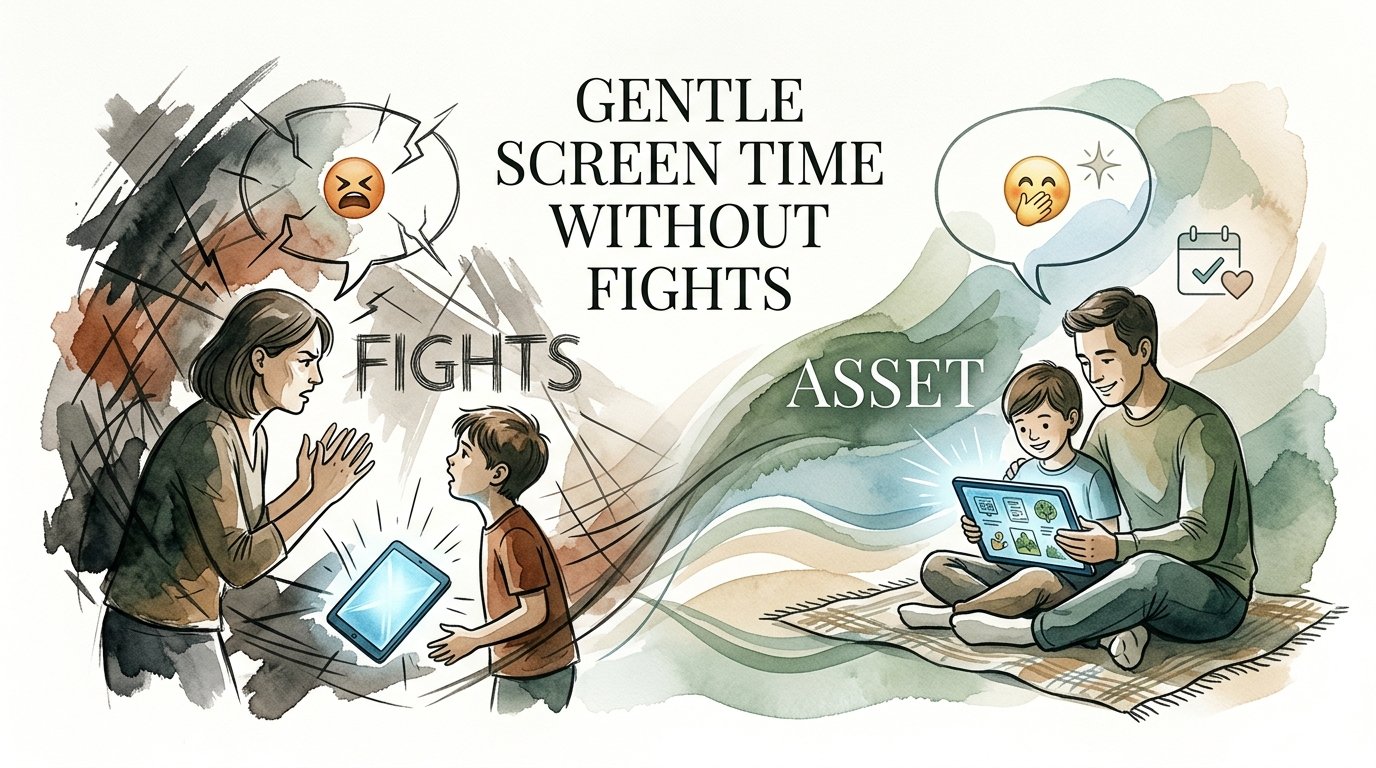
Stop fighting the device and start using it as a tool. The secret to ending screen time fights isn’t banning the tech—it’s changing its role in your home. Shift from nuisance to asset with these steps.
Screens are everywhere. They are in our pockets, on our walls, and increasingly in the hands of our children. For most parents, the device feels like a rival for their child’s attention. It feels like a constant source of friction, noise, and power struggles.
The traditional approach is to fight back. We set timers, we hide chargers, and we issue threats. But these tactics often lead to more meltdowns and deeper resentment. There is a better way to manage digital life without the constant yelling.
Focusing on connection over control is the real game-changer. When you transition from being a “tech police officer” to a “digital mentor,” the dynamic of your home shifts. You stop being the person who takes away the fun and start being the one who guides the experience.
gentle screen time limits without fights
Gentle screen time limits are about structure rather than suppression. This approach acknowledges that technology is a permanent fixture of modern life. Instead of viewing it as a “necessary evil,” gentle limits frame tech as a tool that requires specific skills to master.
At its core, this philosophy removes the element of surprise. Most screen time fights happen because of an abrupt interruption to a child’s “flow state.” When a child is playing a game or watching a show, their brain is flooded with dopamine, a neurotransmitter that creates a sense of reward and focus. Suddenly cutting that off creates what psychologists call “frustrative nonreward,” a state of high stress and irritation.
Gentle limits provide “soft landings” for the brain. They use predictable routines and clear communication to help a child transition back to the physical world. This isn’t about letting them watch whatever they want for as long as they want. It is about setting boundaries that respect the child’s neurological experience.
Real-world application looks like a “Family Media Agreement.” This is a collaborative document where everyone, including parents, agrees on when, where, and how devices are used. When the rules are co-created, children feel a sense of agency rather than just being victims of a parent’s whim.
How to Shift from Nuisance to Asset
Transforming tech use requires a systematic approach. You cannot simply announce a new rule and expect immediate compliance. You have to build a new framework for how devices live in your house.
Understand the Transition Science
Dopamine levels drop sharply when a screen is turned off. This drop leaves children feeling irritable and bored. Educating your child about this “brain crash” can help them understand why they feel like yelling when the iPad goes away. It moves the problem from their “bad behavior” to a biological process they can learn to manage.
Pre-Teach Self-Government
Talk about screen time before the device is even turned on. Ask your child what their plan is. How many levels will they play? What will they do when the timer goes off? Setting the expectation early creates a mental map for the end of the session. It prepares the brain for the eventual transition.
Use “The Bridge” Method
Instead of yelling from the other room, walk over and sit with your child for the last few minutes of their session. Ask questions about what they are watching or playing. This creates a “bridge” between their digital world and your physical world. It makes the transition feel less like a cliff and more like a gentle slope.
Prioritize Active Over Passive
Differentiate between “Active Technology” and “Passive Technology.” Passive tech involves mindless scrolling or watching random videos. Active tech involves creation, building, or learning a new skill. Encourage tools like coding apps, digital photography, or music production. When tech is an asset for growth, it feels less like a nuisance to the family rhythm.
Benefits of This Approach
Moving toward gentle screen time limits creates measurable improvements in family life. The most immediate benefit is a reduction in daily stress. When the “when” and “how” of tech are no longer up for debate, the 96 hours a year the average family spends fighting over screens begins to vanish.
Practical benefits of this transition include:
- Emotional Regulation: Children learn to recognize their own limits and handle the “dopamine crash” without a total meltdown.
- Digital Literacy: Instead of just consuming content, children learn how to use devices as tools for research, creation, and communication.
- Stronger Connection: Co-viewing and engaging with your child’s digital interests builds trust and opens doors for deeper conversations.
- Better Sleep: Establishing screen-free zones and “digital sunsets” helps the whole family’s circadian rhythms stay in sync.
Choosing this path also prepares children for the future. They will eventually have unrestricted access to devices as adults. Learning to self-regulate now, under your guidance, is a critical life skill that a “ban-first” approach simply cannot teach.
Challenges and Common Mistakes
The road to healthy tech habits is rarely a straight line. Many parents start with good intentions but fall into traps that reignite the battles. One of the biggest mistakes is “Intermittent Reinforcement.” This happens when you have a rule but give in to a tantrum “just this once.”
Psychologically, giving in occasionally is the most powerful way to keep a bad behavior alive. It teaches the child that if they just push hard enough or long enough, the rule might break. Consistency is the only antidote to this cycle.
Other common pitfalls include:
- Using Screens as a Threat: “If you don’t clean your room, no iPad.” This turns tech into a “forbidden fruit” and increases its perceived value. It also puts you in an oppositional position.
- Shaming the Content: Calling a child’s favorite YouTube channel “garbage” or saying they look like “zombies” only makes them defensive. It shuts down the dialogue you need to guide them.
- Hypocrisy: If you are constantly scrolling while telling your child to get off their device, they will notice the double standard. Modeling healthy habits is the most effective teaching tool.
- Ignoring the “Why”: Sometimes a child is using a screen to escape anxiety or find a sense of belonging. If you don’t address the underlying need, the screen battle will never end.
Limitations of Gentle Limits
Gentle limits are not a magic wand. There are situations where a more assertive approach is necessary. For children with genuine gaming or social media addictions, professional intervention and a “digital detox” might be the starting point before gentle limits can be implemented.
Realistic constraints also include:
- Educational Demands: Many schools require devices for homework, making it difficult to maintain strict screen-free times during the week.
- High-Needs Children: Children with ADHD or sensory processing issues may struggle significantly more with transitions, requiring much longer “bridge” periods and more intensive support.
- Environmental Factors: If a child’s entire social circle communicates through a specific game or app, removing it can lead to social isolation, creating a different set of mental health challenges.
This approach requires significant time and energy from the parent. It is much easier to simply yell “turn it off” than it is to sit down and co-view a Minecraft session. If a parent is currently overwhelmed or in a crisis, they may not have the emotional bandwidth to “bridge” every transition.
The Nuisance Battle vs. The Asset Reward
To truly change the culture of your home, you must understand the difference between treating tech as a nuisance and treating it as an asset. Most families are stuck in the “Nuisance Battle” loop.
| Factor | The Nuisance Battle | The Asset Reward |
|---|---|---|
| Primary View | Tech is a distraction to be minimized. | Tech is a tool for skill-building. |
| Transition Style | Abrupt (timers, yelling). | Gradual (bridging, routines). |
| Parent Role | Police Officer / Enforcer. | Mentor / Guide. |
| Child’s Feeling | Resentment and loss. | Agency and accomplishment. |
| Long-Term Goal | Compliance. | Self-regulation. |
Moving from the left column to the right column takes time. It starts with a shift in your own mindset. You have to believe that the device can be more than a babysitter or a source of stress.
Practical Tips and Best Practices
Applying these concepts day-to-day requires a toolkit of actionable strategies. Start small. Pick one or two techniques and practice them until they become part of your family’s “muscle memory.”
The “Jumping Jacks” Reset
Help your child physically “shake off” the screen state. When the device goes away, have them do twenty jumping jacks or a quick lap around the house. This physical activity helps process the drop in dopamine and refocuses the brain on the physical environment.
Predictable Content Closures
Use “natural closures” instead of minutes. “You can watch until the end of this episode” or “You can finish this one level” is much easier for a child’s brain to process than “ten minutes.” It respects the narrative or competitive flow of what they are doing.
The Visual Countdown
For younger children, use a visual timer (like an hourglass or a digital countdown that shows a shrinking red circle). Seeing the time “disappear” makes the abstract concept of minutes more concrete and manageable.
Curated Playlists
Instead of letting the algorithm choose the next video, create a playlist with your child. This puts the child back in the “driver’s seat” and prevents them from falling into a mindless “auto-play” loop.
Advanced Considerations for Digital Mentorship
As your child gets older, the focus shifts from managing time to managing content and conduct. This is where the transition to an “asset” really pays off. Serious practitioners of this method move into the realm of digital citizenship.
Consider these deeper insights:
- Algorithm Awareness: Teach your child how algorithms work. Explain that apps are designed to keep them watching. This meta-awareness helps them view the “pull” of the screen with a critical eye.
- Creative Substitution: If a child loves a particular game, find ways to bring that interest into the physical world. If they love Minecraft, try building with real blocks or drawing blueprints. This reinforces the idea that tech is an inspiration tool, not just an end in itself.
- The “Open Door” Policy: Make it clear that if they see something weird, scary, or inappropriate, they can tell you without losing their device. If they fear losing the tech, they will hide the problem.
Optimization is also key. Periodically review your Family Media Agreement. What worked when they were six won’t work when they are ten. Keep the conversation alive and stay curious about their digital world.
Example Scenario: The Weekend Transition
Imagine it is Saturday morning. Traditionally, this is a time for cartoons and tablets, often ending in a fight when it is time to get ready for a soccer game. Here is how the “Asset” approach changes the scene.
First, the expectation is set on Friday night. “Tomorrow we have soccer at 10:00. You can use your tablet until 9:15, and then we will do a five-minute physical reset before we leave.” This removes the surprise.
At 9:00, you sit down next to them. You don’t say anything at first. You just watch the game for a minute. Then you ask, “Who is winning this round?” This is the “bridge.” You have entered their world. They feel seen and respected.
At 9:10, you say, “Five minutes left. When this round ends, we’re doing our jumping jacks.” At 9:15, they finish the round and put the device on the charger. They might still feel a little grumpy, but they know what to do. You do the jumping jacks together, laugh a bit, and head to the car. The battle was avoided because the transition was structured and connected.
Final Thoughts
Ending screen time fights is not about finding the perfect app-blocking software. It is about a fundamental shift in how your family relates to technology. When you move from fighting the device to using it as a tool, you reclaim the peace in your home. You stop being an adversary and start being a guide.
Gentle screen time limits allow your child to develop the self-regulation skills they will need for the rest of their lives. It prioritizes the relationship over the rule. This approach isn’t always the easiest path, but it is the most sustainable one. It builds trust, encourages creativity, and turns a source of friction into a shared family asset.
Start by having a simple, non-judgmental conversation with your child today. Ask them what they love about their favorite game. Listen more than you speak. That small bridge is the first step toward a home where screens are tools for growth rather than triggers for war.
Sources
1 tidepool.tv | 2 mayoclinic.org | 3 medium.com | 4 nurture.is | 5 mother.ly | 6 tidepool.tv | 7 childmind.org | 8 centerforonlinesafety.com | 9 brainbalancecenters.com | 10 sparkandstitchinstitute.com | 11 bestinclasseducation.com | 12 wonjo.kids | 13 childtrends.org | 14 thrivealliancegroup.com | 15 connectedfamilies.org | 16 psychologytoday.com | 17 mindfulmamamentor.com | 18 mindfulmamamentor.com | 19 healthychildren.org | 20 workspaceforchildren.com | 21 childrenandscreens.org | 22 avenues.org | 23 youtube.com | 24 turninglifeon.org