Organizing Math Activities For Focus
Does your child’s math workspace look like a junk drawer or a laboratory? Visual noise is the greatest enemy of deep work. When a child sees a pile of 20 worksheets, their brain enters a state of ‘cognitive overwhelm’ before they even pick up a pencil. Using structured, minimal trays for cognitive activities, you remove the choice paralysis and allow them to dive straight into the logic.
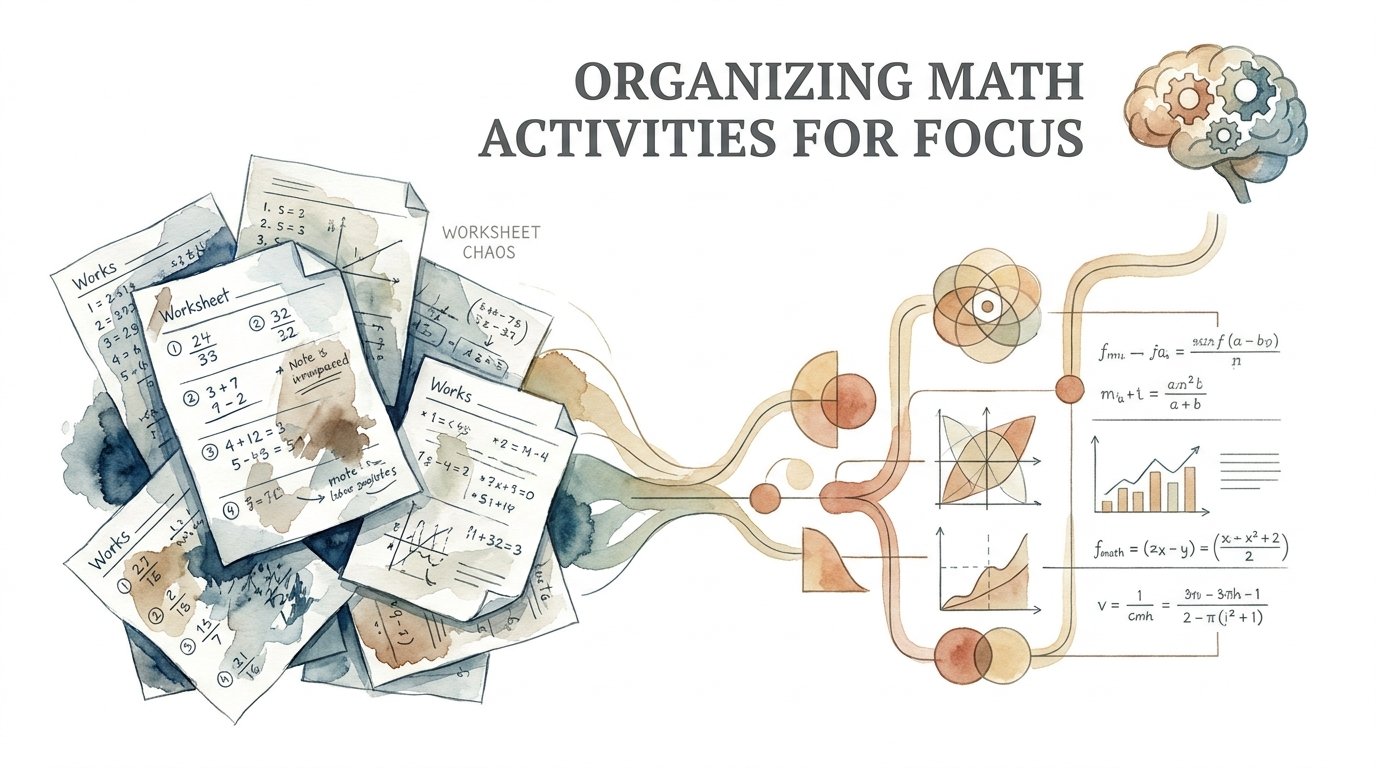
Math doesn’t have to be a chaotic battle of scattered papers and lost erasers. Transforming a workspace from a cluttered mess into a streamlined laboratory changes how a child perceives the challenge ahead. A focused environment signals to the brain that it is time for precision and discovery.
Organizing Math Activities For Focus
Organizing math activities for focus involves creating a physical and mental boundary for a specific learning task. It is the practice of “tray tasking,” where a single mathematical concept is contained within the edges of a tray or a bin. This method exists to minimize extraneous cognitive load—the mental energy wasted on non-essential information like searching for a ruler or deciding which problem to solve first.
In real-world settings, scientists and engineers do not work in cluttered heaps; they use “kits” and “stations” to ensure every tool is within reach. Bringing this concept into a child’s math routine provides a tangible sense of order. Instead of facing a daunting 50-problem worksheet, the child faces a curated selection of tools designed for one purpose.
Visualizing this is simple. Think of a segmented appetizer tray. One section holds counting beads, another holds number cards, and the central section is the “work zone” where the two meet. This clear structure acts as a roadmap for the child’s eyes and hands.
How to Set Up Structured Math Trays
Creating a high-impact math tray requires intentionality rather than expensive equipment. Start by selecting a flat tray with a small lip to prevent items from rolling onto the floor. Wooden trays, baking sheets, or even plastic cafeteria trays work perfectly for this purpose.
Identify the specific skill you want to reinforce. If the goal is addition, the tray should only contain items relevant to addition. Remove everything else. The presence of a stray protractor or a bunch of unrelated stickers only serves to distract the working memory.
Follow these steps for a successful setup:
- Select a Focal Point: Place the primary tool in the center. This might be a hundreds chart, a set of base-ten blocks, or a simple equation card.
- Gather Manipulatives: Use tactile objects like glass gems, wooden beads, or counting bears. These should be placed in small bowls or containers within the tray to maintain order.
- Include a Recording Tool: Provide a small whiteboard or a single slip of paper. Limiting the space for writing prevents the child from feeling buried under a mountain of paperwork.
- Arrange Left to Right: Set up the activity so the child works from left to right. This mimics the direction of reading and creates a natural flow for the logic.
Avoid the trap of adding “fluff.” Decorative items that do not contribute to the math goal increase cognitive load. Every object on that tray must have a job. If it doesn’t help solve the problem, it shouldn’t be there.
Benefits of the Tray Tasking Approach
Transitioning from worksheet chaos to cognitive order offers measurable advantages for both the child and the educator. The most immediate benefit is the increase in independent work time. When a task is clearly defined within a tray, the child knows exactly when they have finished.
Focus levels skyrocket because the brain isn’t fighting for attention. Trays provide a “micro-environment” that shields the child from the distractions of the larger room. This sense of containment fosters a “flow state,” where the child can engage deeply with the logic of numbers without constant interruption.
Independence is the ultimate goal of this system. A well-organized tray is often self-correcting. If a tray has ten slots and the child has twelve beads, they can see for themselves that an error occurred. This allows them to self-reflect and adjust without needing a parent or teacher to point out a mistake.
Common Mistakes in Math Organization
One of the most frequent errors is treating a math tray like a storage bin. Storing all of your math manipulatives in one large bucket is efficient for cleaning up, but it is disastrous for focus. Dumping a massive pile of blocks in front of a child triggers “choice paralysis,” making it harder for them to start the actual task.
Relying too heavily on digital tools is another common pitfall. While apps have their place, they often lack the tactile feedback necessary for early mathematical understanding. A screen cannot provide the weight of ten beads versus one bead, which is a vital part of building number sense.
Hiding supplies in hard-to-reach places creates a dependency on adults. If a child has to ask for a pencil or a calculator every time they hit a roadblock, the momentum of their work is broken. Accessibility is the key to maintaining a state of deep work.
Limitations of Structured Environments
Structured trays are powerful, but they are not a universal solution for every stage of learning. As math becomes more abstract and involves complex algebraic formulas, the need for physical manipulatives may decrease. For older students, a rigid tray might feel too restrictive or “childish” if not adapted properly.
Physical space is a realistic constraint for many families. Maintaining several individual trays requires shelf space that isn’t always available. In these cases, a “modular” system where a single tray is swapped out for different activities might be necessary, though this requires more preparation time from the educator.
Environmental factors can also limit effectiveness. A perfectly organized tray cannot overcome a noisy, high-traffic room. If the surrounding environment is chaotic, the tray becomes a small island of order in a sea of noise, which may still lead to cognitive fatigue.
Worksheet Chaos vs. Cognitive Order
Understanding the difference between these two approaches helps in choosing the right path for your child. Worksheets often prioritize volume and speed, whereas cognitive order through tray tasks priorities depth and mastery.
| Feature | Worksheet Chaos | Cognitive Order (Trays) |
|---|---|---|
| Mental State | Overwhelm / Anxiety | Calm / Focused |
| Learning Style | Passive / Repetitive | Active / Tactile |
| Cleanup | Messy / Disorganized | Systematic / Fast |
| Feedback | Wait for grading | Immediate / Self-Correcting |
Best Practices for Maintaining the System
Sustainability is the secret to a long-term math organization strategy. Establish a “Reset Routine” at the end of every session. The child should return all items to their specific containers and place the tray back on its designated shelf. This reinforces the idea that the work is a cycle with a beginning and an end.
Rotate your activities every one to two weeks. A tray that sits unused for a month becomes “visual background noise” and loses its effectiveness. Keeping the activities fresh ensures the child remains curious and engaged.
Labeling is your best friend. Use clear bins with labels that include both words and pictures. This allows even younger children who cannot read yet to participate in the organization process. Knowing where things belong gives a child a sense of ownership over their space.
Advanced Techniques for Deep Math Work
Serious practitioners can take this a step further by implementing “interleaved practice” within their trays. Instead of a tray focusing on just one type of addition, include a mix of addition and subtraction problems. This forces the brain to constantly evaluate which strategy to use, which leads to much stronger long-term retention.
Incorporate “strategy cards” for more complex tasks. These are small, laminated cards that outline the steps of a process, like long division or fractions. Having the steps visible reduces the burden on the working memory, allowing the child to focus on the execution of the math rather than trying to remember what comes next.
Scaling this system for multiple children requires color-coding. Assign each child a specific color for their trays and tools. This eliminates arguments over supplies and allows you to customize the difficulty level of each tray to match the individual needs of each child.
Scenario: The Multiplication Mystery Tray
Imagine a child who is struggling to understand the concept of multiplication. Instead of a list of 100 times-tables, you present them with a single tray. On the left is a bowl of 24 blue marbles. In the center is a set of small silicone cupcake liners. On the right is a set of cards that say “3 x 4” or “2 x 6.”
The child picks a card: “3 x 4.” They place 3 cupcake liners on the tray. They then count 4 marbles into each liner. Finally, they count the total number of marbles across all liners. The tray has turned an abstract concept into a physical reality. There are no other distractions, no other pages to flip, and no pressure to hurry.
This hands-on experience builds a mental image of “groups” that a worksheet simply cannot replicate. Once the child masterfully completes the tray, they feel a genuine sense of accomplishment. They aren’t just “done” with math; they have actually learned how it works.
Final Thoughts
Organizing math activities for focus is about more than just a tidy room. It is about respecting the child’s cognitive limits and providing them with the tools they need to succeed without unnecessary stress. By removing the visual noise of worksheet chaos, you open the door to genuine mathematical discovery.
Creating these structured environments takes time upfront, but the payoff in child independence and focus is invaluable. You are not just teaching them addition or geometry; you are teaching them how to organize their thoughts and approach challenges with a systematic mind.
Start small with just one tray this week. Observe how your child interacts with the narrowed focus. You will likely find that when the environment is ordered, the mind follows suit, turning every math session into a calm and productive laboratory of learning.
Sources
1 lovelycommotion.com | 2 angathome.com | 3 mathletics.com | 4 luckylittlelearners.com | 5 connectionsacademy.com | 6 edutopia.org | 7 researchschool.org.uk