Edible Plants For Kids Foraging
That ‘annoying’ lawn chore is actually a nutrient-dense pharmacy waiting to be discovered. Most parents spend hundreds on organic greens while throwing away the most nutrient-dense food on the planet. We’ve been taught to see dandelions as ‘invaders,’ but to an outdoor learner, they are a masterclass in botany and nutrition. Here is how to turn a Sunday weed-pulling session into a gourmet wild harvest.
Edible Plants For Kids Foraging
Edible plants for kids foraging refers to the practice of identifying and harvesting wild-growing vegetation that is safe for human consumption. This isn’t just about survival; it’s a sensory-rich educational tool that connects children to the rhythm of the seasons. Instead of seeing a “weed,” children learn to see a resource, transforming the backyard into a living grocery store.
Foraging with kids usually starts with ultra-common, easy-to-identify plants like dandelions, chickweed, and wood sorrel. These plants are resilient and often grow right at eye level for a toddler. By focusing on these “beginner” plants, parents can safely introduce the concept of wild food without the high stakes of complex botanical identification.
The real-world application of this skill is massive. It builds food literacy, encourages picky eaters to try new flavors, and provides free, fresh produce that often exceeds the nutritional value of supermarket staples. It turns a boring walk in the park into a treasure hunt where the “loot” is a healthy snack.
How to Start Harvesting Your Backyard
The process of foraging begins with the “100% Rule.” Never let a child eat something unless you are 100% sure of its identity. Use multiple field guides or reputable apps to cross-reference the plant’s features, such as leaf shape, stem structure, and sap color.
For dandelions, look for a single, hollow, leafless stem that exudes a milky white sap when broken. The leaves should grow in a basal rosette (a circle at the ground) and have those classic “lion’s tooth” jagged edges. If the stem is solid or has leaves growing up it, you’ve likely found a look-alike like sow thistle or cat’s ear.
Once identified, harvesting is the fun part. Use scissors to snip young, tender leaves from the center of the plant for salads, as these are less bitter than older leaves. For the flowers, wait for a sunny day when they are fully open, and pluck the yellow heads to make “honey” or fritters.
Benefits of Wild Foraging for Families
Nutritional density is the biggest win. Dandelion greens, for instance, contain four times more Vitamin C and eight times more calcium than spinach by weight. They are also packed with Vitamin K and iron, making them a true superfood that costs zero dollars.
Beyond the vitamins, foraging offers significant developmental benefits for kids. It sharpens observation skills and critical thinking as they distinguish between similar-looking species. It also fosters a “pro-environment” mindset; children who eat from the land are far more likely to protect it.
For parents of picky eaters, foraging can be a breakthrough. Studies suggest that when kids participate in the harvest and preparation of their food, they are significantly more invested in eating it. A child who normally hates “green stuff” might suddenly be eager to try a “dandelion chip” they picked themselves.
Challenges and Common Mistakes
The biggest challenge is the “Invisible Poison” problem. Even if a plant is perfectly edible, it can be toxic if it has been sprayed with herbicides or pesticides. This is why you should never forage from public parks that look “too perfect” or along busy roadsides where plants absorb exhaust fumes.
A frequent error is mistaking “False Dandelions” (like Cat’s Ear) for the real thing. While many dandelion look-alikes are also edible and often less bitter, they don’t always have the same medicinal properties. The “sap test” is the quickest way to avoid this; true dandelions always have that milky white latex.
Another pitfall is harvesting too late in the season. As dandelions age and prepare to go to seed, the leaves become extremely bitter due to increased tannins. Beginners who try an old leaf might be turned off for life, missing out on the mild, peppery flavor of a spring harvest.
Limitations and When to Skip the Harvest
Foraging is not always ideal in urban settings where soil might contain heavy metals like lead. Plants are highly efficient at pulling minerals from the earth, but they don’t distinguish between “good” minerals like calcium and “bad” ones like lead or arsenic. If you live in an old industrial area, stick to container gardening.
Seasonality is another constraint. You can’t just decide to forage for dandelion fritters in the middle of a drought or the dead of winter. You are at the mercy of nature’s calendar, which requires a shift in mindset from “I want this now” to “What is the earth giving me today?”
There is also the “Ethical Limit.” You should never clear out an entire patch of wild plants. Bees rely on dandelions as one of their first food sources in early spring. A good rule of thumb is to take only one-third of what you see, leaving plenty for the local ecosystem and for the plant to regrow.
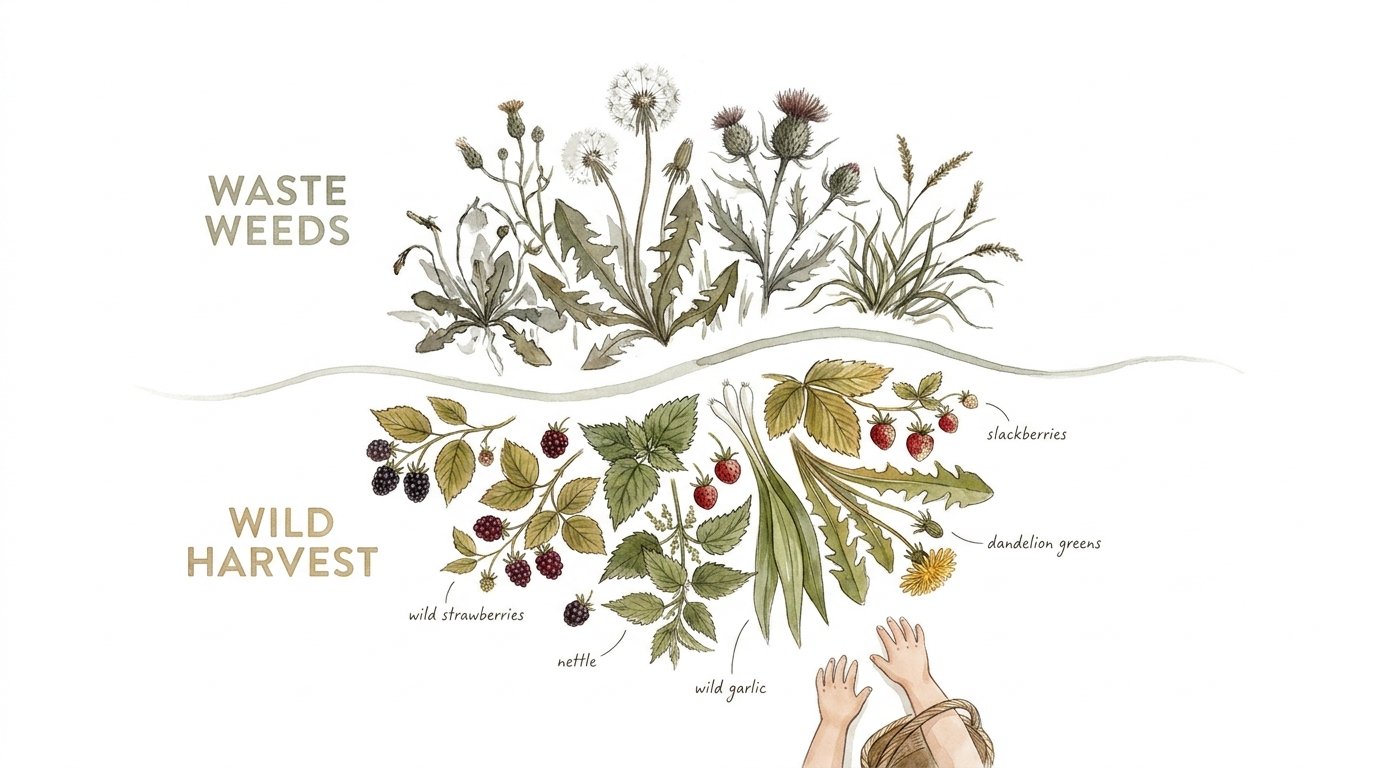
Waste Weeds vs. Wild Harvest
| Feature | Waste Weeds (Store Bought) | Wild Harvest (Foraged) |
|---|---|---|
| Cost | $3 – $6 per bunch | Free |
| Nutrient Density | Moderate (degrades in transit) | High (eaten fresh) |
| Carbon Footprint | High (shipping/packaging) | Zero |
| Skill Level | None required | Beginner Identification |
Practical Tips for Success
Always carry a dedicated “harvest kit” which includes a pair of safety scissors for the kids, a small trowel for roots, and breathable cotton bags. Plastic bags can make wild greens sweat and wilt before you get them into the kitchen.
To reduce the bitterness of dandelion greens, try the “leaching” method. Soak the leaves in cold salt water for 30 minutes before using them. This draws out some of the bitter compounds and leaves you with a flavor similar to high-end arugula or endive.
For the flowers, separate the yellow petals from the green base (the sepals). The green part is where the bitterness lives. If you are making “Dandelion Honey” or syrup, taking the extra five minutes to pluck just the yellow bits will result in a much cleaner, sweeter floral flavor.
Advanced Considerations for Enthusiasts
Once you’ve mastered the basics, consider the medicinal side of these “weeds.” Dandelion roots are excellent for digestive health and can be dried and roasted to make a caffeine-free coffee substitute. This requires digging deeper into the soil and learning how to clean and dehydrate the taproot properly.
Pay attention to soil pH and quality. Dandelions are often “bio-indicators”; they grow in compacted soil to help break it up with their deep roots. If you see them thriving in a particular spot, it tells you a story about the history of that land. Learning to read these signals is the difference between a casual picker and a true naturalist.
Experiment with fermentation. Dandelion flower wine or lacto-fermented dandelion stems (which taste like capers) are advanced techniques that preserve the harvest. These methods introduce beneficial probiotics into the diet, doubling down on the health benefits of your backyard find.
Scenario: The Sunday Morning “Honey” Harvest
Imagine a typical Sunday morning. Instead of dreading the weeds in the flower bed, you hand your six-year-old a basket. You spend 20 minutes together gathering 200 bright yellow dandelion heads from a chemical-free corner of the yard. This isn’t work; it’s a game of “detective” to find the biggest, cleanest blooms.
Back in the kitchen, you show them how to shake out any tiny hitchhiking insects. You boil the petals with water, a few slices of lemon, and an apple for natural pectin. After straining and simmering with sugar, you have “Dandelion Honey”—a golden, floral syrup that tastes exactly like the nectar of spring.
When you serve that syrup over pancakes, your child isn’t just eating breakfast. They are eating something they discovered, identified, and helped create. The “annoying weed” has become a point of pride and a source of genuine nutrition.
Final Thoughts
Foraging is a bridge between the modern world and the ancient knowledge our ancestors used to survive. By teaching Edible Plants For Kids Foraging, you aren’t just giving them a snack; you are giving them the confidence to navigate the natural world. You are showing them that abundance is everywhere, even in the cracks of the sidewalk.
Start small, stay safe, and keep it fun. The goal isn’t to replace your entire grocery bill overnight, but to shift your perspective. Once you start seeing your lawn as a gourmet garden, you’ll never look at a dandelion the same way again.
Encourage your family to try one new wild plant each season. Whether it’s the lemony zing of wood sorrel or the earthy crunch of a dandelion root, each discovery is a step toward a more connected, healthy, and adventurous life.
Sources
1 wilderchild.com | 2 totallywilduk.co.uk | 3 youtube.com | 4 growforagecookferment.com | 5 nationalgeographic.com | 6 mbcmuseum.com | 7 ice.edu | 8 practicalselfreliance.com | 9 thekitchenapothecary.com | 10 muchbetteradventures.com | 11 tulipsandtwill.com