earning screen time for kids chart
Turn your biggest daily battle into your most effective motivational tool. Is screen time the ‘enemy’ in your house? It doesn’t have to be. Shifting to an ‘earned’ system makes the screen a powerful incentive for chores and homework, turning a daily nuisance into a household asset.
Every parent knows the feeling of the “digital tug-of-war.” You want the tablet off; they want “just five more minutes.” This friction often leads to a cycle of negotiation, frustration, and eventually, a full-blown meltdown. Moving toward a structured system changes the conversation from “No more tablet” to “How much have you earned today?” This approach empowers children to manage their own time and teaches them the value of responsibility in a language they already speak: the language of digital rewards.
earning screen time for kids chart
An earning screen time for kids chart is a visual management tool that connects daily responsibilities to the privilege of digital entertainment. It operates on the principle of delayed gratification, requiring a child to complete specific tasks before accessing their devices. In real-world terms, it serves as a “job” for children, where the “paycheck” is delivered in minutes of YouTube, Minecraft, or Roblox.
These charts exist because the modern home is saturated with high-stimulation technology. Research shows that 47% of children under age 8 now have their own tablet device, and 58% of 4-year-olds own one as well. Without a structured system, screens can easily become the default activity, displacing physical movement, reading, and family interaction. A chart acts as a physical boundary that ensures core needs are met before the digital world takes over.
Think of it like a bank account for leisure. Just as adults must work to earn the money they spend on entertainment, children learn that screen time is a finite resource. This system is used in households worldwide to reduce power struggles and transform screens from a source of conflict into a constructive tool for behavior modification.
How to Build Your Earned Screen Time System
Setting up a successful system requires more than just a piece of paper on the fridge. It needs a clear framework that both you and your child understand and respect. Follow these steps to build a system that actually sticks.
Define the Value of Tasks
Assign a specific “price” to every chore or educational activity. Simple tasks like making the bed might earn 5 minutes, while more intensive tasks like cleaning a bathroom or reading for 30 minutes could earn 20 minutes. Creating a tiered system helps children prioritize and understand that harder work yields greater rewards.
Choose Your Currency
Decide how you will track the earnings. Some parents use physical tokens or “screen time tickets” that a child hands over to “buy” time. Others prefer a simple tally on a laminated chart or a digital tracking app. Physical tokens often work best for younger children because the tangible nature of the “money” makes the exchange more real.
Set Hard Boundaries and Expiration Dates
Establish clear “Blackout Zones” where screens are never allowed, such as during meals or 60 minutes before bedtime. It is also helpful to set a “use it or lose it” rule for earned minutes to prevent children from hoarding thousands of minutes and attempting a 10-hour marathon on a Saturday.
Focus on Specificity
Vague instructions like “clean your room” lead to arguments. Instead, list specific requirements: “Pick up all toys, put dirty clothes in the hamper, and clear the floor.” Specificity ensures the child knows exactly what is required to earn their reward, reducing the chance of “rushed and sloppy work” just to get to the device.
Benefits of the Earned Reward Approach
Moving to an earned system offers measurable improvements in household harmony and child development. It shifts the parental role from “The Enforcer” to “The Banker.”
Teaches Time Management: When kids have to work for every minute, they become remarkably efficient. They start to weigh the cost of a 10-minute YouTube video against the effort required to earn it, which is a foundational lesson in resource management.
Reduces Power Struggles: The chart becomes the authority. Instead of you saying “no,” you can simply point to the chart and ask, “Do you have enough minutes for that?” This removes the personal conflict and places the responsibility squarely on the child’s shoulders.
Encourages Life Skills: Children who might otherwise complain about chores often become eager helpers when a screen is on the line. Over time, these repeated actions can build “habit loops” where the behavior becomes second nature, even without the immediate lure of a screen.
Supports Academic Goals: You can weight the chart toward learning. Offering a 2:1 ratio for reading (earning 30 minutes of screen for 15 minutes of reading) can turn a reluctant reader into a bookworm.
Challenges and Common Mistakes
Even the best-designed charts can fail if they aren’t maintained properly. Parents often run into pitfalls that turn the system into a source of stress rather than a solution.
One major error is being inconsistent. If a child realizes they can sometimes get screen time without completing the chart, the system loses all credibility. The rules must be absolute. Another common mistake is making the tasks too difficult. If a child feels they have to work for three hours just to get 15 minutes of play, they will eventually lose motivation and give up entirely.
Many parents also forget to update the chart as the child grows. A 5-year-old’s chores are very different from a 10-year-old’s. If the tasks stay stagnant, the child will become bored or feel the system is “babyish.” Finally, avoid using the chart as a punishment tool. If you take away earned minutes as a penalty for unrelated bad behavior, the child may feel the “contract” is broken and stop participating in the earning system altogether.
Limitations: When the System May Not Work
While highly effective, an earned screen time chart isn’t a silver bullet for every situation. Understanding its boundaries is key to long-term success.
During family vacations or major holidays, rigid charts can feel restrictive and unnecessary. These are times when “organic” screen use—like a family movie night—should be allowed without a chore requirement. Additionally, children with certain neurodivergent profiles, such as ADHD or Autism, may struggle with the delayed gratification required by a point system. For these children, the “reinforcement schedule” may need to be much faster and more immediate to be effective.
Excessive reliance on extrinsic rewards (prizes from outside) can sometimes undermine intrinsic motivation (doing something because it’s the right thing to do). If every single helpful act in the house is tied to a screen reward, the child might stop helping “just because.” Balancing the chart with praise for unsolicited kindness helps maintain a healthy moral compass.
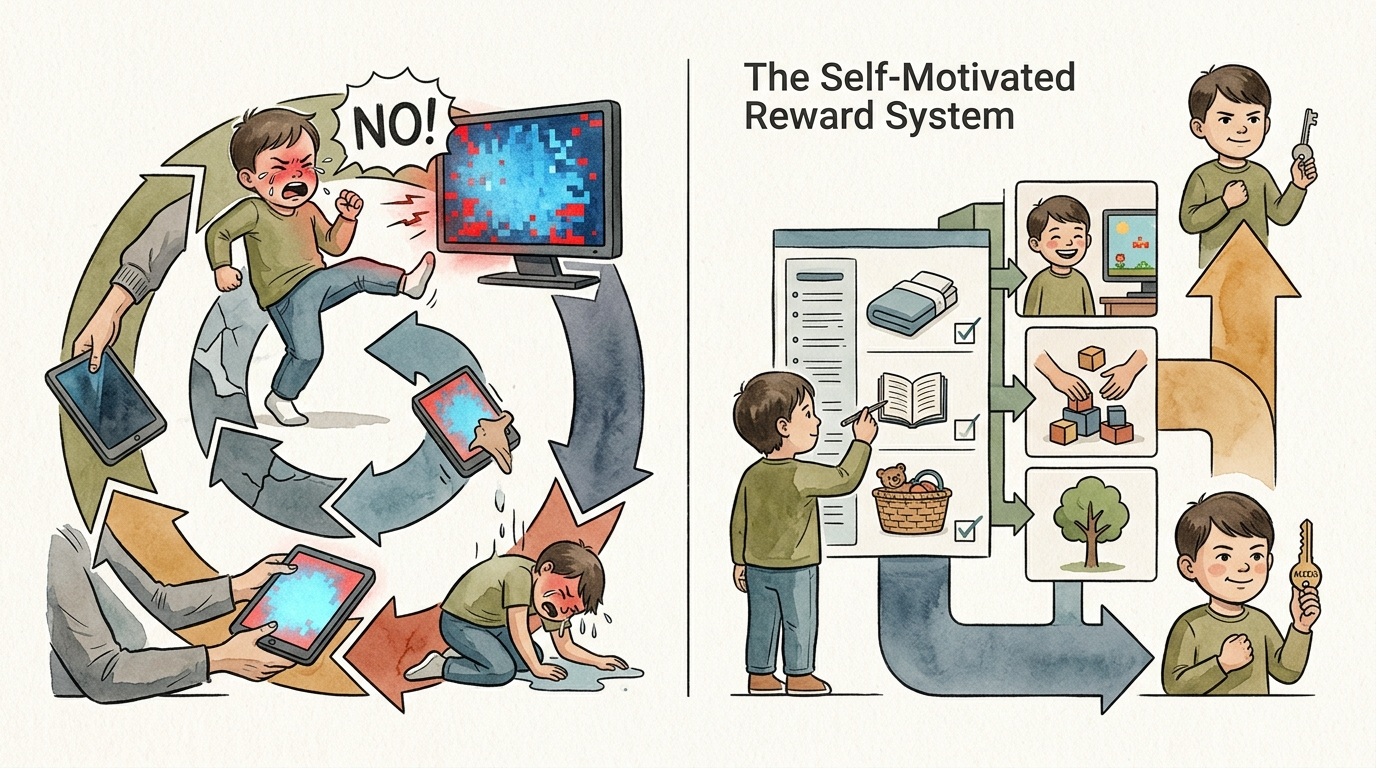
Comparing The ‘Digital Tantrum’ Loop vs The ‘Self-Motivated’ Reward System
Understanding the neurological difference between these two systems helps explain why a chart works. The ‘Digital Tantrum’ Loop is driven by a sudden drop in dopamine when a high-stimulation activity ends abruptly.
| Feature | Digital Tantrum Loop | Self-Motivated Reward System |
|---|---|---|
| Primary Driver | Sudden Dopamine Withdrawal | Anticipatory Reward & Achievement |
| Parental Role | The Barrier/Enforcer | The Facilitator/Coach |
| Child’s Feeling | Powerlessness and Loss | Agency and Ownership |
| Transition Style | Abrupt and Chaotic | Predictable and Scheduled |
The transition from a loop of constant battles to a system of self-motivation is a physiological shift. By making the “ending” of screen time part of a pre-agreed contract, the brain is better prepared for the drop in stimulation.
Practical Tips for Success
* Start with a Win: Give them a few easy tasks on day one so they can experience the satisfaction of “buying” their time immediately.
* Use a Visual Timer: When they start their earned time, use a physical countdown clock. Seeing the time tick away helps them prepare for the transition.
* Model the Behavior: If you expect them to earn their time, show them how you manage your own. Mention out loud, “I’m going to finish this laundry before I sit down to check my phone.”
* Include “Bridge Activities”: Suggest a “low-dopamine” activity (like coloring or LEGOs) for the 10 minutes immediately after the screen turns off to help the brain reset.
* Customize the Chart: Use a printable template that includes their favorite characters or colors. Ownership starts with the design.
Advanced Considerations for Older Kids
As children enter their tween and teen years, a simple chore-for-minutes chart may feel patronizing. For older kids, the system should evolve into a Digital Wellness Contract. Instead of just “earning” time, they should be learning “digital literacy” and “self-regulation.”
Advanced systems might include bonuses for maintaining high grades or practicing a hobby for a set number of hours per week. For teens, the focus should shift toward “budgeting.” Give them a weekly allotment of hours and let them decide how to spend it. If they use it all by Wednesday, they have to “work” for extra hours through higher-level tasks like yard work or meal prep. This mimics real-world budgeting and prepares them for the autonomy of adulthood.
Example Scenario: The Weekend Point System
Imagine it’s Saturday morning. Instead of the usual scramble for the iPad, your child looks at the chart.
The Goal: 60 minutes of gaming.
The Tasks:
– Morning Routine (Dressed, Teeth, Bed Made) = 15 Minutes
– 20 Minutes of Reading = 20 Minutes
– Walk the Dog = 15 Minutes
– Unload the Dishwasher = 10 Minutes
The child completes these tasks by 10:30 AM. They haven’t just “gotten” screen time; they have accomplished four productive goals and felt the “serotonin boost” of completing a job. They then spend their 60 minutes with a sense of pride rather than guilt or entitlement. When the timer goes off, the battle is non-existent because the “contract” was fulfilled on both sides.
Final Thoughts
Turning screen time into an earned privilege isn’t about being “mean” or restrictive. It is about providing a roadmap for children to navigate a high-tech world with discipline and balance. Shifting the focus from the screen to the effort required to earn it creates a healthier relationship with technology for the entire family.
Start small, stay consistent, and involve your children in the process. You’ll likely find that the “battle” disappears when the rules are clear and the rewards are earned. Over time, the goal isn’t just to manage the screen—it’s to raise a child who can manage themselves.
Sources
1 peaceathomeparenting.com | 2 gentleparentinginstitute.com | 3 betterscreentime.com | 4 pakeys.org | 5 magnushealth.com | 6 healthychildren.org | 7 psychologytoday.com | 8 medium.com | 9 kubrio.com | 10 tinypal.com | 11 3blmedia.com | 12 mother.ly | 13 365daysofnoscreens.com