How Boredom Helps Child Brain Development
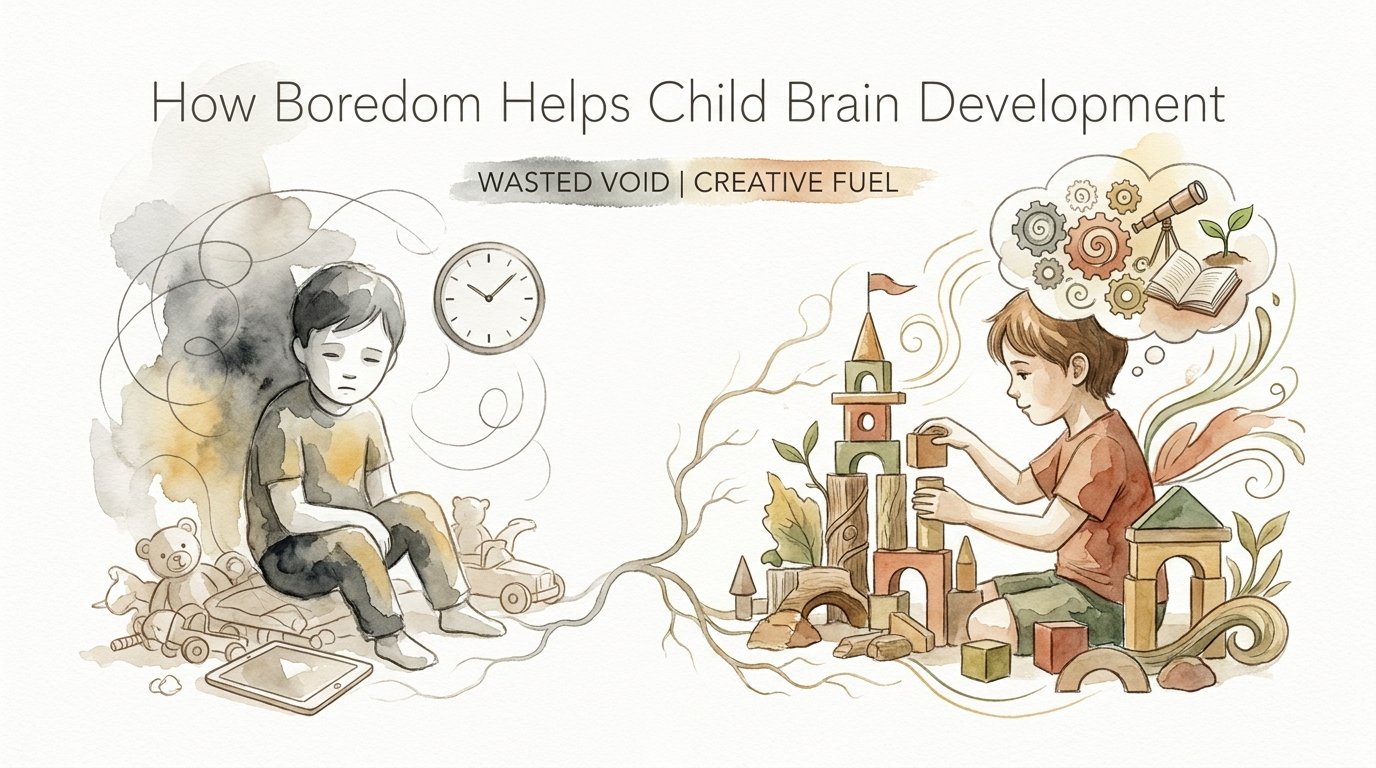
If your child views 10 minutes of silence as an emergency rather than an opportunity, the screen has hijacked their ‘inner engine’. Boredom isn’t a problem to be solved; it’s the raw fuel for invention. When we use screens to ‘kill’ time, we actually kill the very spark that leads to genius. Learn to see the difference between a wasted void and creative potential.

The modern world is terrified of stillness. We see a quiet moment and feel the urge to fill it with a notification, a video, or an app. For children, this constant stream of external stimulation acts like a digital crutch. It prevents them from developing the internal machinery they need to navigate life.

Understanding the value of boredom is about more than just limiting screen time. It is about reclaiming the space where a child’s personality and intellect actually grow. This article will guide you through the science of the “bored” brain and show you how to turn restlessness into a powerful developmental tool.
How Boredom Helps Child Brain Development
Boredom is far from a sign of neglect or a lack of resources. It is an emotional state that signals the brain is ready for new engagement but hasn’t yet found a target. In child development, this gap is where the most critical cognitive work happens. When a child says they are bored, their brain is essentially asking, “What do I do next?”
Research shows that boredom activates the Default Mode Network (DMN). This is a complex web of brain regions that fires up when we are not focused on an external task. The DMN is responsible for daydreaming, imagination, and self-reflection. It is the “magic space” where the brain makes connections between distant memories and new ideas.
When children are constantly entertained, their DMN rarely gets the chance to strengthen. This network is essential for developing cognitive flexibility. It helps kids think outside the box and adapt to new situations. By allowing a child to sit with their boredom, you are essentially giving them a mental workout that builds a more resilient and creative mind.
The Engine Under the Hood: How It Works
The process of turning boredom into creativity follows a predictable neurobiological cycle. It starts with a lack of external stimulation. This causes a drop in dopamine, the “reward” chemical. For a child accustomed to high-stimulation screens, this feels like an itch they can’t scratch.
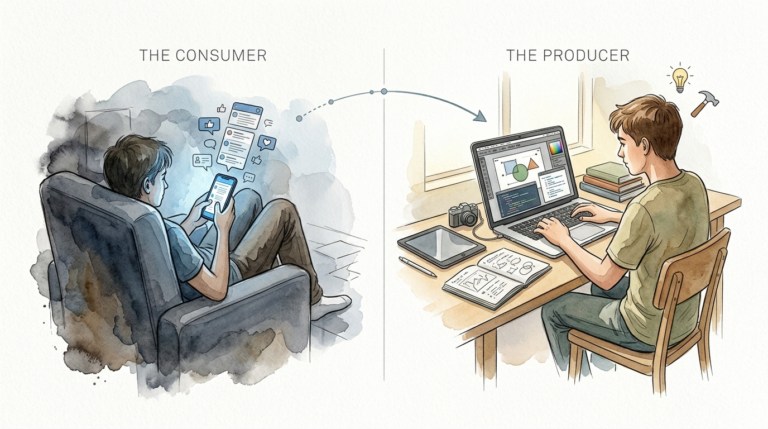
This discomfort is actually the “creative fuel” ignite point. To escape the restlessness, the brain begins to search inward. It starts scanning for internal entertainment. This is when a cardboard box becomes a spaceship or a pile of sticks becomes a forest fort. The child is forced to become the producer of their own joy rather than a passive consumer.
This internal search also strengthens executive function. To build that spaceship, a child has to plan, organize materials, and solve the problem of how to keep the “wings” attached. These are high-level cognitive skills that prepare them for academic success and real-world challenges.
Why Silence is the Ultimate Cognitive Upgrade
Choosing unstructured time over digital “pacifiers” offers measurable benefits for a growing brain. These advantages go beyond just “keeping them busy.” They build the foundational skills that define a child’s character and intelligence.
- Emotional Resilience: Learning to sit with the discomfort of boredom builds frustration tolerance. It teaches children that they don’t need a constant “hit” of dopamine to be okay.
- Self-Regulation: Boredom helps children strengthen their focus by practicing self-management. They learn to regulate their own thoughts and emotions without an external device doing it for them.
- Independence: When children are not constantly rescued from restlessness, they learn to take initiative. This fosters a sense of agency—the belief that they can change their environment and solve their own problems.
- Empathy and Reflection: The Default Mode Network is also linked to social cognition. Quiet time allows kids to process social interactions and develop a deeper understanding of themselves and others.
The Screen Trap: Common Pitfalls and Mistakes
Many parents fall into the trap of viewing boredom as a problem that needs a solution. This often leads to a cycle of over-scheduling or “digital babysitting.” One common mistake is using a screen to bridge every transition, such as car rides or waiting for a meal.
These “micro-moments” of boredom are exactly when the brain should be recharging. When we fill them with screens, we create a dopamine withdrawal cycle. The child becomes so used to high-intensity rewards that normal life starts to feel gray and uninteresting. This makes future bouts of boredom even harder for them to handle.
Another pitfall is “managing” their play too much. If a parent is always the one providing the ideas, the child never learns how to generate them. The goal is to be a facilitator, not a director. Providing the tools is helpful; providing the script is not.
The Reality Check: When Boredom Hits a Wall
Boredom is a tool, but like any tool, it has its limits. It is not a substitute for active engagement and connection. A child who is consistently bored because they are being ignored is not experiencing “creative fuel”; they are experiencing neglect. Balance is the key.
Environmental factors also play a role. If a child’s environment is completely sterile and devoid of any raw materials—like books, craft supplies, or outdoor space—boredom can lead to destructive behavior rather than creative play. The brain needs something to work with.
Furthermore, children with certain neurodivergent profiles, such as ADHD, may struggle more with the “itch” of boredom. For these children, the lack of stimulation can feel physically painful. In these cases, boredom needs more structure and a “scaffolded” approach to help them transition from restlessness to engagement.
Wasted Void vs. Creative Fuel: A Side-by-Side Look
It is helpful to distinguish between the two types of “nothingness” a child might experience. Not all downtime is created equal.
| Feature | The Wasted Void (Passive) | Creative Fuel (Active Boredom) |
|---|---|---|
| Primary Activity | Scrolling, watching short-form videos. | Staring at the wall, daydreaming, tinkering. |
| Brain State | Passive consumption, low effort. | DMN activation, internal searching. |
| Outcome | Dopamine crash, irritability, lethargy. | Invention, play, problem-solving. |
| Long-term Effect | Reduced attention span. | Increased executive function and agency. |
The Parent’s Playbook: Practical Tips and Best Practices
If you want to help your child turn their boredom into an asset, you have to be intentional. You are not just “doing nothing”; you are creating a laboratory for their mind.
- Provide, Don’t Plan: Stock your home with “open-ended” materials. Cardboard boxes, old clothes for dress-up, art supplies, and LEGOs are better than toys with only one way to play.
- Reframe the Phrase: When they say “I’m bored,” respond with “That’s exciting! I can’t wait to see what your brain comes up with.” This validates the feeling without taking responsibility for fixing it.
- Model the Behavior: Let your children see you being “bored.” Put down your phone in the checkout line. Stare out the window. Show them that silence is a comfortable place to be.
- Outdoor Access: Nature is the ultimate boredom buster. It provides infinite sensory input without the high-octane dopamine spikes of a screen.
Advanced Strategies: Raising Future Thinkers
For those who want to go deeper, consider the concept of “Boredom Threshold Training.” This involves gradually increasing the amount of unstructured time your child handles. Start with 15 minutes of “nothing time” and slowly expand it.
You can also introduce the “Boredom Menu.” This is a list the child creates when they are not bored. It includes things they enjoy doing but often forget about in the heat of a “boredom emergency.” When the restlessness hits, they can consult their own menu for inspiration.
Think of this as building a “dopamine recalibration.” By lowering the intensity of their daily entertainment, you are making the “small” joys of life—like reading a book or drawing—feel rewarding again. This is the secret to long-term focus and academic endurance.
The Sandbox Theory: Realistic Scenarios
Consider a typical rainy Saturday afternoon. In Scenario A, the child is given a tablet to “stay quiet.” They spend three hours in the Wasted Void. When the tablet is taken away, they are irritable, their eyes are strained, and they haven’t developed a single new skill.
In Scenario B, the parent says “No screens today.” For the first 20 minutes, the child complains and mopes. This is the “itch” phase. But then, they notice a stack of old magazines and some tape. Two hours later, they have created an entire “city” on the living room floor. They have practiced fine motor skills, spatial reasoning, and narrative storytelling.
This is the theory in action. The discomfort of the first 20 minutes was the price of admission for the creative explosion that followed. The “inner engine” was forced to start because there was no outside fuel being poured in.
Final Thoughts
The “I’m bored” breakthrough is one of the most important milestones in a child’s life. It marks the moment they stop looking at the world as something that should entertain them and start seeing it as something they can create. By protecting these quiet spaces, you are safeguarding their ability to think, innovate, and thrive.
Success isn’t measured by how quiet your child is, but by the complexity of the world they build when no one is watching. Encourage the silence. Welcome the moping. It is the sound of a brain growing stronger, one “boring” minute at a time.
Next time the house goes quiet, resist the urge to turn on the TV. Instead, wait. Give their ‘inner engine’ a chance to roar to life. You might just be surprised by the genius that emerges from the stillness.
Sources
1 nodi.kids | 2 braintasticscience.com | 3 integratedcareclinic.com | 4 sparkandstitchinstitute.com | 5 tierpediatrics.com | 6 heatherhaupt.com | 7 safariltd.com | 8 childrenandscreens.org | 9 nordangliaeducation.com | 10 indiatimes.com | 11 buildingbrains.ca | 12 mariashriver.com | 13 focusonthefamily.ca | 14 childtherapycenterla.com | 15 parentingnow.org | 16 childrensdayton.org | 17 courageouskidscounseling.com | 18 childrenandscreens.org | 19 graysonexecutivelearning.com | 20 illinois.edu | 21 reddit.com