screen time chart free printable for kids
One chart shouldn’t just track time—it should build a better daily routine for the whole family. Don’t just count the minutes; make the minutes count. Our multi-use printable helps kids manage chores, reading, and exercise all in one place. It’s not just a screen chart, it’s a life-skills builder.
Are you tired of the “just five more minutes” battle? We’ve all been there. You hand over the tablet for a quick break, and suddenly, two hours have vanished into a YouTube rabbit hole. It’s not just about the lost time; it’s about the missed opportunities for play, connection, and real-world learning.
The secret isn’t just cutting the cord—it’s creating a roadmap. By integrating digital limits with daily responsibilities, you transform a source of conflict into a tool for independence. Let’s dive into how you can use a structured system to bring peace back to your living room.
screen time chart free printable for kids
A screen time chart free printable for kids is a visual tool designed to help children understand the balance between digital entertainment and real-life responsibilities. Unlike a simple timer that just counts down to an inevitable meltdown, an integrated chart acts as a “Daily Success Map.” It lists specific tasks—like chores, reading, or outdoor play—that must be completed before or alongside device use.
In the real world, this works much like a “work-before-play” system. Just as adults finish their professional tasks before relaxing with a movie, children learn to prioritize their developmental needs. According to 2026 updates from the American Academy of Pediatrics (AAP), managing screen time is no longer just about hitting a “magic number” of minutes; it’s about navigating a “digital ecosystem” where quality and context matter most.
Think of the chart as a training wheel for the brain. It helps children develop executive functioning skills—the mental processes that allow us to plan, focus attention, and juggle multiple tasks. Instead of the parent being the “bad guy” who takes the tablet away, the chart becomes the neutral authority that shows exactly what needs to happen next.
How to Implement Your Screen Time System
Setting up a screen time chart isn’t about printing a piece of paper and walking away. It’s about building a rhythm that fits your family’s unique personality. Follow these steps to turn that printable into a powerhouse of productivity.
1. Identify the “Must-Do” Tasks
Before a single pixel lights up, what needs to happen? Standard pillars include morning routines (brushing teeth, getting dressed), academic goals (reading for 20 minutes, finishing homework), and physical movement. Research suggests that “crowding out” sedentary screen time with physical activity is vital for healthy development.
2. Define Your Screen Time Currency
Decide if your system is “Earned” or “Scheduled.” In an earned system, each chore might equal 10 minutes of gaming. In a scheduled system, screens are only available during specific windows (like 4:00 PM to 5:00 PM) provided the checklist is done. The AAP’s 2026 guidance emphasizes “balanced screen use,” ensuring that digital time doesn’t displace sleep or family meals.
3. Create a Visual Headquarters
Laminate your printable and stick it somewhere central, like the refrigerator or a command center. Use dry-erase markers or stickers to track progress. For younger kids (ages 4–7), visual icons work best. For tweens (ages 8–12), a more detailed list that tracks “streaks” can provide a dopamine hit similar to the games they love.
4. Set the “Hard Stop” Rules
Transitions are the hardest part of screen time. Use the chart to establish a “No Screens 60 Minutes Before Bed” rule. This helps mitigate the effects of blue light on sleep patterns, which is a common concern among pediatricians.
The Major Benefits of an Integrated Routine
Why bother with a chart when you could just set a timer on your phone? The benefits of a physical, integrated routine go far deeper than just monitoring minutes.
Development of Self-Regulation
When kids see a checklist, they begin to monitor their own behavior. They learn to ask themselves, “Have I moved my body today?” or “Is my room clean?” This shifts the responsibility from the parent to the child, fostering a sense of autonomy.
Reduction in Power Struggles
Most screen-time fights happen because the “end” feels arbitrary to the child. A chart provides a predictable structure. If the rule is “No screens until the dog is fed,” there is no room for negotiation. The expectations are clear and constant.
Encourages “High-Quality” Engagement
A good system encourages kids to think about what they are doing on their devices. The 2026 AAP guidelines suggest focusing on the “5 Cs”: Child, Content, Calm, Crowding Out, and Communication. By using a chart to ensure screens don’t “crowd out” other activities, you naturally steer children toward more intentional, high-quality content.
Common Mistakes and How to Avoid Them
Even the best-looking printable can fail if the implementation is shaky. Avoid these frequent pitfalls to keep your system running smoothly.
Treating All Screen Time as the “Enemy”
One of the biggest mistakes is viewing every minute of digital use as inherently negative. This creates a culture of guilt and secrecy. Instead, differentiate between “passive” consumption (mindless scrolling) and “active” creation (coding, digital art, or educational games). Use the chart to reward the latter.
Using Screens as a “Pacifier”
It is tempting to hand over a phone to stop a tantrum in a restaurant or during a long car ride. However, using screens to manage emotions prevents children from learning how to self-soothe. Use your chart to establish that screens are a planned part of the day, not an emergency response to boredom or frustration.
Setting Unrealistic or Rigid Limits
If your chart is too demanding, your child will give up. Ensure the “Must-Do” tasks are age-appropriate. A 5-year-old might only be able to handle two simple chores, while a 10-year-old can manage a more complex routine.
When This System May Not Be Ideal
While a screen time chart free printable for kids is a fantastic tool, it isn’t a universal cure. There are specific scenarios where you might need to adjust your approach.
Neurodivergent Considerations
For children with ADHD or Autism, the high-dopamine payoff of screens makes stopping incredibly difficult. A simple chart might not be enough to overcome the “hyperfocus” associated with gaming. These families may need additional tools, such as visual countdown clocks or “bridge activities” that help transition the brain from a high-stimulation screen to a lower-stimulation reality.
Extreme Household Stress
If your family is going through a major transition—like a move, a new baby, or a loss—a rigid chart might add unnecessary pressure. In these times, “survival mode” is okay. Focus on connection and co-viewing rather than strict tallying until life stabilizes.
Comparing Methods: Paper vs. Digital Tracking
Many parents wonder if they should stick to a paper printable or move to a digital chore app. Both have pros and cons depending on the age of your children and your lifestyle.
| Feature | Printable Chart | Digital App |
|---|---|---|
| Visibility | High (always on the wall/fridge). | Low (hidden inside a device). |
| Tactile Satisfaction | Checking boxes or adding stickers is satisfying. | Tapping a screen feels like more “tech.” |
| Maintenance | Requires printing and pens/stickers. | Automatic tracking and notifications. |
| Age Appropriateness | Best for Toddlers and Young Kids. | Best for Tweens and Teens. |
Practical Best Practices for Success
To make your screen time system stick, you need more than just a chart; you need a strategy. Here are the pro tips for long-term habit building.
- Model the Behavior: If you’re constantly scrolling through your phone while telling your kids to “get off the iPad,” the chart will lose its authority. Establish “Device-Free Zones” (like the dining table) that apply to everyone, parents included.
- Embrace “Co-Viewing”: Don’t just use screens as a babysitter. The latest pediatric research shows that “co-viewing”—watching or playing together—can actually turn a passive activity into a bonding and learning experience.
- Review and Adjust: Every Sunday, look at the chart together. Ask your child, “What worked this week? Which chores felt too hard?” This makes them a partner in the process rather than a subject of the rules.
- Focus on “The Reset”: If the day goes off the rails, don’t throw the chart away. Use it as a tool to “reset” the next morning. It’s about progress, not perfection.
Advanced Consideration: The Psychology of the “Dopamine Loop”
For those who want to understand *why* their kids struggle so much with screens, it comes down to brain chemistry. Most modern apps and games are designed with “engagement-based design.” This includes features like autoplay, endless scrolling, and loot boxes that trigger a dopamine release in the brain.
Children have developing prefrontal cortexes—the part of the brain responsible for impulse control. This means they are biologically disadvantaged when it comes to stopping a high-dopamine activity. A screen time chart acts as an “external prefrontal cortex.” It provides the logic and structure that their developing brains haven’t fully formed yet. By linking screens to “low-dopamine” tasks like cleaning or reading, you help balance their brain’s reward system.
Example Scenario: The Summer Break Reset
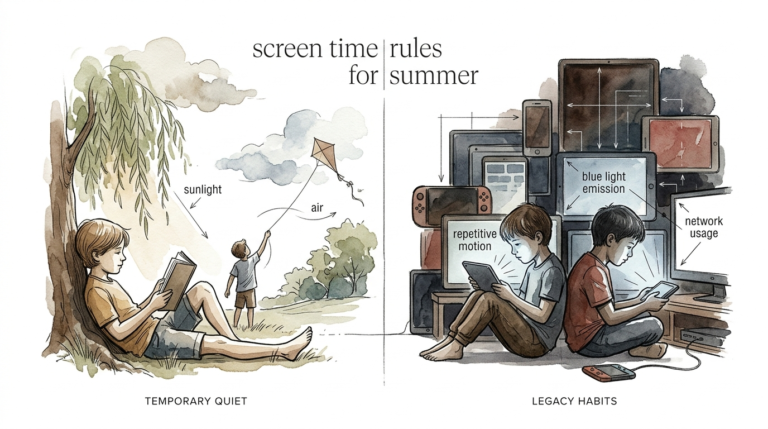
Imagine it’s the middle of July. The “school-year” routine is long gone, and the kids are starting to look like “screen zombies.” You feel the guilt creeping in every time you see the glow of a tablet.
You print out the **screen time chart free printable for kids** and call a family meeting. You explain that screens aren’t “gone,” but they are now part of a “Summer Success Map.”
- Step 1: You define the daily “Basics” (Dressed, teeth brushed, bed made).
- Step 2: You add one “Brain Power” task (Read for 30 minutes).
- Step 3: You add one “Body Power” task (Play outside for 45 minutes).
- Step 4: Once those are checked off, they “unlock” 60 minutes of gaming.
Within three days, the atmosphere changes. Instead of whining for the iPad at 8:00 AM, the kids are racing to finish their reading so they can “earn” their time. You’ve moved from being the enforcer to being the coach.
Final Thoughts
Managing digital habits in a world of “omnipresent screens” is one of the toughest challenges of modern parenting. However, it is also an incredible opportunity to teach your children about balance, responsibility, and the value of time. A screen time chart isn’t just a way to limit technology; it’s a way to prioritize life.
By using a structured, visual system, you replace the daily “nagging” with a clear, predictable routine. You move away from arbitrary time limits and toward a model of “digital literacy” where children learn to manage their own impulses.
Download your printable, grab some markers, and start building those life skills today. Your future self (and your kids’ future selves) will thank you for making the minutes count.
Sources
1 cbwchc.org | 2 choc.org | 3 betterscreentime.com | 4 mychoreboard.com | 5 dailymom.com | 6 ccrcca.org | 7 childrenandscreens.org | 8 medlineplus.gov | 9 cacfp.org | 10 mumlyfe.com.au | 11 youtube.com | 12 netpsychology.org | 13 365daysofnoscreens.com | 14 mother.ly